Real-world asset (RWA) tokenization is rapidly moving from a niche blockchain concept toward a practical financial infrastructure. Businesses can now explore tokenizing real estate, private credit, commodities, bonds, funds, intellectual property, art, and other assets by representing ownership rights or economic claims through blockchain-based tokens. The opportunity is significant: CoinGecko reported that tokenized RWAs reached approximately $19.3 billion by the end of Q1 2026, more than tripling from the beginning of 2025.
At the same time, choosing an RWA tokenization platform is not simply a matter of selecting blockchain software with token-minting functionality. The platform must connect the underlying asset with legal ownership, compliance, custody, investor onboarding, smart contracts, trading, reporting, and potentially secondary-market infrastructure. A technically impressive platform can still fail commercially if it cannot support the legal and operational requirements surrounding the asset.
This makes platform selection one of the most important decisions for businesses entering tokenization. The right solution should be selected according to the asset being tokenized, the target investors, regulatory requirements, business model, blockchain architecture, security expectations, and long-term growth strategy.
Understanding What an RWA Tokenization Platform Actually Does
Before comparing platforms, businesses should understand what they are actually purchasing or developing.
RWA tokenization involves creating a blockchain-based representation of an underlying real-world asset or a legal/economic claim associated with that asset. The token itself does not automatically create ownership simply because it exists on a blockchain. The legal structure must establish what the token represents and what rights the holder receives.
For example, suppose a company wants to tokenize a commercial property. The platform may issue 100,000 tokens representing fractional interests in an investment vehicle that owns the property. Investors might receive rights to rental income, capital appreciation, or another defined economic benefit. The blockchain can manage token ownership and transfers, while legal agreements, custodians, property managers, and compliance procedures support the connection to the physical asset.
The U.S. Securities and Exchange Commission has emphasized that tokenized securities remain subject to securities laws where the underlying instrument qualifies as a security. Its January 2026 statement also distinguishes between issuer-sponsored tokenized securities and securities tokenized by unaffiliated third parties.
Therefore, a serious RWA platform must be designed around the asset and its legal structure first, and the blockchain second.
1. Start With Your Asset and Business Model
The first question should not be "Which blockchain should we choose?" It should be "What exactly are we tokenizing, and how will the business make money?"
Different assets have very different requirements.
A real estate tokenization platform, for example, may need property valuation, SPV management, investor accreditation, rental-income distribution, ownership records, property documentation, and potentially a secondary marketplace. A tokenized private-credit platform may instead require loan origination, repayment schedules, credit assessments, collateral management, and automated interest distributions.
Similarly, tokenizing gold or commodities can require reliable custody arrangements and mechanisms for verifying reserves. Tokenizing funds may require transfer-agent functions, investor eligibility controls, NAV calculations, subscriptions, redemptions, and regulatory reporting.
Your business model should therefore determine the platform's functionality.
Important questions include:
- What asset class will be tokenized?
- Who will purchase the tokens?
- Will investors receive ownership, income rights, governance rights, or another claim?
- Will the tokens be transferable?
- Will there be a secondary marketplace?
- Which jurisdictions will the platform serve?
- Will the platform target retail investors, institutions, or both?
- How will investors redeem or exit their positions?
Answering these questions first prevents businesses from choosing technology that looks attractive but does not support the actual commercial model.
2. Evaluate Regulatory and Compliance Infrastructure
Regulatory compliance is arguably the most important factor when selecting an RWA tokenization platform.
Tokenization does not eliminate existing financial regulations. Instead, it introduces blockchain into an existing legal and financial structure. Depending on the asset and jurisdiction, businesses may need to address securities laws, KYC and AML requirements, investor eligibility, tax obligations, data protection, custody requirements, transfer restrictions, and reporting.
The SEC's current educational material defines a digital security as a financial instrument that meets the definition of a security and is represented by a crypto asset, while noting that holder rights can differ materially from those associated with the underlying security.
Consequently, the platform should support compliance features such as:
- KYC and AML integration
- Whitelisted wallets
- Investor accreditation or eligibility checks
- Geographic restrictions
- Transfer restrictions
- Transaction monitoring
- Compliance reporting
- Audit trails
- Role-based administrative controls
- Secure document management
Businesses should also determine whether the platform can adapt to regulatory changes. A platform designed around one jurisdiction's rules may become difficult to scale internationally.
A strong platform should therefore offer configurable compliance rather than treating compliance as an afterthought.
3. Examine Blockchain Architecture and Interoperability
Blockchain selection is another critical consideration, but businesses should avoid choosing a network solely because it has a popular token or high transaction volume.
For RWA applications, important technical factors include transaction costs, network reliability, scalability, smart-contract capabilities, ecosystem maturity, privacy, interoperability, and institutional acceptance.
A platform may also need to support multiple networks over time. For example, a business might initially issue tokens on one blockchain but later want to expand to another network to reach different investors or reduce transaction costs.
Interoperability can therefore become a strategic advantage.
BIS research describes tokenization as combining information about an asset and its ownership with programmable rules and governance. This programmability can allow smart contracts to automate transactions and conditional transfers.
The platform should consequently provide a clear architecture for connecting:
Underlying asset → legal structure → token → investor → compliance → custody → settlement → secondary market
The more smoothly these components interact, the more useful the tokenization infrastructure becomes.
4. Assess Smart Contract Security
Smart contracts are at the heart of many tokenization platforms. They can control token issuance, transfers, ownership records, distributions, voting, redemptions, and other automated processes.
However, smart contracts can also introduce significant risks.
A vulnerability in a contract controlling a large tokenized asset could potentially result in unauthorized transfers or disruption of critical functions. For this reason, businesses should examine whether the platform uses audited smart contracts and follows established development and security practices.
Look for:
- Independent smart contract audits
- Multi-signature administrative controls
- Upgrade mechanisms with appropriate safeguards
- Access-control systems
- Emergency pause functionality where appropriate
- Secure wallet integration
- Automated testing
- Monitoring and alert systems
- Transparent contract documentation
Security should also extend beyond the smart contract itself. APIs, investor dashboards, custody systems, identity integrations, databases, and administrative accounts can all become attack surfaces.
A platform that focuses only on blockchain security while neglecting the surrounding infrastructure is not providing comprehensive protection.
5. Look for Strong Asset and Ownership Management
A major difference between ordinary token platforms and serious RWA infrastructure is the ability to connect digital tokens with real-world asset records.
Consider a property worth $10 million. If 1 million tokens represent economic interests associated with that property, the platform needs a reliable mechanism for recording the relationship between those tokens and the underlying legal structure.
This could involve SPVs, trusts, custodians, transfer agents, registries, or other legal arrangements depending on the jurisdiction and asset.
The platform should make it possible to maintain accurate records relating to:
- Asset identification
- Ownership
- Valuation
- Documentation
- Token supply
- Investor holdings
- Income distributions
- Transfers
- Redemptions
- Corporate actions
This is particularly important because blockchain transparency does not automatically guarantee the accuracy of off-chain information. If an incorrect property valuation or fraudulent asset document enters the system, the blockchain may simply preserve inaccurate information very efficiently.
6. Consider Investor Experience
Technical sophistication means little if investors struggle to use the platform.
A successful RWA platform should provide an intuitive experience covering the entire investment journey. Investors should be able to create accounts, complete verification, review offering documents, fund investments, receive tokens, monitor holdings, and understand distributions without needing advanced blockchain knowledge.
Wallet management is especially important.
Businesses targeting mainstream investors may want embedded wallets or simplified custody options rather than requiring users to install external wallets and manage complex private keys.
The platform should also provide clear dashboards showing:
- Token holdings
- Asset information
- Investment value
- Distribution history
- Transaction history
- Documents
- Eligibility status
- Redemption information
The easier the platform is to use, the lower the barrier to adoption.
7. Analyze Liquidity and Secondary-Market Capabilities
One of the strongest potential advantages of tokenization is improved liquidity. But tokenization alone does not create a liquid market.
A token representing a highly illiquid property does not automatically become liquid simply because it exists on a blockchain.
Businesses should therefore examine whether the platform can support secondary trading, compliant peer-to-peer transfers, marketplace integration, or other liquidity mechanisms.
Research from the Bank for International Settlements provides an interesting example from real estate. Its 2025/2026 working paper found that trading in tokenized properties increased by 35% cumulatively over the two days following certain natural-disaster declarations, suggesting that tokenization can provide liquidity under particular conditions. However, the research also found that this benefit depended on platforms offering buyback mechanisms, which can introduce higher insolvency risks.
This illustrates an important point: liquidity mechanisms must be evaluated alongside their financial risks.
8. Check Scalability, APIs, and Integration Capabilities
A tokenization platform should not operate as an isolated blockchain application.
Businesses often need to connect the platform with banking systems, payment providers, accounting software, identity providers, custodians, property-management systems, analytics tools, compliance systems, and exchanges or marketplaces.
APIs are therefore essential.
A scalable platform should allow businesses to integrate external services without rebuilding the entire infrastructure. It should also support growing numbers of investors, assets, transactions, and jurisdictions.
This becomes especially important when a business starts with one tokenized asset but plans to build an entire portfolio of tokenized assets.
9. Evaluate Transparency, Reporting, and Governance
Institutional investors will typically require significantly more transparency than casual cryptocurrency users.
The platform should provide reliable reporting around asset performance, token ownership, transactions, distributions, compliance activity, and administrative actions.
Governance is equally important. Businesses should clearly understand who controls smart-contract upgrades, token issuance, treasury functions, investor permissions, and emergency procedures.
A centralized administrator with unrestricted control over tokenized assets can introduce significant counterparty and governance risks.
The platform should therefore use appropriate permission structures and maintain auditable records of important administrative actions.
10. Compare Development Cost With Long-Term Value
Cost should be evaluated, but it should not be the only deciding factor.
A cheap platform that lacks compliance features, scalability, security, or interoperability can become significantly more expensive when the business has to rebuild it later.
Businesses should calculate the total cost of ownership, including:
- Platform development
- Smart contract development
- Security audits
- Blockchain transaction fees
- Compliance integrations
- Custody infrastructure
- KYC/AML services
- Maintenance
- Cloud infrastructure
- Marketplace development
- Legal and regulatory work
- Ongoing upgrades
The best platform is rarely the cheapest option. It is the one that provides the strongest balance between functionality, security, regulatory readiness, scalability, and long-term business value.
Real-World Market Direction
The broader market indicates why these decisions matter. McKinsey estimates that tokenized financial assets could reach approximately $2 trillion in market capitalization by 2030 in its base case, excluding cryptocurrencies and stablecoins, with an optimistic scenario reaching around $4 trillion.
Meanwhile, tokenized RWAs have already expanded considerably. CoinGecko's Q1 2026 analysis reported approximately $19.32 billion in tokenized RWA market capitalization, compared with $5.42 billion at the beginning of 2025. Tokenized U.S. Treasuries remained the largest category, although commodities, stocks, and ETFs also gained market share.
These numbers demonstrate both the opportunity and the competition. As tokenization becomes more institutional, platforms will increasingly need to deliver financial-grade infrastructure rather than basic token creation.
A Practical Framework for Choosing Your Platform
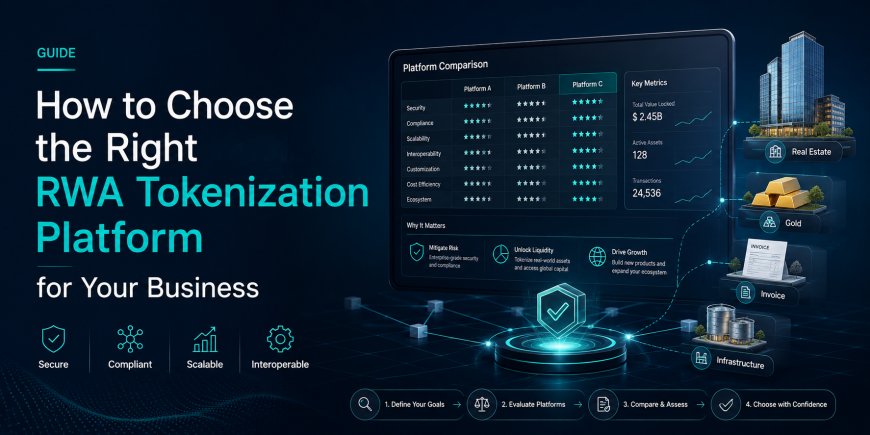
Businesses can simplify the evaluation process by scoring each candidate platform across five major categories:
| Evaluation Area |
What to Examine |
| Regulatory readiness |
KYC, AML, investor restrictions, compliance tools |
| Technology |
Blockchain, smart contracts, scalability, APIs |
| Asset management |
Ownership, valuation, documentation, distributions |
| Investor experience |
Onboarding, wallets, dashboards, payments |
| Security |
Audits, access controls, custody, monitoring |
Rather than selecting the platform with the longest feature list, businesses should prioritize capabilities directly connected to their asset and target market.
For example, a company tokenizing institutional real estate may prioritize compliance, custody, investor management, and secondary-market infrastructure. A company tokenizing commodities may place greater emphasis on asset verification, custody, reserve reporting, and redemption.
Conclusion
Choosing the right RWA tokenization platform requires much more than comparing blockchain networks or token-development features. Businesses should evaluate the complete infrastructure connecting real-world assets with legal rights, investors, compliance, smart contracts, custody, payments, reporting, and secondary-market activity. As the tokenized asset market continues to expand, the strongest platforms will be those capable of combining blockchain efficiency with institutional-grade security, regulatory readiness, scalability, and usability. A carefully designed RWA tokenization solution can help businesses unlock fractional ownership, automate asset management, broaden investor access, and build new financial products while maintaining the controls expected in regulated markets. Companies looking for experienced RWA tokenization services can also consider Blockchain App Factory, which provides comprehensive blockchain and tokenization development solutions designed to help businesses build secure, scalable, and business-focused RWA platforms.