




























ESG (Environmental, Social, Governance) Consulting Business Opportunities 2026: Market Demand and Growth Potential
Governance standards address transparency, ethical leadership, regulatory compliance, accountability, risk management, and effective corporate decision-making.

What is ESG (Environmental, Social, Governance) Consulting?
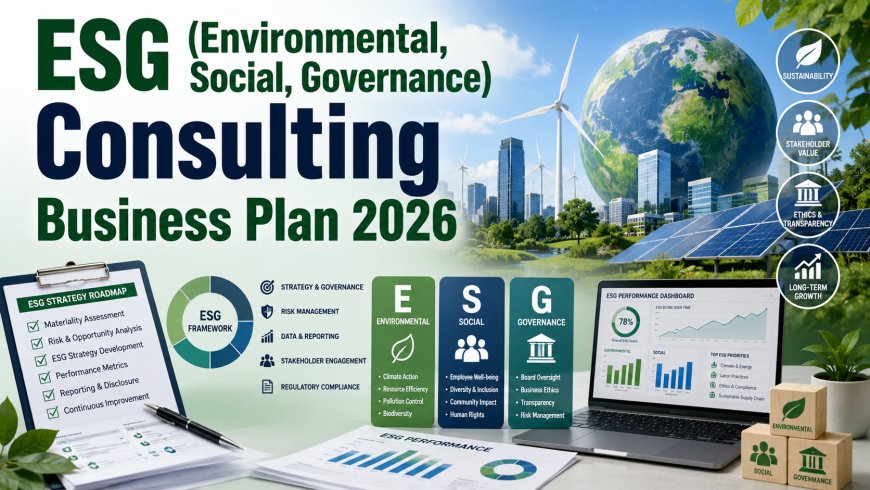
ESG (Environmental, Social, and Governance) consulting refers to professional advisory services that help organizations develop, implement, and manage sustainable and ethical business practices. ESG standards have become increasingly important for businesses, investors, regulators, and consumers, particularly as companies face growing expectations around environmental responsibility, social impact, and corporate governance.
From an environmental perspective, ESG consulting focuses on helping businesses reduce carbon emissions, manage waste efficiently, conserve natural resources, and improve overall sustainability performance. The social component emphasizes fair labor practices, workforce diversity and inclusion, employee well-being, customer satisfaction, and responsible community engagement. Governance standards address transparency, ethical leadership, regulatory compliance, accountability, risk management, and effective corporate decision-making.
As consumer and investor awareness continues to rise, businesses are increasingly evaluated based on their ESG performance. A strong ESG framework can enhance corporate reputation, strengthen stakeholder trust, improve regulatory compliance, and attract socially conscious consumers and investors. Integrating ESG principles into business operations not only supports long-term sustainability goals but also creates competitive advantages in today’s evolving market landscape.
IMARC Group’s report, titled “ESG (Environmental, Social, Governance) Consulting Business Plan and Feasibility Report 2026: Industry Trends, Business Setup, Revenue Model, Investment Opportunities, Income, Expenses, and Profitability” provides a complete roadmap for setting up an ESG consulting firm. It covers a comprehensive market overview down to micro-level details such as business setup, equipment and technology requirements, manpower needs, business workflows, and regulatory considerations. The report provides in-depth insights into project economics, covering capital investments, funding options, operating costs, revenue projections, expected return on investment (ROI), net present value (NPV), profit and loss analysis, and overall financial viability.
ESG Consulting Business Setup Overview
ESG Consulting business setup involves the establishment of a framework that integrates Environmental, Social, and Governance (ESG) principles into the core operations of the company. This setup focuses on creating a structure that ensures sustainable practices, ethical governance, and social responsibility across all facets of the business.
Key considerations include:
• Developing strategies to minimize environmental impact such as reducing waste and carbon emissions
• Promoting fair labor practices, ensuring diversity and inclusion
• Maintaining transparency in governance and regulatory reporting
• Adopting eco-friendly technologies and ethical supply chain management
• Developing robust corporate policies reflecting the company’s ESG commitments
• Aligning with regulatory requirements for ESG reporting and continuous monitoring
ESG Consulting Market Trends and Growth Drivers
Shifting Consumer Expectations
Consumers are becoming more conscientious about the products and services they purchase, with a growing preference for companies that demonstrate strong ESG practices. This shift is particularly noticeable among younger generations who prioritize sustainability, ethical sourcing, and social justice. In response, service providers are increasingly offering ESG consulting, brand management, and reporting services to help companies align their operations with consumer values. By leveraging data analytics and market research, ESG service providers enable businesses to understand consumer preferences and implement strategies that address environmental impact, promote fair labor practices, and enhance corporate transparency. As businesses strive to meet these heightened expectations, ESG services are integral in fostering long-term customer loyalty and trust.
Request Sample - ESG Consulting Business Plan Report 2026
Investor Focus on Long-Term Value
Investors are increasingly considering ESG factors as part of their decision-making process, recognizing that companies with strong ESG practices are more likely to deliver sustainable, long-term value. The rise of impact investing — where investors target companies that contribute positively to social and environmental goals — is directly influencing the demand for ESG-related services. Investors require detailed ESG reports, risk assessments, and performance metrics to assess a company’s ability to mitigate environmental risks, manage social factors, and maintain sound governance. This trend has led to a surge in demand for services that support ESG data analysis, risk management, and sustainability reporting.
Latest Industry Developments
• March 2025: Clarity AI launched an AI-powered solution that generates company briefs automatically and offers an AI Assistant providing real-time insights on policies, climate plans, ESG risks, and corporate controversies.
• February 2025: Sattva Consulting and StepChange entered into a partnership to revolutionize ESG data utilization, empowering Indian organizations to unlock the strategic value of ESG data through robust data collection, precise analysis, and tailored sustainability strategies.
• November 2024: KPMG delivered a two-day ESG assurance training to approximately 40 audit professionals in Qatar, equipping them with its methodology, a streamlined Clara platform workflow, and a new ESG knowledge library aligned with ISSA 5000.
How Do You Set Up an ESG Consulting Business?
The IMARC report serves as a complete guide for setting up an ESG consulting business, covering:
• Industry overview and market performance
• Service workflows and consulting offerings
• Office planning and technology requirements
• Cost structure (CapEx & OpEx)
• Revenue generation models
• Risk mitigation strategies
• Licensing, compliance, and regulatory requirements
• Profitability and investment analysis
Key Requirements for Setting Up ESG Consulting Services
1. Business Model & Operations Plan
Service Overview: ESG Strategy Development, Sustainability Reporting, Carbon Footprint Assessment, Social Impact Evaluation, Governance Advisory, ESG Training & Workshops
Service Workflow: Client Onboarding → ESG Materiality Assessment → Data Collection & Analysis → Strategy Development → Report & Implementation → Ongoing Monitoring & Review
Revenue Model: Retainer consulting contracts, project-based fees, ESG report subscriptions, corporate training packages, certification advisory services
SOPs & Service Standards: Guidelines for client engagement, ESG data handling, reporting standards compliance (GRI, SASB, TCFD), and quality assurance
Speak to an Analyst: https://www.imarcgroup.com/request?type=report&id=41710&flag=C
2. Technical Feasibility
Site Selection Criteria: Business districts, co-working hubs, proximity to corporate clients and financial institutions
Space & Costs: Office setup, meeting rooms, data infrastructure, collaborative workspaces
Equipment & Suppliers: ESG data platforms, analytics software, sustainability reporting tools, CRM systems
Interior Setup & Fixtures: Professional office environment reflecting sustainability values (green office design)
Utility Requirements & Costs: IT infrastructure, internet, cloud services, energy management
Human Resources & Wages: ESG Analysts, Sustainability Consultants, Data Scientists, Client Relationship Managers, Compliance Officers
3. Financial Feasibility
Includes:
○ Capital Investments & Operating Costs
○ Revenue & Expenditure Projections
○ Profit & Loss Analysis
○ Taxation & Depreciation
○ ROI, NPV & Sensitivity Analysis
Market Analysis & Insights
Industry Overview
The report covers:
• Market drivers & challenges in the ESG consulting landscape
• Demand patterns across industries and geographies
• Consumer and corporate ESG preferences
• Segmentation by service type, industry vertical, and company size
Competitive Landscape
Profiles of leading ESG consulting firms and advisory organizations, including:
• Service specializations and ESG framework expertise
• Pricing strategies and contract structures
• Market positioning and geographic reach
• Client engagement models and success case studies
Capital & Operational Cost Breakdown
Capital Expenditure (CapEx)
Equipment & technology costs account for the largest portion of the total capital expenditure. Office facility development and IT infrastructure form another substantial part of the overall capital investment, ensuring a solid foundation for efficient and scalable consulting operations.
Operational Expenditure (OpEx)
In the first year of operations, the operating cost for ESG Consulting is projected to be significant, covering salaries & wages, utilities, overheads, depreciation, taxes, and software subscriptions, among others. By the fifth year, the total operational cost is expected to increase substantially due to business expansion, inflation, and potential increases in labour costs.
Profitability Projections
The report outlines a detailed profitability analysis over the first five years of operations, including projections for:
• Total revenue from consulting contracts, training programs, and reporting services
• Expenditure breakdown including staffing, technology, and overhead costs
• Gross profit and net profit margins for each revenue stream and year of operation
• Revenue per client projections and market penetration growth estimates
Checkout | ESG Consulting Business Plan Report 2026
Frequently Asked Questions (FAQs)
1. Do I need licenses or certifications to operate an ESG consulting firm?
While certifications are not universally mandatory, ESG consulting firms are generally expected to demonstrate professional expertise through recognized credentials such as CFA ESG Investing, GRI Certified Sustainability Professional, SASB FSA, or equivalent qualifications. Regulatory disclosure requirements, including frameworks such as the EU CSRD, ISSB standards, and SEC climate disclosure rules, may vary depending on client industry and geographic region.
2. Who is the ideal target audience for ESG consulting services?
Key target clients include corporate enterprises seeking regulatory compliance, institutional investors requiring ESG portfolio analysis, small and medium-sized enterprises (SMEs) developing sustainability strategies, publicly listed companies preparing ESG disclosures, and government or public sector organizations implementing sustainability initiatives.
3. How do ESG consulting businesses generate revenue?
Revenue is typically generated through retainer-based consulting agreements, project-specific advisory services, sustainability reporting engagements, ESG audits and assurance services, employee training programs, certification support, and strategic partnerships with ESG data and analytics providers.
4. Is ESG consulting a profitable business?
Yes. ESG consulting is considered a highly promising and profitable business segment due to increasing global sustainability regulations, growing investor demand for responsible business practices, and rising corporate commitments to ESG compliance and reporting. The market is expected to experience strong growth through 2030, offering significant revenue potential with relatively low capital investment requirements.
Why This Report Matters
ESG consulting represents one of the fastest-growing segments in the professional services industry. Regulatory mandates, investor scrutiny, and consumer expectations have converged to make ESG performance a critical business imperative. This report equips entrepreneurs and consulting firms with the insights needed to build a successful and scalable ESG consulting practice — from service design and talent acquisition to profitability forecasting and regulatory compliance.
About Us:
IMARC Group is a global market research and consulting firm specializing in helping organizations identify opportunities, manage risks, and develop strategic growth plans.
Contact Us:
IMARC Group
134 N 4th St., Brooklyn, NY 11249, USA
Email: sales@imarcgroup.com
Tel No:(D) +91 120 433 0800
United States: (+1-201971-6302)
What's Your Reaction?