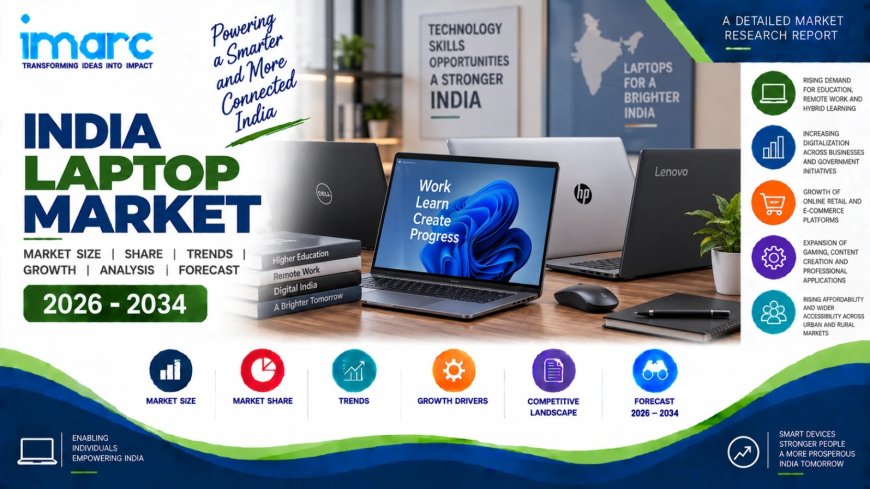
The India laptop market size increased from USD 5.3 Billion in 2025 to USD 6.2 Billion in 2026 and is projected to reach USD 10.1 Billion by 2034, growing at a CAGR of 6.38% during 2026-2034. This growth is further fueled by a combination of underlying structural demand drivers such as the rapid pace of digital adoption, increasing e-governance initiatives, robust growth in the online education segment, and a nascent but rapidly evolving startup culture that is changing the face of computing in India, both in urban and rural India.
Market Snapshot
- Market Valuation (2025): USD 5.3 Billion
- Market Valuation (2026): USD 6.2 Billion
- Forecast Valuation (2034): USD 10.1 Billion
- CAGR (2026-2034): 6.38%
- Base Year: 2025
- Forecast Years: 2026-2034
- Historical Years: 2020-2025
What are the Key Developments and Emerging Shifts in the India Laptop Market?
- PLI 2.0 for IT Hardware and Domestic Manufacturing Mandates: The Ministry of Electronics and Information Technology (MeitY) is aggressively driving the Production Linked Incentive (PLI) Scheme 2.0 for IT Hardware, backed by a ₹17,000 crore financial outlay. By enforcing import management systems and incentivizing net incremental sales of locally manufactured units, the central government has successfully compelled global tech giants (including HP, Dell, Lenovo, Acer, and Apple partners) to set up large-scale assembly and component-sourcing hubs within domestic industrial corridors.
- Mainstreaming of AI-Powered PCs and NPUs: The domestic computing landscape is undergoing a structural transition toward hardware integrated with Neural Processing Units (NPUs). Major OEMs have rapidly introduced AI-optimized laptops capable of executing low-latency, on-device machine learning tasks, automated power management, and advanced biometric security, capturing the interest of enterprise users and tech-savvy consumers alike.
- Rise of Domestic Brands and Mass-Market Affordability: To counter heavy reliance on imported inventory, domestic electronics manufacturers and agile regional brands (such as Lava, Infinix, and custom-label assemblers) are scaling up production of entry-level consumer notebooks priced below ₹30,000. This localized push successfully broadens the computing user base, drawing first-time buyers into the organized retail fold.
- Expansion of Organized E-Commerce and Financing Frameworks: The retail distribution model has shifted heavily toward digital marketplaces and omnichannel retail networks. Backed by aggressive zero-cost EMI structures, institutional exchange programs, and bundled subscription packages (antivirus, productivity suites, and extended warranties), brands are effectively penetrating Tier-2 and Tier-3 urban clusters where family buyers increasingly view laptops as essential educational investments.
What Factors are Driving Growth in the India Laptop Market?
- The rapid nationwide expansion of online education, hybrid learning models, and digital literacy initiatives acts as a primary structural growth catalyst. As universities and K-12 institutions incorporate digital curriculum delivery, parental spending on personal computing devices has surged, generating consistent, high-volume demand across both metropolitan and regional student demographics.
- The widespread consolidation of the corporate hybrid work environment and the surging gig economy heavily dictate commercial procurement. With millions of professionals operating across distributed remote setups, freelancing networks, and co-working spaces, reliable multitasking notebooks equipped with cloud-connectivity tools have become indispensable productivity anchors.
- The exponential growth of India's startup ecosystem and entrepreneurial culture—ranking globally as one of the largest startup hubs with over 115,000 recognized entities—steadily drives institutional demand for performance-oriented enterprise laptops across fintech, healthtech, and deep-tech sectors.
- The rapid commercial rollout of 5G infrastructure and high-speed fiber broadband via BharatNet systematically eliminates connectivity bottlenecks. This robust digital backbone encourages the adoption of connectivity-optimized and cellular-enabled laptops for mobile professionals operating outside traditional fixed broadband zones.
➤ Request Sample Report – TOC, Charts & Key Insights: https://www.imarcgroup.com/india-laptop-market/requestsample
How Is the Market Segmented?
Type Insights
- Traditional Laptop (72.6% Market Share in 2025)
- 2-in-1 Laptop
Design Insights
- Ultrabook
- Notebook (48.9% Market Share in 2025)
- Others
Screen Size Insights
- Up to 10.9"
- 11" to 12.9"
- 13" to 14.9"
- 15.0" to 16.9" (36.4% Market Share in 2025)
- More than 17"
Price Insights
- Less than INR 40,000
- INR 40,000 to INR 80,000 (41.7% Market Share in 2025)
- More than INR 80,000
End Use Insights
- Personal (52.8% Market Share in 2025)
- Business
- Gaming
- Others
Regional Insights
- North India
- West and Central India
- South India (33.5% Market Share in 2025)
- East and Northeast India
Recent Market Developments
- August 2025: Leading original equipment manufacturers (OEMs) like Dell Technologies officially scaled up their commercial delivery of advanced AI PCs featuring dedicated NPUs, signaling a major technological shift toward on-device machine learning capabilities in the Indian enterprise space.
- Mid-2025: Industry performance audits confirmed that global leader HP maintained its dominant market share (hovering near 29.1%) in the Indian PC ecosystem, closely contested by Lenovo and Dell, driven by robust localized manufacturing outputs under PLI guidelines.
- Early 2025–2026: Re-commerce platforms like Cashify highlighted a structural surge in the organized secondary laptop market, utilizing smart pricing algorithms and predictive demand forecasting to optimize the resale value of pre-owned computing devices.
Competitive Landscape
Covering an in-depth analysis of the competitive landscape, market structure, key player positioning, competitive dashboards, top winning strategies, and detailed profiles of all major industry participants you will gain access to all these exclusive insights within the full research report.
Key Market Participants:
- Acer Inc.
- Apple Inc.
- ASUSTeK Computer Inc.
- Dell Inc.
- HP Development Company L.P.
- Lenovo Group Limited
- Samsung Electronics Co. Ltd.
Customization Note: If you require any specific information not covered within this report's scope, we will provide it as part of the customization.
➤ Request Report Customization: https://www.imarcgroup.com/request?type=report&id=20959&flag=E
Frequently Asked Questions (FAQs)
1. How big is the India laptop market?
According to IMARC Group, the India laptop market size stood at USD 5.3 Billion in 2025 and reached USD 6.2 Billion in 2026.
2. What is the expected market growth by 2034?
IMARC Group projects the market to reach USD 10.1 Billion by 2034, exhibiting a steady compound annual growth rate (CAGR) of 6.38% during the 2026–2034 forecast period.
3. Which laptop type dominates the domestic market?
Traditional form-factor laptops command the absolute dominant position, capturing a 72.6% market share, heavily preferred for their structural reliability, repairability, and cost-effectiveness compared to 2-in-1 hybrids.
4. Which price bracket leads overall consumer demand?
The mid-range price bracket of INR 40,000 to INR 80,000 leads the market with a 41.7% share, offering the optimal balance of aspirational performance, processing capability, and cost-effectiveness for students and young professionals.
5. What are the core state-backed drivers propelling the market?
The market is fundamentally propelled by the Production Linked Incentive (PLI) Scheme 2.0 for IT Hardware, government digital literacy initiatives, broadband infrastructure expansion via BharatNet, and rising e-governance adoption.
Strategic Insight & Verdict:
The India laptop market is executing a massive structural transition strictly engineered by central manufacturing incentives and escalating digital adoption across regional educational networks. As the government enforces strict IT hardware import management systems and domestic assembly footprints scale under PLI 2.0, historical reliance on fully imported inventory is permanently vanishing. For corporate stakeholders, immediate capital allocation toward localized manufacturing plants, NPU-integrated AI hardware development, and robust regional financing partnerships successfully secures a permanently optimized, high-margin foothold in India's expanding digital economy.