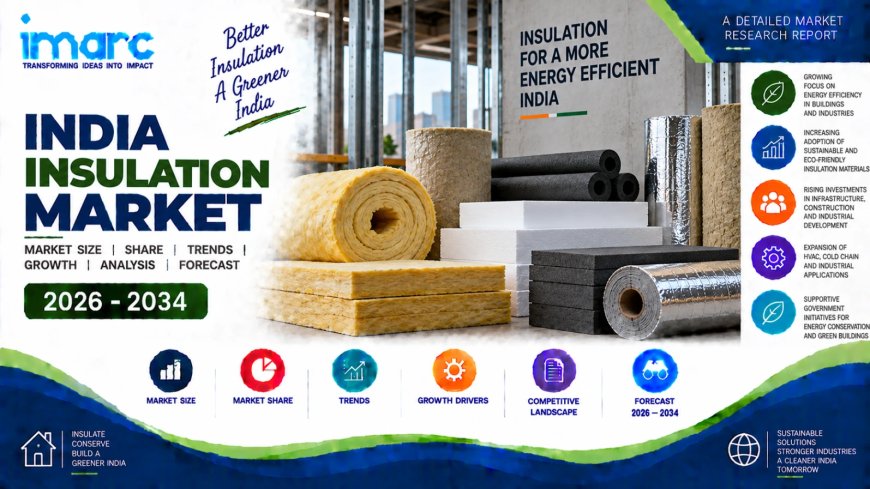
The India insulation market grew from USD 2.75 Billion in 2025 to USD 2.89 Billion in 2026. Looking forward, IMARC Group expects the market to reach USD 3.94 Billion by 2034, exhibiting a growth rate (CAGR) of 3.93% during 2026-2034. The increasing construction and infrastructure development in India, which lead to higher demand for insulation materials in residential, commercial, and industrial buildings, is driving the market.
Market Snapshot
- Market Valuation (2025): USD 2.75 Billion
- Market Valuation (2026): USD 2.89 Billion
- Forecast Valuation (2034): USD 3.94 Billion
- CAGR (2026-2034): 3.93%
- Base Year: 2025
- Forecast Years: 2026-2034
- Historical Years: 2020-2025
What are the Key Developments and Emerging Shifts in the India Insulation Market?
Massive Scale-Up of Domestic Stone Wool Manufacturing
To cater to the surging demand for fire-safe and sustainable construction materials, leading global manufacturers are aggressively expanding domestic production footprints. A prime example is ROCKWOOL's major facility investment, designed to supply thousands of tons of recyclable, non-combustible stone wool insulation annually to support India's high-rise and industrial developments.
Integration of Thermally Insulated Concrete and Sustainable Composites
The sector is transforming through material science innovations. Domestic building material groups are actively launching specialized thermally insulated concrete and eco-friendly composite panels embedded with low thermal conductivity aggregates. These materials actively reduce indoor temperatures, lower cooling loads in commercial complexes, and align seamlessly with national green building rating frameworks.
What Factors are Driving Growth in the India Insulation Market?
Strict Enforcement of Energy Conservation Building Codes (ECBC)
Government-mandated building energy codes and aggressive national sustainability frameworks act as primary growth catalysts. The widespread adoption of green building certifications—such as IGBC, GRIHA, and LEED—compels commercial developers and industrial operators to incorporate high-performance thermal and acoustic insulation to meet rigid energy performance standards.
Escalating Urban Heat Stress and Infrastructure Expansions
The relentless expansion of urban infrastructure, including modern warehousing, data centers, high-speed rail coaches, and sprawling residential townships, drives continuous bulk procurement. Furthermore, escalating regional temperatures and frequent extreme weather events have forced a behavioral shift among consumers and developers, prioritizing high-efficiency insulation to ensure structural resilience and indoor climate control.
How will the India Insulation Market Evolve in the Coming Years?
The India insulation market is positioned for steady, regulation-backed expansion through 2034, structurally supported by the nation's massive capital outlays for infrastructure. As the building ecosystem matures, the transition toward zero-carbon materials, advanced aerogels, and integrated acoustic-thermal hybrid barriers will dictate long-term capacity requirements. Stakeholders who strategically invest in localized, recyclable manufacturing lines, green-certified products, and specialized HVAC applications will remain uniquely positioned to capture dominant market share across both urban and industrial corridors over the forecast period.
➤ Request Sample Report – TOC, Charts & Key Insights: https://www.imarcgroup.com/india-insulation-market/requestsample
How Is the Market Segmented?
Material Type Insights:
- Polystyrene
- Mineral Wool
- Glass Wool
- Polyurethane
- Calcium Silicate
- Others
Function Insights:
- Thermal
- Acoustic
- Electric
- Others
Form Insights:
- Blanket
- Foam
- Board
- Pipe
- Others
End Use Industry Insights:
- Non-Residential
- Residential
- Industrial and Plant Equipment
- HVAC Equipment
- Appliances
- Transport Equipment
- Others
Regional Insights:
- North India
- West and Central India
- South India
- East and Northeast India
Recent Market Developments:
- Green Concrete Innovations (June 2024): Nuvoco Vistas introduced specialized thermal insulated concrete incorporating low-conductivity aggregates, designed to lower indoor temperatures and reduce building energy intensity.
- Domestic SME Expansion (January 2025): Indobell Insulations successfully executed an IPO on the BSE SME platform to scale up its specialized insulation manufacturing capabilities and strengthen domestic supply chains.
Competitive Landscape
Covering an in-depth analysis of the competitive landscape, market structure, key player positioning, competitive dashboards, top winning strategies, and detailed profiles of all major industry participants you will gain access to all these exclusive insights within the full research report.
Customization Note: If you require any specific information not covered within this report's scope, we will provide it as part of the customization.
➤ Request Report Customization: https://www.imarcgroup.com/request?type=report&id=21619&flag=E
Frequently Asked Questions (FAQs):
Q1. How big is the India insulation market?
Ans. The India insulation market reached a valuation of USD 2.75 Billion in 2025.
Q2. What is the future outlook for the India insulation market?
Ans. The overall market is projected to reach USD 3.94 Billion by 2034, registering a steady CAGR of 3.93% during the 2026-2034 forecast period.
Q3. What are the key material types analyzed in the report?
Ans. The market is primarily segmented into polystyrene, mineral wool, glass wool, polyurethane, calcium silicate, and others.
Q4. Which function commands the largest share of the market?
Ans. Thermal insulation leads the market demand, heavily driven by the need for energy-efficient building envelopes and HVAC optimization.
Q5. What are the primary factors fueling market expansion?
Ans. Growth is fundamentally driven by strict Energy Conservation Building Codes (ECBC), expanding green building practices, rapid commercial and residential real estate development, and rising consumer awareness regarding energy savings.
CXO Blindspot
While building material executives heavily prioritize expanding mass-market polystyrene and standard foam lines to capitalize on low-cost residential housing tenders, many completely overlook the severe regulatory and safety liabilities tied to high fire-risk materials. As urban fire safety norms tighten across high-rise residential and commercial complexes, conventional plastic foams face intense scrutiny due to their combustibility and toxic smoke emissions. Failing to aggressively pivot capital expenditures toward non-combustible, certified mineral and stone wool alternatives will inevitably result in strict code disqualification, severe legal exposure, and permanent brand exclusion from premium, institutional-grade green building projects.
Strategic Insight & Verdict
The India insulation sector presents a resilient, regulation-driven expansion opportunity, advancing steadily toward USD 3.94 Billion by 2034. The industry is structurally evolving from a low-involvement utility sub-segment into a critical component of national energy conservation and climate-resilient architecture. Propelled by strict green building mandates, massive warehousing and industrial corridors, and the surging need for thermal comfort in extreme climates, the overarching operating environment remains highly lucrative. Corporate stakeholders and chemical manufacturing investors who prioritize capacity expansions in fire-safe mineral wools, eco-friendly composite boards, and high-performance HVAC insulation will remain uniquely positioned to dictate market leadership across India's modernizing built environment over the forecast period.