






























Australia Fertilizer Market 2026 | Worth USD 3.9 Billion by 2034
Australia fertilizer market to reach USD 3.9B by 2034, driven by sustainable farming, crop diversification, and precision agriculture adoption.

Market Overview
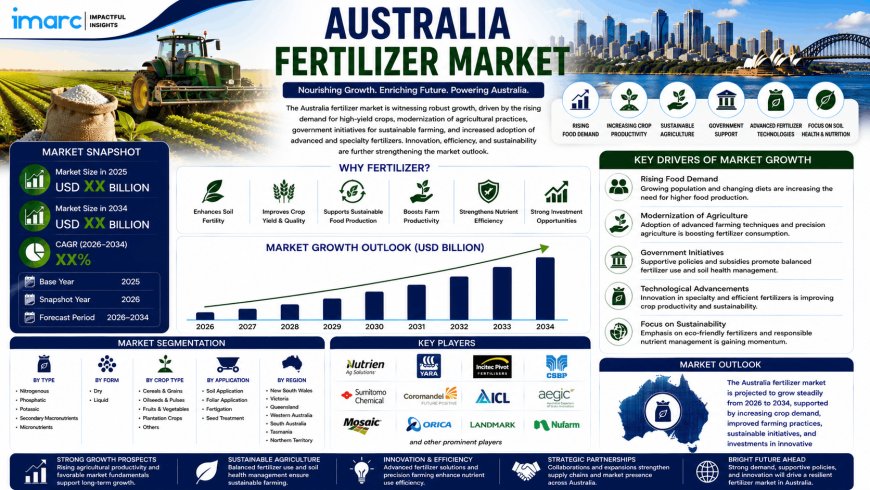
The Australia fertilizer market size increased from USD 2.8 Billion in 2025 to USD 2.9 Billion in 2026. Looking forward, IMARC Group expects the market to reach USD 3.9 Billion by 2034, exhibiting a growth rate (CAGR of 3.43%) during 2026-2034. The market is propelled by the increasing preferences among farmers across the country towards organic product variants that promote soil health and minimize ecological impact, growing agricultural production and crop diversification, pervasive soil nutrient deficiency, government support for sustainable farming, and the adoption of precision agriculture technologies.
Fertilizer refers to a chemical or natural substance applied to land or soil to increase crop yield by supplying essential nutrients such as nitrogen, potassium, and phosphorus. The industry encompasses the production, distribution, and sale of chemical fertilizers and biofertilizers in dry and liquid forms. Fertilizers are crucial for enhancing plant growth, improving soil water retention, and maximizing agricultural output. They serve grain and cereal growers, pulse and oilseed farmers, horticultural producers, and ornamental flower cultivators through a diverse range of straight and complex fertilizer formulations. Fertilizers play a vital role in agriculture, enabling farmers to replenish soil nutrients, maintain long-term soil fertility, and meet the quantity and quality standards demanded by domestic and export markets.
This market is strategically important to Australia's agricultural productivity, food security, and export competitiveness, supporting the region's position as a major global supplier of wheat, barley, canola, and cotton. The Australia fertilizer market encompasses chemical fertilizers and biofertilizers, available as straight fertilizers (nitrogenous, phosphatic, potash, secondary macronutrient, and micronutrient fertilizers) and complex fertilizers, in dry and liquid forms, serving grains and cereals, pulses and oilseeds, fruits and vegetables, flowers and ornamentals, and other crop types across Australia Capital Territory & New South Wales, Victoria & Tasmania, Queensland, Northern Territory & Southern Australia, and Western Australia.
The Australia fertilizer market is poised for sustained expansion, underpinned by precision farming and digital farming solutions, expansion of controlled-release and specialty fertilizers, and emerging demand for organic and bio-based fertilizer solutions. With a projected CAGR of 3.43% through 2034, the market presents significant opportunities for providers focusing on customized fertilizer blends, controlled-release technologies, biofertilizers, and precision agriculture-compatible products.
AUSTRALIA FERTILIZER MARKET SUMMARY
The Australia fertilizer market encompasses the production, distribution, and sale of chemical fertilizers and biofertilizers designed to supply essential nutrients to crops and improve soil health across the country.
The ecosystem spans fertilizer manufacturers, importers and distributors, agronomic advisors, precision agriculture technology providers, government agricultural agencies, research institutions, and farmers serving customers across grains and cereals, pulses and oilseeds, fruits and vegetables, flowers and ornamentals, and other crop segments throughout Australia.
- By Product Type, the market is segmented into Chemical Fertilizer and Biofertilizers.
- By Product, the market serves Straight Fertilizers (Nitrogenous, Phosphatic, Potash, Secondary Macronutrient, and Micronutrient Fertilizers) and Complex Fertilizers.
- By Product Form, the market serves Dry and Liquid.
- By Crop Type, the market serves Grains and Cereals (dominating), Pulses and Oilseeds, Fruits and Vegetables, Flowers and Ornamentals, and Others.
- By Region, the market serves Australia Capital Territory & New South Wales, Victoria & Tasmania, Queensland, Northern Territory & Southern Australia, and Western Australia.
Key trends shaping the market include precision farming and digital farming solutions, expansion of controlled-release and specialty fertilizers, emerging demand for organic and bio-based fertilizer solutions, and government support for sustainable fertilizer practices and innovation.
PORTER'S FIVE FORCES ANALYSIS – AUSTRALIA FERTILIZER MARKET
- Competitive Rivalry: Moderate to High. The market features competition among established fertilizer manufacturers, importers, and distributors. Competition centres on product quality, price, distribution network strength, agronomic support services, and sustainable product offerings. The market is moderately concentrated, with major players investing in storage and distribution infrastructure to improve operational efficiency and farmer access. Business implication: Companies must differentiate through product innovation, agronomic expertise, sustainable offerings, and reliable supply chains to capture market share.
- Supplier Power (Raw Material Providers): Moderate to High. Fertilizer manufacturers rely on suppliers of natural gas (for nitrogenous fertilizers), phosphate rock, potash, and other raw materials. Critical inputs such as potash are concentrated among a few global suppliers, creating significant supplier power. Australia's reliance on imported fertilizers further elevates supplier power. Business implication: Strategic partnerships with global suppliers, investment in domestic storage and distribution infrastructure, and diversified sourcing can reduce long-term dependency and supply chain risk.
- Buyer Power (Farmers and Agricultural Enterprises): High. Farmers have significant choice among fertilizer brands, formulations, and suppliers. They demand competitive pricing, agronomic advice, and products tailored to specific soil and crop requirements. Large-scale grain and cotton producers leverage volume purchasing power to negotiate favourable terms. Business implication: Providers must offer competitive pricing, customized fertilizer blends, precision agriculture-compatible products, and strong agronomic support to attract and retain customers.
- Threat of Substitutes: Moderate. Fertilizers serve essential functions for crop nutrition that cannot be easily substituted, but alternatives exist. Organic amendments, biofertilizers, and soil conditioners compete for certain applications. Precision agriculture technologies that optimize fertilizer use can reduce overall volume requirements. Business implication: Demonstrating superior nutrient use efficiency, environmental sustainability, and cost-effectiveness is essential to maintaining market relevance against alternative soil management approaches.
- Threat of New Entrants: Moderate. Significant capital requirements for manufacturing and distribution infrastructure, regulatory compliance, and established farmer relationships create barriers. However, the growth of biofertilizers, specialty fertilizers, and precision agriculture solutions has enabled new entrants focused on niche product categories. Business implication: Incumbents must leverage scale, distribution networks, and agronomic expertise while monitoring emerging niches and innovative product categories.
KEY ASPECTS REQUIRED FOR THE AUSTRALIA FERTILIZER MARKET
- Market Performance: USD 2.8 Billion in 2025, projected to reach USD 3.9 Billion by 2034, driven by agricultural production growth, soil nutrient deficiency, and government support for sustainable farming.
- Market Outlook: A 3.43% CAGR through 2034 reflects steady growth led by chemical fertilizers, straight fertilizers, dry product forms, grains and cereals crop types, and ACT and NSW regional dominance.
- Growth Drivers: Growing agricultural production and crop diversification; soil health issues and nutrient deficiency; government support and climate resilience strategies; precision farming and digital farming solutions; expansion of controlled-release and specialty fertilizers; and emerging demand for organic and bio-based fertilizer solutions.
- Competitive Landscape: A moderately concentrated market with major fertilizer manufacturers, importers, and distributors. Key players invest in storage and distribution infrastructure, precision agriculture-compatible products, and sustainable fertilizer solutions.
- Value Chain Analysis: From raw material procurement through fertilizer manufacturing and importation, distribution to wholesalers and retailers, agronomic advisory services, and application by farmers across grains, pulses, horticulture, and ornamental crop segments.
- Industry Trends: Precision farming and digital farming solutions; expansion of controlled-release and specialty fertilizers; emerging demand for organic and bio-based fertilizer solutions; government support for sustainable fertilizer practices; and innovation in fertilizer technologies.
- Strategic Recommendations: Invest in precision agriculture-compatible fertilizer products; develop controlled-release and specialty fertilizer lines; expand biofertilizer and organic product offerings; strengthen storage and distribution infrastructure; pursue government research and development partnerships; and strengthen presence in New South Wales, Victoria, and Western Australia.
Request for Sample Report: https://www.imarcgroup.com/australia-fertilizer-market/requestsample
MARKET GROWTH DRIVERS
Growing Agricultural Production and Crop Diversification
One of the primary growth drivers for Australia's fertilizer industry is growing agricultural production across a range of cropping systems. From broadacre grain and pulse farming in Western Australia and New South Wales to high-value horticulture in states such as Victoria and Queensland, agriculture in Australia remains dynamic with increased focus on productivity and crop diversification. The drive to raise yields on irrigated as well as dryland farms generates regular demand for various fertilizers designed specifically for various soil types and crop requirements. The nation's extensive export-oriented production consisting of wheat, barley, canola, and cotton is also pushing producers to invest in fertilizers that are capable of sustaining quantity and quality standards demanded by overseas consumers. Moreover, the emergence of new crops such as avocados and almonds in areas such as South Australia and the Murray-Darling Basin has brought in new nutrient management issues, further fueling demand for specialist fertilizer products that promote root development, flowering, and fruit growth.
Soil Health Issues and Nutrient Deficiency
Another key driver of the Australia fertilizer market growth is the pervasive problem of soil nutrient deficiency and heterogeneity. Most Australian soils, particularly in areas such as Western Australia and Northern Territory, are inherently poor in essential nutrients like nitrogen, phosphorus, and potassium. Nutrient imbalances have been further accentuated by years of intensive farming without balanced replenishment, rendering the application of fertilizers a necessary step to keep the soil fertile. Growers are increasingly turning towards soil testing and agronomic recommendations to identify the best fertilizers and doses to apply. On sandy and acidic soils, prevalent in much of southern and coastal Australia, specialized nutrient programs are necessary to counteract leaching and low nutrient retention. This creates demand for traditional NPK fertilizers and products supplemented with micronutrients such as zinc, boron, and manganese. With increased awareness surrounding long-term soil health, farmers are also spending on organic conditioners and amendments for the soil, further broadening the base of the fertilizer market within the country.
Government Support and Climate Resilience Strategies
Governmental programs and climate resilience requirements are also driving expansion in Australia's fertilizer market. Via rural development grants, soil improvement initiatives, and agricultural extension programs, federal and state governments encourage appropriate fertilizer utilization to maximize farm productivity and environmental sustainability. Farmers are helped to implement precision agriculture, conservation tillage, and best fertilization practices to counteract soil erosion, salinity, and drought tolerance, which are issues widespread throughout Australia's diverse climate regions. Additionally, with climate change promoting irregular rainfalls and weather extremes, the value of effective use of fertilizer is even more significant. Farmers are increasingly looking for fertilizer products that enhance water-use efficiency, enhance stress tolerance in plants, and increase nutrient acquisition under changing environmental conditions. This demand for climate-smart agriculture is stimulating the development of new-age fertilizers and catalyzing the collaboration of manufacturers, agronomists, and the government to make Australian farms productive and competitive under a shifting climate.
Precision Farming and Digital Farming Solutions
One of the emerging trends in Australia's fertilizer market is the growth of precision agriculture and digital farming solutions. Farmers throughout regions such as the Murray-Darling Basin and Western Australia are adopting soil-mapping technology, field monitoring through drones, and yield data analysis to maximize fertilizer application. These technologies assist in aligning nutrient inputs with requirements of crops, reducing wastage and environmental loss while increasing productivity. Online platforms facilitate site-specific recommendation of fertilizers according to soil fertility, moisture levels, and previous yield performance. Such a trend resonates with sustainable farming objectives and is attractive for large-scale producers of grain, cotton, and horticultural crops concerned with cost-effectiveness and environmental care. Fertilizer formulators are, in turn, responding by providing customized blends and low-rate-of-application products that complement these precision systems. Overall, the trend toward data-driven nutrient management is transforming the Australia fertilizer market share, promoting innovation and improved resource use in various cropping regions.
Expansion of Controlled-Release and Specialty Fertilizers
Another new trend in Australia's fertilizer industry is increasing demand for controlled release and specialty fertilizer formulations. Conventional fertilizers are being complemented or substituted by slow- and controlled-release fertilizers that release nutrients over a period, lessening nitrogen volatilization and phosphorus fixation in Australian soils, particularly in sandy, acidic, or calcareous soils. This is especially beneficial where there is a risk of nutrient leaching or alkalinity in soils prevalent in certain areas of Queensland and South Australia. Specialty fertilizers, such as micronutrient mixtures specific to iron and zinc deficiencies, are becoming popular among vineyards, orchards, and specialty vegetable businesses in Victoria and Tasmania. Fertilizer manufacturers are increasing their product lines to incorporate polymer-coated granules, efficiency-enhanced nitrogen products, and colloidal or foliar-applied micronutrient solutions. These technologies aid sustainable farm systems, enhance nutrient use efficiency, and address demands of environmentally aware farmers for lower input losses and improved crop quality, which further contributes to the growth of Australia fertilizer market demand.
AUSTRALIA FERTILIZER MARKET SEGMENTATION
Segmentation analysis provides a detailed view of the Australia fertilizer market by category:
Product Type Insights: The report has provided a detailed breakup and analysis of the market based on the product type. This includes chemical fertilizer and biofertilizers. Chemical fertilizers remain the dominant segment, driven by their predictability, reliability, and swift impact on crops. These products are easy to transport, store, and apply, and they readily dissolve in the soil to supply essential nutrients. Biofertilizers represent a growing segment, driven by increasing consumer trends and regenerative agriculture practices. With a healthy local organic food industry and exporter image, especially from areas such as New South Wales and Victoria where livestock and horticulture farming exist together, there is increasing demand for fertilizers produced through composting, microbial inoculants, and plant-based nutrient amendments. These environmentally friendly products promote soil health, microbial function, and long-term fertility, consistent with Australian regenerative farming programs and cover cropping systems.
Product Insights: The report has provided a detailed breakup and analysis of the market based on the product. This includes straight fertilizers and complex fertilizers. Straight fertilizers, including nitrogenous fertilizers (urea, calcium ammonium nitrate, ammonium nitrate, ammonium sulfate, anhydrous ammonia, and others), phosphatic fertilizers (mono-ammonium phosphate (MAP), di-ammonium phosphate (DAP), single super phosphate (SSP), triple super phosphate (TSP), and others), potash fertilizers (muriate of potash (MoP) and sulfate of potash (SoP)), secondary macronutrient fertilizers (calcium, magnesium, and sulfur fertilizers), and micronutrient fertilizers (zinc, manganese, copper, iron, boron, molybdenum, and others), represent the leading product segment. These products are widely used for specific nutrient supplementation based on soil testing and agronomic recommendations. Complex fertilizers represent a significant segment, offering multiple nutrients in a single product for convenient application.
Product Form Insights: The report has provided a detailed breakup and analysis of the market based on the product form. This includes dry and liquid. Dry fertilizers remain the dominant form, preferred for their ease of transport, storage, and application across broadacre farming operations. Liquid fertilizers represent a growing segment, particularly for precision agriculture applications and high-value horticultural crops where fertigation systems enable precise nutrient delivery. Liquid formulations are increasingly popular for their rapid nutrient availability and compatibility with modern irrigation systems.
Crop Type Insights: The report has provided a detailed breakup and analysis of the market based on the crop type. This includes grains and cereals, pulses and oilseeds, fruits and vegetables, flowers and ornamentals, and others. Grains and cereals represent the leading crop type segment, driven by Australia's extensive export-oriented production of wheat, barley, and other cereals across Western Australia, New South Wales, and other grain-growing regions. These crops require significant fertilizer inputs to maintain yields and quality standards demanded by overseas consumers. Pulses and oilseeds, including canola and chickpeas, represent a significant segment, supported by crop rotation practices and growing export demand. Fruits and vegetables represent a growing segment, driven by high-value horticulture in Victoria, Queensland, and South Australia, requiring specialized fertilizer formulations for optimal quality and yield. Flowers and ornamentals represent a niche but growing segment, supported by the floriculture industry's demand for precision nutrient management.
Regional Insights: The report has also provided a comprehensive analysis of all the major regional markets, which include Australia Capital Territory & New South Wales, Victoria & Tasmania, Queensland, Northern Territory & Southern Australia, and Western Australia. Australia Capital Territory & New South Wales represents a leading region, driven by extensive grain and pulse farming, horticultural production, and the concentration of fertilizer distribution infrastructure. Victoria & Tasmania represents a significant market, with high-value horticulture, viticulture, and dairy farming driving demand for specialty and micronutrient fertilizers. Queensland experiences strong demand, driven by extensive cropping operations, sugarcane production, and horticulture. Northern Territory & Southern Australia represents a strategically important region, with broadacre grain farming and horticulture requiring specialized nutrient programs for challenging soil conditions. Western Australia represents a significant market, driven by extensive grain and canola production and the need for fertilizers that address sandy and acidic soil conditions.
COMPETITIVE LANDSCAPE
The key players in the market have made several innovations and advancements to meet the evolving demands of consumers and businesses. These industry players have invested in expanding their storage and distribution infrastructure to improve operational efficiency and farmer access. They are also developing customized fertilizer blends and controlled-release formulations that complement precision agriculture systems. In addition, they are expanding their product lines to include biofertilizers and organic amendments that support sustainable farming practices. Collaborations with research institutions and government agencies are enabling the development of new products tailored to Australian soil conditions and climate variability.
Major players include established fertilizer manufacturers, importers, and distributors investing in storage and distribution infrastructure, precision agriculture-compatible products, and sustainable fertilizer solutions.
Recent Developments:
- December 2024: Agfert Fertilizers announced plans to complete its new 20,000t fertilizer storage and distribution plant on the Eyre Peninsula in South Australia by February or March 2025. After completion, Agfert Fertilizers will have approximately 80,000 t of fertilizer storage space spread over Southern Australia, with expected throughput of more than 100,000 t/yr.
- February 2025: Incitec Pivot Fertilisers (IPF) enhanced farmer access to fertilisers in the Murrumbidgee Irrigation Area (MIA) of New South Wales after completing a USD 2.5 Million investment in its Whitton EASY Liquids facility, boosting capacity by roughly 30% to 5 million liters.
- August 2024: Incitec Pivot Fertilisers (IPF) launched its revamped fertiliser import and distribution facility in Portland, regional Victoria, after investing USD 20 million in the location, improving operational efficiency and storage capabilities for growers on Australia's East Coast.
Investment opportunities exist in precision agriculture-compatible fertilizer products, controlled-release and specialty fertilizer lines, biofertilizer production, and storage and distribution infrastructure.
REGIONAL ANALYSIS
Australia Capital Territory & New South Wales represents the leading region in the Australia fertilizer market. The region benefits from extensive grain and pulse farming across the state's interior, along with significant horticultural production and the concentration of fertilizer distribution infrastructure. New South Wales hosts major fertilizer import and distribution facilities, supporting efficient supply to farming regions across the state. The region's diverse cropping systems, from broadacre grains to high-value horticulture, create demand for a wide range of fertilizer products. Government agricultural extension programs and research institutions further support the adoption of best fertilization practices.
Victoria & Tasmania represents a significant market, with high-value horticulture, viticulture, and dairy farming driving demand for specialty and micronutrient fertilizers. Victoria hosts advanced fertilizer distribution facilities, including Incitec Pivot Fertilisers' Portland facility, supporting supply to the state's diverse agricultural regions. Tasmania contributes through its growing viticulture and horticulture sectors, which require precision nutrient management for premium crop quality.
Queensland experiences strong demand, driven by extensive cropping operations, sugarcane production, and horticulture. The state's warm climate and diverse cropping systems create demand for a range of fertilizer products, from nitrogenous fertilizers for sugarcane to specialty formulations for tropical fruits and vegetables. Queensland's fertilizer demand is further supported by the state's growing population and agricultural export sector.
Northern Territory & Southern Australia represents a strategically important region, with broadacre grain farming and horticulture requiring specialized nutrient programs for challenging soil conditions. Southern Australia's alkaline soils and limited rainfall create unique nutrient management challenges that require tailored fertilizer formulations. The region's grain growers rely on precision agriculture technologies to optimize fertilizer application and maximize yields under variable climatic conditions.
Western Australia represents a significant market, driven by extensive grain and canola production and the need for fertilizers that address sandy and acidic soil conditions. The state's sandy soils are prone to nutrient leaching, requiring specialized fertilizer formulations and application strategies to maintain nutrient availability for crops. Western Australia's grain growers are increasingly adopting precision agriculture technologies and controlled-release fertilizers to improve nutrient use efficiency and reduce environmental impact.
RECENT INDUSTRY DEVELOPMENTS
2026 Activity: The Australia fertilizer market continued its growth trajectory from USD 2.8 Billion in 2025 toward USD 3.9 Billion by 2034 at a CAGR of 3.43%.
February 2025: Incitec Pivot Fertilisers (IPF) completed a USD 2.5 Million investment in its Whitton EASY Liquids facility in New South Wales, boosting capacity by roughly 30% to 5 million liters.
December 2024: Agfert Fertilizers announced plans to complete its new 20,000t fertilizer storage and distribution plant on the Eyre Peninsula in South Australia by February or March 2025.
August 2024: Incitec Pivot Fertilisers (IPF) launched its revamped fertiliser import and distribution facility in Portland, regional Victoria, after investing USD 20 million.
Government initiatives: Rural development grants; soil improvement initiatives; agricultural extension programs; Rural Research and Development Corporations (RDCs) funding for fertilizer research; and sustainable fertilizer practice promotion.
FREQUENTLY ASKED QUESTIONS
Q1: What is the current size of the Australia fertilizer market?
A: The Australia fertilizer market increased from USD 2.8 Billion in 2025 to USD 2.9 Billion in 2026 and is projected to reach USD 3.9 Billion by 2034, exhibiting a CAGR of 3.43% from 2026-2034.
Q2: What are the key drivers of the Australia fertilizer market?
A: The market is driven by: (i) growing agricultural production and crop diversification; (ii) soil health issues and nutrient deficiency; (iii) government support and climate resilience strategies; (iv) precision farming and digital farming solutions; and (v) emerging demand for organic and bio-based fertilizer solutions.
Q3: What are the major product types in the Australia fertilizer market?
A: Major product types include Chemical Fertilizer and Biofertilizers.
Q4: What are the major products in the Australia fertilizer market?
A: Major products include Straight Fertilizers (Nitrogenous, Phosphatic, Potash, Secondary Macronutrient, and Micronutrient Fertilizers) and Complex Fertilizers.
Q5: What are the major crop types in the Australia fertilizer market?
A: Major crop types include Grains and Cereals (dominating), Pulses and Oilseeds, Fruits and Vegetables, Flowers and Ornamentals, and Others.
Q6: What are the challenges facing the Australia fertilizer market?
A: Key challenges include dependence on imported fertilizers and global supply chain disruptions, price volatility of raw materials, regulatory complexity, climate variability affecting application timing, and the need to balance productivity with environmental sustainability.
Q7: What is the outlook for the Australia fertilizer market?
A: The market is projected to grow at a 3.43% CAGR through 2034, with growth driven by precision agriculture adoption, expansion of controlled-release and specialty fertilizers, and growing demand for organic and bio-based fertilizer solutions. The shift toward data-driven nutrient management and climate-smart agriculture is expected to shape the market's evolution.
Q8: Who are the key players in the Australia fertilizer market?
A: Key players include Incitec Pivot Fertilisers (IPF), Agfert Fertilizers, and other established fertilizer manufacturers, importers, and distributors.
Note: If you need any specific information that is not covered currently within the scope of the report, we will provide the same as a part of customization.
https://www.imarcgroup.com/request?type=report&id=21966&flag=E
Report Format, Delivery, and Customization Details
Report Format Mode: PPT, PDF, and Excel
Report Delivery Mode: Online Delivery, Physical Delivery
Report Delivery Time: Report Delivered Over Email within 24 to 48 hours. If requested by the client, a physical copy will be delivered within three to ten days.
Report Confirmation Mode: Yes via Email
Report Customization Mode: Yes via Email / Call
Report Table of Content: Yes
Report List of Figures: Yes
Report Methodology Mode: Yes
Request For Sample Report: Yes
What's Your Reaction?