


























Philippines Air Compressor Market Size, Share, Report 2026-2034
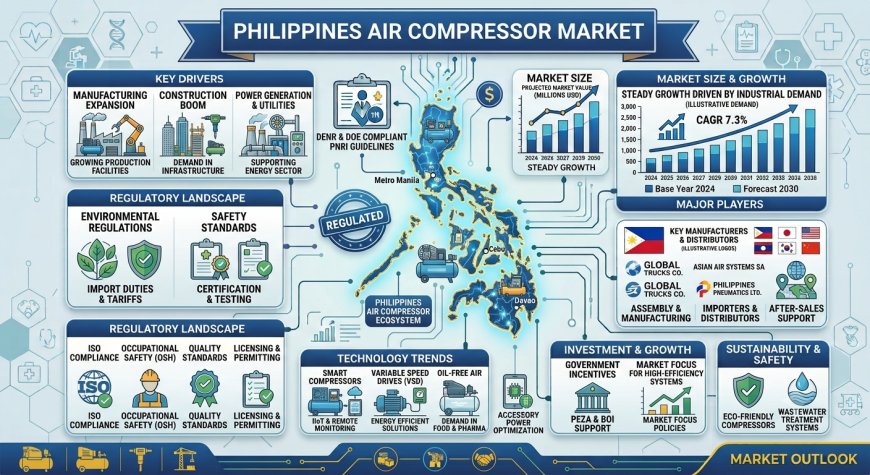
Philippines air compressor market grew from USD 393.37 Million in 2025 to USD 404.95 Million in 2026 and is projected to reach USD 512.18 Million by 2034, growing at a compound annual growth rate (CAGR) of 2.98% during 2026-2034.

Market Overview
The Philippines air compressor market grew from USD 393.37 Million in 2025 to USD 404.95 Million in 2026 and is projected to reach USD 512.18 Million by 2034, growing at a compound annual growth rate (CAGR) of 2.98% during 2026-2034. Industrialisation, expansion of electronics and semiconductor manufacturing, infrastructure development, growing food processing, and the push for energy-efficient compressed air systems are shaping the Philippines air compressor market share and outlook through 2034. Growth is expected to be steady rather than rapid, as the market is mature in several industrial segments and demand follows manufacturing and construction cycles.
Market Summary
- Industrial growth is the main foundation. The market is experiencing steady expansion, driven by the country’s accelerating industrialisation and large-scale infrastructure development programmes.
- Stationary compressors lead the market. Stationary units held 61.2% of the market in 2025, rotary or screw technology held 46.8%, and oil-filled models held 58.9%.
- Mid-sized industrial units are in highest demand, with the 101 to 300 kW range leading at a 34.6% share, and manufacturing the leading end user at 39.7%.
- Regional concentration is high. Luzon accounts for 66.1% of the market, reflecting the location of major economic zones, industrial estates, and ports.
- Energy efficiency is shaping purchases, as the shift toward energy optimisation is reshaping procurement decisions across manufacturing, semiconductor, and food processing sectors.
- The market is segmented by type, technology, lubrication method, power rating, end user, and region, with forecasts for 2026-2034.
Market Growth Drivers
Manufacturing and Electronics Sector Expansion
Compressed air is a core utility in factories, powering tools, automation, packaging, painting, cleaning, and process equipment. The Philippines’ manufacturing base is anchored by electronics and food processing, and investment activity remains strong. PEZA reported that manufacturing accounts for more than P2 trillion in overall investments and creates 720,000 jobs, with electronics and semiconductor manufacturing services leading. Export performance supports this base, as semiconductor and electronics exports rose from US$42.75 billion in 2024 to US$49.64 billion in 2025, a 16.11% annual increase. Each new line and cleanroom adds demand for reliable, often oil-free, compressed air systems.
Investment Inflows and Industrial Policy Support
Government agencies are encouraging new plants and expansions through economic zones and incentives. From January to July 2026, the PEZA Board approved 174 new and expansion projects, up 16 percent, with total approved investments of P151.901 billion, a 66.99 percent increase from a year earlier. The electronics roadmap targets annual electronics exports of US$110 billion by 2030. Advanced packaging, aerospace components, and automotive electronics bring more demanding air quality and reliability requirements, supporting replacement and upgrade cycles for higher-specification compressors.
Energy Efficiency, Technology Upgrades, and Infrastructure Needs
Rising electricity costs and sustainability goals are pushing industries toward variable-speed drive compressors, heat recovery, leak detection, and smart monitoring. Buyers increasingly evaluate lifecycle cost rather than purchase price alone, favouring modern rotary screw units over older piston models. Hygiene standards also matter, as food, pharmaceutical, and electronics producers follow hygiene and air-quality standards that favour certified oil-free compressed air systems. Construction, mining, and utilities add demand for portable units, although public works spending has been uneven, with cement makers expecting demand to finish 2026 flat amid sluggish construction activity.
Browse Full Report with TOC & List of Figures for In-Depth Market Insights: https://www.imarcgroup.com/philippines-air-compressor-market
Porter’s Five Forces Analysis
Competitive Rivalry: High
- Global manufacturers, regional brands, and local distributors compete on price, efficiency, reliability, and service coverage.
- Lower-cost imports and refurbished units add price pressure, particularly in small and medium-sized businesses.
- After-sales service, spare parts availability, and energy-saving features are key points of differentiation.
Supplier Power: Moderate
- Compressor makers depend on specialised components such as airends, motors, drives, and controllers, often sourced globally.
- Steel, copper, and electronics prices affect manufacturing costs and pricing.
- Large brands manage risk through global sourcing and long-term supplier arrangements.
Buyer Power: Moderate to High
- Large manufacturers and multinational plants negotiate firmly on price, service contracts, and efficiency guarantees.
- Smaller buyers are more price-sensitive and often rely on distributors for advice.
- Buyers can compare multiple brands and consider rental or used options.
Threat of Substitutes: Moderate
- Electric tools, hydraulic systems, and vacuum or blower technologies can replace compressed air in some applications.
- On-site nitrogen and oxygen generators and centralised utilities may reduce use of standalone compressors.
- Compressed air remains widely used because of its safety, simplicity, and versatility.
Threat of New Entrants: Moderate
- Importing and distribution require limited capital, enabling new brands to enter through low-cost products.
- Building service networks, brand trust, and technical support takes time and favours established players.
- Technical standards and efficiency expectations raise the bar for high-end and industrial segments.
Market Segmentation
Type Insights
- Portable
- Stationary
Technology Insights
- Reciprocating/Piston
- Rotary/Screw
- Centrifugal
Lubrication Method Insights
- Oil-filled
- Oil-free
Power Rating Insights
- 0 to 100 kW
- 101 to 300 kW
- 301 to 500 kW
- 501 kW and Above
End User Insights
- Manufacturing
- Oil and Gas
- Construction
- Energy and Power
- Food and Beverage
- Others
Regional Insights
- Luzon
- Visayas
- Mindanao
Regional Analysis
Luzon: Luzon is the dominant regional market, holding 66.1% of the total in 2025. It hosts Metro Manila, the CALABARZON and Central Luzon industrial corridors, major economic zones, and the country’s largest concentration of electronics, automotive, and food manufacturing. A planned advanced packaging project in Batangas shows the region’s role in moving up the chip value chain.
Visayas: The Visayas region, led by Cebu, has a significant manufacturing and export base in electronics, furniture, and processed goods, alongside tourism and construction activity. Demand is supported by economic zones and port-linked industries, with growth tied to expansion of local manufacturers and infrastructure upgrades.
Mindanao: Mindanao supports demand through agriculture and food processing, mining, and energy projects. Portable and heavy-duty compressors are used in construction and mining, while growing industrial parks and port development support gradual expansion of stationary demand.
Competitive Landscape
The Philippines air compressor market features global compressor manufacturers, regional brands, and local distributors and service providers competing across portable and stationary segments. Competition is being shaped by energy efficiency, oil-free technology for clean-air industries, availability of service and spare parts, financing and rental options, and strong distributor networks. Suppliers are also introducing connected monitoring and variable-speed models to help customers cut electricity use. The report covers market structure, key player positioning, top winning strategies, competitive dashboard, and company evaluation quadrant, along with detailed profiles of all major companies.
Key players include:
- Atlas Copco
- Ingersoll Rand
- Kaeser Kompressoren
- Hitachi Industrial Equipment Systems
- Kobelco Compressors
- Fusheng
Recent Industry Developments
September 2026: The S&P Global Philippines Manufacturing PMI fell to 49.6 in September from August’s over nine-year high of 54.9, signalling the first deterioration in manufacturing conditions since April. The reading shows how quickly factory conditions can change and why compressor demand follows industrial cycles.
August 2026: The manufacturing PMI improved to 54.9 in August from 51.8 in July, the fastest growth since December 2016. The surge pointed to rising output and orders, supporting demand for industrial equipment and utilities in factories.
July 2026: PEZA said manufacturing remains its top investment driver, with approved investments reaching P151.901 billion between January and July 2026. The approvals indicate a pipeline of new and expanded plants that will need compressed air and related utilities.
April 2026: PEZA expected a Batangas project to help the chip industry climb the value chain, noting that advanced hermetic packaging and liquid-cooled technologies will bolster the semiconductor and electronics value chain. Higher-value electronics production tends to require cleaner, more precise air systems, supporting demand for oil-free and high-efficiency compressors.
Key Aspects Required for the Philippines Air Compressor Market
- Market Performance: The market grew from USD 393.37 Million in 2025 to USD 404.95 Million in 2026 and is projected to reach USD 512.18 Million by 2034, driven by manufacturing, investment inflows, and efficiency upgrades.
- Market Outlook: A 2.98% CAGR during 2026-2034 reflects steady, moderate growth supported by industrial investment and technology replacement.
- Growth Drivers: Manufacturing and electronics sector expansion; investment inflows and industrial policy support; and energy efficiency, technology upgrades, and infrastructure needs.
- Competitive Landscape: Atlas Copco, Ingersoll Rand, Kaeser Kompressoren, Hitachi Industrial Equipment Systems, Kobelco Compressors, and Fusheng compete on efficiency, reliability, price, and service.
- Value Chain Analysis: The value chain runs from component and compressor manufacturing overseas through importers, distributors, and service providers, to end users in manufacturing, construction, energy, and food processing across Luzon, Visayas, and Mindanao.
- Industry Trends: Shift to rotary screw and variable-speed models; rising demand for oil-free air in clean industries; energy monitoring and leak management; growth of rental and service contracts; and exposure to manufacturing cycles.
- Strategic Recommendations: Offer energy-efficient and oil-free ranges; strengthen service and spare parts networks outside Luzon; provide rental, financing, and maintenance packages; target electronics, food, and pharmaceutical clusters; and use connected monitoring to build recurring revenue.
Note: If you need any specific information that is not covered currently within the scope of the report, we will provide the same as a part of customization.
Speak to an analyst: http://imarcgroup.com/request?type=report&id=45302&flag=E
Frequently Asked Questions
1. What is the size of the Philippines air compressor market?
The market grew from USD 393.37 Million in 2025 to USD 404.95 Million in 2026 and is projected to reach USD 512.18 Million by 2034.
2. What is the expected growth rate of the Philippines air compressor market?
The market is projected to grow at a CAGR of 2.98% during 2026-2034.
3. What is driving the growth of the Philippines air compressor market?
Growth is driven by manufacturing and electronics sector expansion, investment inflows and industrial policy support, and energy efficiency, technology upgrades, and infrastructure needs.
About Us
IMARC Group is a global management consulting firm that helps the world’s most ambitious changemakers to create a lasting impact. The company provides a comprehensive suite of market entry and expansion services. IMARC offerings include thorough market assessment, feasibility studies, company incorporation assistance, factory setup support, regulatory approvals and licensing navigation, branding, marketing and sales strategies, competitive landscape and benchmarking analyses, pricing and cost research, and procurement research.
Contact Us
IMARC Group
134 N 4th St., Brooklyn, NY 11249, USA
Email: sales@imarcgroup.com
Tel No: (D) +91 120 433 0800
United States: +1-631-791-1145
What's Your Reaction?