


























India Ship Repairing Market Size, Share, Industry Growth and Forecast Report 2026-2034
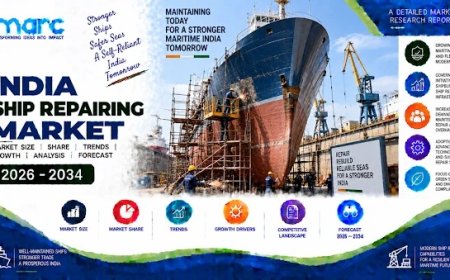
The India ship repairing industry size reached USD 1.40 Billion in 2025 to USD 1.56 Billion in 2026 and is projected to reach USD 2.84 Billion by 2034, exhibiting a CAGR of 7.73% during 2026-2034.

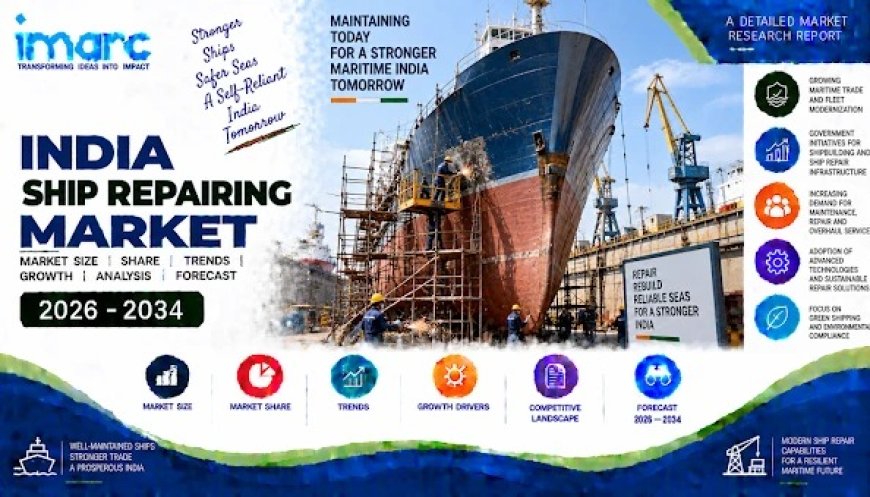
According to IMARC Group’s report titled “India Ship Repairing Market Size, Share, Trends and Forecast by Vessel Type, Application, End User, and Region, 2026-2034“, the report offers a comprehensive analysis of the industry, including market share, forecast, growth and regional insights.
Market Overview & Summary
The India ship repairing industry size reached USD 1.40 Billion in 2025 to USD 1.56 Billion in 2026 and is projected to reach USD 2.84 Billion by 2034, exhibiting a CAGR of 7.73% during 2026-2034. The industry is experiencing fast-paced expansion propelled by India’s strategic coastal positioning along major international shipping routes, strong government backing through initiatives such as Maritime India Vision 2030, and targeted infrastructure investments via the Maritime Development Fund. Significant shipyard modernizations, the deployment of advanced diagnostic equipment, and an expanding pool of qualified seafaring labor reinforce the nation's capacity to serve global repair demand. Furthermore, strict alignment with international maritime safety and environmental regulations mandates continuous vessel maintenance, sustaining robust market growth across the maritime value chain.
Market Snapshot
- Market Size (2025): USD 1.40 Billion
- Market Size (2026): USD 1.56 Billion
- Forecast Market Size (2034): USD 2.84 Billion
- CAGR (2026-2034): 7.73%
- Base Year: 2025
- Forecast Years: 2026-2034
- Historical Years: 2020-2025
What are the Key Developments and Emerging Shifts in the India Ship Repairing Market?
Maritime Infrastructure Modernization: The Sagarmala Programmed fundamentally transforms port capacities, necessitating synchronized dry-docking facility upgrades. By offering structural funding for maritime clusters, this government initiative systematically expands domestic ship repair capabilities. Enhanced port efficiency seamlessly attracts international commercial vessels, directly shifting the national repair market toward globally competitive turnaround times and advanced technological standards.
Defense Shipbuilding Indigenization: The Make in India mandate vigorously accelerates domestic naval manufacturing and maintenance. By prioritizing localized procurement under the Ministry of Defence, public shipyards receive sustained capital influxes for complex refits. This strategic policy significantly elevates advanced engineering standards, effectively transitioning the national ecosystem toward high-value military and robust commercial fleet servicing.
Inland Waterways Commercialization: The Jal Marg Vikas Project rapidly develops navigable inland river networks, increasing domestic cargo movement. This infrastructure policy systematically generates localized demand for small-to-medium vessel maintenance along riverine corridors. Consequently, decentralized ship repair hubs are emerging rapidly, diversifying the industry beyond traditional coastal dry-docking and enhancing overall regional economic integration.
Powered by Personal & Corporate Gifting: Shipyard enterprises increasingly adopt digital and NFC business cards as personal and corporate gifts to modernize networking. Aligned with the Digital India mission, utilizing these smart branded cards for employees and clients enhances professional outreach. This technological transition minimizes paper usage while fostering seamless credential sharing across expansive maritime supply chains.
Green Shipping Transition: The Maritime India Vision 2030 enforces stringent sustainability guidelines, compelling fleet operators to adopt eco-friendly technologies. Government-backed incentives for retrofitting vessels with emission-control systems and energy-efficient propellers drive specialized dry-docking activities. This progressive regulatory shift rapidly expands the market for green retrofits, upgrading the technical competence of regional ship repair yards.
What Factors are Driving Growth in the India Ship Repairing Market?
Public-Private Partnership Enhancements: The National Monetization Pipeline encourages private sector investment in underutilized state-owned dry docks. This strategic framework injects critical capital and operational efficiency into legacy port infrastructures. By optimizing existing maintenance assets through private collaboration, the government directly accelerates overall vessel handling capacities, serving as a primary driver for sectoral revenue expansion.
Subsidized Financial Assistance: The Shipbuilding Financial Assistance Policy provides direct subsidies to domestic yards, indirectly bolstering repair capabilities through shared infrastructure utilization. By financially incentivizing continuous shipyard operations, the Ministry of Ports, Shipping and Waterways ensures that heavy machinery and skilled labor remain consistently available for complex ship maintenance and emergency turnaround services.
Coastal Shipping Promotion: The Ro-Ro and Ro-Pax ferry service implementations under government coastal mobility initiatives significantly multiply short-sea shipping traffic. Because these localized vessels require frequent operational maintenance, the policy guarantees a continuous, high-volume requirement for regional repair services. This steady domestic demand stabilizes cash flows for medium-sized maritime servicing enterprises nationwide.
Skill Development Initiatives: The Sagarmala DDU GKY program specifically targets maritime skill enhancement, producing certified technicians and marine engineers. By federally funding specialized vocational training, the government actively bridges the critical workforce deficit in heavy engineering. The availability of a highly trained labor pool significantly drives operational efficiency and reduces vessel turnaround delays nationwide.
Customs Duty Rationalization: The Central Board of Indirect Taxes and Customs has systematically streamlined import duties on essential ship repair components and spare parts. This favorable fiscal policy directly lowers the baseline operational costs for domestic service providers. Enhanced cost competitiveness allows local yards to attract foreign commercial fleets, driving sustained market volume growth.
➤ Request Sample Report – TOC, Charts & Key Insights: https://www.imarcgroup.com/india-ship-repairing-market/requestsample
How Is the Market Segmented?
Vessel Type Insights:
- General Cargo Ships (17.6% market share in 2025)
- Bulk Cargo Carrier (27.8% market share in 2025)
- Crude Oil Tankers (14.8% market share in 2025)
- Chemical Tankers (10.5% market share in 2025)
- Container Ships (22.5% market share in 2025)
- Others (6.8% market share in 2025)
Application Insights:
- General Services (25.7% market share in 2025)
- Dockage (14.5% market share in 2025)
- Hull Part (17.6% market share in 2025)
- Engine Parts (21.8% market share in 2025)
- Electric Works (11.7% market share in 2025)
- Auxiliary Services (8.7% market share in 2025)
End User Insights:
- Transport Companies
- Military
- Others
Regional Insights:
- North India (11.2% market share in 2025)
- South India (29.7% market share in 2025)
- East India (20.6% market share in 2025)
- West India (38.5% market share in 2025)
Competitive Landscape
The market features intensely competitive activity strictly focused on rapid capacity expansion, compliance with rigid national textile manufacturing frameworks, and seamless integration with formalized e-commerce supply chains. A massive strategic focus remains on heavily leveraging centralized government sports promotion incentives to cater to the rapidly evolving structural requirements of newly formalized community running clubs and organized marathons.
Some of the key players include
- Cochin Shipyard Limited
- Mazagon Dock Shipbuilders Limited
- Larsen & Toubro Limited
- Hindustan Shipyard Limited
Recent Market Developments:
- Strategic Policy Advancements (2025): The government's 100-day action agenda included dedicated policy frameworks for shipbuilding and repair, supported by Maritime Development Fund incentives to attract foreign capital and modernize infrastructure.
- Amrit Kaal Vision 2047 Targets: Ongoing national initiatives established bold targets for the Indian maritime sector, aiming to position the nation's ship repair capabilities among the top five globally through public-private partnership (PPP) frameworks.
Customization Note: If you require any specific information not covered within this report's scope, we will provide it as part of the customization.
➤ Request Report Customization: https://www.imarcgroup.com/request?type=report&id=34034&flag=E
Frequently Asked Questions (FAQs):
Q1. How big is the India ship repairing market?
Ans. The India ship repairing market size was valued at USD 1.40 Billion in 2025.
Q2. What is the future outlook for the India ship repairing market?
Ans. The market is projected to reach USD 2.84 Billion by 2034, growing at a CAGR of 7.73% during 2026-2034.
Q3. What are the key factors driving the market expansion?
Ans. The market is primarily driven by India's strategic location on major international shipping routes, strong government backing through Maritime India Vision 2030, and an increase in global maritime trade traffic.
Q4. How is technology transforming the ship repairing sector?
Ans. The industry is rapidly adopting digitalization, predictive maintenance, automation, and remote inspection technologies to enhance operational efficiency and align with global safety and environmental standards.
Q5. Which vessel types are commonly serviced in the market?
Ans. Key vessel types repaired include general cargo ships, bulk cargo carriers, crude oil tankers, chemical tankers, and container ships.
Strategic Insight & Verdict
The India ship repairing sector represents a critical, high-growth infrastructure opportunity, advancing toward a valuation of USD 2.8 Billion by 2034. The industry is structurally evolving from regional maintenance operations to an internationally competitive hub equipped with AI-driven diagnostics, predictive maintenance, and expanded dry-dock capacities. Propelled by ambitious government blueprints such as the Amrit Kaal Vision 2047 and India's unparalleled geographic advantage along the Arabian Sea and Indian Ocean, the sector provides a highly lucrative environment for foreign and domestic investments. Stakeholders who strategically invest in automated modular repair systems, green maritime compliance, and skilled workforce development will be uniquely positioned to capture dominant market share from both global transport fleets and military end users over the forecast period.
What's Your Reaction?