


































Europe Refrigerated Transport Market Projected to Reach USD 7,108.8 Million by 2034
Europe refrigerated transport market to grow from USD 4.9B in 2025 to USD 7.1B by 2034, driven by cold-chain demand in food and pharmaceuticals.

Market Overview
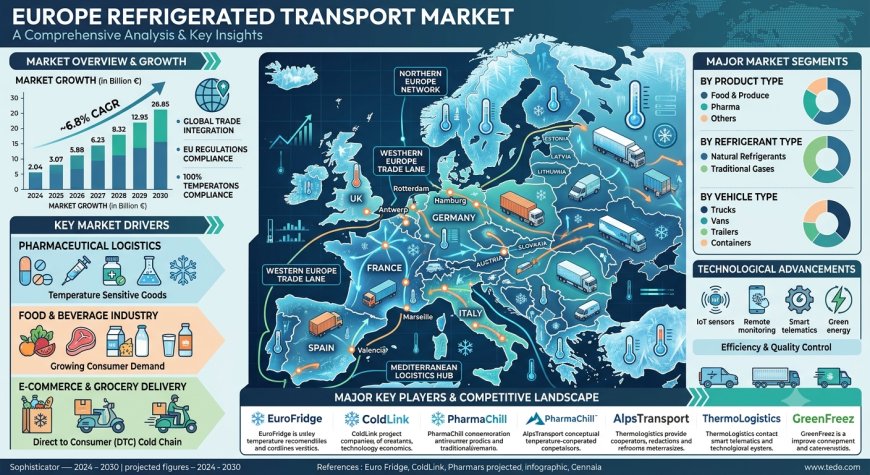
The Europe refrigerated transport market size reached USD 4,949.5 Million in 2025. Looking forward, IMARC Group expects the market to reach USD 7,108.8 Million by 2034, exhibiting a growth rate (CAGR) of 3.98% during 2026-2034. The market is driven by heightened demand for precise temperature control in pharmaceutical and meal-kit logistics, coupled with retailer net-zero commitments reshaping fleet specifications and route planning. The growing consumer preference for fresh and chilled food products, expansion of organised retail and e-commerce, and stringent EU food safety regulations mandating temperature-controlled transportation are also key drivers.
This market is strategically important to Europe's food security and pharmaceutical supply chain infrastructure, supporting the region's position as a global leader in cold chain logistics standards. The Europe refrigerated transport market encompasses refrigerated road transport, refrigerated sea transport, refrigerated rail transport, and refrigerated air transport, utilising vapour compression systems, air-blown evaporators, eutectic devices, and cryogenic systems across single-temperature and multi-temperature configurations, serving chilled food products (dairy, bakery and confectionery, fresh fruits and vegetables) and frozen food products (frozen dairy, processed meat, fish and seafood) across Germany, France, United Kingdom, Italy, Spain, and other European countries.
The Europe refrigerated transport market is poised for sustained expansion, underpinned by pharmaceutical cold chain requirements, sustainability mandates, and technology-driven cold chain visibility. With a projected CAGR of 3.98% through 2034, the market presents significant opportunities for providers focusing on IoT-enabled monitoring, low-GWP refrigerants, multi-temperature systems, and last-mile cold chain solutions.
EUROPE REFRIGERATED TRANSPORT MARKET SUMMARY
The Europe refrigerated transport market encompasses the provision of temperature-controlled transportation services and equipment designed to preserve the integrity of perishable goods including food products, pharmaceuticals, and other temperature-sensitive commodities across the cold chain.
The ecosystem spans refrigerated vehicle and trailer manufacturers, refrigeration system suppliers, telematics and monitoring technology providers, cold chain logistics operators, and food and pharmaceutical shippers serving customers across retail, food service, healthcare, and industrial sectors throughout Europe .
By Mode of Transportation, the market is segmented into Refrigerated Road Transport (dominating at 65.97% share in 2025), Refrigerated Sea Transport, Refrigerated Rail Transport, and Refrigerated Air Transport.
By Technology, the market serves Vapour Compression Systems (dominating), Air-Blown Evaporators, Eutectic Devices, and Cryogenic Systems.
By Temperature, the market serves Single-Temperature (dominating) and Multi-Temperature. Chilled products (0-5°C) represented 52.00% of the market in 2025.
By Application, the market serves Chilled Food Products (dominating, including Dairy Products, Bakery and Confectionery Products, Fresh Fruits and Vegetables) and Frozen Food Products (including Frozen Dairy Products, Processed Meat Products, Fish and Seafood Products).
By Country, the market serves Germany (dominating), France, United Kingdom, Italy, Spain, and Others.
Key trends shaping the market include IoT-enabled end-to-end cold chain visibility, booster immunisation campaigns driving pharmaceutical flows, EU F-Gas quota cuts raising low-GWP refrigerant prices, meal-kit and ready-to-cook subscription growth, and retailer net-zero targets accelerating fleet electrification.
PORTER'S FIVE FORCES ANALYSIS – EUROPE REFRIGERATED TRANSPORT MARKET
Competitive Rivalry: Moderate. The market features competition among global logistics providers including DHL, DB Schenker, Kuehne Nagel, DSV, Lineage, NewCold, and Americold alongside regional operators. Competition centres on temperature integrity, network coverage, technology capabilities, and sustainability credentials. The market is moderately consolidated, with leading players investing in automated high-bay facilities and connected cold chain platforms. Business implication: Companies must differentiate through technology-enabled visibility, sustainability performance, and service reliability.
Supplier Power (Equipment and Refrigerant Providers): Moderate to High. Operators rely on suppliers of refrigerated vehicles, trailers, refrigeration systems, and refrigerants. EU F-Gas Regulation 2024/573 is dramatically reducing hydrofluorocarbon availability, driving R452A prices toward USD 49 per kg versus USD 6-17 for natural CO2 or propane, with retrofit bills of USD 16,000-37,000 per truck for compliant systems. Business implication: Strategic partnerships with equipment suppliers and investment in natural refrigerant technologies can reduce long-term dependency and compliance risk.
Buyer Power (Retailers, Food Manufacturers, and Pharmaceutical Companies): High. Major supermarket chains, food manufacturers, and pharmaceutical companies leverage volume purchasing power to negotiate favourable terms. Buyers increasingly demand documented temperature compliance, real-time visibility, and sustainability reporting. Retailer net-zero commitments are pushing operators to electrify fleets and adopt low-GWP refrigerants. Business implication: Providers must demonstrate verifiable temperature integrity, data transparency, and alignment with buyer sustainability objectives.
Threat of Substitutes: Low. Refrigerated transport serves essential functions for perishable goods and pharmaceuticals that cannot be substituted by ambient transportation. Within the cold chain, alternative modes (rail, sea) compete for certain routes, but road transport remains indispensable for door-to-door service and last-mile delivery. Business implication: Demonstrating superior reliability, temperature control, and network flexibility is essential.
Threat of New Entrants: Moderate. Significant capital requirements for refrigerated fleets, compliance with EU regulations, and established shipper relationships create barriers. However, the growth of last-mile cold chain delivery and meal-kit subscriptions has enabled new entrants focused on urban micro-fulfilment and direct-to-consumer models. Business implication: Incumbents must leverage scale, network density, and technology capabilities while monitoring emerging niche players.
KEY ASPECTS REQUIRED FOR THE EUROPE REFRIGERATED TRANSPORT MARKET
Market Performance: USD 4,949.5 Million in 2025, projected to reach USD 7,108.8 Million by 2034, driven by pharmaceutical logistics, chilled food demand, and regulatory compliance.
Market Outlook: A 3.98% CAGR through 2034 reflects steady growth led by road transport, single-temperature systems, chilled food products, and German market dominance.
Growth Drivers: Heightened demand for precise temperature control in pharmaceutical and meal-kit logistics; retailer net-zero commitments; EU F-Gas quota cuts driving refrigerant transition; growing consumer demand for fresh and chilled foods; expansion of organised retail and e-commerce; stringent EU food safety regulations.
Competitive Landscape: A moderately consolidated market with global logistics providers and regional operators. Key players include DHL, DB Schenker, Kuehne Nagel, DSV, Lineage, NewCold, and Americold.
Value Chain Analysis: From refrigerated vehicle and equipment manufacturing through refrigerant supply, telematics integration, cold chain logistics operations, and last-mile delivery across food and pharmaceutical supply chains.
Industry Trends: IoT-enabled end-to-end cold chain visibility; natural refrigerant adoption under F-Gas phasedown; multi-temperature systems for mixed loads; electric and hybrid refrigerated vehicles; reusable packaging with embedded data-loggers; automated high-bay cold storage facilities.
Strategic Recommendations: Invest in IoT-enabled temperature monitoring and predictive analytics capabilities; transition to natural refrigerants including CO2 and ammonia for F-Gas compliance; expand multi-temperature fleet capabilities for mixed loads; pursue electric and hybrid refrigerated vehicle adoption for sustainability compliance; develop GDP-certified pharmaceutical logistics capabilities; strengthen presence in Germany and high-growth markets; adopt reusable packaging and data-logger solutions to reduce waste and costs.
Request for Sample Report: https://www.imarcgroup.com/europe-refrigerated-transport-market/requestsample
MARKET GROWTH DRIVERS
IoT-Enabled End-to-End Cold-Chain Visibility
5G-linked sensors now stream temperature, humidity, and location data across road, rail, sea, and air legs, cutting excursion incidents by up to 35% for fleets deploying platforms such as Carrier's Lynx Fleet. Insurance firms are rewarding documented visibility with 10-15% premium discounts, improving return on technology spend. European Good Distribution Practice rules for medicines mandate continuous monitoring, pushing IoT uptake beyond early adopters. Trailer builders are integrating telematics at the factory, evidenced by Schmitz Cargobull's Atlantis Global System purchase, which embeds tracking hardware into new reefers. Predictive analytics built on sensor streams now flag compressor faults before cargo risk escalates, trimming unplanned downtime by roughly a quarter.
Booster Immunization Campaigns Driving Pharma Flows
Continued COVID-19 and influenza booster programs, plus a surge of temperature-sensitive biologics, keep 2-8 °C lanes running near capacity. DHL has expanded GDP-certified hubs across Europe, adding validated storage zones to support multi-temperature breaks in transit. High-value GLP-1 drugs for diabetes and obesity therapy move under reinforced chain-of-custody protocols, justifying premium freight rates. Modal diversification is growing; stable products shift to ocean or rail to cut emissions, while cell and gene therapies stay in air corridors for speed. Reusable packaging with embedded data-loggers is gaining traction, cutting waste and slicing total packaging spend by nearly half over multi-cycle use.
EU F-Gas Quota Cuts Raising Low-GWP Refrigerant Prices
Regulation 2024/573 slashes hydrofluorocarbon availability by nearly 88% in 2027 and 95% in 2030, driving R452A prices toward USD 49 per kg (EUR 45) versus USD 6-17 for natural CO2 or propane. Operators face retrofit bills of USD 16,000-37,000 per truck to adopt compliant systems. Carrier has introduced surcharges to offset steep input costs, yet promises 89% lower climate impact with next-gen refrigerants. Capital strain is harshest on small haulers that run older fleets. The European Commission introduced a revised framework accelerating the mandatory transition to natural refrigerants like ammonia and carbon dioxide for new industrial refrigeration installations in March 2025.
Growth of Chilled and Convenience Food Demand
The market for refrigerated transport in the chilled food products segment is expanding, fueled by the rising consumer demand for fresh and quality foods, such as fruits, vegetables, dairy, and ready-to-eat meals. As consumers become increasingly health-conscious and aware of food safety, the requirement for reliable, temperature-controlled transport solutions for chilled items gains prominence. Along with this, the growth of organized retail and e-commerce platforms has also elevated the demand for efficient refrigerated transport services, particularly for last-mile deliveries. Additionally, urbanization and changing lifestyle patterns contribute to the consumption of convenience foods that require chilled transportation to maintain their quality and freshness.
Retailer Net-Zero Targets Accelerating Fleet Electrification
Major European supermarket chains are setting zero-emission vehicle delivery targets between 2030 and 2040, accelerating the phase-out of diesel from refrigerated fleets. This is driving investment in electric and hybrid refrigerated vehicles that reduce emissions and noise pollution while maintaining temperature integrity. Operators deploying battery electric vehicles (BEVs) and fuel cell electric vehicles (FCEVs) include DB Schenker with 1,540 BEVs and Petit Forestier Group with 1,000 BEVs. The shift toward sustainable refrigerated transport is supported by EU emissions reduction targets and corporate sustainability commitments, creating competitive advantages for operators with low-emission fleets.
EUROPE REFRIGERATED TRANSPORT MARKET SEGMENTATION
Segmentation analysis provides a detailed view of the Europe refrigerated transport market by category:
Mode of Transportation Insights: Road transport captured 65.97% of the Europe refrigerated transport market share in 2025, anchored by flexible door-to-door service for grocery and pharma shippers. Driver shortages, such as 426,000 vacancies in early 2025 and steep toll hikes, are eroding cost advantages, but embedded telematics and expanded direct-store routes keep trucks indispensable. Rail and sea gain share where carbon targets are stringent; the Brenner Base Tunnel is forecast to increase the corridor's daily train capacity by over 50% (accommodating up to 400 trains per day) once fully opened, drawing frozen protein flows from Northern ports to Italian retailers. Air freight, paced by 7.66% CAGR, channels high-value biologics that justify premium lift prices, especially out of pharma clusters in Frankfurt and Basel. The ascent of controlled-atmosphere reefers on short-sea lanes also eases pressure on congested roads, extending shelf life by an extra week for citrus and berries.
Technology Insights: Vapour compression systems dominate the Europe refrigerated transport market, representing the established standard technology for road, sea, and rail applications. Air-blown evaporators hold the largest share within technology segments, driven by the growing need for rapid and efficient cooling systems capable of maintaining precise temperature control. Eutectic devices serve niche applications including small delivery vehicles and specialised transports where passive cooling is advantageous. Cryogenic systems serve specialised applications requiring ultra-low temperatures, including pharmaceutical and biological transport.
Temperature Insights: Chilled products (0-5°C) represented 52.00% of the Europe refrigerated transport market in 2025, driven by the dominance of chilled dairy, ready-meal, and fresh produce handling in European retail, with Germany, UK, and France forming the core chilled-distribution corridor. Frozen products (-18-0°C) represent a significant segment, serving ice cream, frozen meats, seafood, and frozen ready meals. Multi-temperature systems enable the transport of mixed loads at different temperature requirements, driving efficiency for distributors serving diverse retail product categories.
Application Insights: Chilled food products hold the largest share of the Europe refrigerated transport market, driven by rising consumer demand for fresh and quality foods. Dairy products represent the leading sub-segment within chilled foods, underwritten by Europe's position as a leading dairy producer, with high-volume chilled milk, yogurt, cheese, and butter flows between Netherlands, Germany, France, and UK retail networks. Fresh fruits and vegetables constitute a major sub-segment, with year-round supply strategies extending cold-chain penetration. Bakery and confectionery products represent a growing application, with flash-freezing techniques allowing centralised par-bake production. Frozen food products represent a significant segment, including processed meat products, fish and seafood products, frozen dairy products, and other frozen foods. Fish and seafood maintains resilient demand as aquaculture output scales.
Country Insights: Germany exhibits clear dominance in the Europe refrigerated transport market, playing a significant role in driving the industry. As Europe's largest economy and a key player in international trade, Germany's strong industrial and commercial sectors contribute to high demand for refrigerated transport services. The country's central location in Europe and well-developed transportation infrastructure make it a strategic hub for the distribution of perishable goods across the continent. Germany is known for its efficient logistics networks and advanced supply chain management practices, which attract businesses from various industries. Additionally, Germany has a rapidly expanding food and beverage industry, which requires reliable and temperature-controlled transportation to ensure timely delivery of fresh and perishable products. The country's commitment to strict food safety regulations and quality standards further reinforces the need for efficient refrigerated transport services. France represents a significant market, with strong dairy, meat, and fresh produce sectors driving refrigerated transport demand. The United Kingdom constitutes a major market, with chilled food distribution across retail networks and pharmaceutical logistics supporting demand. Italy and Spain represent growing markets, with fresh produce exports, meat processing, and seafood distribution driving refrigerated transport requirements.
COMPETITIVE LANDSCAPE
The competitive landscape of the Europe refrigerated transport market features a moderately consolidated structure with global logistics providers, regional operators, and specialised cold chain companies competing across temperature-controlled transport services. Competition centres on temperature integrity, network coverage, technology capabilities, and sustainability credentials. Key players including DHL, DB Schenker, Kuehne Nagel, DSV, Lineage, NewCold, and Americold maintain strong positions through extensive networks, advanced facilities, and technology investments. Regional operators compete through local expertise, flexible service models, and specialised capabilities. The market is characterised by ongoing investment in automated high-bay facilities, connected cold chain platforms, and low-GWP refrigerant technologies.
DHL International GmbH is a global logistics leader with extensive European cold chain operations, offering GDP-certified hubs, temperature-controlled transport, and specialised pharmaceutical logistics. DHL has expanded its Life Sciences & Healthcare campus in Florstadt, Germany, transforming the facility into a European pharmaceutical hub with multiple temperature zones including capability for cooling to -70°C.
DB Schenker AG is a major European logistics provider with extensive cold chain capabilities. In February 2023, DB Schenker AG negotiated with MSC Mediterranean Shipping Company to adopt 12,000 tons of biofuel components across all its consolidated cargo, LCL, FCL, and refrigerated container operations.
Kuehne Nagel Management AG is a global logistics company with significant European cold chain operations, offering temperature-controlled transport and warehousing for food and pharmaceutical customers.
Lineage Logistics Holdings, LLC is a leading cold storage and logistics provider with extensive European operations. In February 2025, Lineage Logistics completed the expansion of its automated facility in Aarhus, Denmark, to enhance the seafood export capabilities of the region. In May 2025, Lineage completed construction of a next-generation automated cold storage hub in Northern Germany, featuring hydrogen-powered backup systems for zero-emission resilience.
NewCold Cooperatief U.A. is a major cold chain logistics provider with automated high-bay facilities across Europe, serving food manufacturers and retailers with temperature-controlled storage and distribution.
Americold Realty Trust, Inc. is a global cold storage operator with European operations, offering temperature-controlled warehousing and distribution services.
Other key players include DSV AS, GEODIS, WILMS Transport GmbH, Pfenning Logistics, and specialised refrigerated transport operators serving regional and pan-European routes.
Recent Developments:
February 2025: Lineage Logistics completed the expansion of its automated facility in Aarhus, Denmark, to enhance seafood export capabilities.
March 2025: The European Commission introduced a revised framework accelerating the mandatory transition to natural refrigerants like ammonia and carbon dioxide for new industrial refrigeration installations.
April 2025: AP Moller Maersk AS inaugurated a state-of-the-art cold storage facility in the port of Rotterdam, which utilizes advanced carbon dioxide refrigeration systems to reduce environmental impact.
May 2025: Lineage completed construction of a next-generation automated cold storage hub in Northern Germany, featuring hydrogen-powered backup systems for zero-emission resilience.
Investment opportunities exist in IoT-enabled cold chain visibility, natural refrigerant transitions, multi-temperature fleet expansion, electric refrigerated vehicles, and automated cold storage facilities.
REGIONAL ANALYSIS
Germany dominates the Europe refrigerated transport market, playing a significant role in driving the industry. As Europe's largest economy and a key player in international trade, Germany's strong industrial and commercial sectors contribute to high demand for refrigerated transport services. The country's central location in Europe and well-developed transportation infrastructure make it a strategic hub for the distribution of perishable goods across the continent. Germany is known for its efficient logistics networks and advanced supply chain management practices, which attract businesses from various industries to establish their operations in the country. Additionally, Germany has a rapidly expanding food and beverage industry, which requires reliable and temperature-controlled transportation to ensure the timely delivery of fresh and perishable products. The country's commitment to strict food safety regulations and quality standards further reinforces the need for efficient refrigerated transport services. Germany is set to lead regional growth, reflecting cold storage capacity expansion by NewCold and Lineage and strong activity around EU Farm to Fork food waste reduction policy.
France represents a significant market, with strong dairy, meat, and fresh produce sectors driving refrigerated transport demand. The country's position as a major agricultural producer and food exporter supports substantial cold chain requirements. French retailers' net-zero commitments are accelerating fleet electrification and natural refrigerant adoption.
The United Kingdom constitutes a major market, with chilled food distribution across retail networks and pharmaceutical logistics supporting demand. Post-Brexit trade flows have created additional cold chain complexity, with border checks and customs procedures requiring temperature-controlled logistics solutions. The UK's pharmaceutical sector and food retail networks drive sustained refrigerated transport demand.
Italy and Spain represent growing markets, with fresh produce exports, meat processing, and seafood distribution driving refrigerated transport requirements. Italy's position as a major exporter of fresh fruits and vegetables, particularly to Northern European markets, supports substantial refrigerated transport demand. Spain's expanding agricultural exports, including citrus, berries, and vegetables, create growing cold chain requirements. Both markets benefit from investments in cold storage capacity and fleet modernisation.
Other European markets including Netherlands, Belgium, Poland, and Nordic countries collectively contribute to the Europe refrigerated transport market. The Netherlands serves as a major cold chain hub, with Rotterdam port handling substantial refrigerated container traffic. Belgium's central location and logistics infrastructure support cold chain distribution. Poland's growing food processing sector and position as a gateway to Eastern European markets create refrigerated transport demand. Nordic countries maintain high cold chain standards and sustainability requirements, driving adoption of advanced technologies.
RECENT INDUSTRY DEVELOPMENTS
2026 Activity: The Europe refrigerated transport market continued its growth trajectory from USD 4,949.5 Million in 2025 toward USD 7,108.8 Million by 2034 at a CAGR of 3.98% .
May 2025: Lineage completed construction of a next-generation automated cold storage hub in Northern Germany, featuring hydrogen-powered backup systems for zero-emission resilience.
April 2025: AP Moller Maersk AS inaugurated a state-of-the-art cold storage facility in the port of Rotterdam, which utilizes advanced carbon dioxide refrigeration systems to reduce environmental impact.
March 2025: The European Commission introduced a revised framework accelerating the mandatory transition to natural refrigerants like ammonia and carbon dioxide for new industrial refrigeration installations.
February 2025: Lineage Logistics completed the expansion of its automated facility in Aarhus, Denmark, to enhance seafood export capabilities.
FREQUENTLY ASKED QUESTIONS
Q1: What is the current size of the Europe refrigerated transport market?
A: The Europe refrigerated transport market reached USD 4,949.5 Million in 2025 and is projected to reach USD 7,108.8 Million by 2034, exhibiting a CAGR of 3.98% from 2026-2034 .
Q2: What are the key drivers of the Europe refrigerated transport market?
A: The market is driven by: (i) heightened demand for precise temperature control in pharmaceutical and meal-kit logistics; (ii) retailer net-zero commitments; (iii) EU F-Gas quota cuts driving refrigerant transition; (iv) growing consumer demand for fresh and chilled foods; (v) expansion of organised retail and e-commerce; and (vi) stringent EU food safety regulations.
Q3: What are the major modes of transportation in the Europe refrigerated transport market?
A: Major modes of transportation include Refrigerated Road Transport (dominating at 65.97% share), Refrigerated Sea Transport, Refrigerated Rail Transport, and Refrigerated Air Transport.
Q4: What are the major applications in the Europe refrigerated transport market?
A: Major applications include Chilled Food Products (dominating, including Dairy Products, Bakery and Confectionery Products, Fresh Fruits and Vegetables) and Frozen Food Products (including Frozen Dairy Products, Processed Meat Products, Fish and Seafood Products).
Q5: Which country leads the Europe refrigerated transport market?
A: Germany dominates the Europe refrigerated transport market, driven by its strong economy, central European location, well-developed transportation infrastructure, and expanding food and beverage industry.
Q6: Who are the major players in the Europe refrigerated transport market?
A: Major players include DHL, DB Schenker, Kuehne Nagel, DSV, Lineage, NewCold, Americold, and regional operators across Europe.
Q7: What are the challenges facing the Europe refrigerated transport market?
A: Key challenges include driver shortages (426,000 vacancies in early 2025), EU F-Gas compliance costs (retrofit bills of USD 16,000-37,000 per truck), high fuel and energy prices, capital requirements for natural refrigerant transitions, and cross-border regulatory complexity.
Q8: What is the outlook for the Europe refrigerated transport market?
A: The market is projected to grow at a 3.98% CAGR through 2034, with growth driven by pharmaceutical cold chain requirements, sustainability mandates, and technology-driven cold chain visibility. The shift toward IoT-enabled monitoring, natural refrigerants, multi-temperature systems, and electric refrigerated vehicles are expected to shape the market's evolution .
Note: If you need any specific information that is not covered currently within the scope of the report, we will provide the same as a part of customization.
https://www.imarcgroup.com/request?type=report&id=2628&flag=E
Report Format, Delivery, and Customization Details
Report Format Mode: PPT, PDF, and Excel
Report Delivery Mode: Online Delivery, Physical Delivery
Report Delivery Time: Report Delivered Over Email within 24 to 48 hours. If requested by the client, a physical copy will be delivered within three to ten days.
Report Confirmation Mode: Yes via Email
Report Customization Mode: Yes via Email / Call
Report Table of Content: Yes
Report List of Figures: Yes
Report Methodology Mode: Yes
Request For Sample Report: Yes
What's Your Reaction?