




























Portable LIBS Spectrometer LIS-02, Carbon Detection Spectrometer
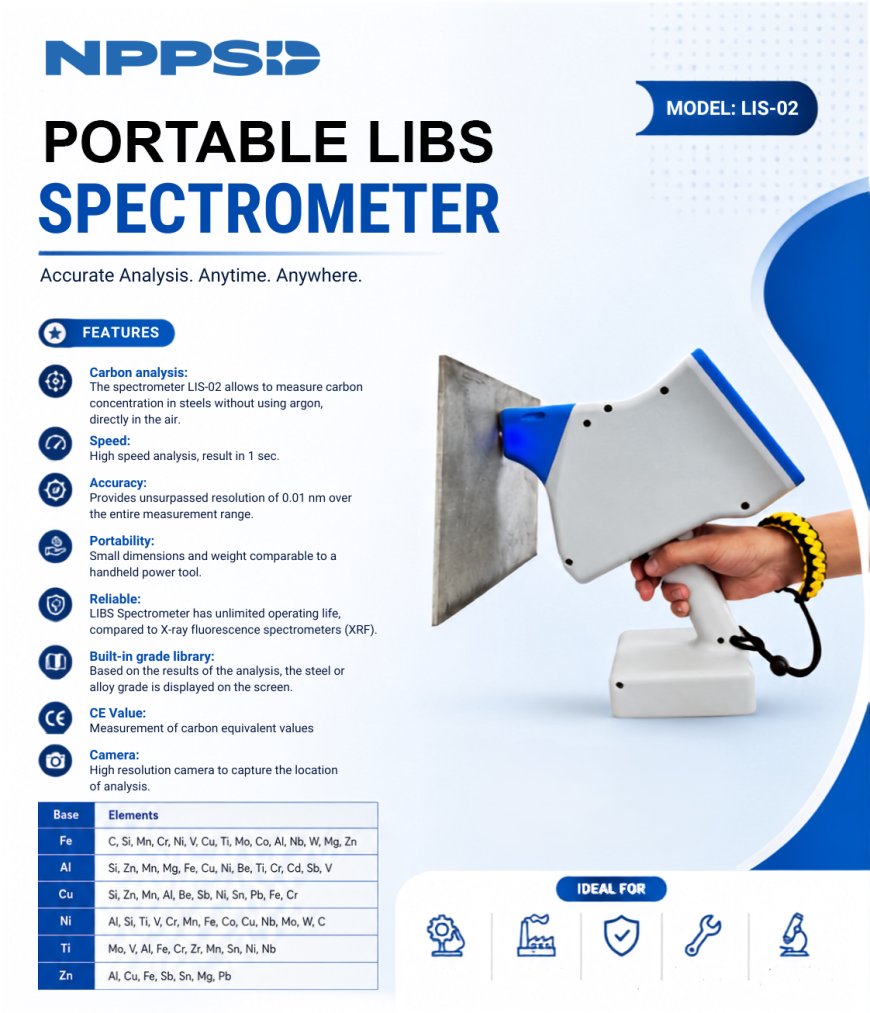
Portable LIBS Spectrometer LIS-02 deducts the carbon without use of argon gas in one second. It is Fast, precise metal analyzer.

Portable LIBS Spectrometer LIS-02, Carbon Detection
Spectrometer
The Portable LIBS Spectrometer LIS-02 is a compact instrument designed for rapid elemental analysis of metals and alloys. It uses Laser-Induced Breakdown Spectroscopy (LIBS) to identify material composition and supports carbon detection in steel without the use of argon gas. For professionals involved in metal inspection, automotive manufacturing, aerospace, fabrication, and quality control, portable elemental analysis can make material verification faster and more practical.
What Is a Portable LIBS Spectrometer?
A Portable LIBS Spectrometer uses a focused laser to create a small plasma on the surface of a material. The plasma emits light containing information about the elements present in that material. The instrument analyses this light and provides elemental information.
The main advantage of a portable system is simple: the equipment can be taken to the component. This is useful when a part is large, heavy, installed, or difficult to transport to a laboratory.
For inspection professionals, this can reduce unnecessary sample handling and support quicker decisions during material verification.
Portable LIBS Spectrometer LIS-02 for Carbon Detection
Carbon is an important element when identifying and differentiating many steel grades. Even when two components look similar, their chemical composition may differ significantly.
The Portable LIBS Spectrometer LIS-02 is designed to support carbon detection in steel without argon gas. This makes the instrument suitable for certain field-based applications where carrying or managing an argon supply would be inconvenient.
Rapid carbon analysis can help inspection teams gather useful information when checking steel composition and verifying materials against specified requirements.
How Does the LIS-02 Work?
The measurement process uses LIBS technology and can be understood in a few basic steps:
-
The operator positions the instrument on the material surface.
-
A laser pulse interacts with the surface.
-
A small plasma is produced.
-
The plasma emits characteristic light.
-
The spectrometer records and analyses the emitted light.
-
The system provides elemental information based on the measured spectrum.
Although the process is fast, good measurement practice still matters. Surface condition, material type, calibration, measurement procedure, and operator technique can affect analytical results.
Applications of a Portable LIBS Spectrometer
The versatility of portable elemental analysis makes it relevant to several industrial applications.
Steel and Metal Manufacturing
Manufacturers can use elemental analysis for material verification, alloy identification, incoming inspection, production checks, and quality-control activities.
When raw materials arrive at a facility, portable testing can provide an additional verification step before the material enters production.
Automotive Industry
Automotive manufacturing involves numerous steel and alloy grades. A Portable LIBS Spectrometer can support material checks on components and raw materials where rapid identification is required.
Its portable format is useful when parts cannot easily be moved from their production or inspection location.
Aerospace Industry
Aerospace components require controlled material specifications. Portable elemental analysis can support inspection teams when they need composition information directly at the component.
The exact testing procedure should always follow the organization's quality requirements and applicable technical standards.
Fabrication and Engineering
Fabrication companies often work with different grades of steel, stainless steel, aluminium, and other alloys.
A portable instrument can help identify unknown materials and support alloy verification before fabrication, repair, maintenance, or installation.
Portable LIBS Spectrometer for PMI
Positive Material Identification, commonly called PMI, involves verifying the composition or grade of metallic materials.
A PMI Machine can use different analytical technologies depending on the application. LIBS is one technology that can support PMI-related inspection when its capabilities match the required testing conditions.
Before selecting an instrument, professionals should consider:
-
Required elements
-
Material types
-
Measurement environment
-
Detection requirements
-
Required measurement speed
-
Surface condition
-
Applicable inspection procedures
-
Required documentation and reporting
This ensures that equipment selection is based on actual inspection requirements rather than simply choosing a portable instrument.
Key Benefits of LIS-02
The Portable LIBS Spectrometer LIS-02 is designed around practical requirements for rapid metal analysis.
Rapid Elemental Analysis
Fast measurements can help inspection teams obtain composition information without waiting for every sample to reach a laboratory.
Portable Operation
The compact format allows users to bring the instrument directly to large or difficult-to-move components.
Carbon Detection
The ability to support carbon detection in steel without argon gas is particularly relevant for certain field inspection applications.
Multi-Element Analysis
LIBS technology can provide information about multiple elements, depending on the instrument configuration, material, and application.
Industrial Use
Portable elemental analysis can support inspection, quality control, material verification, and alloy identification across different industrial environments.
Why Training Matters When Using LIBS Equipment
Using analytical equipment effectively involves more than pressing a measurement button. Operators need to understand the instrument, prepare the measurement surface correctly, follow appropriate procedures, and interpret results within the context of the material specification.
Practical training can help professionals understand:
-
Basic LIBS principles
-
Material preparation
-
Measurement procedures
-
Elemental analysis
-
Result interpretation
-
Common inspection considerations
-
Quality-control workflows
For technical professionals, combining equipment knowledge with practical inspection experience can make training more useful in real industrial environments.
Choosing the Right Portable LIBS Spectrometer
Before investing in a Portable LIBS Spectrometer, define the intended application first.
Ask the following questions:
What materials will be tested?
Steel, aluminium, copper, nickel alloys, and other materials can have different analytical requirements.
Which elements matter?
Carbon may be critical for one application, while chromium, nickel, molybdenum, manganese, or other elements may be more important for another.
Where will measurements take place?
A production floor, workshop, outdoor site, or maintenance location may present different operating conditions.
How quickly are results required?
For high-volume inspection, measurement speed can have a direct effect on workflow efficiency.
What level of operator training is available?
Users should understand the measurement procedure and limitations of the technology.
Real-World Example: Checking an Unidentified Metal Part
Imagine an engineering facility receives a batch of metal components with incomplete identification information.
The components look similar, but the inspection team needs to determine whether their composition is consistent with the specified material grade.
A suitable portable elemental-analysis instrument can allow the team to examine the components at the facility. The operator prepares the surface, performs the measurement, reviews the elemental information, and compares the result with the required specification.
If the result raises a concern, the organization can proceed with additional investigation or confirmatory testing.
This illustrates an important point: portable analysis is most useful when it forms part of a well-defined inspection process.
Portable LIBS Spectrometer LIS-02: Industrial Value
For organizations handling metal components across multiple locations, portability can be an important practical advantage.
Instead of designing every inspection workflow around laboratory testing, teams can use appropriate portable analysis methods when the application permits. This can help reduce unnecessary movement of components and provide elemental information closer to the point of work.
However, every measurement technology has an appropriate scope. The final testing method should always be selected according to material requirements, technical specifications, inspection procedures, and the level of confidence required.
Frequently Asked Questions
What is a Portable LIBS Spectrometer?
A Portable LIBS Spectrometer is a field-oriented analytical instrument that uses Laser-Induced Breakdown Spectroscopy to determine the elemental composition of materials.
What is the LIS-02 used for?
The LIS-02 is designed for rapid elemental analysis of metals and alloys. It can support applications such as material identification, alloy verification, quality control, and PMI-related inspection.
Can the LIS-02 detect carbon in steel?
Yes. The LIS-02 is designed to support carbon detection in steel without using argon gas during measurement.
Can LIBS be used for PMI?
LIBS can support PMI-related material identification when the instrument's capabilities and testing procedure meet the specific requirements of the application.
Which industries can use a Portable LIBS Spectrometer?
Potential applications include steel manufacturing, automotive production, aerospace, fabrication, engineering, maintenance, material inspection, and quality control.
Conclusion
The Portable LIBS Spectrometer LIS-02 offers a practical approach to rapid elemental analysis of metals and alloys. Its portable design allows professionals to perform measurements closer to the component, while its carbon-detection capability without argon gas can be valuable for appropriate steel-inspection applications.
For professionals in metal, automotive, aerospace, fabrication, and engineering sectors, understanding both the technology and its practical limitations is essential. With suitable procedures and operator training, a Portable LIBS Spectrometer can become a useful part of a modern material-inspection workflow.
NPP Strukturnaya Diagnostika Pvt. Ltd. provides technical knowledge and practical guidance for professionals working with material inspection and analysis. Contact NPPSD to learn more about the Portable LIBS Spectrometer LIS-02, its applications, and relevant technical training.
What's Your Reaction?