































Customer Satisfaction Survey: Measuring Customer Experiences and Building Stronger Relationships
Discover how Customer Satisfaction Survey Services help businesses measure customer experiences, understand feedback, and improve customer relationships.
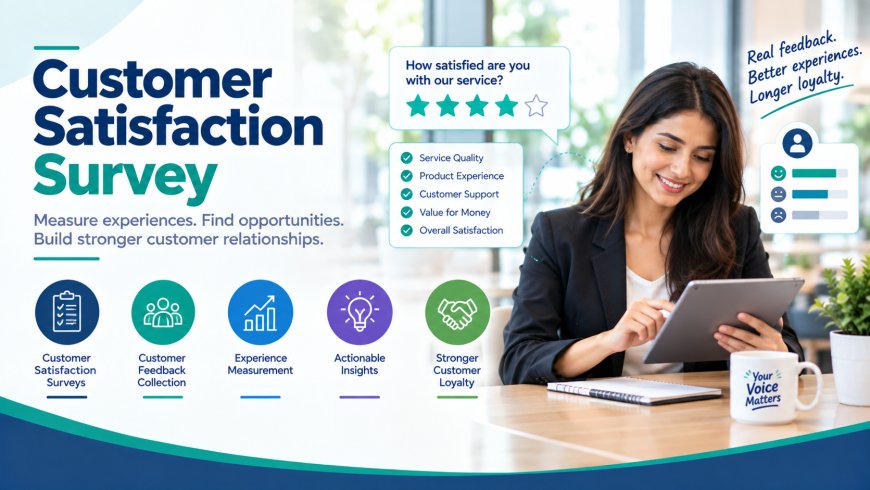
Customer satisfaction plays an important role in how people perceive a business, evaluate its products, and decide whether to continue using its services. Customers develop opinions through multiple interactions, including product purchases, customer support, service delivery, and after-sales experiences. Understanding these opinions can help organizations identify what they are doing well and where improvements may be needed.
A Customer Satisfaction Survey provides businesses with a structured way to collect feedback directly from customers. It helps organizations understand whether their products and services meet expectations, identify areas of dissatisfaction, and evaluate the overall customer experience.
Whether a company wants to improve service quality, understand customer concerns, evaluate a new offering, or strengthen customer relationships, satisfaction surveys can provide valuable information for decision-making. By collecting and analysing customer feedback systematically, businesses can make improvements based on actual customer experiences rather than assumptions.
What Is a Customer Satisfaction Survey?
A Customer Satisfaction Survey is a research method used to collect feedback from customers about their experiences with a company's products, services, and interactions. It generally uses structured questions to understand customer perceptions, expectations, and satisfaction levels.
The survey may investigate different aspects of the customer journey, such as product quality, pricing, purchasing convenience, delivery, communication, and customer support.
For example, a retail business may ask customers to evaluate their shopping experience, while a service provider may investigate response times, issue resolution, and the quality of customer assistance.
The questions are designed around specific research objectives, allowing organizations to understand how customers evaluate different aspects of their experience.
A well-designed survey does more than collect ratings. It can also provide explanations behind customer opinions through open-ended questions, helping businesses understand why customers are satisfied or dissatisfied.
Why Are Customer Satisfaction Survey Services Important?
Customer expectations continue to influence how businesses compete and maintain relationships with their audiences. Organizations that regularly understand customer feedback can identify potential issues and respond more effectively.
Customer Satisfaction Survey Services help businesses collect structured information that supports several important activities.
1. Understanding Customer Expectations
Customers evaluate products and services according to their individual needs. Surveys help organizations understand what customers expect and whether their experiences align with those expectations.
2. Identifying Areas of Dissatisfaction
Feedback can reveal problems that may not be immediately visible through internal performance reports. Customers may highlight difficulties with product functionality, communication, delivery, or service responsiveness.
3. Improving Products and Services
Customer opinions can help businesses identify which features are appreciated and which areas require improvement. This information can support product updates, service modifications, and operational decisions.
4. Monitoring Customer Experience
Customer experiences involve several interactions across different channels. Satisfaction surveys can help organizations evaluate these touchpoints and identify where the customer journey may need attention.
5. Supporting Customer Retention
Understanding dissatisfaction can help businesses recognize potential reasons customers may reduce their engagement or consider alternatives. Addressing relevant concerns can support stronger customer relationships.
6. Making Evidence-Based Decisions
Instead of relying only on internal assumptions, businesses can use structured customer feedback to understand how their offerings are perceived. This provides a more informed foundation for improvement initiatives.
Key Types of Customer Satisfaction Research
Customer Satisfaction Research can cover different aspects of the customer relationship. The appropriate survey approach depends on what an organization wants to measure and which interactions it wants to evaluate.
Product Satisfaction Surveys
These surveys evaluate how customers perceive a product's quality, features, usability, performance, and overall value.
They can help businesses understand whether a product meets customer requirements and identify opportunities for improvement.
Service Satisfaction Surveys
Service satisfaction surveys focus on the quality of assistance and service delivery. They may examine employee behaviour, response time, communication, issue resolution, and service accessibility.
Post-Purchase Satisfaction Surveys
These surveys collect feedback after a customer completes a purchase. They can investigate the buying experience, product expectations, delivery process, and initial product impressions.
Customer Support Satisfaction Surveys
Customer support surveys evaluate how customers perceive their interactions with support teams. They may assess the helpfulness of representatives, ease of communication, response quality, and effectiveness of issue resolution.
Relationship Satisfaction Surveys
Relationship-focused surveys examine the customer's overall perception of a business rather than a single transaction. They can explore trust, perceived value, brand experience, and the likelihood of continuing the relationship.
How to Design an Effective Customer Feedback Survey
The usefulness of a Customer Feedback Survey depends largely on how well its questions are designed. A survey should be clear, relevant, and aligned with the information the organization needs.
1. Define the Survey Objectives
- Before preparing questions, businesses should identify what they want to understand.
- For example, a company may want to evaluate product satisfaction, understand service complaints, measure customer support performance, or explore the overall customer relationship.
- Clear objectives help prevent unnecessary questions and keep the survey focused.
2. Identify the Target Respondents
- The next step is to determine which customers should participate.
- Depending on the objectives, respondents may include recent buyers, long-term customers, users of a particular product, or individuals who recently interacted with a support team.
- The target audience should reflect the customer experience being investigated.
3. Choose the Right Question Format
Different question formats collect different types of information. Common options include:
-
Rating-scale questions to measure satisfaction levels.
-
Multiple-choice questions to identify specific preferences.
-
Yes-or-no questions for straightforward feedback.
-
Open-ended questions to understand customer opinions in their own words.
-
Follow-up questions to explore particular experiences.
A combination of structured and open-ended questions can provide both measurable feedback and useful context.
4. Keep the Survey Clear and Relevant
- Questions should be easy to understand and avoid unnecessary complexity. Long surveys can make participation difficult, so businesses should prioritize questions that directly support the research objectives.
- Questions should also remain neutral to avoid influencing customer responses.
5. Select Appropriate Survey Channels
- Surveys can be distributed through different channels, depending on customer preferences and the nature of the interaction.
- Common options include email surveys, online questionnaires, website surveys, mobile surveys, and telephone-based feedback collection.
6. Collect and Review Responses
- Once the survey is distributed, responses should be reviewed for completeness and consistency. Appropriate data quality checks help identify incomplete submissions and other issues that may affect analysis.
7. Analyse Findings and Identify Improvement Areas
- The final stage involves reviewing customer responses to identify satisfaction patterns, recurring concerns, and differences between customer groups.
- The findings should be interpreted in relation to the original objectives so that businesses can identify relevant improvement priorities.
Important Customer Satisfaction Metrics
Customer Satisfaction Measurement involves evaluating customer feedback through defined metrics. These measures help organizations understand different aspects of customer perceptions and experiences.
Customer Satisfaction Score (CSAT)
- Customer Satisfaction Score measures how satisfied customers are with a particular product, service, or interaction.
- Customers are generally asked to rate their satisfaction using a predefined scale. The organization can then calculate the percentage of respondents who selected the satisfaction categories it has defined.
- CSAT is particularly useful for evaluating specific touchpoints, such as a purchase, delivery, or customer support interaction.
Net Promoter Score (NPS)
- Net Promoter Score measures customers' willingness to recommend a company, product, or service to others.
- Respondents are asked to rate their likelihood of recommending the business on a scale from 0 to 10. Based on their answers, they are categorized as promoters, passives, or detractors.
- NPS provides a perspective on customer advocacy and overall relationship strength.
Customer Effort Score (CES)
- Customer Effort Score evaluates how easy or difficult it is for customers to complete a particular task or resolve an issue.
- It can be useful for understanding experiences involving customer support, account management, purchases, and other service interactions.
Customer Retention
- Customer retention measures whether customers continue their relationship with a business over a defined period.
- Although retention is influenced by several factors, satisfaction feedback can help organizations understand experiences that may contribute to continued engagement or customer departure.
- These metrics provide different perspectives and should be selected according to the organization's research objectives rather than treated as interchangeable measures.
Customer Experience Survey vs. Customer Satisfaction Survey
Customer Experience Survey and Customer Satisfaction Survey approaches are closely related, but they generally focus on different aspects of the customer relationship.
A Customer Satisfaction Survey typically measures how customers evaluate a particular product, service, or interaction. A Customer Experience Survey examines the broader journey across multiple touchpoints.
| Comparison Area | Customer Satisfaction Survey | Customer Experience Survey |
|---|---|---|
| Main focus | Satisfaction with products, services, or interactions | Overall customer journey |
| Research scope | Specific experiences or touchpoints | Multiple stages of customer interaction |
| Typical questions | How satisfied were you with the service? | How easy was your overall experience? |
| Evaluation | Customer perceptions and satisfaction levels | Journey consistency and interaction quality |
| Application | Identifying satisfaction gaps | Improving the wider customer experience |
Both approaches can complement each other. Satisfaction surveys can identify how customers feel about individual interactions, while experience surveys help businesses understand how those interactions connect throughout the customer journey.
The Role of Customer Loyalty Research in Satisfaction Measurement
Customer satisfaction and customer loyalty are related, but they are not the same. A customer may be satisfied with a particular purchase without necessarily choosing the same brand again.
Customer Loyalty Research helps businesses understand the factors that influence repeat purchases, continued engagement, and long-term customer relationships.
Satisfaction surveys can contribute to loyalty research by exploring:
-
Customer trust and confidence in the brand.
-
Perceived product and service value.
-
Reasons for repeat purchases.
-
Factors that may encourage customers to switch brands.
-
Experiences that strengthen or weaken customer relationships.
-
Customer willingness to recommend the business.
By examining these areas, organizations can better understand how customer experiences relate to loyalty and retention.
Common Challenges in Customer Satisfaction Measurement
Although surveys provide valuable feedback, collecting useful information requires careful research planning and execution.
- Low response rates: Customers may not participate if surveys are too long, poorly timed, or difficult to complete.
- Poorly designed questions: Ambiguous or leading questions can influence responses and reduce the usefulness of collected information.
- Limited respondent representation: If the survey reaches only a particular customer group, findings may not reflect the wider audience the organization wants to understand.
- Response bias: Some respondents may provide answers influenced by recent experiences, personal expectations, or a desire to give socially acceptable responses.
- Overdependence on numerical scores: Satisfaction ratings alone may not explain why customers feel a certain way. Open-ended feedback can provide additional context.
- Difficulty translating findings into action: Collecting feedback is only one part of the process. Organizations also need to interpret findings and identify practical improvement areas.
Addressing these challenges through clear survey design, appropriate respondent selection, structured data collection, and careful analysis can improve the quality of customer satisfaction research.
How to Choose the Right Customer Satisfaction Research Provider
Selecting an appropriate research partner can help organizations design effective surveys and collect relevant customer feedback.
Businesses should consider the following factors when evaluating a provider.
Understanding of Research Objectives
The provider should understand what the organization wants to measure and how the findings will support business decisions.
Survey Design Expertise
A suitable research partner should be able to develop clear, neutral, and relevant questions that reflect the study objectives.
Respondent Recruitment Capabilities
Reaching the right customers is important for collecting relevant information. The provider should understand the target audience and associated eligibility requirements.
Data Collection and Quality Processes
Structured fieldwork and appropriate data quality checks help maintain consistency and identify issues that could affect research findings.
Qualitative and Quantitative Research Capabilities
Quantitative surveys can measure satisfaction patterns, while qualitative research can explore customer opinions in greater depth. The ability to support both approaches can be valuable for broader research requirements.
Industry and Market Understanding
Customer expectations differ across industries and markets. A research partner should be able to align its approach with the relevant customer environment and business requirements.
How IMARC Pulse Supports Customer Satisfaction Research
IMARC Pulse specializes in primary research and global fieldwork, helping organizations connect with the people who shape their markets. The company provides respondent recruitment, quantitative and qualitative fieldwork, data collection, and research quality services across industries and global markets.
Its research approach combines rigorous fieldwork and verified data to deliver reliable insights that support informed business decisions.
For organizations conducting customer satisfaction research, reaching relevant respondents and maintaining data quality are important parts of the research process. IMARC Pulse's focus on respondent recruitment, quantitative and qualitative fieldwork, data collection, and research quality supports organizations in managing their primary research requirements.
By aligning research activities with defined objectives and audience requirements, businesses can collect relevant customer feedback to better understand experiences, expectations, and perceptions.
Conclusion
A Customer Satisfaction Survey provides organizations with a structured way to understand how customers evaluate their products, services, and interactions. By collecting feedback directly from customers, businesses can identify satisfaction gaps, explore expectations, and recognize opportunities to improve the overall experience.
From product satisfaction and customer support to broader relationship evaluation, survey research can support a wide range of business objectives. However, its effectiveness depends on clear objectives, relevant questions, suitable respondent selection, and reliable data collection.
When customer feedback is regularly evaluated and connected to meaningful improvement activities, organizations can develop a better understanding of their audiences and build stronger customer relationships.
Frequently Asked Questions (FAQs)
1. What is a Customer Satisfaction Survey?
A Customer Satisfaction Survey is a structured questionnaire used to collect feedback about customers' experiences with a company's products, services, or interactions. It helps organizations understand satisfaction levels, identify concerns, and evaluate customer perceptions.
2. What are the benefits of Customer Satisfaction Survey Services?
Customer Satisfaction Survey Services help businesses understand customer expectations, identify dissatisfaction, evaluate service quality, collect product feedback, and recognize opportunities to improve customer experiences.
3. What is the difference between a Customer Feedback Survey and a Customer Satisfaction Survey?
A Customer Feedback Survey is a broad approach to collecting customer opinions, suggestions, and comments. A Customer Satisfaction Survey specifically focuses on understanding how satisfied customers are with particular products, services, or experiences.
4. Which metrics are used for Customer Satisfaction Measurement?
Common metrics include Customer Satisfaction Score (CSAT), Net Promoter Score (NPS), and Customer Effort Score (CES). Each measures a different aspect of the customer relationship and should be selected according to the research objectives.
5. How often should businesses conduct customer satisfaction surveys?
Survey frequency depends on the business model, customer interaction patterns, and research objectives. Organizations may collect feedback after specific interactions or conduct periodic surveys to monitor customer perceptions over time.
6. How does Customer Satisfaction Research support customer loyalty?
Customer Satisfaction Research helps businesses understand what customers value, where their expectations are not being met, and which experiences influence their relationship with a brand. These findings can support improvements that contribute to stronger customer relationships and retention.
What's Your Reaction?