











Australia Luxury Fashion Market 2026 | Projected to Reach USD 6.84 Billion by 2034
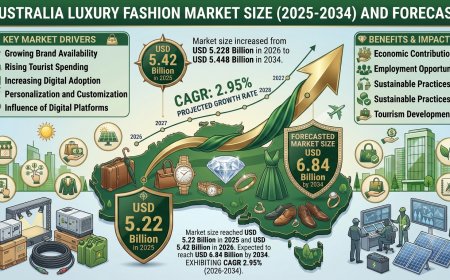
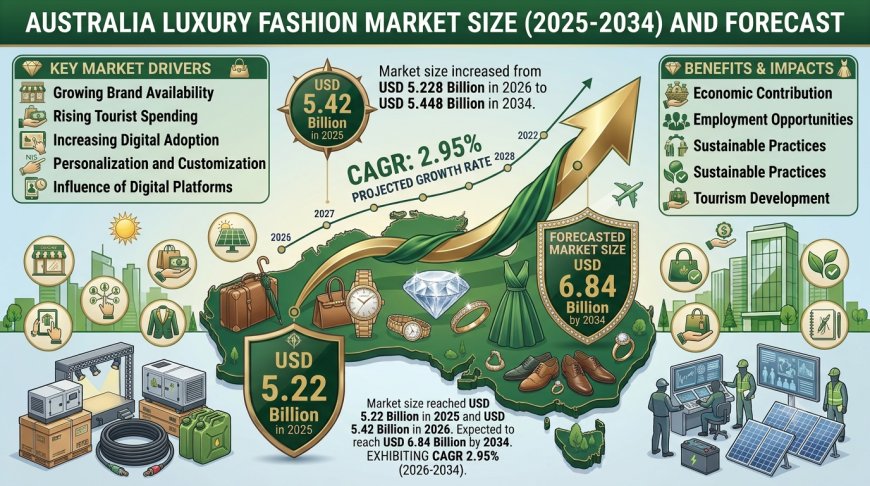
Australia luxury fashion market grew from USD 5.22 Billion in 2025 to USD 5.42 Billion in 2026 and is projected to reach USD 6.84 Billion by 2034, growing at a CAGR of 2.95% during 2026-2034.

Market Overview
The Australia luxury fashion market grew from USD 5.22 Billion in 2025 to USD 5.42 Billion in 2026 and is projected to reach USD 6.84 Billion by 2034, growing at a CAGR of 2.95% during 2026-2034. Rising disposable incomes, expanding high-net-worth individuals, digital luxury retail growth, and Australia's per capita GDP in 2025 exceeding USD 65,130, a 0.8% increase from 2024, are key demand enablers.
The Australia luxury fashion market covers the design, production, distribution, and retail of premium clothing, footwear, and accessories through branded boutiques, department store concessions, and digital platforms, serving high-net-worth individuals, aspirational professionals, and international tourists across Australia Capital Territory & New South Wales, Victoria & Tasmania, Queensland, Western Australia, and Northern Territory & Southern Australia. Australia's per capita GDP exceeding USD 65,130 in 2025 underpins one of the Asia-Pacific region's highest luxury spending capacities, positioning the country as a strategic priority market for global luxury fashion brands, with key enablers including smartphone penetration, high urban luxury retail density in Sydney and Melbourne, and growing cultural emphasis on premium lifestyle consumption among 25-44 year-olds. The market is strategically important to Australia's premium retail sector, tourism economy, and aspirational consumer culture, supporting flagship boutique networks, department store concessions, and digital commerce platforms while contributing to luxury tourism and premium lifestyle consumption trends.
AUSTRALIA LUXURY FASHION MARKET SUMMARY
The Australia luxury fashion market encompasses the design, production, distribution, and retail of premium clothing, footwear, and accessories through branded boutiques, department store concessions, and digital platforms serving high-net-worth individuals, aspirational professionals, and international tourists throughout Australia.
The ecosystem spans luxury conglomerates, independent luxury houses, domestic premium brands, emerging designers, department stores, digital commerce platforms, luxury logistics providers, authentication and traceability technology providers, and sustainable material suppliers serving customers across high-net-worth individuals, aspirational professionals, and international tourists.
By Product Type, the market is segmented into Clothing and Apparel (dominating, 42.0% share in 2025, fastest-growing at 3.20% CAGR) including Jackets and Coats, Skirts, Shirts and T-Shirts, Dresses, Trousers and Shorts, Denim, Underwear and Lingerie, and Others; Accessories (35.0% share, 2.85% CAGR) including Gems and Jewellery, Belts, Bags, and Watches; and Footwear (23.0% share, 2.75% CAGR). By Distribution Channel, the market is segmented into Store-Based and Non-Store Based. By End User, the market is segmented into Women (dominating, 52.0% share, 3.10% CAGR), Men (33.0% share), and Unisex (15.0% share). By Region, the market serves Australia Capital Territory & New South Wales (dominating, 40.0% share), Victoria & Tasmania (25.0%), Queensland (15.0%), Western Australia (12.0%), and Northern Territory & Southern Australia (8.0%).
Key trends shaping the market include rise of quiet luxury and understated elegance, AI-driven personalization and digital innovation, sustainable and circular luxury, experiential luxury and brand immersion, blockchain-based authentication and traceability, and gender-neutral luxury collections targeting Gen-Z consumers.
PORTER'S FIVE FORCES ANALYSIS – AUSTRALIA LUXURY FASHION MARKET
Competitive Rivalry: High. The Australia luxury fashion market exhibits moderately high concentration at the premium tier, where luxury conglomerates command significant market presence through multi-brand portfolios and flagship boutique networks, with the premium segment characterized by high brand barriers to entry, strong consumer loyalty, and consistent pricing power across product categories and economic cycles. The broader market landscape encompassing accessible luxury brands, domestic premium labels, and emerging designers is considerably more fragmented, with a diverse range of independent brands and second-tier luxury labels competing for the mid-market premium consumer, resulting in a dynamic and competitively active mid-market segment with greater price sensitivity and lower switching costs. Competition centers on brand heritage and positioning, product quality and craftsmanship, exclusivity and scarcity, sustainability credentials, digital commerce capability, and experiential retail. International brands are accelerating regional boutique expansion and digital commerce investment, while domestic luxury labels are gaining recognition on global platforms, adding competitive depth to a market that increasingly rewards brand authenticity, sustainability credentials, and omnichannel capability. Business implication: Brands must differentiate through heritage positioning, product scarcity, sustainability credentials, and omnichannel capability to defend market positions across premium and mid-market segments.
Supplier Power (Premium Material and Artisanal Craftsmanship Providers): Moderate to High. Luxury fashion brands rely on suppliers of premium natural and sustainable inputs including fine wool, cashmere, silk, exotic leather, and specialty textiles essential for authentic luxury product creation, with critical materials concentrated among a limited number of qualified suppliers creating significant supplier power. Artisanal craftsmanship and proprietary production methods represent critical inputs concentrated among specialized ateliers and workshops, with these skills, heritage, and craftsmanship concentrated at the manufacturing stage being the primary determinants of product authenticity, brand desirability, and long-term luxury equity. Sustainable material innovation including lab-grown leather alternatives, recycled high-performance fibers, and bio-based materials introduces new supply dependencies on qualified sustainable material providers. Business implication: Strategic relationships with premium material suppliers, investment in artisanal capability, and sustainable material partnerships can reduce dependency, with manufacturing and crafting carrying the greatest value-added contribution to the luxury fashion supply chain and being where artisanal techniques, proprietary production methods, and strict quality benchmarks transform raw inputs into products commanding premium pricing.
Buyer Power (High-Net-Worth Individuals and Aspirational Consumers): High. High-net-worth individuals, aspirational professionals, and international tourists exercise significant purchasing power through brand comparison, price sensitivity, and access to global shopping alternatives including international travel and e-commerce platforms. Affluent Australian consumers can be discerning and price-conscious, particularly during economic uncertainty when elevated inflation and rising interest rates moderate discretionary luxury spending among aspirational consumers at the market periphery, compressing growth velocity for entry-level luxury price segments. Buyers increasingly prioritize sustainability, with 46% of shoppers factoring it into buying decisions and 60% demonstrating preference for sustainably produced clothing, while quiet luxury adopters demonstrate higher customer loyalty and lower price sensitivity among core consumers. Business implication: Brands must deliver authentic heritage, superior craftsmanship, exclusivity, sustainability credentials, and experiential engagement to justify premium pricing and retain customers who have access to global shopping alternatives, with local storytelling and relationship-building essential for building brand loyalty.
Threat of Substitutes: Moderate. Luxury fashion faces competition from accessible luxury and premium brands, fast fashion alternatives, luxury resale platforms, rental and subscription services, and counterfeit products. The pre-owned luxury segment growth reflects rising consumer appetite for certified pre-loved fashion as a sustainable and cost-accessible luxury alternative, substituting for new luxury purchases. Counterfeit luxury goods through online platforms continue to pose brand integrity challenges, eroding consumer trust and suppressing willingness to pay full retail prices. Luxury rental and subscription services offer access without ownership, competing for aspirational consumer spending. However, luxury fashion's role in status signaling, craftsmanship appreciation, heritage value, and investment potential sustains demand despite substitution pressures, with quiet luxury positioning reporting higher customer loyalty and lower price sensitivity among core consumers. Business implication: Demonstrating superior craftsmanship, heritage value, exclusivity, and sustainability credentials relative to accessible luxury, resale, rental, and counterfeit alternatives is essential, while addressing resale market growth through certified pre-owned programs and brand-controlled circular initiatives.
Threat of New Entrants: Moderate. Barriers to entry include brand heritage establishment, prime retail location access with intense competition for flagship sites in Sydney's CBD and Melbourne's premium precincts creating high occupancy costs, capital requirements for inventory and marketing, artisanal craftsmanship capability, and customer relationship building. However, the growth of digital commerce platforms, AI-powered personalization, and direct-to-consumer models has lowered barriers for emerging luxury brands and niche labels to reach affluent consumers without traditional retail infrastructure. Regional geographic expansion in Brisbane, Perth, and the Gold Coast with rising affluence and premium shopping center development creates new addressable luxury consumer pools and entry opportunities. Domestic luxury labels gaining recognition on global platforms add competitive depth, while sustainable luxury niches create entry pathways for brands with verified green credentials. Business implication: Incumbents must leverage heritage, prime retail presence, craftsmanship capability, and customer relationships while monitoring digital-native luxury brands, sustainable labels, and regional expansion entrants targeting underserved segments and geographies.
KEY ASPECTS REQUIRED FOR THE AUSTRALIA LUXURY FASHION MARKET
Market Performance: USD 5.22 Billion in 2025, growing to USD 5.42 Billion in 2026, and projected to reach USD 6.84 Billion by 2034, driven by rising disposable incomes, expanding high-net-worth individuals, digital luxury retail growth, and per capita GDP exceeding USD 65,130 in 2025.
Market Outlook: A 2.95% CAGR through 2034 reflects measured growth led by clothing and apparel product dominance (42.0% share, 3.20% CAGR), women end-user leadership (52.0% share, 3.10% CAGR), and ACT & New South Wales regional dominance (40.0% share), with the market projected to reach approximately USD 6.04 Billion by 2030.
Growth Drivers: Rising high-net-worth individual population with 760,000 individuals collectively holding a record $4 trillion in assets according to LGT Wealth Management's 2025 State of Wealth report; international tourism and retail traffic with 7.7 million international visitor trips during the year ending March 2025 and inbound visitors from East and South Asia contributing significantly to boutique traffic; cultural shift toward premium lifestyles with rising aspirations, greater exposure to global fashion trends, and increasing preference for luxury experiences; Australia's per capita GDP exceeding USD 65,130 in 2025 representing a 0.8% increase from 2024; smartphone penetration; high urban luxury retail density in Sydney and Melbourne; growing cultural emphasis on premium lifestyle consumption among 25-44 year-olds.
Competitive Landscape: A moderately concentrated market at the premium tier with luxury conglomerates commanding significant market presence. Key players include LVMH with brands including Louis Vuitton, Givenchy, Celine, Loewe, Fendi, and Berluti playing a dominant and expanding role; Kering with brands including Gucci, Saint Laurent, Bottega Veneta, Balenciaga, and McQueen operating through direct physical and digital retail presence; Hermès playing a dominant ultra-exclusive role at the apex of the market as a symbol of quiet luxury and tightly controlled scarcity; Chanel Limited playing a major economic and cultural role as a primary retailer and wholesaler; and Burberry Group plc operating as an upscale international luxury fashion presence through direct flagship boutiques, department store partnerships, airport terminals, and outlet locations.
Value Chain Analysis: From raw material sourcing including premium natural and sustainable inputs such as fine wool, cashmere, silk, exotic leather, and specialty textiles through design and creative development, manufacturing and crafting combining artisanal craftsmanship and controlled production, quality control and authentication, distribution and logistics including secure storage and climate-controlled transportation, and retail and end consumers through flagship boutiques, travel retail, department store concessions, and digital platforms, with manufacturing and crafting carrying the greatest value-added contribution.
Industry Trends: Rise of quiet luxury and understated elegance with minimalist aesthetics, premium materials, and subdued branding gaining traction among high-net-worth individuals; AI-driven personalization and digital innovation with AI-powered styling recommendations, virtual fitting rooms, and predictive personalization including Threadicated's May 2024 AI-powered Curated Collection; sustainable and circular luxury with ethical sourcing, recycled materials, and luxury resale platforms and with 46% of shoppers factoring sustainability into buying decisions and 60% demonstrating preference for sustainably produced clothing; experiential luxury and brand immersion with immersive retail experiences, private shopping events, and brand heritage exhibitions in Sydney and Melbourne; blockchain-based authentication and traceability with digital product passports enabling purchase authentication and ethical sourcing verification; gender-neutral luxury collections targeting Gen-Z consumers; sustainable material innovation including lab-grown leather alternatives, recycled high-performance fibers, and bio-based materials.
Strategic Recommendations: Invest in sustainable and circular luxury models with verified green credentials and circular initiatives including resale, rental, and recycled material collections; develop AI-driven personalization and digital commerce platforms with virtual styling, virtual fitting rooms, and predictive personalization; pursue quiet luxury and heritage brand positioning with minimalist aesthetics, premium materials, and subdued branding; expand into regional markets including Brisbane, Perth, and the Gold Coast with rising affluence and premium shopping center development; develop experiential retail formats with immersive experiences, private shopping events, and brand heritage exhibitions; implement blockchain-based authentication and traceability with digital product passports; develop gender-neutral luxury collections targeting Gen-Z consumers; strengthen flagship boutique presence in Sydney's CBD and Melbourne's premium precincts; pursue sustainable material innovation including lab-grown leather alternatives and recycled fibers; address counterfeit and grey market challenges through authentication technology and consumer education; develop certified pre-owned programs to capture resale market growth.
Request for Sample Report - https://www.imarcgroup.com/australia-luxury-fashion-market/requestsample
MARKET GROWTH DRIVERS
Rising High-Net-Worth Individual Population and Wealth Concentration
According to LGT Wealth Management's 2025 State of Wealth report, Australia's high-net-worth population has expanded to 760,000 individuals, collectively holding a record $4 trillion in assets, directly sustaining premium fashion demand across all product categories. This wealth concentration represents the core luxury demand base, insulating the market from broader economic cycles and supporting premium price points across clothing, accessories, and footwear, with high-net-worth individuals demonstrating higher brand loyalty, lower price sensitivity, and greater engagement with heritage luxury houses. Australia's per capita GDP exceeding USD 65,130 in 2025, a 0.8% increase from 2024, underpins one of the Asia-Pacific region's highest luxury spending capacities, positioning the country as a strategic priority market for global luxury fashion brands, with sustained HNWI wealth concentration reinforcing the core luxury demand base and supporting premium price points across all product categories. The quiet luxury movement gaining traction among Australia's high-net-worth individuals drives demand for investment-grade fashion from heritage houses, with brands adopting quiet luxury positioning reporting higher customer loyalty and lower price sensitivity among core consumers, and with wealth concentration enabling core luxury consumers to prioritize craftsmanship, heritage, and quality over visible branding. Wealth accumulation through rising stock and real estate values, combined with the arrival of wealthy immigrants particularly from Asia, diversifies and expands the customer base for luxury brands, with these consumers bringing established luxury purchasing habits and familiarity with global luxury brands that expand the addressable market across retail, hospitality, and real estate sectors.
International Tourism and Retail Traffic
Australia recorded 7.7 million international visitor trips during the year ending March 2025, with inbound visitors from East and South Asia contributing significantly to boutique traffic in Sydney and Melbourne, with these visitors being major contributors to luxury spending and often purchasing premium goods in city boutiques and airports. Luxury brands in locations including Sydney's premium retail precincts and Gold Coast benefit from duty-free shopping and tailored services for high-spending tourists, with cultural attractions and events drawing affluent global travelers and increasing traffic to luxury retail hubs, and with this tourism-driven boost enhancing demand for high-end fashion, accessories, and luxury experiences particularly during peak travel seasons. Australia Capital Territory & New South Wales leads with a 40.0% share in 2025 underpinned by Sydney's globally recognized luxury retail precincts attracting premium domestic consumers and international visitors, with the region hosting the highest concentration of flagship boutiques for international luxury houses and benefiting from strong East Asia-originating inbound luxury tourism. The concentration of luxury retail activity in Sydney and Melbourne creates network effects where skilled retail professionals, specialized service providers, and international tourists co-locate, accelerating luxury retail development and supporting flagship boutique investment, with tourism-driven demand supplementing domestic luxury consumption and providing additional revenue streams particularly for brands located in prime tourist destinations.
Cultural Shift Toward Premium Lifestyles and Digital Adoption
Rising aspirations, greater exposure to global fashion trends, and increasing preference for luxury experiences are supporting demand for high-end apparel, footwear, and accessories, with consumers increasingly viewing luxury fashion as a reflection of personal identity, social status, and individual style, strengthening market growth. Australia's growing cultural emphasis on premium lifestyle consumption among 25-44 year-olds, combined with smartphone penetration and high urban luxury retail density in Sydney and Melbourne, creates favorable conditions for luxury fashion expansion across digital and physical channels. Digital luxury commerce adoption is broadening the addressable consumer pool beyond traditional high-income demographics, enabling brands to engage aspirational consumers through data-driven personalization and omnichannel retail models, with AI-powered styling recommendations, virtual fitting rooms, and predictive personalization reshaping luxury fashion engagement. In May 2024, Australian online styling platform Threadicated introduced its AI-powered Curated Collection, offering customers personalized clothing recommendations based on their style preferences and budget, with the subscription-free feature providing daily updated selections and using customer feedback to continuously refine recommendations. A generational transition is reshaping brand expectations, product preferences, and purchasing behaviors, accelerating demand for sustainability, digital integration, and authentic brand storytelling across all luxury fashion categories, with the unisex segment holding 15.0% share reflecting growing adoption of gender-neutral luxury collections targeting Gen-Z consumers who favor inclusive and fluid fashion expressions from leading global fashion houses.
Sustainable and Circular Luxury Adoption
By 2025, sustainability had emerged as an important purchasing consideration for Australian consumers, with 46% of shoppers factoring it into their buying decisions and 60% demonstrating a preference for sustainably produced clothing, creating scope for brands to command pricing authority through verified green credentials and circular models. Environmental consciousness is driving adoption of sustainable luxury practices including ethical sourcing, recycled materials, and luxury resale platforms, with Australia's pre-owned luxury segment growth reflecting rising consumer appetite for certified pre-loved fashion as a sustainable and cost-accessible luxury alternative. Advanced textile innovation including lab-grown leather alternatives, recycled high-performance fibers, and bio-based materials is entering luxury supply chains, with luxury brands operating in Australia integrating sustainable material innovations into mainline collections and responding to consumer and emerging regulatory demand for environmental accountability. Blockchain technology enables immutable product provenance records and anti-counterfeiting verification for luxury goods, with digital product passports allowing Australian consumers to authenticate purchases and verify ethical sourcing credentials, strengthening brand trust and supporting the growing secondary luxury resale market. The sustainable luxury opportunity positions brands adopting circular models, resale, rental, and recycled material collections for premium pricing authority and accelerated market share gains, with sustainability credentials increasingly determining brand preference and consumer willingness to pay premium prices, and with regulatory policies and consumer expectations evolving to make sustainability a core value rather than an optional differentiator.
Experiential Luxury and Brand Immersion
Luxury brands are investing in immersive retail experiences, private shopping events, and brand heritage exhibitions in Sydney and Melbourne, with experiential retail formats reporting higher customer retention rates compared to transactional boutique models and redefining the strategic role of physical stores in an omnichannel ecosystem. The quiet luxury movement characterized by minimalist aesthetics, premium materials, and subdued branding is gaining traction among Australia's high-net-worth individuals, with this trend driving demand for investment-grade fashion from heritage houses and with brands adopting quiet luxury positioning reporting higher customer loyalty and lower price sensitivity among core consumers. Experiential luxury and brand immersion create opportunities for luxury brands to deepen customer relationships beyond transactional purchases, with private shopping events, brand heritage exhibitions, and immersive retail experiences fostering emotional connections and brand loyalty that sustain premium pricing and customer retention. The competitive landscape increasingly rewards brand authenticity, sustainability credentials, and omnichannel capability, with international brands accelerating regional boutique expansion and digital commerce investment while domestic luxury labels gain recognition on global platforms, adding competitive depth to a market where experiential differentiation becomes increasingly important. Regional geographic expansion in Brisbane, Perth, and the Gold Coast represents incremental opportunities, with rising affluence and premium shopping center development creating new addressable luxury consumer pools where experiential retail formats can establish brand presence in emerging luxury markets, and with these secondary markets offering lower occupancy costs and less intense competition for prime retail locations compared to Sydney's CBD and Melbourne's premium precincts.
AUSTRALIA LUXURY FASHION MARKET SEGMENTATION
Segmentation analysis provides a detailed view of the Australia luxury fashion market by category:
Product Type Insights: The report has provided a detailed breakup and analysis of the market based on product type. This includes clothing and apparel, accessories, and footwear. Clothing and apparel lead with a 42.0% share in 2025, sustained by seasonal demand for designer ready-to-wear collections across coats, dresses, tailored wear, and luxury casualwear, with consumer engagement with global fashion weeks and social media-driven trends sustaining high purchase frequency, and with the segment projected to grow at 3.20% CAGR during 2026-2034 as the fastest-growing product segment. The segment benefits from brands expanding flagship boutiques across Sydney and Melbourne, with clothing and apparel including jackets and coats, skirts, shirts and t-shirts, dresses, trousers and shorts, denim, underwear and lingerie, and others serving diverse consumer needs across seasonal and occasion-based purchasing. Accessories hold a 35.0% share in 2025, driven by demand for luxury handbags, jewellery, designer watches, and leather goods, categories with high unit value and recurring gifting demand, with the segment recording a projected 2.85% CAGR and with accessories including gems and jewellery, belts, bags, and watches serving both self-purchase and gifting occasions. Footwear accounts for a 23.0% share, with luxury sneakers and premium formal footwear registering increasing interest among younger affluent consumers at a 2.75% CAGR, with footwear benefiting from growing casualization trends in luxury fashion and with luxury sneakers bridging the gap between comfort and premium positioning for younger consumers.
End User Insights: The report has also provided a detailed breakup and analysis of the market based on end user. This includes women, men, and unisex. Women represent the dominant end-user segment with a 52.0% share in 2025, reflecting higher engagement with luxury fashion across clothing, accessories, and footwear, with rising female professional income and digital luxury adoption expected to sustain the segment at a 3.10% CAGR during 2026-2034 as the highest growth rate among all end-user segments. The women's segment benefits from higher luxury fashion engagement across all categories, with rising female professional income participation across Australia supporting sustained growth, and with digital luxury adoption enabling brands to reach female consumers through AI-powered personalization and omnichannel retail models. Men account for a 33.0% share in 2025, with growing male engagement in luxury driven by premium professional dressing, luxury streetwear, and personal styling trends, with male consumers increasingly engaging with luxury fashion across categories including footwear, accessories, and ready-to-wear. The unisex segment holds 15.0%, reflecting growing adoption of gender-neutral luxury collections targeting Gen-Z consumers who favor inclusive and fluid fashion expressions from leading global fashion houses, with this segment representing an emerging growth opportunity as brands respond to evolving gender expression and inclusivity preferences among younger consumers.
Regional Insights: The report has also provided a comprehensive analysis of all the major regional markets, which include Australia Capital Territory & New South Wales, Victoria & Tasmania, Queensland, Western Australia, and Northern Territory & Southern Australia. Australia Capital Territory & New South Wales leads with a 40.0% share in 2025, underpinned by Sydney's globally recognized luxury retail precincts attracting premium domestic consumers and international visitors, with the region hosting the highest concentration of flagship boutiques for international luxury houses and benefiting from strong East Asia-originating inbound luxury tourism, alongside the highest luxury retail density in Australia and Australia's highest HNWI concentration. Victoria & Tasmania contributes 25.0%, driven by Melbourne's established luxury retail district and a vibrant luxury ecosystem centered on designer boutique districts and a culturally engaged premium consumer base, with Melbourne's cultural calendar including fashion weeks and major events supporting luxury engagement. Queensland accounts for 15.0%, with Brisbane and Gold Coast registering growing luxury retail investment and premium lifestyle demand supported by expanding affluent populations, with the region reflecting growing premium lifestyle demand and luxury retail investment. Western Australia holds 12.0%, supported by Perth's increasing high-income density, resources-sector wealth concentration, and emerging luxury retail infrastructure. Northern Territory & Southern Australia contributes a combined 8.0%, with Adelaide emerging as a tertiary luxury market reflecting an emerging luxury market with growing premium consumer activity supported by urban retail development and tourism.
COMPETITIVE LANDSCAPE
The market research report has also provided a comprehensive analysis of the competitive landscape. Competitive analysis such as market structure, key player positioning, top winning strategies, competitive dashboard, and company evaluation quadrant has been covered in the report. Also, detailed profiles of all major companies have been provided.
The Australia luxury fashion market is moderately concentrated at the premium tier, where luxury conglomerates command significant market presence through multi-brand portfolios and flagship boutique networks, with the premium segment characterized by high brand barriers to entry, strong consumer loyalty, and consistent pricing power across product categories and economic cycles. The broader market landscape encompassing accessible luxury brands, domestic premium labels, and emerging designers is considerably more fragmented, with a diverse range of independent brands and second-tier luxury labels competing for the mid-market premium consumer, resulting in a dynamic and competitively active mid-market segment with greater price sensitivity and lower switching costs. International brands are accelerating regional boutique expansion and digital commerce investment, while domestic luxury labels are gaining recognition on global platforms, adding competitive depth to a market that increasingly rewards brand authenticity, sustainability credentials, and omnichannel capability. Key players include LVMH, Kering, Hermès, Chanel Limited, and Burberry Group plc. LVMH plays a dominant and expanding role in Australia's luxury fashion and retail market by anchoring high-end shopping destinations, growing its direct-retail presence, and generating strong local profitability, with key brands including Louis Vuitton, Givenchy, Celine, Loewe, Fendi, and Berluti, and with strategic focus on expanding premium retail footprint across key growth markets, strengthening digital commerce capabilities, and deepening consumer engagement through immersive brand experiences. Kering operates in Australia's luxury fashion market through the direct physical and digital retail presence of its primary global fashion and leather goods houses, with key brands including Gucci, Saint Laurent, Bottega Veneta, Balenciaga, and McQueen, and with strategic focus on selective boutique network expansion, sustainable luxury supply chain development, and digital commerce investment. Hermès plays a dominant, ultra-exclusive role at the apex of Australia's luxury fashion market, operating as a symbol of quiet luxury, steep financial growth, and tightly controlled scarcity. Chanel Limited plays a major economic and cultural role in the Australian luxury market as a primary retailer and wholesaler of fashion, fine jewelry, watches, eyewear, cosmetics, and fragrance. Burberry Group plc operates as an upscale international luxury fashion presence in Australia through direct flagship retail boutiques, department store partnerships, airport terminals, and outlet locations.
Investment opportunities exist in sustainable and circular luxury models, AI-driven personalization and digital commerce platforms, quiet luxury and heritage brand positioning, regional expansion into Brisbane, Perth, and the Gold Coast, experiential retail and brand immersion, blockchain-based authentication and traceability, and gender-neutral luxury collections targeting Gen-Z consumers.
REGIONAL ANALYSIS
Australia Capital Territory & New South Wales leads with a 40.0% share in 2025, underpinned by Sydney's globally recognized luxury retail precincts attracting premium domestic consumers and international visitors. The region hosts the highest concentration of flagship boutiques for international luxury houses and benefits from strong East Asia-originating inbound luxury tourism, with Australia Capital Territory & New South Wales dominating due to Sydney's premier luxury retail precinct density, international tourism luxury traffic, and Australia's highest HNWI concentration. The region reflects the highest luxury retail density in Australia, anchored by Sydney's premium boutique precincts and strong inbound luxury tourism, with LVMH anchoring high-end shopping destinations, growing direct-retail presence, and generating strong local profitability, while Kering operates through direct physical and digital retail presence of its primary global fashion and leather goods houses. The Australian Capital Territory hosts federal government operations and contributes to premium consumer activity through government and professional workforce, while Sydney's concentration of flagship boutiques and department store concessions creates a luxury retail ecosystem where international brands establish flagship presence. The region's status as an Asia-Pacific financial center facilitates luxury fashion adoption in cross-border tourism and premium consumption, with the concentration of luxury retail activity creating network effects where skilled retail professionals, specialized service providers, and international tourists co-locate, accelerating luxury retail development and supporting flagship boutique investment.
Victoria & Tasmania contributes 25.0%, driven by Melbourne's established luxury retail district. The region reflects a vibrant luxury ecosystem centered on Melbourne's established designer boutique districts and a culturally engaged premium consumer base, with Melbourne's cultural calendar including fashion weeks and major events supporting luxury brand engagement through sponsorships and immersive brand experiences. Melbourne's luxury retail and hospitality sectors benefit from the city's cultural attractions and events, with these events providing ideal platforms to showcase products and connect with high-spending clientele, and with collaborations with artists, designers, and influencers at these gatherings allowing luxury labels to reach aspirational audiences. Victoria's diverse and multicultural consumer base drives broad product category demand, with the state's luxury retail precincts supporting flagship boutiques, department store concessions, and emerging designer labels. Tasmania's smaller market creates niche opportunities in premium tourism and sustainable luxury, with the state's pristine environment and premium produce supporting luxury eco-tourism and sustainable fashion offerings, and with growing consumer interest in sustainable and circular luxury providing opportunities for brands with verified green credentials to establish presence.
Queensland accounts for 15.0%, with Brisbane and Gold Coast registering growing luxury retail investment. The region reflects growing premium lifestyle demand, supported by expanding affluent populations and luxury retail investment in Brisbane and the Gold Coast, with the Gold Coast's luxury retail benefiting from tourism and duty-free shopping and tailored services for high-spending tourists. Brisbane's growing affluent population supports regional expansion opportunities for luxury brands, with the city's increasing investment, growing wealthy population, and tourism activity creating opportunities for luxury brands to open boutique stores, host pop-up experiences, and form partnerships with local developers in high-end malls and resorts. The state's premium tourism destinations including the Great Barrier Reef and tropical north Queensland support luxury travel and experiential luxury demand, with high-end hospitality and resort offerings catering to affluent domestic and international travelers, and with Queensland's warm climate and outdoor lifestyle supporting demand for luxury resort wear, accessories, and experiential luxury.
Western Australia holds 12.0%, supported by resource-sector wealth and emerging luxury retail infrastructure. The region reflects Perth's increasing high-income density, resources-sector wealth concentration, and emerging luxury retail infrastructure, with the state's resource sector including mining operations creating significant wealth accumulation among executives, professionals, and business owners, supporting demand for luxury goods including premium clothing, accessories, and footwear. Perth's luxury retail infrastructure continues to develop, with regional expansion opportunities as the state's wealthy population and tourism activity create opportunities for luxury brands to establish presence, and with the state's geographic isolation and distance from east coast luxury retail hubs creating distinct demand dynamics where affluent consumers travel to Sydney and Melbourne or shop internationally for luxury goods, and with this pattern creating opportunities for local luxury retail development to capture spending that currently flows interstate or overseas.
Northern Territory & Southern Australia contributes a combined 8.0%, with Adelaide emerging as a tertiary luxury market. The region reflects an emerging luxury market with growing premium consumer activity in Adelaide, supported by urban retail development and tourism, with South Australia's wine regions including the Barossa Valley and McLaren Vale supporting luxury wine and fine dining demand among affluent consumers and tourists. Adelaide's luxury retail infrastructure and affluent consumer base support demand for premium goods and services, with the state's growing food and wine culture supporting sustainable fine dining and luxury lifestyle demand, and with premium tourism destinations and cultural attractions creating opportunities for luxury hospitality and experiential luxury offerings. The Northern Territory's smaller market creates distinct demand patterns driven by tourism and remote operations, with luxury travel and experiential offerings catering to affluent visitors seeking premium outback and cultural experiences, and with the region representing an emerging luxury market with significant growth potential as premium consumer activity expands beyond major metropolitan centers.
RECENT INDUSTRY DEVELOPMENTS
2026 Activity: The Australia luxury fashion market continued its growth trajectory from USD 5.22 Billion in 2025 to USD 5.42 Billion in 2026, on track toward USD 6.84 Billion by 2034 at a CAGR of 2.95%.
May 2024: Australian online styling platform Threadicated introduced its AI-powered Curated Collection, offering customers personalized clothing recommendations based on their style preferences and budget. The subscription-free feature provides daily updated selections and uses customer feedback to continuously refine recommendations.
2025: According to LGT Wealth Management's 2025 State of Wealth report, Australia's high-net-worth population has expanded to 760,000 individuals, collectively holding a record $4 trillion in assets, directly sustaining premium fashion demand across all product categories.
2025: Australia recorded 7.7 million international visitor trips during the year ending March 2025, with inbound visitors from East and South Asia contributing significantly to boutique traffic in Sydney and Melbourne.
2025: Australia's per capita GDP exceeded USD 65,130 in 2025, a 0.8% increase from 2024, underpinning one of the Asia-Pacific region's highest luxury spending capacities and positioning the country as a strategic priority market for global luxury fashion brands.
2025: Sustainability emerged as an important purchasing consideration for Australian consumers, with 46% of shoppers factoring it into their buying decisions and 60% demonstrating a preference for sustainably produced clothing, creating scope for brands to command pricing authority through verified green credentials and circular models.
2025-2026: Continued growth in digital luxury commerce with AI-powered styling recommendations, virtual fitting rooms, and predictive personalization reshaping luxury fashion engagement, alongside blockchain-based authentication and traceability with digital product passports enabling purchase authentication and ethical sourcing verification.
FREQUENTLY ASKED QUESTIONS
Q1: What is the current size of the Australia luxury fashion market?
A: The Australia luxury fashion market grew from USD 5.22 Billion in 2025 to USD 5.42 Billion in 2026 and is projected to reach USD 6.84 Billion by 2034, exhibiting a CAGR of 2.95% from 2026-2034.
Q2: What are the key drivers of the Australia luxury fashion market?
A: The market is driven by: (i) rising high-net-worth individual population with 760,000 individuals collectively holding a record $4 trillion in assets according to LGT Wealth Management's 2025 State of Wealth report; (ii) international tourism and retail traffic with 7.7 million international visitor trips during the year ending March 2025 and inbound visitors from East and South Asia contributing significantly to boutique traffic; (iii) cultural shift toward premium lifestyles with rising aspirations, greater exposure to global fashion trends, and increasing preference for luxury experiences; (iv) Australia's per capita GDP exceeding USD 65,130 in 2025 representing a 0.8% increase from 2024; (v) smartphone penetration; (vi) high urban luxury retail density in Sydney and Melbourne; and (vii) growing cultural emphasis on premium lifestyle consumption among 25-44 year-olds.
Q3: What are the major segments in the Australia luxury fashion market?
A: Major segments include Product Type (Clothing and Apparel dominating at 42.0% and fastest-growing at 3.20% CAGR including Jackets and Coats, Skirts, Shirts and T-Shirts, Dresses, Trousers and Shorts, Denim, Underwear and Lingerie, Others; Accessories at 35.0% and 2.85% CAGR including Gems and Jewellery, Belts, Bags, Watches; Footwear at 23.0% and 2.75% CAGR), Distribution Channel (Store-Based, Non-Store Based), End User (Women dominating at 52.0% and 3.10% CAGR, Men at 33.0%, Unisex at 15.0%), and Region (ACT & New South Wales dominating at 40.0%, Victoria & Tasmania at 25.0%, Queensland at 15.0%, Western Australia at 12.0%, Northern Territory & Southern Australia at 8.0%). Clothing and apparel lead driven by sustained designer ready-to-wear demand, women dominate due to higher luxury fashion engagement across all categories, and ACT & New South Wales lead due to Sydney's premier luxury retail precinct density and highest HNWI concentration.
Q4: Which region leads the Australia luxury fashion market?
A: Australia Capital Territory & New South Wales leads with a 40.0% share in 2025, underpinned by Sydney's globally recognized luxury retail precincts attracting premium domestic consumers and international visitors. The region hosts the highest concentration of flagship boutiques for international luxury houses and benefits from strong East Asia-originating inbound luxury tourism, dominating due to Sydney's premier luxury retail precinct density, international tourism luxury traffic, and Australia's highest HNWI concentration. Victoria & Tasmania contributes 25.0% driven by Melbourne's established luxury retail district and culturally engaged premium consumer base, Queensland accounts for 15.0% with Brisbane and Gold Coast registering growing luxury retail investment, Western Australia holds 12.0% supported by resource-sector wealth, and Northern Territory & Southern Australia contributes a combined 8.0% with Adelaide emerging as a tertiary luxury market.
Q5: What are the challenges facing the Australia luxury fashion market?
A: Key challenges include price sensitivity during economic uncertainty, with elevated inflation and rising interest rates moderating discretionary luxury spending among aspirational consumers at the market periphery and compressing growth velocity for entry-level luxury price segments. Foreign currency exposure and import cost pressures present additional challenges, with a significant proportion of luxury goods sold in Australia manufactured overseas making pricing and margins sensitive to AUD/USD and AUD/EUR fluctuations. Intense competition for prime retail locations in Sydney's CBD and Melbourne's premium precincts intensifies competition for flagship sites, creating high occupancy costs and barriers for emerging luxury brands. Counterfeit products and grey market erosion through online platforms continue to pose brand integrity challenges, eroding consumer trust and suppressing willingness to pay full retail prices, and with the proliferation of counterfeit luxury goods through online platforms continuing to challenge brand integrity and consumer confidence.
Q6: What is the outlook for the Australia luxury fashion market?
A: The market is projected to grow at a 2.95% CAGR through 2034, with the market projected to reach approximately USD 6.04 Billion by 2030, supported by HNWI population growth, digital commerce expansion, and geographic diversification beyond Sydney and Melbourne, reaching USD 6.84 Billion by 2034. Three structural forces are driving market expansion through 2034: sustained HNWI wealth concentration in Australia reinforcing the core luxury demand base and insulating the market from broader economic cycles while supporting premium price points across all product categories; digital luxury commerce adoption broadening the addressable consumer pool beyond traditional high-income demographics and enabling brands to engage aspirational consumers through data-driven personalization and omnichannel retail models; and a generational transition reshaping brand expectations, product preferences, and purchasing behaviors, accelerating demand for sustainability, digital integration, and authentic brand storytelling across all luxury fashion categories. The shift toward sustainable and circular luxury models, AI-driven personalization and digital commerce platforms, quiet luxury and heritage brand positioning, regional expansion into Brisbane, Perth, and the Gold Coast, experiential retail and brand immersion, blockchain-based authentication and traceability, and gender-neutral luxury collections targeting Gen-Z consumers is expected to shape the market's evolution.
Q7: Who are the key players in the Australia luxury fashion market?
A: Key players include LVMH, Kering, Hermès, Chanel Limited, and Burberry Group plc. LVMH plays a dominant and expanding role in Australia's luxury fashion and retail market by anchoring high-end shopping destinations, growing its direct-retail presence, and generating strong local profitability, with key brands including Louis Vuitton, Givenchy, Celine, Loewe, Fendi, and Berluti, and with strategic focus on expanding premium retail footprint across key growth markets, strengthening digital commerce capabilities, and deepening consumer engagement through immersive brand experiences. Kering operates in Australia's luxury fashion market through the direct physical and digital retail presence of its primary global fashion and leather goods houses, with key brands including Gucci, Saint Laurent, Bottega Veneta, Balenciaga, and McQueen, and with strategic focus on selective boutique network expansion, sustainable luxury supply chain development, and digital commerce investment to capture evolving premium consumer demand. Hermès plays a dominant, ultra-exclusive role at the apex of Australia's luxury fashion market, operating as a symbol of quiet luxury, steep financial growth, and tightly controlled scarcity. Chanel Limited plays a major economic and cultural role in the Australian luxury market as a primary retailer and wholesaler of fashion, fine jewelry, watches, eyewear, cosmetics, and fragrance. Burberry Group plc operates as an upscale international luxury fashion presence in Australia through direct flagship retail boutiques, department store partnerships, airport terminals, and outlet locations.
Note: If you need any specific information that is not covered currently within the scope of the report, we will provide the same as a part of customization.
https://www.imarcgroup.com/request?type=report&id=31978&flag=E
Report Format, Delivery, and Customization Details
Report Format Mode: PPT, PDF, and Excel
Report Delivery Mode: Online Delivery, Physical Delivery
Report Delivery Time: Report Delivered Over Email within 24 to 48 hours. If requested by the client, a physical copy will be delivered within three to ten days.
Report Confirmation Mode: Yes via Email
Report Customization Mode: Yes via Email / Call
Report Table of Content: Yes
Report List of Figures: Yes
Report Methodology Mode: Yes
Request For Sample Report: Yes
What's Your Reaction?