





























Shop-Along Research Services for Shopper Behaviour Insights
Discover how Shop-Along Research helps businesses understand shopper behaviour, purchase decisions, in-store experiences, and product preferences.
Why does a shopper choose one product over another? What catches their attention on a crowded shelf? Which factors influence their final purchase decision? These questions can be difficult to answer through surveys alone because shoppers may not always remember or explain every factor that influences their behaviour.
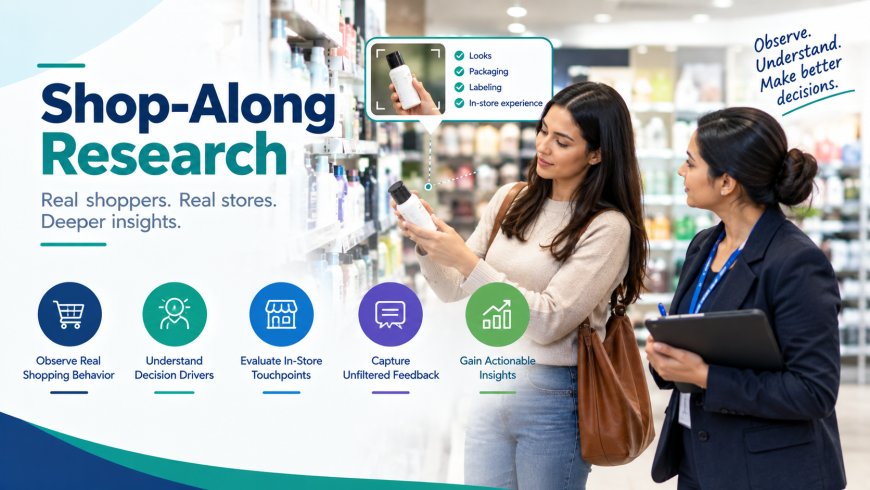
Shop-Along Research helps businesses explore these decisions by observing and engaging with shoppers during their shopping journeys. By combining real-world observation with direct conversations, organisations can better understand how customers navigate stores, evaluate products, and make purchasing choices.
What Is Shop-Along Research?
Shop-Along Research is a qualitative research method in which a researcher accompanies a participant during a shopping trip to understand their behaviour, preferences, and decision-making process.
During the session, researchers observe how shoppers navigate the store, interact with products, compare alternatives, and respond to different elements of the shopping environment. They may also ask questions to understand the reasoning behind specific actions.
Unlike traditional surveys conducted after a purchase, this approach captures insights closer to the moment decisions occur.
A typical study may explore:
-
How shoppers navigate aisles and product categories.
-
What attracts their attention on shelves.
-
How they compare brands, prices, and product features.
-
Which packaging elements influence their perceptions.
-
How promotions affect product consideration.
-
Why they select or reject particular products.
These observations help businesses understand the practical factors influencing shopping decisions.
Why Do Businesses Need Shop-Along Research Services?
Shopping behaviour is influenced by several factors, including personal preferences, product availability, pricing, packaging, store layout, and promotional messages. Understanding how these factors interact can help businesses make more informed decisions.
Professional Shop-Along Research Services allow organisations to investigate shopper behaviour in realistic environments rather than relying exclusively on what people remember after shopping.
1. Understand Real Shopping Behaviour
People may describe their shopping habits differently from how they behave in stores. Observing actual shopping journeys helps researchers identify the actions, comparisons, and considerations involved in purchasing decisions.
This can reveal differences between shoppers' stated preferences and their observed behaviour.
2. Evaluate Product Visibility and Packaging
Packaging and shelf presentation can influence which products shoppers notice and consider. Researchers can observe whether participants recognise a product, understand its packaging, or find the information they need.
These findings can help businesses identify aspects of product presentation that warrant further evaluation.
3. Investigate Price and Promotional Responses
Shoppers often compare prices, review offers, and assess perceived value before making a purchase.
Shop-along sessions can help researchers understand how participants interpret promotions, compare available options, and decide whether a product justifies its price.
4. Identify Barriers to Purchase
Some shoppers abandon a product choice because of confusion, limited availability, unclear information, or concerns about value.
By observing these moments and asking relevant follow-up questions, researchers can investigate potential barriers and help businesses determine where further improvements may be needed.
How Shopper Research Reveals Purchase Decisions
Shopper Research focuses on understanding how people behave and make decisions while shopping. It examines the factors that influence product consideration, brand selection, and purchase completion.
Shop-along studies contribute to this understanding by capturing behaviour within the shopping environment.
For example, a shopper may initially approach a familiar brand but switch to another product after comparing prices or reviewing the packaging. A researcher can explore what prompted the change and which product attributes influenced the final choice.
These observations can help organisations investigate:
-
The role of brand familiarity in product selection.
-
How shoppers compare competing products.
-
The influence of shelf placement and product visibility.
-
The importance of pricing and promotional offers.
-
The information shoppers seek before purchasing.
-
The reasons shoppers change their initial preferences.
Shopper Research can also help identify differences between audience groups, provided the study includes participants who appropriately represent the intended segments.
The Role of In-Store Research
In-Store Research examines how shoppers interact with the physical retail environment and the products available within it.
Shop-along research offers a way to investigate these interactions while considering the shopper's own goals and preferences.
Store Navigation and Layout
Researchers can observe how participants move through aisles, locate products, and respond to store layouts. These observations may reveal areas where navigation is confusing or product discovery is difficult.
Shelf Placement and Product Visibility
Product positioning can affect what shoppers notice first. Researchers can explore whether participants see the intended products, recognise relevant brands, and consider different options.
Packaging and Product Information
Shoppers may examine ingredients, instructions, specifications, or other product details before deciding. Observing these interactions helps researchers understand which information receives attention and where confusion may occur.
Promotional Displays
Displays and offers may attract attention, encourage product consideration, or have little influence on a particular shopper. In-store observations help researchers investigate how participants respond to these elements in context.
The findings can inform further evaluation of retail presentation, merchandising, and the overall shopping experience.
How Purchase Decision Research Benefits Businesses
Purchase Decision Research investigates the factors that influence how people move from considering a product to selecting or rejecting it.
Shop-along studies can help organisations explore these factors as decisions unfold.
For example, a business introducing a new packaged product may want to understand whether shoppers notice it, how they interpret its benefits, and what concerns prevent them from selecting it.
Similarly, a retailer may investigate why customers compare several products before making a choice or why certain promotions attract attention without leading to a purchase.
The resulting insights can support:
-
Product development: Understand which features shoppers notice and evaluate.
-
Packaging decisions: Explore how customers interpret product information and visual presentation.
-
Pricing strategy: Investigate how shoppers compare prices and perceived value.
-
Retail merchandising: Examine product visibility, shelf interactions, and navigation.
-
Marketing planning: Understand how brand messages and promotional materials influence consideration.
These findings provide context for business decisions, although additional research may be necessary to establish how widespread an observed behaviour is across a larger shopper population.
What Happens During Accompanied Shopping Research?
Accompanied Shopping Research follows a structured process designed to capture relevant observations while allowing participants to shop naturally.
1. Define the Research Objectives
The study begins by identifying the questions the business needs to answer. Objectives may focus on product selection, store navigation, brand comparison, pricing, or the shopping experience.
2. Recruit Relevant Shoppers
Participants are selected according to the study requirements. Criteria may include shopping habits, product usage, category involvement, or other characteristics relevant to the research objectives.
3. Prepare the Research Guide
Researchers develop an observation framework and discussion guide. These materials help ensure that important behaviours are recorded while allowing flexibility to explore unexpected findings.
4. Conduct the Shopping Session
The researcher accompanies the participant through the relevant shopping environment, observing their actions and asking questions when appropriate.
The aim is to understand the participant's reasoning without unnecessarily influencing their decisions.
5. Document Observations
Researchers record relevant actions, comments, product comparisons, and decision points. Consistent documentation helps maintain clarity when reviewing findings across participants.
6. Analyse the Findings
Observations are reviewed to identify recurring themes, differences between participants, and potential explanations for shopping behaviour. The findings can then be organised around the original research objectives.
Choosing the Right Shop-Along Research Partner
Selecting an appropriate provider is important for obtaining meaningful findings from a shop-along study.
Businesses should consider the following factors when evaluating potential research partners:
Relevant respondent recruitment: The provider should understand the shopper characteristics required for the study and apply suitable eligibility criteria.
Experience with qualitative fieldwork: Researchers should be able to observe behaviour carefully, ask useful follow-up questions, and avoid leading participants towards particular responses.
Clear research objectives: The proposed methodology should address the specific questions the business needs to investigate.
Consistent documentation: Structured observation guides and reporting procedures help make findings easier to review and compare.
Data quality and research standards: The provider should apply suitable checks to ensure that observations are complete, relevant, and aligned with the study requirements.
Businesses should also consider whether the research approach suits the intended retail environment and whether the findings will provide sufficient detail for the decisions being evaluated.
How IMARC Pulse Supports Primary Research and Fieldwork
IMARC Pulse specialises in primary research and global fieldwork, helping organisations connect with the people who shape their markets.
Its services include respondent recruitment, quantitative and qualitative fieldwork, data collection, and research quality services across industries and global markets.
These capabilities support organisations seeking firsthand information from relevant audiences. Through structured fieldwork processes and an emphasis on verified data, IMARC Pulse helps businesses collect reliable information to support their research requirements and business decisions.
Conclusion
Shop-Along Research helps businesses understand shopping behaviour by examining how people interact with products, compare alternatives, and make decisions in real-world retail environments.
By combining observation with direct conversations, organisations can investigate factors that may be difficult to capture through conventional surveys alone. These findings can inform further work on packaging, product visibility, pricing, merchandising, and the shopping experience.
The effectiveness of a study depends on clear objectives, relevant participant recruitment, thoughtful observation, and consistent analysis. When these elements are aligned, shop-along research can provide valuable context for understanding shopper decisions and identifying opportunities for improvement.
Frequently Asked Questions
1. What is Shop-Along Research used for?
Shop-Along Research helps businesses understand how shoppers navigate stores, evaluate products, compare brands, respond to promotions, and make purchasing decisions.
2. How does Shopper Research differ from traditional surveys?
Traditional surveys generally rely on participants' reported opinions and recollections. Shopper Research using shop-along methods combines direct observation with conversations during the shopping journey, providing additional context about actual behaviour.
3. What is the difference between In-Store Research and Shop-Along Research?
In-Store Research is a broad term for studies conducted in retail environments. Shop-Along Research is a specific approach in which a researcher accompanies a shopper and explores their actions, choices, and reasoning during a shopping trip.
4. What types of businesses benefit from Shop-Along Research Services?
Retailers, consumer goods companies, product manufacturers, and businesses evaluating shopping experiences may benefit from shop-along research. Its suitability depends on the research objectives and the behaviours being investigated.
5. How does Accompanied Shopping Research identify purchase barriers?
Researchers observe moments when participants hesitate, compare alternatives, reject products, or struggle to find information. Follow-up questions help explore the reasons behind these behaviours and identify issues requiring further investigation.
6. How many participants are needed for a shop-along study?
The appropriate number depends on the study objectives, audience diversity, research scope, and depth of investigation required. Qualitative studies typically prioritise detailed understanding over statistical representation, so the sample should be designed around the questions being explored.
What's Your Reaction?