

































Philippines Fertilizer Market to Reach USD 4,773.86 Million by 2034
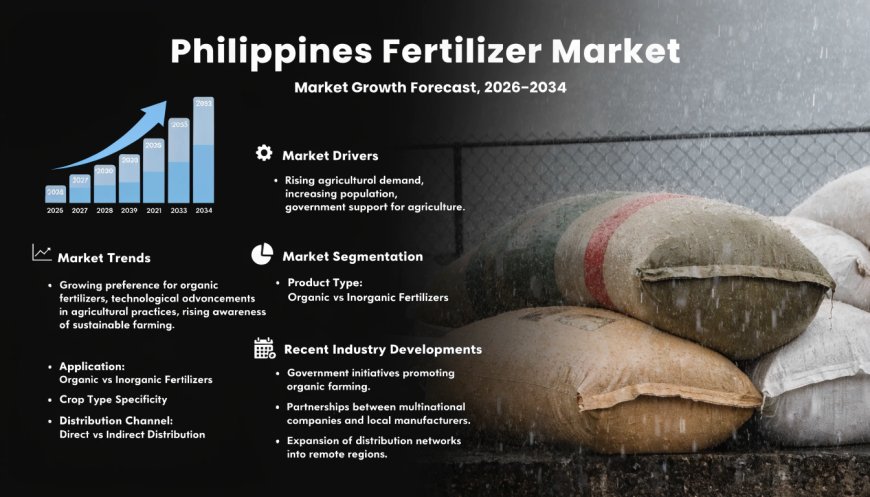
The Philippines fertilizer market size reached USD 3,646.00 Million in 2025, according to the latest report from IMARC Group. The market is projected to reach USD 4,773.86 Million by 2034, exhibiting a growth rate (CAGR) of 3.04% during 2026-2034.

The Philippines fertilizer market size reached USD 3,646.00 Million in 2025, according to the latest report from IMARC Group. The market is projected to reach USD 4,773.86 Million by 2034, exhibiting a growth rate (CAGR) of 3.04% during 2026-2034. Market growth is driven by expanded government agricultural support programs through the tripling of the Rice Competitiveness Enhancement Fund (RCEF) budget, which provides comprehensive subsidies for seeds, mechanization, and farm inputs. Additionally, the accelerating transition toward sustainable and organic-based fertilizers to reduce import dependency is supporting market evolution, while strategic international partnerships with regional fertilizer manufacturers for technology transfer and supply security are expanding the Philippines fertilizer market share.
Request Sample Report (Including Graphs, Charts & Figures):
https://www.imarcgroup.com/philippines-fertilizer-market/requestsample
How AI is Reshaping the Future of the Philippines Fertilizer Market
The integration of artificial intelligence into Philippine agriculture is fundamentally transforming how farmers access fertilizer recommendations, optimize application rates, and improve crop yields.
AI-Powered Fertilizer Recommendation Systems – The Department of Agriculture–Philippine Rice Research Institute (DA-PhilRice) has upgraded PALAI, an AI chatbot that provides farmers with specific guidance on what fertilizer to use, how much to apply per hectare, and when to apply it from initial application to succeeding crop stages. The system's performance improved from 34% to 89% accuracy, with 119 out of 133 test questions answered correctly, backed by an upgraded knowledge base of more than 8,000 expert-reviewed question-and-answer pairs covering rice production, varieties, pest management, and fertilizer. PALAI can detect fertilizer intent from farmers' messages, recognize Filipino terms like "abono" and "pataba," and ask follow-up questions before generating personalized recommendations using the TIPID Abono database.
AI-Assisted Agricultural Input Regulation – The Fertilizer and Pesticide Authority (FPA) launched GAB-AI (Guide to Authorized and Beneficial Agricultural Inputs) in June 2025, an intuitive AI-assisted mobile platform designed to help farmers and industry stakeholders easily identify FPA-registered fertilizer and pesticide products for their target crops, pests, and plant diseases. The application also provides timely updates on prevailing weekly fertilizer prices, supporting data-driven decision-making in the field.
Digital Soil Health Management – The DA-Bureau of Soils and Water Management (BSWM) introduced the Fertilizer Recommendation Mobile Application (FertRight), a mobile-based platform that helps farmers determine the right type and amount of fertilizer for specific crops and soil conditions. Additionally, AI-powered soil sensors from platforms like Enfarm are delivering real-time, lab-precision nutrient analysis, enabling farmers to reduce input costs by up to 30% while increasing yields and growing income.
Precision Agriculture for Rice and Coconut Sectors – Through the application of AI and Machine Learning-based digital innovations, projects like Palay+ are supporting the government's efforts to enhance efficiency and guide smarter agricultural investments in the country. The Philippine Coconut Authority (PCA) is also exploring the adoption of Synthetic Aperture Radar (SAR) technology and artificial intelligence to address key challenges in the coconut sector, enabling coconut farmers to access timely and reliable information to withstand climate-related risks.
Future AI Integration – The E-Governance Act (Republic Act No. 12254) is driving interoperable digital services, with PALAI being developed to integrate its tools, data, and services with other systems, reducing reliance on fragmented or standalone platforms. Additional upgrades underway include voice support, improved recognition of Filipino farming terms, faster responses, and enhanced coordination between farmers and chatbot agents.
Philippines Fertilizer Market Trends
Expanded Government Agricultural Support Programs Through RCEF Extension – On December 9, 2024, Philippine President Ferdinand R. Marcos Jr. signed Republic Act No. 12078, amending the Rice Tariffication Law to extend the Rice Competitiveness Enhancement Fund until 2031, increasing the annual RCEF budget from PHP 10 Billion to PHP 30 Billion. The amendment allocates PHP 6 Billion for high-quality rice seeds, PHP 9 Billion for farm mechanization, and PHP 15 Billion for extension and training programs, rice farmers financial assistance, expanded rice credit assistance, composting facilities, pest and disease management, soil health improvement, and solar-powered irrigation systems. This substantial funding increase represents the government's recognition that sustained investment in agricultural inputs, particularly fertilizers, is essential for achieving food security objectives.
Accelerating Transition Toward Sustainable and Organic-Based Fertilizers – The organic fertilizer market in the Philippines is projected to grow significantly, driven by increasing consumer awareness of sustainable farming practices and the health benefits of organic products. The Department of Agriculture is actively promoting alternatives such as liquid fertilizers, biofertilizers, and soil ameliorants to offset rising costs of petroleum-based inputs. Agri Specialists Inc. produces commercial quantities of biofertilizer developed by the University of the Philippines Los Baños' National Institute of Molecular Biology and Biotechnology, where one kilogram can replace two 50-kilo bags of urea-based fertilizer at roughly one-third of the price.
Strategic International Partnerships for Supply Security – In July 2024, Agriculture Secretary Francisco P. Tiu Laurel Jr. led a delegation to Vietnam to meet with executives of Binh Dien Fertilizer Joint Stock Co., discussing potential collaboration on fertilizer supply or local production in the Philippines. Binh Dien has become Vietnam's top producer of NPK fertilizers, operating several plants with a total capacity of 1 million metric tons, enough to meet 30% of Vietnam's fertilizer demand. The Philippines continues to rely on key suppliers such as Indonesia, China, Vietnam, Brunei, and Malaysia for its fertilizer imports, with ammonium sulfate fertilizers entirely imported from China and Japan.
Philippines Fertilizer Market Summary
- Market Valuation: The market reached USD 3,646.00 Million in 2025 and is projected to reach USD 4,773.86 Million by 2034, registering a CAGR of 3.04% during 2026-2034.
- Government Support: The RCEF budget was tripled from PHP 10 Billion to PHP 30 Billion annually through Republic Act No. 12078, allocating substantial funds for seeds, mechanization, training, financial assistance, and soil health improvement.
- Consumer Drivers: Rising demand for food security and agricultural productivity, with the Philippines targeting a 3% annual growth rate in the agricultural sector supported by approximately PHP 50 Billion in government investment in agricultural infrastructure and technology.
- Product Diversity: The market is segmented into nitrogenous, phosphatic, potassic, organic, biofertilizers, specialty fertilizers, and others, with nitrogenous fertilizers being the most widely used.
- Distribution Breadth: Supermarkets/hypermarkets, convenience stores, online retail, specialty stores, and direct-to-farm distribution provide extensive reach across Luzon, Visayas, and Mindanao.
- Regional Demand: Luzon dominates market demand due to its high concentration of agricultural activities and infrastructure, followed by Visayas and Mindanao.
Philippines Fertilizer Market Growth Drivers
Expanded Government Support and Food Security Imperatives – The tripling of the RCEF budget to PHP 30 Billion annually represents the government's strongest commitment to agricultural modernization and food security. The program's emphasis on balanced fertilization strategies, soil health improvement, and pest management creates a holistic approach to agricultural productivity that goes beyond simple input subsidies. For fertilizer manufacturers and distributors, this expanded government support translates into predictable demand patterns and opportunities to participate in large-scale procurement programs, while encouraging innovation in product formulations that align with sustainable farming practices and soil health objectives promoted by the government framework.
Return of Major Industry Players and New Market Entrants – On October 20, 2025, Planters Products Inc. (PPI) re-entered the fertilizer trade after a 43-year hiatus, bringing 120,000 bags of 14-14-14 inorganic fertilizer imported from Vietnam. The initial shipment can support about 20,000 hectares of rice fields, equivalent to six bags per hectare, and benefit approximately 20,000 farmers nationwide. PPI's return underscores the government's renewed focus on supporting farmers and strengthening local food production through higher crop productivity, sustainable soil management, and national food security.
Supply Security and Diversification Amid Global Uncertainties – Despite tensions in the Middle East threatening global supply routes, the Philippines has sufficient fertilizer sources and viable alternatives to cushion the impact of rising prices. Based on 2025 data, only about 20 percent of the country's 713,000 metric tons of imported urea-based fertilizers were sourced directly from Qatar and Saudi Arabia, with the bulk coming from Indonesia, Brunei, Malaysia, China, and Vietnam, while ammonium sulfate fertilizers were entirely imported from China and Japan, further reducing reliance on Middle Eastern routes. President Marcos has assured farmers of sufficient fertilizer supply for upcoming planting seasons, with government-to-government collaboration intensifying to diversify the country's fertilizer sources.
Philippines Fertilizer Market Segments
Breakup by Product Type
- Nitrogenous Fertilizer
- Phosphatic Fertilizer
- Potassic Fertilizer
- Organic Fertilizer
- Biofertilizers
- Specialty Fertilizers
- Others
Breakup by Product Form
- Dry Fertilizer
- Liquid Fertilizer
Breakup by Crop Type
- Cereals & Grains (Rice, Corn, etc.)
- Oilseeds & Pulses
- Fruits & Vegetables
- Plantation Crops (Coconut, Sugarcane, etc.)
- Others
Breakup by Distribution Channel
- Supermarkets/Hypermarkets
- Convenience Stores
- Online Retail
- Specialty Stores
- Direct-to-Farm Distribution
Breakup by Region
- Luzon (including National Capital Region, Cagayan Valley, Central Luzon, Calabarzon, Bicol Region)
- Visayas
- Mindanao
Competitive Landscape of the Philippines Fertilizer Market
The Philippines fertilizer market features a dynamic competitive landscape that blends international agribusiness giants, established Philippine agrochemical firms, and emerging domestic manufacturers. Leading participants include Pilipinas AgriNurture, Inc., La Filipina Uy Gongco, East-West Seed Company, Inc., Syngenta Philippines, Inc., Bayer CropScience, Inc., Yara International ASA, Agri-Fert, Inc., Fertiphil Corporation, Greenfield Agro Products, Chemrez Technologies, Inc., A. Brown Company, Inc., and Philippine Phosphate Fertilizer Corporation.
Planters Products Inc. (PPI) returned to the fertilizer market in October 2025 after a 43-year hiatus, importing 120,000 bags of 14-14-14 inorganic fertilizer from Vietnam. Agri Specialists Inc. produces commercial quantities of biofertilizer developed by UP Los Baños researchers, with one kilogram capable of replacing two 50-kilo bags of urea-based fertilizer.
Competition is centered on formulation innovation, NPK content, organic certification, pricing strategy, and distribution reach. The market remains highly concentrated with key suppliers from China, South Korea, Norway, Vietnam, and Israel. Brand trust, sustainable packaging, transparent labeling, and compliance with FPA regulations are emerging as key competitive differentiators. Strategic international partnerships for technology transfer and supply security are intensifying competition, while Philippine brands differentiate through locally sourced ingredients, biofertilizer innovation, and government-aligned sustainability propositions.
Latest Recent News & Development in the Philippines Fertilizer Market
March 2026: President Ferdinand R. Marcos Jr. assured farmers that the country has sufficient fertilizer supply for the upcoming planting season, with government continuing to explore measures and secure agreements with other countries to maintain a stable fertilizer supply. Fertilizer subsidies remain continuous to support farmers amid global price challenges.
March 2026: The Department of Agriculture prepared a PHP 1 Billion quick response fund to protect farmers from impacts of rising fuel prices, allocating PHP 500 Million to procure biofertilizer to offset projected fertilizer price hikes.
March 2026: DA-PhilRice upgraded the PALAI AI fertilizer recommendation system, improving performance from 34% to 89% accuracy. The upgrade includes voice support development, improved recognition of Filipino farming terms, and integration with other digital services following the E-Governance Act.
February 2026: Global tensions affecting the Strait of Hormuz prompted the DA to accelerate promotion of biofertilizers, liquid fertilizers, and soil ameliorants, with field tests showing farmers can significantly reduce traditional urea use without sacrificing yields.
October 2025: Planters Products Inc. (PPI) re-entered the fertilizer market after 43 years, importing 120,000 bags of 14-14-14 inorganic fertilizer from Vietnam, supporting approximately 20,000 hectares of rice fields and benefiting around 20,000 farmers nationwide.
July 2024: Agriculture Secretary Francisco P. Tiu Laurel Jr. led a delegation to Vietnam to discuss fertilizer collaboration with Binh Dien Fertilizer Joint Stock Co., the country's top NPK fertilizer producer with 1 million metric tons of annual capacity.
2025: The Philippines organic fertilizer market continued its expansion, driven by increasing consumer awareness of health and environmental issues, leading to a 15% annual rise in organic farming practices.
Browse Full Report with TOC & List of Figures:
https://www.imarcgroup.com/philippines-fertilizer-market
About Us
IMARC Group is a leading market research company that offers management strategy and market research worldwide. We partner with clients in all sectors and regions to identify their highest-value opportunities, address their most critical challenges, and transform their businesses.
IMARC's information products include major market, scientific, economic and technological developments for business leaders in pharmaceutical, industrial, and high technology organizations. Market forecasts and industry analysis for agriculture, biotechnology, advanced materials, pharmaceuticals, food and beverage, travel and tourism, nanotechnology and novel processing methods are at the top of the company's expertise.
Contact Us
IMARC Group
134 N 4th St., Brooklyn, NY 11249, USA
Email: sales@imarcgroup.com
Tel No: (D) +91 120 433 0800
United States: +1-631-791-1145
What's Your Reaction?