






























Why Construction Estimating in Hawaii Is a Completely Different Calculation
Learn why Hawaii construction estimating differs from mainland projects due to labor, materials, shipping, codes, and local costs.

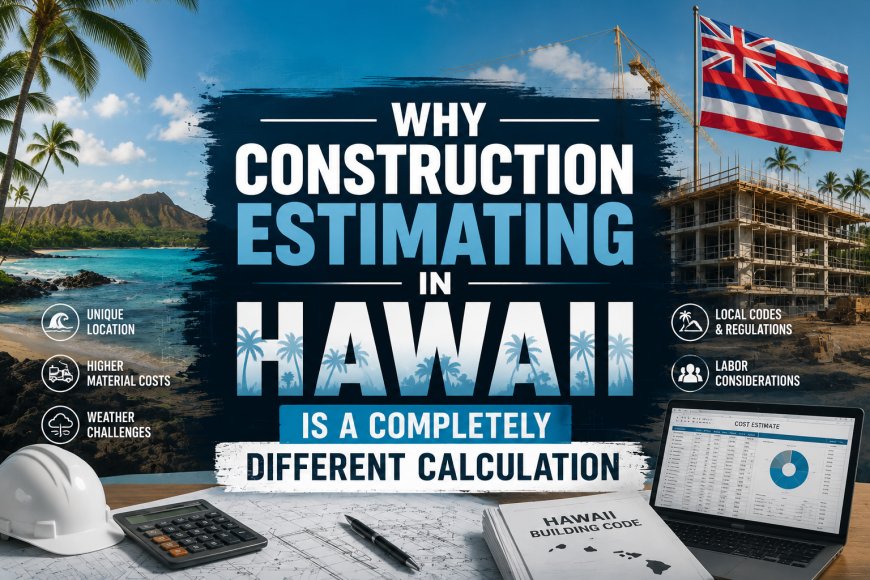
A contractor's standard cost estimating process works fine for mainland projects. Then they get their first Hawaii bid request and realize that nearly every assumption they've built their estimating around doesn't apply anymore. Material costs are wildly different. Labor rates bear little resemblance to the mainland. Supply chains work on completely different timelines. Building codes have island-specific requirements. What looked like a straightforward project on the surface becomes genuinely complex once someone actually tries to estimate it accurately.
This isn't a regional variant of standard estimating. It's a fundamentally different problem that requires understanding Hawaii-specific factors that don't show up in any national cost database.
The material cost problem that catches every outsider off guard
Material costs in Hawaii run 20-40% higher than mainland equivalents for most categories, and sometimes significantly more for specialized items. This isn't arbitrary markup, it's the practical result of geography: nearly everything gets shipped by ocean freight, which adds time, transportation cost, and handling. A lumber shipment that costs X to truck across Texas costs substantially more to barge to Honolulu, then truck to a job site on the Big Island.
But more importantly, the supply chain timeline is completely different. A mainland contractor can get most materials within days of ordering. Hawaii requires planning weeks ahead because shipments happen on fixed schedules, not continuous delivery. Missing a shipping window can delay a material order by a week or more, which costs money in crew idle time and schedule impact.
This affects pricing in ways that standard estimating software doesn't account for. A mainland estimator looking at material costs in a database might not even register that they're bidding a Hawaii project, and underestimate material cost significantly.
Local labor market dynamics that don't match national averages
Hawaii's labor market is tight in ways that most mainland metros aren't. There's a limited pool of construction workers, which means labor rates are higher and availability is more constrained. A project that would pull crew from an available labor pool on the mainland might require waiting for crew, paying premiums for specific trades, or flying in expertise from somewhere else.
This is also true for trades requiring certification specific to Hawaii or specialized expertise. An electrician licensed in California still needs Hawaii licensure, which creates barriers that inflate labor costs. A trade that's experiencing shortage conditions in Hawaii will have markedly different pricing than the same trade in a labor-rich market.
Building code and permitting timelines that add real cost
Hawaii has building codes that are specific to island conditions: hurricane resilience, salt corrosion, volcanic soil considerations, earthquake resistance standards that differ from mainland codes. An estimator unfamiliar with Hawaii's specific requirements might miss special construction practices, material specifications, or structural considerations that drive cost.
The permitting process also operates differently. Honolulu's permit timeline is different from Maui's, which is different from Hilo's. A contractor used to mainland permitting processes might not budget realistic time for Hawaii municipal reviews, which can extend project timelines and add cost.
Weather and site conditions that are island-specific
Hurricane season, volcanic soil, salt spray corrosion, extreme sun exposure, these factors affect material durability, construction methods, and labor productivity in ways that don't apply everywhere on the mainland. A roofing method that works in Denver might not stand up to Hawaii conditions. HVAC systems need different capacity planning in a tropical climate. Concrete specifications need to account for salt corrosion in coastal projects.
Waste factors that work for mainland projects might not apply in Hawaii. A drywall installation might generate different waste patterns based on humidity, weather during construction, or crew familiarity with tropical conditions.
Why generic estimating software isn't enough
The major commercial estimating databases have national pricing but limited Hawaii specificity. RS Means and similar tools have Hawaii adjusters, but they're broad multipliers that don't capture project-specific realities. A contractor building their estimate around database numbers plus a Hawaii adjustment multiplier might be close to right, or might be significantly off, depending on what those numbers don't account for.
This is exactly why contractors working in Hawaii regularly need local expertise. Someone who understands Hawaii's supply chains, labor markets, local codes, and site-specific conditions can estimate far more accurately than someone working from mainland data and applying a blanket regional adjustment.
How projects that seem straightforward become expensive mistakes
A contractor bids a Hawaii project using mainland assumptions plus a 20% adjustment for regional costs. The bid comes in competitively enough to win. Then construction starts and the realities emerge: material costs were actually 35% higher, labor availability was worse than estimated, permit timelines slipped, weather delays happened, local code interpretations required unexpected design changes.
By mid-project, the margin is gone and there's no mechanism to recover it. This isn't an unusual story, it's the pattern that shows up repeatedly when contractors underestimate the complexity of estimating work in Hawaii.
What actually changes when someone understands the Hawaii context
A proper Hawaii construction estimate accounts for actual local supply chain timing, realistic Hawaii labor rates based on current market conditions not national averages, Hawaii-specific building code requirements, realistic permitting timelines by jurisdiction, weather impact on logistics and labor productivity, and material specification differences required by Hawaiian climate and environmental conditions.
The best estimates for Hawaii projects come from someone who understands not just construction estimating in general, but construction in Hawaii specifically. There's a comprehensive resource on Hawaii construction estimating services that covers the specific considerations and regional factors that go into accurate Hawaii project pricing, which is a genuinely useful context whether you're a contractor working in Hawaii or learning to estimate projects there for the first time.
A practical approach if you're bidding Hawaii projects
-
Don't rely on national databases as your primary source. Use them as a starting point and adjust significantly based on actual Hawaii conditions.
-
Build relationships with Hawaii suppliers and get actual pricing, not theoretical costs adjusted by a multiplier.
-
Research labor availability for specific trades in the specific islands where work will happen, not assuming uniform rates statewide.
-
Verify building code requirements with the specific jurisdiction, not assuming Hawaii codes are a simple variant of mainland standards.
-
Budget realistically for supply chain timeline, not mainland delivery assumptions.
Hawaii construction projects aren't harder than mainland projects to build. They're just genuinely different in ways that require someone who understands that difference to estimate them accurately.
What's Your Reaction?