Market Outlook
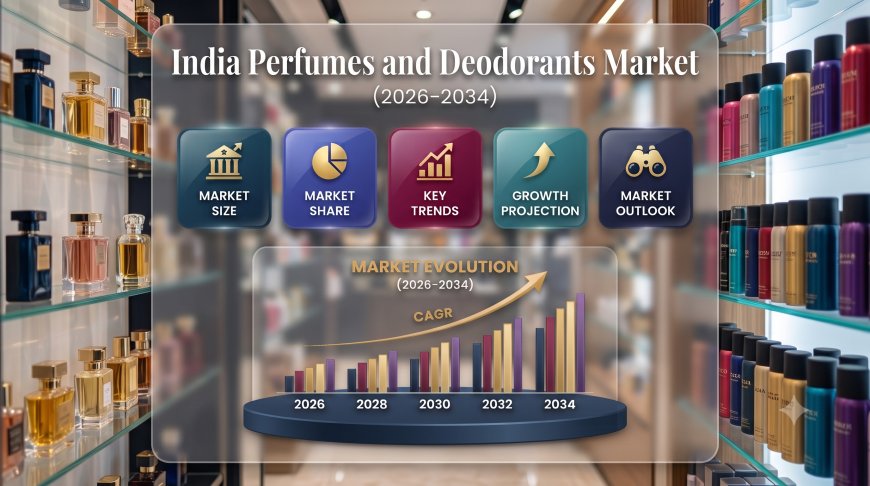
The India perfumes and deodorants industry size reached USD 2,890.8 Million in 2025. Looking forward, IMARC Group expects the market to reach USD 7,146.3 Million by 2034, exhibiting a growth rate (CAGR) of 10.26% during 2026-2034.
The modernization of the domestic personal care sector is driving a significant capital realignment as personal grooming routines transition from functional hygiene practices into luxury lifestyle choices. For global retail operators, domestic brands, and institutional investors, this evolution opens high-yield avenues across premium fragrance formulations, direct-to-consumer (D2C) ecosystems, and tier-2 and tier-3 expansion networks.
What are the Key Developments and Emerging Shifts in the India Perfumes and Deodorants Market?
Premiumization and D2C Expansion: The fragrance sector is witnessing notable growth through Direct-to-Consumer models supported by the Startup India initiative. Emerging homegrown brands leverage government incubation benefits to offer customized luxury fragrances. This enabling policy framework lowers entry barriers, allowing domestic enterprises to compete successfully and capture the expanding premium demographic across evolving urban markets globally (Source: Startup India).
Powered by Personal & Corporate Gifting: The market is increasingly shaped by innovative gifting solutions. Alongside premium fragrances, digital and NFC business cards are emerging as popular personal and corporate gifts. Backed by MeitY and the Digital India vision, companies are adopting these branded smart cards for employees and clients, seamlessly blending tech-enabled networking with modern luxury gifting bundles effectively (Source: MeitY).
Rise of Indigenous Fragrances: Local sourcing of raw materials has accelerated due to the CSIR Aroma Mission. By promoting the intensive cultivation of aromatic crops, the government generates vital rural employment and localizes the supply chain. This strategic shift empowers domestic perfume manufacturers to produce high-quality essential oils while consistently reducing overall international import dependency and procurement costs (Source: PIB).
Omnichannel Retail Integration: The rapid expansion of organized retail is continuously accelerating product accessibility. DPIIT’s progressive foreign direct investment policies in single and multi-brand retail have encouraged FMCG players to strengthen their physical and digital footprints. This regulatory support systematically enhances distribution networks, ensuring deodorants reach urban and semi-urban consumers seamlessly without logistical disruptions efficiently (Source: DPIIT).
Quality and Regulatory Alignment: Stricter quality controls are fundamentally elevating consumer trust in personal care products. The Central Drugs Standard Control Organisation carefully regulates cosmetics, ensuring that deodorants and perfumes adhere to stringent safety standards. This government-mandated compliance actively minimizes substandard products, propelling organized sector growth and making Indian fragrances globally competitive and scientifically justified (Source: Ministry of Health).
What Factors are Driving Growth in the India Perfumes and Deodorants Market?
Surging E-Commerce Penetration: The Digital India initiative has steadily improved broadband connectivity, fostering a robust online ecosystem for personal care items. With enhanced digital infrastructure, e-commerce platforms now account for a substantial portion of retail sales. This widespread internet accessibility enables fragrance brands to directly target rural and semi-urban demographics efficiently, ensuring sustained regional market expansion (Source: Digital India).
Rising Disposable Incomes: Sustained economic growth policies spearheaded by NITI Aayog have contributed to a noticeable increase in per capita income. As consumer spending power rises, individuals are steadily upgrading from basic hygiene products to premium perfumes and deodorants. This upward financial mobility remains a fundamental economic driver for the organized fragrance sector across varied consumer demographics (Source: NITI Aayog).
Boost in Domestic Manufacturing: The Make in India campaign continues to incentivize local production of cosmetics and toiletries. By offering structural support and subsidies, the Ministry of MSME empowers small and medium enterprises to manufacture cost-effective deodorants. This strategic localization lowers production costs significantly, ensuring that quality fragrances remain consistently affordable for the broader mass market nationally (Source: Ministry of MSME).
Urbanization and Demographic Shifts: Rapid urban development supported by the Smart Cities Mission has transformed modern lifestyle patterns. The expanding urban middle class, characterized by a younger demographic, prioritizes grooming and personal care daily. This cultural shift toward regular fragrance usage creates sustained demand across both offline supermarkets and modern specialty retail outlets nationwide, driving continuous sector growth (Source: MoHUA).
FDI Inflows and Retail Expansion: Relaxed foreign direct investment norms managed by DPIIT have successfully attracted international brands to the domestic market. Permitting completely foreign-owned single-brand retail encourages global perfume giants to establish a local physical presence. This capital influx enhances market competitiveness, introduces diverse product ranges, and subsequently drives overall category consumption higher securely across the nation (Source: DPIIT).
➤ Request Sample Report – TOC, Charts & Key Insights: https://www.imarcgroup.com/india-perfumes-deodorants-market/requestsample
India Perfumes And Deodorants Market Segmentation:
The market report offers a comprehensive analysis of the segments, highlighting those with the largest India perfumes and deodorants market share. It includes forecasts for the period 2026-2034 and historical data from 2020-2025 for the following segments.
Product Type Insights:
Price Insights:
Sales Channel Insights:
- Supermarkets and Hypermarkets
- Specialty Stores
- Online
- Others
Regional Insights:
- North India
- West and Central India
- South India
- East and Northeast India
Recent Market Developments
- Global luxury fragrance consortiums, including Creed, aggressively expanded their omnichannel distribution across India in 2025 by partnering with established luxury e-commerce platforms and opening physical boutiques, heavily boosting domestic procurement of ultra-premium perfumes continuously.
- Indian botanical attar manufacturers experienced a significant surge in demand from eco-conscious demographics in early 2025, validating the massive structural shift toward heritage-based, sustainable fragrance formulations.
- Domestic lifestyle brands structurally executed massive technological expansions into digital-first marketing, utilizing influencer networks to radically reduce customer acquisition costs and drive unprecedented premium fragrance sales in non-metro urban clusters.
By the IMARC Group, the Top Competitive Landscape & their Positioning:
Covering an in-depth analysis of the competitive landscape, market structure, key player positioning, competitive dashboards, top winning strategies, and detailed profiles of all major industry participants you will gain access to all these exclusive insights within the full research report.
Note: If you need specific information that is not currently within the scope of the report, we can provide it to you as a part of the customization.
➤ Request Report Customization: https://www.imarcgroup.com/request?type=report&id=21111&flag=E
Frequently Asked Questions (FAQs)
1. How big is the India perfumes and deodorants market?
According to IMARC Group, the India perfumes and deodorants market size reached USD 2,890.8 Million in 2025.
2. What is the expected market growth by 2034?
IMARC Group expects the market to reach USD 7,146.3 Million by 2034, exhibiting a CAGR of 10.26% during 2026-2034.
3. Which products dominate the market?
According to IMARC Group, the overall market comprises perfumes and deodorants, with premium and mass products catering to extensive and evolving consumer preferences.
4. Which sales channels lead the demand?
IMARC Group identifies supermarkets and hypermarkets, specialty stores, and online retail as the leading sales channels for these fragrance products.
5. Which regions hold the largest market share?
According to IMARC Group, North India, West and Central India, South India, and East and Northeast India represent the primary regional markets driving robust fragrance procurement.
CXO Blindspot & Strategic Insight
The India perfumes and deodorants market is executing a massive structural expansion strictly engineered by CDSCO safety mandates and DPIIT manufacturing subsidies. As the government rigorously enforces BIS quality standardization and eliminates toxic aerosol formulations, reliance on unorganized, hazardous cosmetics is permanently vanishing. For corporate stakeholders, state-backed digital retail modernization successfully secures a highly lucrative, permanently optimized environment for premium commercial cosmetic and personal care investments.