

































How Telecom Invoice Management Improves Cash Flow and Customer Experience
Discover how Telecom Invoice Management improves cash flow, automates invoicing, reduces billing errors, and delivers a better customer experience.

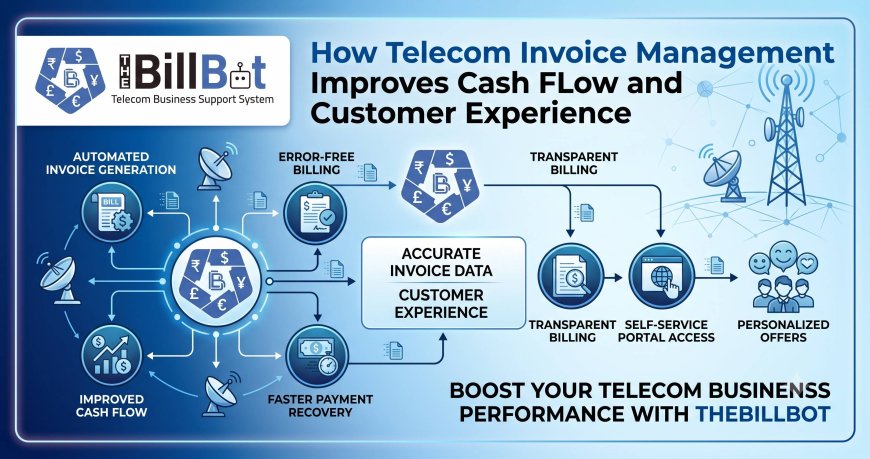
For telecom providers, billing is more than simply creating invoices and sending them to customers. It is a critical part of the customer journey and has a direct impact on revenue, cash flow, customer satisfaction, and overall business efficiency.
As telecom businesses grow, billing operations can become increasingly complicated. Providers may manage recurring subscriptions, usage-based charges, call records, packages, discounts, taxes, one-time fees, and different payment terms across hundreds or thousands of customers. Managing all of this manually can lead to delayed invoices, billing errors, missed payments, and unnecessary customer disputes.
This is where Telecom Invoice Management becomes important.
A well-designed invoice management process helps telecom providers automate invoice creation, improve billing accuracy, deliver invoices on time, monitor payment status, and communicate clearly with customers. When connected with billing, payment, and customer management systems, it can also help businesses improve cash flow while delivering a better customer experience.
What Is Telecom Invoice Management?
Telecom Invoice Management refers to the processes and technologies used to create, manage, deliver, track, and maintain customer invoices for telecom services.
It can cover the complete invoice lifecycle, including:
-
Collecting customer and usage information
-
Calculating charges
-
Generating invoices
-
Applying taxes and discounts
-
Delivering invoices electronically
-
Tracking invoice status
-
Sending payment reminders
-
Managing overdue invoices
-
Recording payments
-
Maintaining invoice history
-
Supporting reporting and reconciliation
For telecom providers, invoice management becomes particularly important because billing often involves multiple services and pricing structures.
A customer may have a monthly subscription, usage charges, additional services, international calls, discounts, and one-time fees on the same invoice. Managing these details accurately requires a structured and automated process.
Why Invoice Management Matters for Telecom Providers
A telecom provider can have excellent services, competitive pricing, and strong customer support, but poor billing can still create customer dissatisfaction.
Customers expect invoices to be:
-
Accurate
-
Easy to understand
-
Delivered on time
-
Consistent
-
Transparent
-
Convenient to pay
At the same time, businesses need invoices to be generated quickly and payments to be collected on schedule.
Effective Telecom Invoice Management helps address both sides of the equation.
It creates a more predictable billing process for the provider while making invoices easier for customers to understand and manage.
How Telecom Invoice Management Improves Cash Flow
Cash flow is one of the most important financial considerations for a growing telecom business. Even profitable businesses can face operational challenges when customer payments are delayed.
Invoice management can help reduce these delays in several ways.
1. Faster Invoice Generation
Manual invoice preparation can take considerable time, particularly when billing involves usage-based services.
Automated invoice management can gather the required billing information and generate invoices according to predefined billing cycles.
Instead of waiting for staff to manually prepare individual invoices, businesses can process large volumes of invoices more efficiently.
Faster invoice generation means invoices can reach customers sooner, giving them more time to review and make payments.
2. Consistent Billing Cycles
A predictable billing schedule makes it easier for both providers and customers to manage payments.
Telecom providers may have different billing cycles depending on their services or customer agreements. An automated system can manage these cycles according to configured rules.
This reduces the risk of missed billing dates and ensures that invoices are produced consistently.
3. Automated Payment Reminders
Late payments can negatively affect cash flow.
Instead of relying on employees to manually track overdue invoices and contact customers, automated invoice management can support scheduled payment reminders.
For example, reminders can be triggered:
-
Before the payment due date
-
On the due date
-
Shortly after the due date
-
During an overdue period
This creates a consistent collections process without requiring staff to monitor every invoice manually.
4. Better Visibility into Outstanding Invoices
Telecom providers need to know where their receivables stand.
A centralised invoice management system can provide visibility into:
-
Paid invoices
-
Unpaid invoices
-
Overdue invoices
-
Upcoming payments
-
Outstanding balances
-
Payment history
This allows finance and billing teams to identify potential collection issues earlier.
Instead of discovering a cash-flow problem at the end of the month, businesses can monitor receivables continuously.
5. Faster Payment Processing
Modern customers expect convenient payment options.
When invoice management is connected with online payment systems, customers can often move directly from reviewing an invoice to making a payment.
Reducing the number of steps between receiving an invoice and paying it can make the payment process easier and potentially shorten payment cycles.
6. Reduced Billing Errors
Billing errors can delay payments.
If customers receive invoices containing incorrect charges, missing discounts, duplicate usage, or unclear information, they may contact support before making payment.
Resolving these issues takes time and can delay revenue collection.
Telecom Invoice Management helps reduce such problems by automating invoice generation from structured billing data and applying predefined rules consistently.
How Telecom Invoice Management Improves Customer Experience
Cash flow is only one side of the equation. Billing is also a major customer touchpoint.
A confusing or inaccurate invoice can negatively affect the customer's perception of a telecom provider.
1. Clear and Professional Invoices
Customers should be able to understand what they are paying for without having to contact support.
A professional telecom invoice can clearly present:
-
Service charges
-
Usage charges
-
Taxes
-
Discounts
-
Additional fees
-
Previous balance
-
Payments received
-
Current amount due
-
Payment deadline
Clear invoices reduce confusion and help customers understand the value they are receiving.
2. Greater Billing Transparency
Telecom services can involve complex usage information.
For example, a business customer may have multiple numbers, extensions, calling plans, destinations, or usage-based services.
Providing detailed and organised billing information gives customers greater visibility into their charges.
This transparency can build trust and reduce unnecessary billing disputes.
3. Faster Invoice Delivery
Late invoices can create frustration for customers, especially businesses that need to manage their accounts payable processes.
Automated invoice delivery ensures that invoices can be sent promptly after billing runs are completed.
Customers receive their billing information when they expect it, making payment planning easier.
4. Convenient Payment Options
Customer experience does not end when an invoice is delivered.
Customers also expect convenient ways to pay.
Integration with online payment methods can allow customers to make payments without lengthy manual processes.
A smoother payment journey can improve satisfaction while also helping providers collect revenue more efficiently.
5. Easy Access to Invoice History
Customers may need previous invoices for accounting, budgeting, audits, or internal reporting.
A digital invoice management system can provide access to historical invoices and payment information.
This reduces the need for customers to contact support simply to request an old invoice.
6. Fewer Billing Disputes
Accurate, detailed, and transparent invoices can reduce misunderstandings.
When customers can clearly see how charges were calculated, they are more likely to understand their bills.
If a dispute does occur, having structured billing information and invoice history makes it easier for support teams to investigate and respond.
The Role of Automation in Telecom Invoice Management
Automation is one of the biggest advantages of modern invoice management.
A connected workflow can look like:
Usage Data → Billing Calculation → Invoice Generation → Invoice Delivery → Payment → Reconciliation → Reporting
Once configured, many of these steps can happen automatically.
For example, after usage is processed and charges are calculated, the system can generate the invoice, send it to the customer, update its status, and trigger reminders when necessary.
This reduces repetitive work for billing and finance teams.
Telecom Invoice Management and Business Scalability
As a telecom provider grows, invoice volume grows as well.
A process that works for 100 customers may become difficult to manage with 1,000 or 10,000 customers.
Manual invoice management creates additional operational pressure as the customer base expands.
Automated Telecom Invoice Management provides a more scalable foundation by allowing businesses to handle higher invoice volumes without increasing administrative work at the same rate.
This is especially valuable for ITSPs, VoIP providers, MSPs, and other service providers offering multiple products and pricing models.
Best Practices for Effective Telecom Invoice Management
To get the most value from invoice management, telecom providers should focus on several key practices.
Keep Billing Data Accurate
Invoice quality depends on the quality of the underlying billing data. Customer information, usage data, pricing, taxes, and discounts should be maintained accurately.
Automate Repetitive Processes
Automate invoice generation, delivery, reminders, payment updates, and reporting wherever practical.
Make Invoices Easy to Understand
Avoid unnecessary complexity. Present charges in a clear structure so customers can quickly understand their bills.
Monitor Outstanding Receivables
Regularly track unpaid and overdue invoices to identify collection risks early.
Provide Convenient Payment Methods
Make it simple for customers to pay through secure and accessible payment options.
Maintain Complete Invoice History
Keep historical invoice and payment information easily accessible for both internal teams and customers.
Final Thoughts
Effective billing can have a direct impact on both financial performance and customer relationships.
Telecom Invoice Management helps providers move beyond basic invoice creation by improving the entire invoice lifecycle. From automated invoice generation and faster delivery to payment reminders, receivables tracking, and customer access to billing information, a well-managed process creates value for both the business and its customers.
For telecom providers, ITSPs, VoIP businesses, and MSPs, the goal should be to make billing accurate, predictable, transparent, and easy to manage.
When invoice management is connected with billing, customer management, payments, and reporting, providers can improve cash-flow visibility, reduce administrative effort, minimise billing disputes, and deliver a smoother customer experience.
In a competitive telecom market, a better billing experience is not just an operational advantage. It can become an important part of building customer trust and supporting long-term business growth.
Frequently Asked Questions
1. What is Telecom Invoice Management?
Telecom Invoice Management is the process of creating, delivering, tracking, managing, and maintaining invoices for telecom services. It can include invoice generation, payment tracking, reminders, reconciliation, and reporting.
2. How does Telecom Invoice Management improve cash flow?
It can improve cash flow by speeding up invoice generation, delivering invoices on time, automating payment reminders, providing visibility into overdue accounts, and supporting convenient online payments.
3. How does invoice management improve customer experience?
It provides customers with accurate, clear, timely, and transparent invoices. Customers can also benefit from convenient payment options and easier access to their invoice and payment history.
4. Can Telecom Invoice Management handle usage-based billing?
Yes. When connected with a suitable telecom billing system, invoice management can incorporate usage-based charges such as call, data, or other service usage into customer invoices.
5. Can telecom providers automate payment reminders?
Yes. Automated invoice management systems can trigger reminders based on payment due dates and invoice status, reducing the need for manual follow-up.
6. Is Telecom Invoice Management suitable for growing ITSPs and VoIP providers?
Yes. It can help growing providers manage increasing invoice volumes, multiple pricing structures, recurring services, usage-based charges, and customer payments more efficiently.
7. What should businesses look for in Telecom Invoice Management software?
Important capabilities include automated invoice generation, flexible billing integration, invoice delivery, payment tracking, reminders, reporting, invoice history, security, and scalability.
What's Your Reaction?