























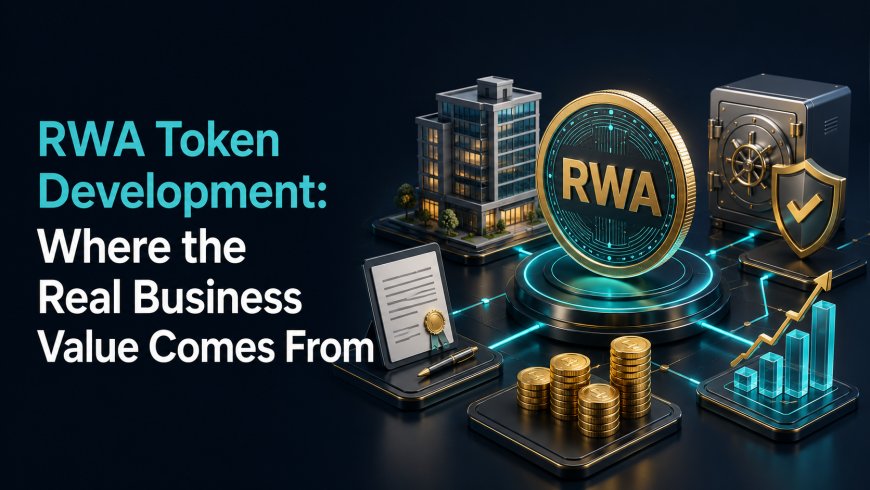
RWA Token Development: Where the Real Business Value Comes From
Discover how RWA token development creates business value through fractional ownership, new liquidity, wider investor access, and efficient asset management.

Real-world assets have long been associated with traditional ownership structures, lengthy paperwork, limited market access, and complicated transfer processes. Real estate, commodities, private credit, artwork, infrastructure, and other physical or financial assets can hold substantial value, but accessing that value has often required significant capital and specialized intermediaries.
RWA token development introduces a blockchain-based approach to representing ownership, economic rights, or claims connected to these assets. Instead of treating blockchain as simply a place to issue digital tokens, businesses can use tokenization to redesign how assets are issued, managed, transferred, and accessed.
The real business value does not come from creating a token alone. It comes from solving practical problems around liquidity, ownership, investor participation, settlement, compliance, and asset administration.
Turning Illiquid Assets Into Accessible Investment Opportunities
One of the biggest business opportunities in RWA token development is improving access to assets that traditionally require substantial capital.
For example, a commercial property may be worth millions of dollars, making direct ownership difficult for smaller investors. Through tokenization, the economic interest associated with the property can potentially be divided into smaller digital units, subject to the applicable legal and regulatory structure.
This model can create new participation opportunities while allowing asset owners to reach a broader investor base. Businesses can apply similar approaches to private credit, infrastructure projects, commodities, and other suitable assets.
The value comes from changing how participation is structured rather than simply putting an asset on a blockchain.
Creating New Liquidity Models
Liquidity is another area where RWA token development can create measurable business value.
Many traditional assets cannot be sold quickly without lengthy negotiations, extensive documentation, and intermediary involvement. A tokenized structure can introduce digital transfer mechanisms and marketplace functionality that may make eligible assets easier to transact.
However, tokenization does not automatically make an asset liquid. There must be demand, suitable market infrastructure, legal transferability, and an appropriate trading environment.
For businesses, the opportunity lies in creating a system where investors can access eligible tokenized assets through organized marketplaces while asset owners gain additional routes to capital.
Reducing Administrative Work
Traditional asset management often involves multiple parties handling records, ownership documents, investor information, payments, reporting, and settlement.
An RWA platform can bring many of these activities into a coordinated digital environment. Smart contracts can manage predefined actions such as token issuance, transfer restrictions, distribution rules, and transaction records.
This can reduce repetitive administrative work and lower the possibility of errors caused by fragmented recordkeeping.
For example, a tokenized real estate platform could connect property information, investor records, token balances, compliance checks, and distribution processes within one system. The exact level of automation depends on the asset class and regulatory framework.
Improving Ownership Records
Blockchain-based records can provide a consistent digital record of token transactions. This can be particularly useful when several parties need access to ownership or transaction information.
Instead of relying entirely on separate databases maintained by different organizations, a tokenization platform can maintain transaction history on a blockchain while connecting it with off-chain legal and asset records.
This does not mean that blockchain replaces legal documentation. Rather, it can become one part of a broader ownership and compliance framework.
For businesses, better record coordination can support investor reporting, auditing, reconciliation, and asset administration.
Expanding Investor Reach
Traditional investment opportunities are often distributed through established financial networks. RWA token development can provide businesses with digital channels for reaching eligible investors across different markets.
A tokenized investment platform may support investor onboarding, identity verification, wallet management, investment allocation, and secondary transactions from a single interface.
This creates an opportunity for asset owners and financial businesses to develop new distribution models.
At the same time, investor access must remain subject to applicable securities laws, jurisdictional restrictions, accreditation requirements, KYC procedures, and other compliance obligations.
Supporting Programmable Financial Products
Tokenized assets can also support programmable financial structures.
Smart contracts can define rules around ownership transfers, income distributions, redemption conditions, voting rights, and other functions. This can allow businesses to create digital financial products that operate according to predefined conditions.
For example, a token representing an economic interest in an income-generating asset could be connected to a distribution mechanism. When defined conditions are satisfied, the relevant payment process could be initiated through the platform.
Such automation can reduce manual intervention while providing a structured way to manage recurring transactions.
Building Business Models Around Tokenized Assets
The commercial value of RWA token development also comes from the business models that can be created around the platform.
A company may generate revenue through token issuance fees, transaction fees, asset listing charges, marketplace fees, custody services, compliance services, or subscription-based platform access.
A specialized RWA Tokenization Company can also provide infrastructure for asset owners that do not want to develop the entire technology stack internally.
This creates opportunities for businesses to operate not only as asset issuers but also as technology providers, marketplaces, infrastructure platforms, and service providers within the tokenized asset ecosystem.
What a Business Needs Before Starting RWA Token Development
Technology should not be the first consideration. Businesses should first determine what asset is being tokenized, what rights the token represents, who can purchase it, how ownership will be legally structured, and which jurisdictions are involved.
The business model should then define the token structure, compliance framework, custody model, investor onboarding process, asset verification method, smart contract logic, and marketplace requirements.
Only after these elements are established should development begin.
A typical platform may include an asset management module, token issuance system, investor dashboard, KYC and AML integration, smart contract layer, wallet functionality, transaction management, compliance controls, reporting tools, and an administrative panel.
The architecture should reflect the legal and commercial model rather than simply adding blockchain features.
The Long-Term Business Value of RWA Token Development
The strongest value proposition of RWA token development is its ability to connect traditional assets with digital financial infrastructure.
Businesses can potentially gain new methods for capital formation, investor distribution, asset administration, ownership management, and transaction processing. Investors may gain access to investment structures that were previously difficult to reach, depending on applicable regulations and market conditions.
However, successful tokenization requires more than smart contracts and digital tokens. Legal structure, asset verification, compliance, investor protection, liquidity strategy, custody, and platform usability all influence whether a tokenized asset model can succeed.
Conclusion
RWA token development becomes commercially meaningful when it solves real problems in the asset lifecycle. The token itself is only one component of the model. The larger opportunity lies in improving how assets are structured, offered, managed, transferred, and monitored.
Businesses considering RWA Tokenization should therefore begin with the asset and its economic purpose, then design the legal, operational, and technical framework around it. With the right structure, tokenization can become a practical business model rather than simply another blockchain use case.
What's Your Reaction?