


































Philippines CT Scanners Market Estimated to Exceed USD 355.98 Million By 2034: IMARC Group
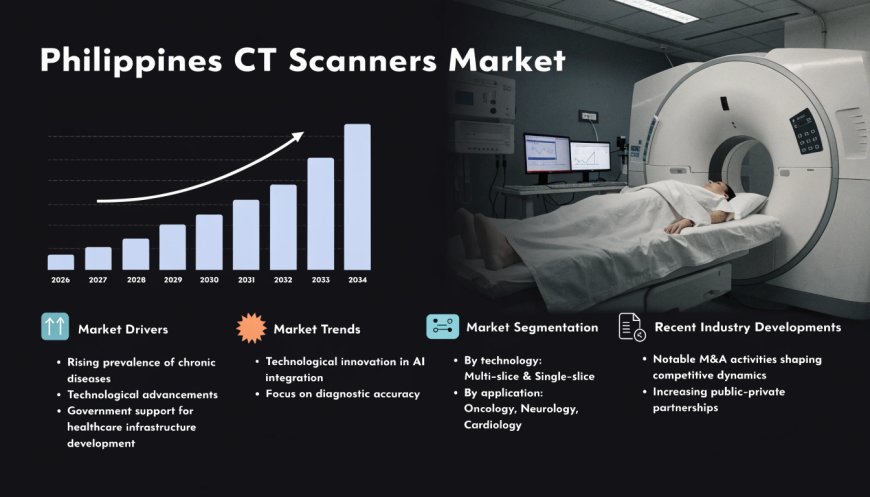
The Philippines CT scanners market size reached USD 196.65 Million in 2025. The market is projected to reach USD 355.98 Million by 2034, growing at a CAGR of 6.82% during 2026-2034.

Market Overview
The Philippines CT scanners market is advancing at a remarkable pace, driven by substantial government infrastructure investment, healthcare modernization initiatives, and the rising prevalence of chronic diseases necessitating advanced diagnostic imaging capabilities. According to IMARC Group, the market size reached USD 196.65 Million in 2025 and is projected to reach USD 355.98 Million by 2034, exhibiting a compound annual growth rate (CAGR) of 6.82% during 2026‑2034. The growing incorporation of cutting-edge imaging technologies and artificial intelligence to improve operational effectiveness and diagnostic precision is expanding the Philippines CT scanners market share. This market is strategically important to the Philippines’ economy as it directly supports the nation’s healthcare modernization agenda, enhances diagnostic capacity in underserved areas, and strengthens the overall medical tourism ecosystem.
The Philippines CT scanners market is poised for sustained expansion, driven by escalating demand for advanced diagnostic imaging amid rising chronic disease burden, government commitments to healthcare infrastructure modernization, and the integration of artificial intelligence technologies. With expanding diagnostic capacity through national health programs and increasing private hospital networks, the market presents significant opportunities for technology providers, healthcare institutions, and investors focused on next-generation diagnostic solutions.
Philippines CT Scanners Market Summary
The Philippines CT scanners market encompasses a wide range of computed tomography imaging systems, including multi-slice scanners with varying slice configurations, fixed and mobile modalities, and O-Arm and C-Arm device architectures. The ecosystem includes international medical device manufacturers, local distributors, hospital networks, diagnostic centers, and government health agencies such as the Department of Health (DOH) and the Philippine Health Insurance Corporation (PhilHealth). Major segments identified in the market include technology (16-Slice, 32-Slice, 128 and Above Slice, 64-Slice, 8-Slice, Less Than 8 Slices), modality (fixed, mobile), device architecture (O-Arm, C-Arm), application (cardiology, oncology, neurology, others), end user (hospital, diagnostic centers, others), and region (Luzon, Visayas, Mindanao). The market is driven by substantial government infrastructure investment and healthcare modernization initiatives, rising prevalence of chronic diseases, and the growing integration of artificial intelligence and advanced imaging technologies.
PORTER’S FIVE FORCES ANALYSIS – PHILIPPINES CT SCANNERS MARKET
The competitive dynamics of the Philippines CT scanners market can be analyzed using Porter’s Five Forces framework.
Bargaining Power of Suppliers – Moderate
The market relies on a concentrated group of global medical device manufacturers that supply advanced CT imaging systems, including GE HealthCare, Philips, Siemens Healthineers, and Canon Medical Systems. These global suppliers hold moderate influence due to their technological expertise, brand recognition, and established distribution networks. However, the presence of multiple international vendors and the increasing availability of refurbished equipment alternatives provide healthcare institutions with sourcing options, moderating individual supplier power.
Bargaining Power of Buyers – Moderate to High
Buyers include public hospitals, private hospital networks, diagnostic imaging centers, and government procurement agencies. Large-scale public procurement programs, such as the USD 59 million UNOPS-DOH-ADB HEAL Project, give institutional buyers significant negotiating leverage. Private healthcare facilities, particularly those catering to medical tourism, have the financial capacity to select premium equipment, giving them moderate negotiating power.
Threat of New Entrants – Low to Moderate
Capital requirements for developing and manufacturing CT scanners are substantial, with high barriers related to regulatory approvals, intellectual property, and technical expertise. However, the Philippines’ growing healthcare market is attracting new international entrants. Niche opportunities exist for specialized vendors focusing on mobile CT units, refurbished equipment for provincial hospitals, or AI-powered imaging solutions tailored to the Philippine market.
Threat of Substitutes – Low
While other imaging modalities such as MRI, ultrasound, and X-ray systems serve complementary diagnostic purposes, CT scanners provide unique advantages in speed, detailed cross-sectional imaging, and versatility across multiple clinical applications including trauma, oncology, cardiology, and neurology. The growing demand for multi-slice CT scanners with superior imaging quality and faster scan times reinforces their essential role, keeping substitution pressures low.
Competitive Rivalry – Moderate
The market is moderately competitive, featuring a dynamic mix of regional and international players. Key participants such as GE HealthCare, Koninklijke Philips N.V., Siemens Healthineers AG, and Canon Medical Systems contribute to innovation, technology transfer, and equipment distribution. Local distributors, such as Medilines renewing its distribution partnership with Siemens Healthineers in January 2022, play critical roles in market penetration. Rivalry centres on technological innovation, AI integration, service and maintenance support, and financing options.
Request for Sample Report: https://www.imarcgroup.com/philippines-ct-scanners-market/requestsample
MARKET GROWTH DRIVERS
Government Infrastructure Investment and Healthcare Modernization Driving Nationwide Diagnostic Expansion
The Philippine government has prioritized healthcare infrastructure development through substantial investments in diagnostic equipment and facility upgrades across public health institutions. Diagnostic capacity deficiencies in underprivileged areas have been systematically addressed by major national health efforts, such as the Health System Enhancement to Address and Limit COVID‑19 (HEAL) Project. More than 45 CT scanners were delivered to more than 100 public health facilities throughout the Philippines in February 2025 as part of this USD 59 million initiative, a collaboration between UNOPS, the Department of Health, and the Asian Development Bank, significantly improving diagnostic capacity in previously underserved areas. At Leyte Provincial Hospital, the CT scanner began operations in January 2024, serving 5‑10 patients daily who previously had to travel hours to other hospitals for diagnosis. The Department of Health has allocated significant budgetary resources for medical equipment procurement, ensuring that tertiary and secondary hospitals receive state-of-the-art diagnostic tools. Public-private partnerships are increasingly facilitating technology transfer and capacity building in medical imaging. This strategic focus on healthcare modernization is strengthening the entire diagnostic ecosystem, from urban teaching hospitals to remote rural facilities, fundamentally transforming access to advanced medical imaging throughout the archipelago.
Rising Prevalence of Chronic Diseases Driving Diagnostic Imaging Demand
The Philippines is experiencing a significant epidemiological transition characterized by escalating rates of non-communicable chronic diseases, particularly cardiovascular conditions, cancer, and neurological disorders. Ischemic heart diseases, stroke, and diabetes mellitus now rank among the leading causes of mortality, creating substantial demand for advanced diagnostic imaging capabilities. Ischemic heart disease is the top cause of death in the Philippines, accounting for 85,868 fatalities (19.4% of total mortality) between January and October 2024, according to the Philippine Statistics Authority. According to a 2024 study published in the Journal of the Asia-Pacific Society of Cardiology, the Philippines had a higher incidence rate of cardiovascular illnesses (11.0 per 1,000 person‑years) than its neighbor Malaysia, accounting for 58% of all deaths. The aging population structure, coupled with lifestyle-related risk factors including sedentary behavior, unhealthy dietary patterns, and smoking prevalence, is accelerating chronic disease incidence across all demographic segments. Cancer detection rates are rising as screening programs expand and awareness initiatives improve early-stage identification. The complexity of these chronic conditions demands sophisticated imaging modalities like multi-slice CT scanners capable of providing detailed anatomical visualization and functional assessment, fundamentally driving CT scanner adoption across hospitals, diagnostic centers, and specialized medical facilities nationwide.
Integration of Artificial Intelligence and Advanced Imaging Technologies
The market for CT scanners is rapidly evolving due to the incorporation of deep learning algorithms, artificial intelligence, and advanced reconstruction techniques that greatly enhance operational efficiency and diagnostic capabilities. AI-powered CT systems now offer automated patient positioning, intelligent protocol selection, dose optimization, and real-time image quality enhancement that reduce scan times while improving diagnostic accuracy. As of 2024, approximately 35% of newly installed CT scanners globally are AI‑enabled, with studies demonstrating 30‑40% reduction in radiologist reading time, improved noise reduction, and enhanced detection accuracy for abnormalities. Deep learning‑based reconstruction algorithms enable substantial radiation dose reduction without compromising image quality, addressing critical patient safety concerns. These technological innovations are particularly valuable in addressing the Philippines’ acute shortage of radiologists and imaging specialists, as AI‑driven automation reduces interpretation time and enhances diagnostic confidence. In June 2025, the Ilocos Training and Regional Medical Center became the first public hospital in La Union province to install a PHP 130 million GE Revolution Maxima 128‑slice CT scanner featuring artificial intelligence automation, deep learning reconstruction, and auto‑positioning capabilities, enhancing both patient comfort and radiology efficiency, particularly for cardiac cases.
MARKET GROWTH DRIVERS
Expansion of Diagnostic Capacity in Previously Underserved Areas Through National Health Programs
Expansion of diagnostic capacity in previously underserved areas through national health programs is expanding the Philippines CT scanners market share across all regions. Government‑led initiatives are systematically addressing the historical lack of advanced diagnostic equipment in provincial and district hospitals. The first‑ever PET‑CT scan facility procured by the Philippine government at UP‑PGH required a four‑year wait, demonstrating the pent-up demand for advanced diagnostic capabilities, with the new equipment serving indigent patients 80% of the time versus 20% for paying patients. The Philippine Children’s Medical Center received new MRI and upgraded CT scanners through the efforts of Senators Bong Go, Pia Cayetano, and Sonny Angara, doubling patient capacity and providing clearer images. The Bangui District Hospital in Ilocos Norte unveiled a new cutting‑edge CT scan unit providing “faster, more accurate, and highly detailed” diagnoses for conditions including stroke, trauma, cancer, cardiovascular disease, and other critical illnesses. These strategic expansions are fundamentally transforming healthcare delivery in previously underserved areas.
Increasing Healthcare Expenditure, Private Hospital Network Growth, and Medical Tourism
Increasing healthcare expenditure, growing medical tourism, and expanding private hospital networks will further accelerate market penetration throughout the forecast period. The Philippines healthcare devices and diagnostics market is valued at USD 1.5 billion, with the diagnostic imaging devices segment currently leading the market due to the increasing demand for advanced imaging technologies such as MRI and CT scans. Private healthcare facilities in the Philippines, particularly private hospitals known for their superior service quality and fast diagnosis, are investing heavily in CT scanners and other diagnostic imaging equipment. The rising demand for diagnostic imaging services is driven by a growing population of approximately 115 million and increasing awareness among patients regarding diagnostic imaging. The expansion of hospital networks and improvements in healthcare infrastructure are positioning the Philippines as a prominent market for diagnostic imaging, with medical tourism further driving demand for state-of-the-art equipment in private facilities serving international patients.
Philippines CT Scanners Market Segmentation
Segmentation analysis provides a detailed view of the Philippines CT scanners market by category:
- Technology Insights: 16-Slice, 32-Slice, 128 and Above Slice, 64-Slice, 8-Slice, Less Than 8 Slices
- Modality Insights: Fixed, Mobile
- Device Architecture Insights: O-Arm, C-Arm
- Application Insights: Cardiology, Oncology, Neurology, Others
- End User Insights: Hospital, Diagnostic Centers, Others
- Regional Insights: Luzon, Visayas, Mindanao
Competitive Landscape
The competitive landscape of the Philippines CT scanners market is moderately competitive, featuring a dynamic mix of regional and international players. Key participants such as GE HealthCare, Koninklijke Philips N.V., Siemens Healthineers AG, and Canon Medical Systems contribute to innovation, technology transfer, and equipment distribution. The multi‑slice CT scanner segment has shown a dominant market share, primarily due to its superior imaging quality, faster scan times, and reduced radiation exposure compared to single‑slice models. The competitive landscape of the Philippines CT equipment market is highly consolidated, with a few key players dominating the market. Local distributors play critical roles in market penetration; Medilines renewed its distribution partnership with Siemens Healthineers in January 2022, involving the sale and distribution of CT scans, MRIs, x‑rays, and PET/CTs, with Medilines and Siemens Healthineers selling the majority of current installations of linear accelerators and imaging systems for radiation therapy in the Philippines. Competition centres on technological innovation, AI integration, after‑sales service and maintenance support, financing options, and the ability to provide training for radiology staff.
Regional Analysis
Regional dynamics within the Philippines CT scanners market are shaped by varying levels of population density, healthcare infrastructure, and government investment across the archipelago.
- Luzon is the largest market region, driven by the concentration of major tertiary hospitals, government medical centers, and private healthcare facilities in Metro Manila and surrounding provinces. The region benefits from substantial government infrastructure investment, including the HEAL Project deliveries and advanced AI‑powered CT scanner installations. Key facilities include UP‑PGH (first government PET‑CT scanner), Ilocos Training and Regional Medical Center (128‑slice AI‑enabled scanner), Bangui District Hospital, and Philippine Children’s Medical Center.
- Visayas represents a growing market, supported by significant diagnostic capacity expansion. Leyte Provincial Hospital received its first CT scanner in January 2024, serving 5‑10 patients daily who previously had to travel hours to other hospitals for diagnosis. Biliran Provincial Hospital also received its first CT scanner under the HEAL Project, demonstrating the government’s commitment to extending diagnostic capabilities to previously underserved island communities.
- Mindanao is an emerging market, with increasing diagnostic capacity expansion through government programs. The Department of Science and Technology is producing the radioisotope Technetium‑99m (Tc‑99m) locally, which will cut at least 50% of hospital procedure costs, making CT scans more accessible for public patients. Over 35 hospitals around the country with nuclear medicine centers have to import Tc‑99m generators, making medical procedures costly; local production will significantly reduce costs and improve affordability for CT scanning procedures.
Recent Industry Developments
- June 2025: The Ilocos Training and Regional Medical Center became the first public hospital in La Union province to install a PHP 130 million GE Revolution Maxima 128‑slice CT scanner featuring artificial intelligence automation, deep learning reconstruction, and auto‑positioning capabilities, funded by the Department of Health.
- February 2025: More than 45 CT scanners were delivered to more than 100 public health facilities throughout the Philippines as part of the USD 59 million HEAL Project, a collaboration between UNOPS, the Department of Health, and the Asian Development Bank, significantly improving diagnostic capacity in previously underserved areas.
- January 2025: The UP‑PGH acquired its first‑ever PET‑CT scanner after a four‑year wait, with the equipment accommodating up to eight patients daily, scaling up to 15 with regular operations, serving indigent patients 80% of the time versus 20% for paying patients.
- May 2025: The DOST‑PNRI announced local production of Technetium‑99m (Tc‑99m) radioisotope, cutting at least 50% of hospital procedure costs and making CT scans more affordable for the public, with over 35 hospitals around the country with nuclear medicine centers previously reliant on expensive imports.
- September 2025: A new cutting‑edge CT scan unit was unveiled at Bangui District Hospital in Ilocos Norte, providing “faster, more accurate, and highly detailed” diagnoses for conditions including stroke, trauma, cancer, cardiovascular disease, and other critical illnesses.
- 2024 (Throughout): The Philippine Children’s Medical Center received a new MRI TESLA, a first in the country, and upgraded CT scanner through the efforts of Senators Christopher “Bong” Go, Pia Cayetano, and Sonny Angara, doubling patient capacity and providing clearer images.
Browse Full Report with TOC & List of Figures for In‑Depth Market Insights: https://www.imarcgroup.com/philippines-ct-scanners-market
Note: If you need any specific information that is not covered currently within the scope of the report, we will provide the same as a part of customisation.
About Us
IMARC Group is a global management consulting firm that helps the world’s most ambitious changemakers to create a lasting impact. The company provides a comprehensive suite of market entry and expansion services. IMARC offerings include thorough market assessment, feasibility studies, company incorporation assistance, factory setup support, regulatory approvals and licensing navigation, branding, marketing and sales strategies, competitive landscape and benchmarking analyses, pricing and cost research, and procurement research.
Contact Us
IMARC Group
134 N 4th St., Brooklyn, NY 11249, USA
Email: sales@imarcgroup.com
Tel No.: (D) +91 120 433 0800
United States: +1-201-971-6302
What's Your Reaction?