




























UK Data Center Market Size, Share, Growth & Analysis Report 2026-2034
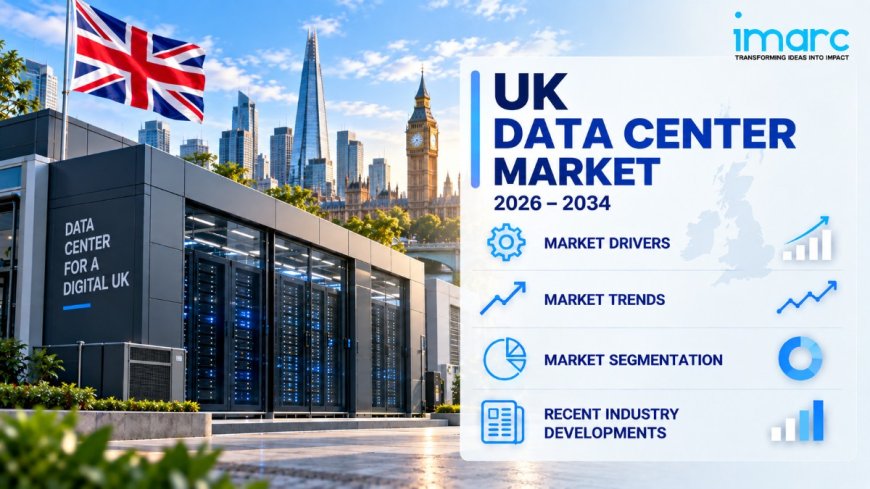
The UK data center market size was valued at USD 7,459.39 Million in 2025, is projected to reach USD 12,457.48 Million by 2034, growing at a CAGR of 5.65%.

Market Overview
The UK data center market is growing, driven by rising adoption of cloud computing services, rapid adoption of AI workloads, the UK's strategic position as Europe's premier connectivity hub, and the government's 2023 recognition of data centers as Critical National Infrastructure. The market size was valued at USD 7,459.39 Million in 2025 and is projected to reach USD 12,457.48 Million by 2034, registering a compound annual growth rate (CAGR) of 5.65% during 2026-2034. Enhanced focus on sustainability and net-zero commitments, edge computing expansion, liquid cooling adoption, and modular construction are further shaping the UK data center market share and outlook through 2034.
Request a Sample Report for In-Depth Market Insights: https://www.imarcgroup.com/uk-data-center-market/requestsample
Market Summary
-
Cloud adoption and digital transformation, supported by government cloud-first policies and NHS digital transformation, are increasing demand for data center capacity and intensifying competition among operators, with the market focused on diverse solutions for varying enterprise needs.
-
A competitive landscape anchored by global hyperscalers AWS, Microsoft Azure, and Google Cloud alongside colocation operators Equinix, Digital Realty, and CyrusOne is driving differentiation through sustainability credentials and AI-ready high-density infrastructure.
-
AI and machine learning workload surge is driving high-density infrastructure investment, with Alphabet announcing plans in September 2025 to invest 5 billion pounds (USD 6.82 Billion) over two years in UK AI research, DeepMind expansion, and green data centers.
-
Critical National Infrastructure designation in September 2023 has strengthened investor confidence, providing enhanced government support during cyber incidents and outages while improving resilience and reducing operational risks.
-
Solution component commands 56.3% share, hyperscale leads type at 40.2%, large enterprises hold 58.4%, IT and telecom dominates end user at 28.7%, and London commands 35.1% in 2025.
-
The market is segmented by component, type, enterprise size, end user, and region for 2026-2034, with power availability constraints, planning delays, and rising energy costs shaping operator strategies.
Market Growth Drivers
Cloud Adoption and Digital Transformation Across Enterprise and Public Sectors
The UK's enterprise and public sector cloud migration is driving sustained demand for data center capacity. Government cloud-first policies, NHS digital transformation, and enterprise adoption of hybrid and multi-cloud architectures are increasing colocation and hyperscale usage, while frameworks like G-Cloud and Crown Hosting support structured procurement and long-term capacity planning. Organizations across financial services, healthcare, retail, and the public sector are migrating critical workloads to cloud and colocation environments, requiring scalable, resilient infrastructure to support digital transformation initiatives and growing data volumes across the UK economy.
AI and Machine Learning Workload Surge Driving High-Density Infrastructure Investment
Generative AI adoption in the UK's financial services, healthcare, media, and professional services sectors is driving significant demand for computing resources. In September 2025, Alphabet, the parent company of Google, announced plans to invest 5 billion pounds (USD 6.82 Billion) over two years in UK AI research, the expansion of DeepMind, and green data centers. This investment supports Britain's ambition to become a global leader in AI. The rapid adoption of artificial intelligence, machine learning, and high-performance computing is becoming the primary growth engine of the UK data center market, with Nscale, a UK-based AI infrastructure company, raising USD 2 Billion in Series C funding to accelerate global expansion of its AI data center and compute platform.
Critical National Infrastructure Designation Strengthening Investor Confidence and Government Support
The UK government's recognition of data centers as Critical National Infrastructure has materially strengthened the investment case for the sector. The designation provides enhanced government support during cyber incidents and outages, improves resilience, and reduces operational risks. This policy reassurance is encouraging large-scale investments, including multibillion-pound projects supporting jobs and long-term digital infrastructure growth. Operators have received increased government support during cyberattacks and major disruptions and are engaging more directly with regulators on planning, energy, and workforce development. The government has also increased efforts to address structural barriers, including grid connections and workforce training.
Porter's Five Forces Analysis
Competitive Rivalry: High
-
Global hyperscalers including AWS, Microsoft Azure, and Google Cloud alongside colocation operators Equinix, Digital Realty, CyrusOne, VIRTUS Data Centers, Ark Data Centers, Kao Data, and Vantage Data Centers are competing on capacity, connectivity, and AI readiness.
-
Operators are differentiating through sustainability credentials, AI-ready high-density infrastructure, and geographic diversification into secondary markets.
-
Long-term hyperscaler pre-commitment relationships support capital investment decisions and competitive positioning.
Supplier Power: Moderate to High
-
Power distribution, cooling system, and IT hardware suppliers hold influence, with solution components representing 56.3% of market value.
-
Liquid cooling technology providers are gaining importance as AI workloads increase density requirements.
-
Energy suppliers hold significant leverage given power availability constraints and the UK's high electricity costs relative to Europe.
Buyer Power: High
-
Large enterprises, hyperscalers, and government customers can compare and switch providers based on capacity, connectivity, resilience, and pricing.
-
Price sensitivity is high given rising energy costs, though customers pay premiums for carrier-neutral connectivity and low-latency proximity.
-
Demand for sustainability credentials, operational resilience, and AI-ready infrastructure is raising expectations for service quality.
Threat of Substitutes: Low to Moderate
-
On-premises infrastructure provides an alternative for some workloads, though cloud and colocation offer superior scalability and cost efficiency.
-
Alternative European data center markets including Frankfurt, Amsterdam, and Dublin provide substitutes for cross-border capacity.
-
Edge computing complements rather than replaces core data center capacity for latency-sensitive applications.
Threat of New Entrants: Moderate
-
Institutional infrastructure capital and hyperscaler pre-commitments are enabling new capacity development.
-
Power availability constraints, planning permission complexity, and capital intensity raise operational barriers.
-
Established operators with connectivity, land banks, and hyperscaler relationships favor incumbents.
Market Segmentation
Component Insights
-
Solution
-
Services
Type Insights
-
Hyperscale
-
Colocation
-
Edge
-
Others
Enterprise Size Insights
-
Large Enterprises
-
Small and Medium Enterprises
End User Insights
-
IT and Telecom
-
BFSI
-
Government
-
Energy and Utilities
-
Others
Regional Insights
-
London
-
South East
-
North West
-
East of England
-
South West
-
Scotland
-
West Midlands
-
Yorkshire and The Humber
-
East Midlands
-
Others
Regional Analysis
London: London dominates the UK data center market with a 35.1% share in 2025, strengthening its status as one of the world's top five global data center markets alongside Northern Virginia, Singapore, Frankfurt, and Amsterdam. The capital's advantages include unparalleled carrier-neutral connectivity anchored by the London Internet Exchange (LINX), proximity to global financial markets, a deep pool of digital infrastructure talent, and established long-term relationships with all major hyperscalers. Key clusters include Docklands/East London, Slough/Heathrow M4 Corridor, Park Royal, and City of London financial district proximity. Grid power availability, Green Belt planning restrictions, and land cost premiums are redirecting new large-scale development to the M25 periphery and secondary markets.
South East: The South East represents a significant regional market for data centers, supported by proximity to London, the M4 corridor's established connectivity infrastructure, and a concentration of enterprise and financial services demand. The region benefits from Slough and Heathrow corridor capacity while increasingly absorbing new development redirected from constrained central London locations.
North West: The North West, including Manchester, is emerging as a significant secondary market, supported by growing technology ecosystems, enterprise demand, and improving connectivity infrastructure. Operators are increasingly targeting the region for new capacity as London power constraints intensify, with Manchester positioning itself as a northern digital infrastructure hub.
East of England: The East of England has mid-range demand, with the London-Stansted M11 corridor attracting campus-style development. Kao Data's KLOUD Campus in Harlow exemplifies purpose-built carrier-neutral campus operations positioned near London connectivity nodes and targeting AI compute and research institution customers.
South West: The South West has a growing data center market, supported by enterprise demand, research institutions, and improving connectivity infrastructure, with operators targeting regional capacity to serve local businesses and complement London-centric operations.
Scotland: Scotland is emerging as a significant secondary market for data center capacity, supported by renewable energy availability, cooler climate advantages, and government support for digital infrastructure. Operators are increasingly targeting Scotland for large campus-style facilities as London becomes constrained by power and land costs.
West Midlands: The West Midlands has mid-range demand, with its central location, manufacturing base, and logistics infrastructure supporting data center development. The region is positioned to absorb capacity redirected from London and the M4 corridor as power constraints intensify.
Yorkshire and The Humber: Yorkshire and The Humber has demand around the national average, with large urban centres supporting enterprise demand and improving connectivity infrastructure enabling regional capacity development.
East Midlands: The East Midlands has mid-range demand, with Northampton emerging as a significant data center cluster benefiting from power availability, land costs, and connectivity advantages relative to central London.
Others: Other regions, including Wales and Northern Ireland, generally see lower-to-mid demand, although government digital infrastructure initiatives and improving connectivity are supporting gradual capacity development.
Competitive Landscape
The UK data center landscape is anchored by global hyperscalers—Amazon Web Services, Microsoft Azure, and Google Cloud—which account for an estimated majority of new capacity investment. Major international colocation operators include Equinix, Digital Realty, and CyrusOne. Domestic specialists include VIRTUS Data Centers, Ark Data Centers, and Kao Data. Operators are differentiating through sustainability credentials and AI-ready high-density infrastructure, alongside geographic diversification into secondary markets and developing long-term hyperscaler pre-commitment relationships to support capital investment decisions. The report covers market structure, key player positioning, top winning strategies, competitive dashboard, and company evaluation quadrant, along with detailed profiles of all major companies.
Key players include:
-
Equinix Inc.
-
Digital Realty Trust Inc.
-
Amazon Web Services (AWS)
-
Microsoft Azure
-
Google Cloud
-
CyrusOne LLC
-
Vantage Data Centers
-
VIRTUS Data Centers
-
Ark Data Centers
-
Kao Data
Recent Industry Developments
November 2026: Drax, Brookfield and Radiant announced a strategic partnership to develop more than 1 GW of AI data center capacity at Drax Power Station in North Yorkshire. The overall development could attract more than £20 billion in investment, with the first phase targeting up to 100 MW of capacity and up to £2.5 billion in financial backing. The initial facility is targeted to become operational in the first quarter of 2028, subject to planning, regulatory and investment approvals. The partnership combines Drax's land and power infrastructure with Radiant's AI infrastructure expertise and Brookfield's investment capabilities.
November 2026: The UK Government published a draft National Policy Statement for data centers in England, establishing a proposed planning and assessment framework for major facilities seeking consent through the Nationally Significant Infrastructure Projects process. The draft addresses the assessment of large-scale data center developments and is open for consultation until January 8, 2027. The framework is intended to provide greater clarity for developers while considering the infrastructure and wider impacts associated with new facilities.
November 2026: The UK Government outlined plans to bring qualifying data centers under the Cyber Security and Resilience Bill, recognising data infrastructure as an essential service. Facilities with a rated IT load of at least 1 MW would generally fall within the proposed regulatory scope, while enterprise data centers would be covered at a threshold of 10 MW. Operators would be required to implement proportionate cybersecurity and operational resilience measures and report significant incidents. The proposals reflect the growing importance of data centers to the UK's critical digital infrastructure.
October 2026: The UK Government advanced its Data Centre Covenant, setting out measures to accelerate electricity connections for strategically important data center projects. These include prioritising qualifying developments for grid capacity, exploring temporary power arrangements where necessary, and aligning data center connections with regional infrastructure targets beyond 2030. The framework also seeks to discourage speculative applications that occupy scarce grid capacity without demonstrating sufficient project progress.
Key Aspects Required for the UK Data Center Market
-
Market Performance: The market was valued at USD 7,459.39 Million in 2025 and is projected to reach USD 12,457.48 Million by 2034, driven by cloud adoption, AI workloads, connectivity hub status, and Critical National Infrastructure designation.
-
Market Outlook: A 5.65% CAGR during 2026-2034 reflects steady growth supported by cloud, AI, edge computing, and digital transformation, with secondary UK markets in Manchester, the Midlands, and Scotland gaining larger shares as London becomes constrained by power and land costs.
-
Growth Drivers: Cloud adoption and digital transformation across enterprise and public sectors; AI and machine learning workload surge driving high-density infrastructure investment; and Critical National Infrastructure designation strengthening investor confidence and government support.
-
Competitive Landscape: Hyperscalers AWS, Microsoft Azure, and Google Cloud alongside colocation operators Equinix, Digital Realty, CyrusOne, VIRTUS, Ark, Kao Data, and Vantage are competing on capacity, connectivity, sustainability, and AI readiness.
-
Value Chain Analysis: The value chain runs from power, cooling, and IT hardware suppliers through data center operators and colocation providers to enterprise, hyperscale, and government customers across UK regions, supported by connectivity infrastructure including LINX, energy suppliers, and construction partners.
-
Industry Trends: AI and high-density compute reshaping design architecture; sustainability and net-zero commitments driving operational transformation; edge computing expansion; liquid cooling adoption; modular and prefabricated construction; and Critical National Infrastructure status elevating government engagement.
-
Strategic Recommendations: Invest in AI-ready high-density infrastructure with liquid cooling capability; expand into secondary markets including Manchester, the Midlands, and Scotland to access power and land; strengthen sustainability credentials through renewable energy and net-zero commitments; and develop long-term hyperscaler pre-commitment relationships to support capital investment.
Note: If you need any specific information that is not currently covered within the scope of the report, we will provide the same as a part of customization.
Speak to an analyst: https://www.imarcgroup.com/request?type=report&id=23076&flag=C
Frequently Asked Questions
1. What is the size of the UK data center market?
The market was valued at USD 7,459.39 Million in 2025 and is projected to reach USD 12,457.48 Million by 2034.
2. What is the expected growth rate of the UK data center market?
The market is projected to grow at a CAGR of 5.65% during 2026-2034.
3. What is driving the growth of the UK data center market?
Growth is driven by accelerating enterprise and public sector cloud migration, the surge in AI and machine learning workload demands, Critical National Infrastructure designation providing regulatory support, 5G-driven edge computing requirements, data sovereignty and UK GDPR requirements, and sustained hyperscaler capital investment commitments.
What's Your Reaction?