































Japan Air Freight Logistics Market Expansion: Trade Demand & Growth Analysis 2026-2034
The Japan freight logistics market size increased from USD 331.3 Billion in 2025 to USD 340.5 Billion in 2026 and is projected to reach USD 423.2 Billion by 2034 at a CAGR of 2.76% during 2026-2034.

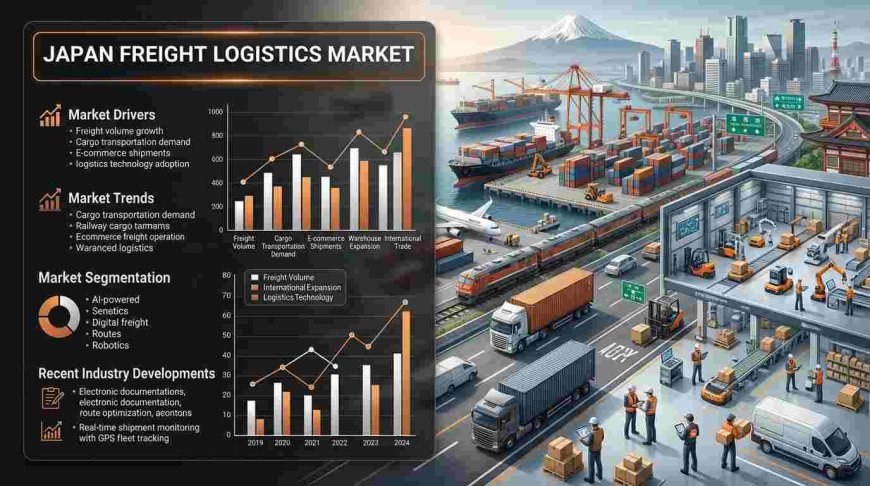
IMARC Group, a leading global market research and management consulting firm, has published its latest market intelligence report on the Japan Freight Logistics Market. The Japan freight logistics market size increased from USD 331.3 Billion in 2025 to USD 340.5 Billion in 2026 and is expected to reach USD 423.2 Billion by 2034, exhibiting a CAGR of 2.76% during 2026-2034. Growth is being driven by expanding transportation infrastructure, rising e-commerce activity, increasing demand for efficient cargo movement, automation adoption, and the need to strengthen supply chain connectivity.
Freight logistics remains one of the most critical components of Japan's highly developed industrial and commercial ecosystem, supporting the movement of raw materials, components, manufactured products, consumer goods, food and beverages, and high-value exports across domestic and international markets. Japan's extensive road, rail, maritime, and air transportation infrastructure enables efficient movement of goods across major economic centers, while strategic ports and airports strengthen the country's role in Asia-Pacific trade. At the same time, logistics operators are increasingly investing in automation, robotics, digital platforms, and advanced distribution hubs to overcome labor shortages and improve delivery efficiency. The rapid expansion of e-commerce, rising demand for time-sensitive shipments, and increasing adoption of sustainable freight solutions are further reshaping the competitive landscape and setting the stage for continued long-term growth across the Kanto, Kansai/Kinki, Central/Chubu, Kyushu-Okinawa, Tohoku, Chugoku, Hokkaido, and Shikoku regions.
Japan Freight Logistics Market at a Glance:
- Market Size (2025): USD 331.3 Billion
- Market Size (2026): USD 340.5 Billion
- Market Forecast (2034): USD 423.2 Billion
- Growth Rate (2026-2034): CAGR of 2.76%
- Base Year: 2025 | Historical Period: 2020-2025 | Forecast Period: 2026-2034
- Leading Type Segment: Road, offering significant flexibility and direct access to urban, suburban, and remote locations across Japan
- Leading End User Segment: Manufacturing, supported by strong demand for transporting raw materials, components, and industrial products
How Digital Transformation Is Reshaping the Future of the Japan Freight Logistics Market
- Automation, Robotics, and Smart Logistics Hubs: Japanese logistics companies are increasingly integrating automated handling systems, robotics, digital tracking, and smart distribution centers to improve operational efficiency, reduce manual workloads, and address persistent labor shortages. Logistics hubs positioned near ports, airports, and rail terminals are becoming important centers for technology-enabled freight management.
- E-Commerce and Faster Delivery Requirements: The rapid growth of online shopping is increasing demand for reliable, flexible, and faster freight services across Japan. Consumer expectations for timely deliveries are encouraging logistics operators to strengthen regional distribution networks, optimize routes, and expand last-mile capabilities.
- AI, Autonomous Freight, and Logistics DX: Digital transformation is becoming increasingly important as Japan addresses workforce shortages and transportation capacity constraints. Government initiatives are promoting logistics DX, automation, autonomous trucking demonstrations, drone logistics, and standardization of logistics data and equipment to improve supply chain productivity.
Grab a sample PDF of this report: https://www.imarcgroup.com/japan-freight-logistics-market/requestsample
Japan Freight Logistics Market Trends and Drivers:
The expansion and modernization of transportation infrastructure is one of the key factors supporting Japan's freight logistics market. High-speed rail networks facilitate efficient intercity freight movement, while upgraded highways and expressways improve road-based cargo transportation and last-mile distribution. Major ports are also undergoing expansion and modernization, including larger container terminals, while logistics hubs and distribution centers are increasingly being developed near ports, airports, and rail terminals. These infrastructure improvements are strengthening domestic distribution capabilities and supporting Japan's position within regional and global supply chains.
The rapid expansion of e-commerce is another major market driver. Growing online shopping activity has increased demand for reliable and fast freight services, particularly for consumer goods and small shipments. At the same time, Japan's manufacturing and automotive industries require dependable transportation of raw materials, components, and finished products, while food and beverage logistics increasingly depends on timely and controlled transportation to preserve product freshness. These diverse end-use requirements are sustaining demand for road, maritime, rail, and air freight services across the country.
A third driver is the growing need to address labor shortages and transportation capacity constraints. Japan's logistics industry has been affected by an aging workforce and the implementation of working-hour restrictions for truck drivers under the country's logistics "2024 problem." This has accelerated investment in automation, modal shifting, optimized freight operations, and alternative delivery technologies. Government policy is also increasingly focused on improving logistics productivity, strengthening supply chain resilience, and promoting digitalization and automation through 2030.
Government Initiatives and Logistics Policy Driving Market Development:
- Comprehensive Physical Distribution Policy Outline FY2026-2030: The Japanese government approved the Comprehensive Physical Distribution Policy Outline for FY2026-2030 in March 2026, focusing on improving logistics efficiency, addressing transportation capacity constraints, improving the working environment for logistics personnel, promoting logistics DX and GX, and strengthening supply chain resilience.
- Logistics Innovation and 2024 Problem Measures: Japan has implemented measures to address truck-driver shortages and transportation capacity constraints through logistics efficiency improvements, changes in shipper and consumer behavior, and reforms to commercial practices. These measures are encouraging companies to optimize transportation and distribution operations.
- Logistics Efficiency Law: Japan's revised logistics efficiency framework places efforts on shippers and logistics operators to improve logistics efficiency, while specified large-scale businesses face additional requirements relating to medium- and long-term plans and reporting from FY2026.
- Promotion of Logistics DX and Standardization: Government programs are encouraging digitalization, automation, mechanization, autonomous trucking, drone logistics, and standardization of pallets and logistics data to optimize supply chains and improve productivity.
- Sustainable and Green Logistics: Japan is increasingly emphasizing environmentally sustainable transportation and logistics solutions, including green logistics, energy-efficient operations, and technologies designed to reduce carbon emissions throughout freight transportation networks.
Japan Freight Logistics Market Industry Segmentation:
The report has segmented the market into the following categories:
Breakup By Type:
- Road
- Maritime
- Rail
- Air
Road transport holds a substantial market share due to its flexibility and ability to provide direct delivery across urban, suburban, and remote areas. Trucks can accommodate different cargo types and delivery schedules, making road transportation particularly important for domestic distribution and last-mile freight movement. Maritime transport also remains vital because Japan is an island nation with extensive port infrastructure and strong international trade connections, while rail and air freight provide efficient alternatives for medium-to-long-distance and time-sensitive cargo movement.
Breakup By End User:
- Manufacturing
- Automotive
- Consumer Goods
- Food and Beverage
- Others
Manufacturing represents a major end-user segment due to Japan's strong industrial base and the continuous requirement to transport raw materials, components, machinery, and finished products. The automotive sector further generates substantial freight demand through domestic production and international supply chains, while consumer goods and food and beverage companies increasingly require fast, reliable, and specialized logistics services to support retail distribution and e-commerce fulfillment.
Breakup By Region:
- Kanto Region
- Kansai/Kinki Region
- Central/Chubu Region
- Kyushu-Okinawa Region
- Tohoku Region
- Chugoku Region
- Hokkaido Region
- Shikoku Region
The Kanto region accounts for a considerable portion of Japan's freight logistics activity, supported by Tokyo's role as a major commercial, industrial, transportation, and distribution hub. The Kansai/Kinki and Central/Chubu regions also represent important logistics centers due to their manufacturing concentration, ports, airports, and strong connections with domestic and international supply chains. Meanwhile, Kyushu-Okinawa, Tohoku, Chugoku, Hokkaido, and Shikoku continue contributing to regional freight movement through their respective industrial, agricultural, commercial, and trade activities.
Competitive Landscape:
Key industry participants are concentrating on network expansion, automation, digital transformation, sustainability, and integrated freight solutions, while strengthening their domestic and international service capabilities. Key players include:
- DHL
- FedEx Corporation
- Japan Post Co. Ltd.
- Nippon Express Co. Ltd.
- Sagawa Express Co. Ltd.
- Seino Transportation Co. Ltd.
- Yamato Transport Co. Ltd.
Leading logistics providers are increasingly investing in specialized freight services, technology-enabled operations, international connectivity, and sustainable transportation solutions. For instance, Yamato Group launched a cargo aircraft service connecting Tokyo's Haneda Airport, Sapporo's New Chitose Airport, and Kitakyushu Airport in August 2024, expanding its cargo network and strengthening regional distribution capabilities. Nippon Express also launched a Japan-US airfreight service between Chubu Centrair International Airport and Cincinnati/Northern Kentucky International Airport in June 2024 to address demand for urgent cargo transportation.
Market Concentration Analysis:
- Established domestic logistics companies, including Japan Post, Nippon Express, Sagawa Express, Seino Transportation, and Yamato Transport, maintain strong positions through extensive distribution networks, nationwide coverage, and diversified freight services.
- International logistics companies such as DHL and FedEx are strengthening their presence in Japan through cross-border freight, express transportation, specialized cargo services, and international supply chain solutions.
- Competition is increasingly shifting toward technology-enabled and integrated logistics solutions, with companies investing in automation, robotics, digital platforms, sustainable transportation, and advanced logistics hubs to overcome labor shortages and improve operational efficiency.
- The market remains competitive as providers differentiate themselves through service reliability, geographic reach, cargo handling capabilities, international connectivity, and the ability to provide end-to-end logistics solutions.
What Does The Full Report Cover?
- Historical, current, and forecast market size for the Japan freight logistics market from 2020 to 2034
- Market breakup by type, end user, and region
- Regional analysis covering Kanto, Kansai/Kinki, Central/Chubu, Kyushu-Okinawa, Tohoku, Chugoku, Hokkaido, and Shikoku
- Key growth drivers, restraints, and opportunities shaping the market
- Porter's Five Forces analysis and value chain assessment
- Competitive landscape, market structure, and player positioning
- Detailed profiles of major domestic and international freight logistics companies
Recent News and Developments in the Japan Freight Logistics Market
- February 2024: DHL Express announced a collaboration with SCREEN Semiconductor Solutions Co. Ltd. to achieve carbon neutrality in logistics operations in alignment with Japan's Mission 2050, including the use of sustainable aviation fuel through its GoGreen Plus service.
- June 2024: Nippon Express launched a new Japan-US airfreight service connecting Chubu Centrair International Airport with Cincinnati/Northern Kentucky International Airport to address demand for urgent cargo transportation, particularly from automotive-related industries.
- August 2024: Yamato Group launched a cargo aircraft service connecting Tokyo's Haneda, Sapporo's New Chitose, and Kitakyushu airports, expanding its cargo transportation network and supporting faster regional and national distribution.
- March 2026: Japan's Cabinet approved the Comprehensive Physical Distribution Policy Outline for FY2026-2030, establishing measures to improve logistics efficiency, strengthen logistics personnel capabilities, promote logistics DX and GX, and enhance supply chain resilience.
- 2026: Japan continued advancing logistics-efficiency measures under its revised logistics framework, with efforts applying to all shippers and logistics operators from FY2025 and additional obligations for specified large-scale operators from FY2026.
Note: If you require specific details, data, or insights that are not currently included in the scope of this report, we are happy to accommodate your request. As part of our customization service, we will gather and provide the additional information you need, tailored to your specific requirements. Please let us know your exact needs, and we will ensure the report is updated accordingly to meet your expectations.
Key Questions This Report Answers
- How big is the Japan freight logistics market and what is its growth outlook through 2034?
- What are the key growth drivers, restraints, and opportunities in the Japan freight logistics market?
- Which type segment holds the largest share of the Japan freight logistics market?
- Which end-user industries are generating the highest demand for freight logistics services?
- Which region leads the Japan freight logistics market, and why?
- How are e-commerce growth, infrastructure development, and international trade shaping freight logistics demand?
- How are automation, robotics, AI, and logistics DX transforming Japan's freight logistics industry?
- Who are the key players in the Japan freight logistics market, and how is the competitive landscape evolving?
About Us
IMARC Group is a global management consulting firm that helps the world's most ambitious changemakers to create a lasting impact. The company provides a comprehensive suite of market entry and expansion services. IMARC offerings include thorough market assessment, feasibility studies, company incorporation assistance, factory setup support, regulatory approvals and licensing navigation, branding, marketing and sales strategies, competitive landscape and benchmarking analyses, pricing and cost research, and procurement research.
Media and Sales Contact
IMARC Group
Email: sales@imarcgroup.com
United States: +1-201-971-6302
India: +91-120-433-0800
United Kingdom: +44-753-714-6104
What's Your Reaction?