



































India Electric Substation Market, Trends, Growth, Share, Size, Analysis, Forecast 2034
The India electric substation market size reached USD 4.2 Billion in 2025. Looking forward, IMARC Group expects the market to reach USD 6.6 Billion by 2034, exhibiting a growth rate (CAGR) of 4.88% during 2026-2034.
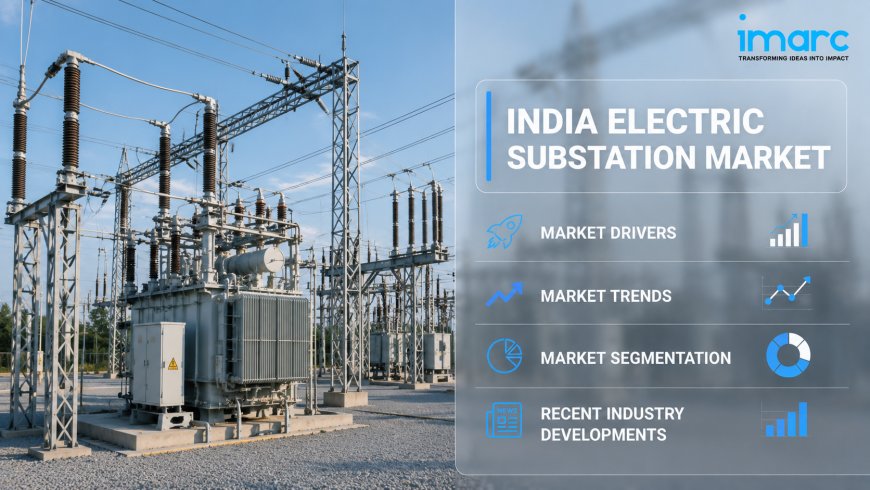
According to IMARC Group's report titled "India Electric Substation Market Size, Share, Trends and Forecast by Type, Application, and Region, 2026-2034", The report offers a comprehensive analysis of the India electric substation industry, including market forecast, growth, Size, and regional insights.
India’s rapid shift toward renewable energy integration and industrial modernization is forcing a structural overhaul of its power transmission framework. For institutional investors and power sector stakeholders, the domestic electric substation sector presents a high-yield, capital-intensive growth avenue underpinned by state-backed grid reinforcements.
-
Market Valuation: Valued at USD 4.2 billion in 2025, the sector demonstrates robust expansion fundamentals.
-
Growth Trajectory: Projected to reach USD 6.6 billion by 2034, registering a steady 4.88% CAGR from 2026 to 2034.
-
Capacity Expansion Target: Actively building infrastructure to integrate 20 GW of renewable energy through new transmission pipelines by 2026.
-
M&A and Consolidation: Highlighted by Power Grid Corporation of India’s ₹651 million acquisition of KVB1B2 in 2025, signaling strong tariff-based competitive bidding (TBCB) activity.
Current Market Trends
-
Adoption of Gas Insulated Substations (GIS): To overcome land scarcity and right-of-way (RoW) constraints in urban centers and difficult terrains, the sector is aggressively shifting from conventional Air Insulated Substations (AIS) to highly compact Gas Insulated Substations (GIS). For instance, central PSUs like the Power Grid Corporation of India Limited (POWERGRID) have successfully deployed state-of-the-art GIS substations in challenging environments such as Chamba, Hamirpur, and Banala.
-
Automation and Smart Grid Integration: Substation infrastructure is becoming increasingly digitized to enable real-time monitoring and swift fault response. Under the government's Revamped Distribution Sector Scheme (RDSS), the Ministry of Power is funding the widespread integration of Supervisory Control and Data Acquisition (SCADA) and Distribution Management Systems (DMS) to improve the reliability and efficiency of power distribution networks.
-
Dedicated Infrastructure for Renewable Integration: Substations are undergoing systemic upgrades to manage the intermittency of non-fossil energy sources. Under Phase-II of the government's Green Energy Corridor (GEC) scheme, an estimated 27,546 MVA of new substation transformation capacity is being rolled out specifically to facilitate the grid integration and power evacuation of renewable energy projects.
Market Growth Catalysts
-
Massive Transmission Blueprint Up to 2035: The most significant demand driver is the Ministry of Power's comprehensive "Transmission Plan for Integration of over 900 GW Non-Fossil Fuel Capacity by 2035-36." This ambitious blueprint dictates a monumental addition of 8,27,600 MVA in new substation capacity, carrying an estimated overarching investment of ₹7.93 lakh crore dedicated to seamless renewable energy evacuation.
-
Upward Revision of National Transformation Capacity: According to the Central Electricity Authority (CEA) and the National Electricity Plan, India's broader power transformation capacity is projected to expand dramatically from 1,478 GVA (as of mid-2026) to 2,345 GVA by the year 2032. This aggressive national target guarantees sustained capital expenditure toward high-voltage substation development over the current decade.
-
Funding via Revamped Distribution Sector Scheme (RDSS): The central government is directly financing the strengthening of sub-transmission and distribution networks. Under the RDSS, projects worth ₹1.53 lakh crore have been sanctioned specifically for loss-reduction infrastructure, which heavily subsidizes the creation of new substations, the upgradation of existing facilities, and the augmentation of distribution transformers.
➤ Unlock Industry Insights and Future Forecasts – Request Sample Report: https://www.imarcgroup.com/india-electric-substation-market/requestsample
Competitive Scenario
-
Central and State Utility Dominance: The competitive landscape is predominantly anchored by central public sector enterprises (CPSEs) like POWERGRID, which handles major Inter-State Transmission System (ISTS) and ultra-high-voltage substation developments. Parallelly, respective State Transmission Utilities (STUs) command the execution of intra-state infrastructure under centrally sponsored schemes like the GEC.
-
Surge in Tariff-Based Competitive Bidding (TBCB): To encourage private sector participation, the government routes significant ISTS substation and transmission network projects through the TBCB mechanism. This transparent bidding framework has intensified market competition, allowing private engineering, procurement, and construction (EPC) companies to competitively bid to build, own, operate, and maintain large-scale substations.
-
Indigenization and Public Procurement Preferences: To support the "Aatmanirbhar Bharat" and Make in India initiatives, competitive sourcing is actively pivoting toward domestic manufacturers. Policies enforcing minimum local content are compelling foreign original equipment manufacturers (OEMs) of transformers, reactors, and substation automation systems to localize their manufacturing and supply chains to qualify for public procurement contracts under central government schemes.
India Electric Substation Market Segmentation:
IMARC Group provides an analysis of the key trends in each segment of the market, along with forecasts at the region level for 2026-2034. Our report has categorized the market based on type and application.
Type Insights:
-
AIS Substation
-
GIS Substation
Application Insights:
-
Power Transmission and Distribution
-
Manufacturing and Processing
Regional Insights:
-
North India
-
South India
-
East India
-
West India
Note: If you need specific information that is not currently within the scope of the report, we can provide it to you as a part of the customization.
➤ Align Insights with Your Business Goals – Request Customization: https://www.imarcgroup.com/request?type=report&id=30413&flag=E
Frequently Asked Questions (FAQs)
Q1: What is the current value and projected growth of the India Electric Substation Market?
According to IMARC Group, the India electric substation market size reached USD 4.2 Billion in 2025 and is expected to reach USD 6.6 Billion by 2034, exhibiting a CAGR of 4.88% during 2026-2034.
Q2: Which type of substation currently shows the highest adoption rate in urban centers?
Gas-Insulated Substations (GIS) are experiencing accelerated adoption in urban areas due to their compact footprint, high operational reliability, and reduced maintenance requirements compared to traditional Air-Insulated Substations (AIS).
Q3: What are the primary end-use applications for electric substations in India?
The market is fundamentally segmented into power transmission and distribution, which holds the absolute majority share due to state-sponsored grid expansions, followed by manufacturing and processing driven by industrial automation.
Q4: How does renewable energy integration impact substation demand?
The national objective to integrate 20 GW of renewable energy by 2026 requires massive structural upgrades, necessitating smart substations equipped with advanced power transformers to handle the volatility of solar and wind inputs.
Q5: Which regions are driving the majority of transmission infrastructure investments?
Capital expenditures are highly concentrated in North, West, and South India, directly aligning with the execution of the Green Energy Corridor project spanning states like Gujarat, Rajasthan, Karnataka, and Tamil Nadu.
Strategic Insight & Verdict:
As India recalibrates its transmission architecture to accommodate massive renewable capacity injections, the capital expenditure cycle is firmly shifting toward digitalized, high-voltage infrastructure. Analyzing the aggressive procurement of smart grid technologies and GIS units, we at IMARC Group have observed that early-stage investments in automated, decentralized substation assets yield optimal risk-adjusted returns. For institutional capital, aligning portfolios with the Ministry of Power’s modernization directives and TBCB transmission projects offers a highly resilient, long-term structural growth opportunity.
Verified Data Source: India Electric Substation Market Report By IMARC Group
What's Your Reaction?