



























Portable LIBS Spectrometer LIS-02, Carbon detection spectrometer
Portable LIBS Spectrometer LIS-02 deducts the carbon without use of argon gas in one second. It is Fast, precise metal analyzer.

Portable LIBS Spectrometer: A Practical Guide to Fast Metal
and
Alloy Analysis
A Portable LIBS Spectrometer brings elemental analysis closer to the point where technical decisions happen. Instead of moving every metal component to a laboratory, inspection teams can use laser-based spectroscopy directly on the material.
This approach is especially useful in metallurgy, steel production, automotive manufacturing, aerospace, fabrication, recycling, and quality inspection. The Portable LIBS Spectrometer LIS-02 is designed for this type of industrial application. NPPSD describes it as a compact instrument for rapid elemental analysis of metals and alloys, including carbon measurement in steel without argon gas.
However, choosing a spectrometer should involve more than looking at measurement speed. Technical teams should consider the material range, required elements, measurement procedure, calibration, safety, operating environment, and operator competence.
This article explains the technology and the practical factors that matter when evaluating a portable LIBS system.
What Is a Portable LIBS Spectrometer?
LIBS stands for Laser-Induced Breakdown Spectroscopy.
A LIBS instrument focuses a laser pulse onto a material surface. The laser creates a small plasma. As the excited atoms and ions return toward lower energy states, they emit characteristic wavelengths of light.
The spectrometer measures those wavelengths. Software then relates the spectral information to the elements present in the sample.
In simple terms:
Laser pulse → Plasma formation → Light emission → Spectral measurement → Element identification
This makes LIBS useful for rapid elemental analysis.
Unlike a conventional laboratory workflow, a portable system can be taken to large components, production areas, structures, or field inspection locations.
How Does a Portable LIBS Spectrometer Work?
The measurement process generally follows several practical stages.
1. Position the Instrument
The operator places the measurement head against the selected area.
Good positioning matters because surface condition and measurement geometry can influence the result.
2. Fire the Laser Pulse
The laser interacts with a small area of the sample surface.
The interaction produces plasma containing material from the analyzed region.
3. Collect the Emitted Light
The instrument collects the light produced by the plasma.
Different elements produce characteristic spectral lines.
4. Analyze the Spectrum
The instrument processes the measured spectrum and determines the presence and concentration of relevant elements.
5. Compare the Composition
The software can compare the measured composition with a grade library where applicable.
The LIS-02 includes a built-in grade library that can display a corresponding steel or alloy grade based on the analysis.
Portable LIBS Spectrometer LIS-02: Technical Overview
The Portable LIBS Spectrometer LIS-02 focuses on rapid analysis of metals and alloys.
According to NPPSD's published technical information, the instrument includes a 1064 nm pulsed DPSS laser, a 50-micron measurement point, and a 177–380 nm working spectral range. It also uses a 5-inch color touchscreen and supports Wi-Fi and Bluetooth data transfer.
| Parameter | LIS-02 |
|---|---|
| Technology | LIBS |
| Laser | Pulsed DPSS, 1064 nm |
| Measurement point | 50 micron |
| Measurement duration | 1.0 second |
| Spectral range | 177–380 nm |
| Display | 5-inch color touchscreen |
| Data transfer | Wi-Fi and Bluetooth |
| Battery | Replaceable Li-ion |
| Safety class | Class 3B laser |
| Languages | English, German, Russian |
| Grade library | Built-in |
| Camera | High-resolution camera |
These specifications come from NPPSD's published product information. Users should confirm the latest configuration and application-specific specifications with the manufacturer before procurement.
Carbon Detection: An Important LIBS Application
Carbon measurement often creates a practical challenge in portable metal analysis.
Carbon can help distinguish between different steel grades. Therefore, reliable carbon measurement can be important for material verification.
NPPSD states that the LIS-02 measures carbon concentration in steels without argon and directly in air.
This has practical implications for field inspection.
A conventional setup that requires an external gas supply can add logistical requirements. An argon-free approach can simplify measurements in locations where gas handling is inconvenient.
However, technical teams should still validate the instrument against their own reference materials, procedures, and acceptance criteria.
Portable LIBS Spectrometer Applications
A Portable LIBS Spectrometer can support several industrial inspection activities.
1. Positive Material Identification
PMI involves verifying the identity or composition of metallic materials.
Portable LIBS can help operators check material directly at the inspection location.
2. Steel Grade Identification
Elemental composition helps differentiate steel grades.
The LIS-02's grade-library functionality can assist with this comparison.
3. Scrap Sorting
Scrap yards and recycling operations often handle mixed metal streams.
Rapid elemental analysis can help separate materials according to composition.
NPPSD lists scrap sorting among the documented areas of use for LIS-02.
4. Incoming Material Inspection
Manufacturers can check selected incoming materials before they enter production.
This can provide an additional verification step alongside material certificates and established inspection procedures.
5. Production Quality Control
Manufacturing teams can perform measurements at selected stages of production.
That can help identify material mismatches earlier.
6. Aerospace and Automotive Applications
Aerospace and automotive components often require controlled material specifications.
Portable elemental analysis can support material verification, provided the measurement method meets the organization's applicable quality requirements.
Practical Example: Material Verification on a Production Floor
Consider a fabrication company receiving several batches of alloy steel.
The documentation identifies the material as a specified grade. However, the quality team wants to verify selected pieces before production.
A practical workflow could look like this:
Step 1: Select representative components.
Step 2: Inspect the measurement surface.
Step 3: Prepare the surface if the procedure requires it.
Step 4: Measure selected locations using the Portable LIBS Spectrometer.
Step 5: Review elemental results.
Step 6: Compare the composition against the applicable material specification.
Step 7: Record the result and trace it to the component or batch.
This approach does not replace every laboratory method. Instead, it can provide a rapid screening or verification tool within a broader quality system.
That distinction is important.
Portable LIBS Spectrometer vs Traditional Laboratory Analysis
Portable LIBS and laboratory instruments serve different purposes.
| Factor | Portable LIBS | Laboratory Analysis |
|---|---|---|
| Measurement location | On-site | Usually laboratory |
| Portability | High | Low |
| Large components | Practical | Often difficult |
| Measurement speed | Very fast | Depends on method |
| Sample transportation | Often reduced | Usually required |
| Field inspection | Strong application | Limited |
| Complex analysis | Depends on instrument | Often stronger |
| Operator skill | Important | Highly important |
| Reference procedures | Required | Required |
The correct choice depends on the inspection objective.
For rapid material identification, portability can provide a major operational advantage. For highly detailed laboratory characterization, a laboratory technique may remain more appropriate.
What Should You Check Before Buying a Portable LIBS
Spectrometer?
Technical and procurement teams should evaluate the following points.
Material Compatibility
Check whether the instrument covers the materials you actually inspect.
For example:
- Carbon steel
- Stainless steel
- Aluminum alloys
- Nickel alloys
- Titanium alloys
- Copper alloys
- Zinc-based materials
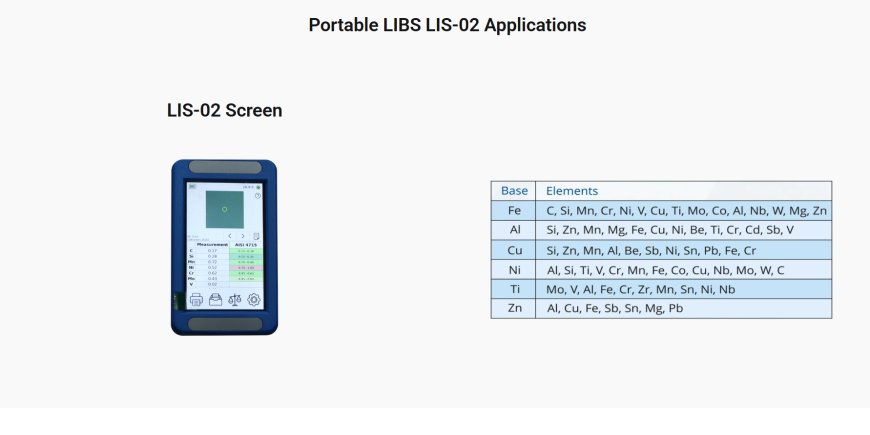
NPPSD states that LIS-02 supports ferrous materials and several non-ferrous material groups.
Required Elements
Create a list of elements that matter to your application.
The published LIS-02 information lists elements including C, Si, Mn, Cr, Ni, Fe, Mg, Al, V, Cu, Zn, Sn, Mo, Ti, W, Nb, Pd, Ag, Cd, Pt, and Au, among others.
Surface Condition
Surface condition can affect measurement quality.
Paint, coatings, corrosion, contamination, scale, and rough surfaces may require appropriate preparation or a defined measurement procedure.
Calibration and Reference Materials
Ask how calibration works for your materials.
Also establish how reference samples will be maintained and used.
Safety
LIBS systems use lasers. The LIS-02 documentation identifies its laser safety class as 3B.
Therefore, trained operators and appropriate laser-safety controls are essential.
Operator Training Matters
A sophisticated instrument cannot compensate for poor measurement practice.
Operators should understand:
- Instrument startup and shutdown
- Measurement positioning
- Surface preparation
- Calibration
- Reference samples
- Grade libraries
- Result interpretation
- Data recording
- Laser safety
- Routine maintenance
NPPSD states that its technical support includes installation, commissioning, operator training, maintenance, and after-sales support.
For organizations using LIBS as part of a formal inspection process, training should align with internal procedures and applicable industry requirements.
Real-World User Feedback
NPPSD's website publishes feedback from users of LIS-02. One user from JTEKT reported that carbon detection without argon made routine testing easier. Another user associated with Indian Railways highlighted the convenience of carbon detection and reliability across measured elements.
These comments are useful as user experiences, but they should not replace independent validation.
For a technical purchasing decision, organizations should request demonstrations, reference measurements, application data, and relevant documentation.
NPPSD and LIBS Technology
NPP Strukturnaya Diagnostika Pvt. Ltd. operates in the industrial LIBS and material-analysis field. NPPSD states that its technology originates from Russian expertise in laser physics and spectroscopy and that the company serves applications across metallurgy, manufacturing, oil and gas, recycling, automotive, aerospace, and steel industries.
NPPSD also provides technical support covering installation, commissioning, operator training, and maintenance.
For technical teams, this support can matter because successful LIBS implementation involves both equipment and measurement practice.
Frequently Asked Questions
1. What is a Portable LIBS Spectrometer?
A Portable LIBS Spectrometer is a handheld analytical instrument that uses Laser-Induced Breakdown Spectroscopy to identify and measure elements in materials.
2. What is the Portable LIBS Spectrometer LIS-02 used for?
The LIS-02 is designed for elemental analysis, metal identification, steel-grade checking, PMI, scrap sorting, and quality testing of metals and alloys.
3. Can the LIS-02 measure carbon in steel?
Yes. NPPSD states that LIS-02 can measure carbon concentration in steel without argon and directly in air.
4. How fast is LIS-02?
NPPSD specifies a measurement duration of approximately 1 second. Actual inspection workflow can vary with the sample and operating procedure.
5. Is Portable LIBS suitable for PMI?
Portable LIBS can support PMI and material verification applications. However, users should confirm that the instrument's specifications, calibration, procedures, and accuracy meet their particular PMI requirements.
Final Thought: Portable LIBS Spectrometer for Practical
Material Verification
A Portable LIBS Spectrometer is most valuable when speed, mobility, and elemental information matter at the inspection point.
The Portable LIBS Spectrometer LIS-02 combines portable operation with rapid elemental analysis and carbon measurement in steel without argon. Its published specifications also include a 50-micron measurement point, 177–380 nm spectral range, built-in grade library, touchscreen interface, and wireless data transfer.
Still, instrument selection should begin with the application rather than the specification sheet.
Define the materials, required elements, inspection procedure, accuracy requirements, operating environment, safety controls, and training needs first. Then evaluate whether a portable LIBS system fits that workflow.
For technical and commercial teams considering LIBS-based material analysis, NPP Strukturnaya Diagnostika Pvt. Ltd. can provide product information, application guidance, and operator-training support for the LIS-02.
What's Your Reaction?