






























India Palm Oil Market Size, Share, Industry Growth and Outlook Report 2026-2034
The India palm oil industry size reached a volume of 10.7 Million Tons in 2025. Looking forward, the market is expected to reach 16.82 Million Tons by 2034, exhibiting a compound annual growth rate (CAGR) of 5.11% during the forecast period of 2026-2034.

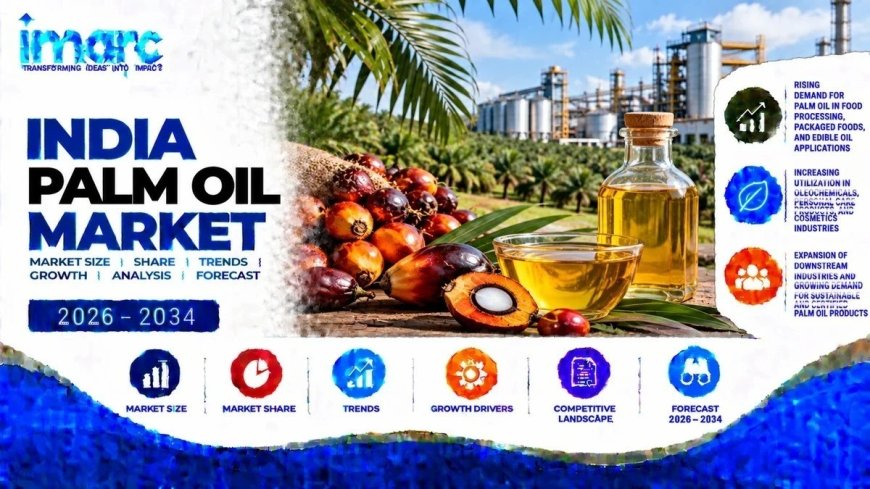
According to IMARC Group’s report titled “India Palm Oil Market Size, Share, Trends and Forecast by Packaging Type, Packaging Material, Pack Size, Domestic Manufacturing/Imports, Application, Distribution Channel, and Region, 2026-2034“, the report offers a comprehensive analysis of the industry, including market share, forecast, growth and regional insights.
Market Overview & Summary
The India palm oil industry size reached a volume of 10.7 Million Tons in 2025. Looking forward, the market is expected to reach 16.82 Million Tons by 2034, exhibiting a compound annual growth rate (CAGR) of 5.11% during the forecast period of 2026-2034.
The market demonstrates a highly lucrative structural transformation driven by rising domestic consumption, systemic supply security concerns, and aggressive government initiatives aimed at reducing import dependence. Capital deployment is being fundamentally accelerated by strategic expansions in domestic processing infrastructure, industry-wide commitments to sustainable palm oil practices, and the integration of structured farmer support systems, cementing the sector as a strategically important, high-volume commodity within India's broader edible oils matrix.
High-Intent Baseline Data
- Market Volume (2025): 10.7 Million Tons
- Forecast Market Volume (2034): 16.82 Million Tons
- CAGR (2026-2034): 5.11%
- Base Year: 2025
- Forecast Years: 2026-2034
- Historical Years: 2020-2025
What are the Key Developments and Emerging Shifts in the India Palm Oil Market?
Aggressive Expansion of Domestic Cultivation
A profound shift is occurring as India attempts to mitigate its heavy reliance on edible oil imports. Backed by the National Mission for Edible Oils – Oil Palm (NMEO-OP), the government has initiated a massive push to expand oil palm plantations across targeted geographies. In 2024 alone, millions of saplings were planted in mega drives aimed at empowering local farmers with financial incentives and robust agricultural infrastructure, directly bolstering domestic supply capabilities.
Pivoting Toward Sustainable and Responsible Sourcing
Facing global environmental scrutiny, the Indian market is rapidly adopting sustainable palm oil practices. Major corporate players and FMCG giants are endorsing frameworks like the India Sustainable Palm Oil Manifesto. This industry-wide alignment focuses on responsible procurement, halting deforestation-linked sourcing, and improving the livelihoods of smallholder farmers, ensuring that future capacity expansions do not come at a severe ecological cost.
What Factors are Driving Growth in the India Palm Oil Market?
Booming F&B Sector and Ready-To-Eat Demand
The exponential expansion of India's food and beverage (F&B) industry acts as the absolute primary volume driver. Because palm oil boasts a high smoke point, neutral flavor, and exceptional oxidative stability, it is the indispensable frying medium and ingredient for the booming processed food, bakery, and instant noodles sectors. The massive urban shift toward convenience foods heavily dictates continuous, high-volume industrial procurement.
Integration into Biofuel Production Networks
The national pivot toward sustainable energy and biofuels is drastically elevating palm oil's industrial utility. Guided by stringent national biofuel policies aiming to reduce fossil fuel imports, major refineries are increasingly utilizing palm oil derivatives as a critical feedstock for biodiesel production. This transition diversifies the market beyond basic food applications, establishing a robust, long-term industrial demand corridor.
How will the India Palm Oil Market Evolve in the Coming Years?
The India palm oil market is positioned for immense, volume-driven expansion through 2034, structurally supported by India's colossal population and inflating disposable incomes. As the industry matures, the aggressive ramp-up of domestic plantation yields and the transition toward 100% RSPO-certified (Roundtable on Sustainable Palm Oil) supply chains will dictate the next phase of operational capacity. Stakeholders who strategically invest in localized, high-efficiency milling infrastructure, direct-to-farmer agricultural technology, and transparently sustainable procurement will remain uniquely positioned to dictate market leadership in India's highly lucrative edible oil ecosystem over the forecast period.
➤ Request Sample Report – TOC, Charts & Key Insights: https://www.imarcgroup.com/india-palm-oil-market/requestsample
How Is the Market Segmented?
Packaging Type Insights:
- Pouches
- Jars
- Cans
- Bottles
Pouches dominates with a market share of 41% of the total market in 2025.
Packaging Material Insights:
- Metal
- Plastic
- Paper
- Others
Plastic leads with a market share of 49% of the total market in 2025.
Pack Size Insights:
- Less than 1 Litres
- 1 Litres
- 1 Litres-5 Litres
- 5 Litres-10 Litres
- 10 Litres and Above
1 litres-5 litres exhibit a clear dominance with a 31% share of the total market in 2025.
Domestic Manufacturing/Imports Insights:
- Domestic Manufacturing
- Imports
Domestic manufacturing dominates with a market share of 67% of the total market in 2025.
Application Insights:
- Household Cooking
- HoReCa
- Food Processing Industry
- Oleo Chemicals
- Personal Care Products
- Animal Feed
- Biofuels
- Others
Household cooking leads with a market share of 49% of the total market in 2025.
Distribution Channel Insights:
- Direct/Institutional Sales
- Supermarkets and Hypermarkets
- Convenience Stores
- Online
- Others
Supermarkets and hypermarkets exhibit a clear dominance with a 43% share of the total market in 2025.
Regional Insights:
- North India
- West and Central India
- East India
- South India
North India dominates with a market share of 30% of the total market in 2025.
CXO Blindspot: Critical Market Challenges
- High Import Dependency and Price Volatility: Despite aggressive domestic localization efforts, India remains heavily reliant on seaborne imports from Indonesia and Malaysia. This structural dependency leaves downstream processors highly vulnerable to international supply chain disruptions, geopolitical shifts, and extreme price fluctuations.
- Environmental and Sustainability Scrutiny: Domestic expansion initiatives—particularly in sensitive ecological zones like the northeastern states—face intense scrutiny regarding deforestation and biodiversity loss, requiring processors to deploy capital carefully toward ESG-compliant sourcing.
- Competition from Alternative Edible Oils: Rising health consciousness among premium consumer segments is catalyzing a pivot toward alternative oils (sunflower, soybean, mustard) perceived as healthier. The proliferation of fortified, heart-healthy functional oils creates significant competitive friction in the high-margin retail segment.
Competitive Landscape
Covering an in-depth analysis of the competitive landscape, market structure, key player positioning, competitive dashboards, top winning strategies, and detailed profiles of all major industry participants you will gain access to all these exclusive insights within the full research report
Key stakeholders defining the market include:
- 3F Industries Ltd.
- AWL Agri Business Ltd
- Emami Agrotech Ltd.
- Gokul Group
- K. S. Oils Limited
- Oil Palm India Ltd.
- Patanjali Foods Ltd.
Customization Note: If you require any specific information not covered within this report's scope, we will provide it as part of the customization.
➤ Request Report Customization: https://www.imarcgroup.com/request?type=report&id=2405&flag=E
Frequently Asked Questions (FAQ)
Q1: What is the current size and projected growth of the India Palm Oil Market?
A1: The India palm oil market reached 10.7 Million Tons in 2025 and is projected to reach 16.82 Million Tons by 2034, growing at a CAGR of 5.11% during 2026–2034.
Q2: Which packaging type holds the largest share in the India Palm Oil Market?
A2: Pouches lead the market with a 41% share in 2025, driven by their affordability and convenience.
Q3: Which application segment dominates the India Palm Oil Market?
A3: Household cooking dominates the market, accounting for a 49% share in 2025 due to widespread daily consumption.
Q4: Which distribution channel accounts for the largest market share?
A4: Supermarkets and hypermarkets hold the largest share with 43% in 2025, supported by organized retail expansion and product variety.
Q5: Which region leads the India Palm Oil Market?
A5: North India leads the market with a 30% share in 2025, driven by its large population, urbanization, and strong retail network.
Strategic Insight & Verdict
The India palm oil sector presents a highly resilient, volume-driven expansion opportunity, advancing decisively toward 16.82 Million Tons by 2034. The industry is structurally pivoting from a heavily import-reliant ecosystem to a robust, domestically cultivated, and processed supply chain heavily backed by national agricultural mandates. Propelled by surging domestic food consumption, rapid formalization of the retail sector, and the expanding industrial applications in biofuels and oleochemicals, the overarching operating environment remains exceptionally lucrative. Corporate stakeholders and agribusiness investors who prioritize massive capacity expansions in local refining, direct farmer integrations, and sustainable sourcing will remain uniquely positioned to dictate market leadership and capitalize on India's booming edible oil modernization over the forecast period.
What's Your Reaction?