




























India Cryptocurrency Market Size, Share, Key Trends and Outlook Report 2026-2034
India Cryptocurrency Market

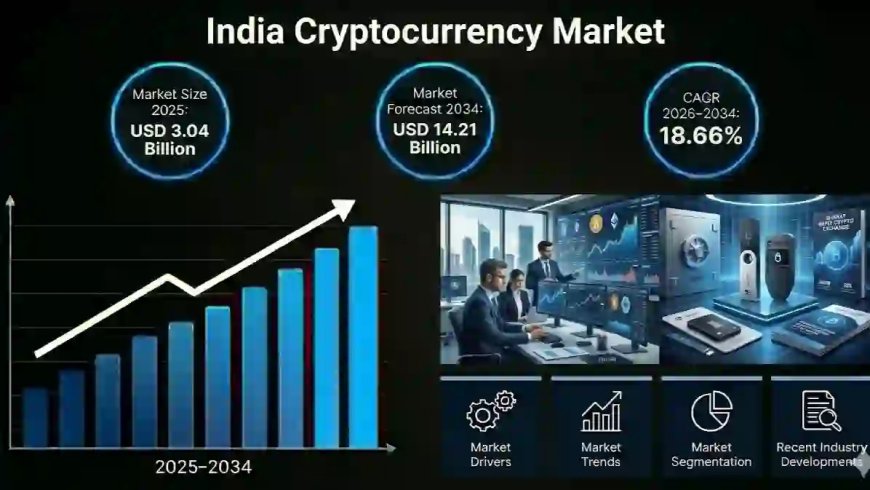
According to IMARC Group’s report titled “India Cryptocurrency Market Size, Share, Trends and Forecast by Type, Component, Process, Application, and Region, 2026-2034“, the report offers a comprehensive analysis of the industry, including market share, forecast, growth and regional insights.
Core Market Metrics & Snapshot
A consolidated view of critical market metrics and leading segments.
- Market Valuation (2025): USD 3.04 Billion
- Forecast Valuation (2034): USD 14.21 Billion
- CAGR (2026-2034): 18.66%
- Leading Region: West & Central India (34.6% Share)
- Dominant Type: Bitcoin (33.05% Share)
- Dominant Component: Software (56.07% Share)
- Dominant Process: Transaction (52.13% Share)
- Dominant Application: Trading (45.06% Share)
Strategic Market Overview & Performance Landscape
The India cryptocurrency market is experiencing a high-magnitude growth trajectory, propelled by the nation's top-ranked retail crypto adoption, expanding digital infrastructure, and a formalizing compliance ecosystem. The structural transition into a regulated Virtual Digital Asset (VDA) market is supported by extensive smartphone usage, high internet penetration, and widespread availability of UPI-linked fiat onboarding rails. While strict capital gains taxation and mandatory transaction-level tax deductions present ongoing compliance considerations, the formal tracking frameworks have crystallized the legitimate participant base around registered domestic platforms, driving steady market growth and robust long-term integration.
➤ Request Sample Report (TOC & Charts): https://www.imarcgroup.com/india-cryptocurrency-market/requestsample
Strategic Market Dynamics
Primary Growth Drivers
- Surging Retail Adoption: India leads globally in digital asset adoption across retail, centralized finance, and decentralized finance categories, encompassing an estimated user base of 119 million individuals.
- Smartphone and UPI Infrastructure: Robust cellular connectivity, high internet penetration, and instant UPI-linked INR conversion protocols dramatically minimize onboarding friction across domestic trading channels.
- FIU-IND Registered Exchange Ecosystem: Mandatory registration under anti-money laundering regulations formalizes trust, standardizes operating transparency, and significantly mitigates counterparty risks for participants.
- Web3 and DeFi Innovation: An expanding domestic developer economy contributes substantially to international blockchain networks, decentralized protocols, and efficient cross-border stablecoin remittance flows.
Primary Market Restraints
- Punitive Tax Regime: The application of flat capital gains taxes, transaction-level withholding taxes (TDS), and operational GST overheads collectively creates an intense financial burden that limits high-frequency trading volumes.
- Regulatory Uncertainty: The lack of a unified, standalone regulatory statute or dedicated oversight authority distributes monitoring duties across multiple agencies, generating structural ambiguity for developers.
- Cybersecurity and Custody Risks: High-profile platform security vulnerabilities and the prohibition of trading loss set-offs elevate financial risk exposure for retail and institutional investors.
Competitive Landscape & Key Industry Players
The industry exhibits a moderately concentrated marketplace anchored by domestic platforms operating as registered reporting entities under Financial Intelligence Unit (FIU-IND) regulations. Leading participants maintain their market positioning by deploying institutional-grade offline cold-storage custody solutions, expanding educational frameworks, and introducing advanced derivatives or options trading features. Strategic financial backing and operational integrations with global custody providers further deepen the architectural security and operational depth of domestic platforms.
Key Market Participants:
- Bitkuber Investments Private Limited
- Mudrex Inc.
- Neblio Technologies Private Limited
- WazirX
- ZebPay
➤ Explore the Full Report with Charts, Table of Contents, and List of Figures: https://www.imarcgroup.com/india-cryptocurrency-market
Segment Dominance Analysis
Type Dynamics
The market by type is segmented into Bitcoin and others, with the bitcoin segment capturing a dominant 33.05% share in 2025.
Component Insights
The market by component is segmented into Software and Hardware, with the software segment capturing a dominant 56.07% share in 2025.
This structural dominance is sustained by the mainstream integration of centralized exchange platforms, hot and cold wallet applications, and smart-contract development frameworks. Furthermore, accelerating digital engagement with automated anti-money laundering and compliance modules, decentralized exchange protocols, and decentralized finance (DeFi) yield products drives continuous software stack utilization. This ongoing development outpaces hardware segments focused primarily on dedicated validation nodes and specialized hardware wallet distributions.
Process Landscape
The market by process is segmented into Transaction and Mining, with the transaction segment capturing a dominant 52.13% share in 2025.
This positioning reflects the intense orientation of the domestic ecosystem toward active retail trading, peer-to-peer asset transfers, and stablecoin-based cross-border remittance mechanisms over energy-intensive industrial mining operations. The expansion of transaction-led activity is heavily reinforced by standardized client verification systems and direct fiat-to-VDA onboarding methods. Mandatory withholding taxes executed directly at the transaction layer further anchor reporting operations within this process segment.
Application Segmentation
The market by application is segmented into Trading and others, with the trading segment representing the largest share at 45.06% in 2025.
Regional Breakdown
The market by region is segmented into West & Central India, South India, North India, and East India, with the west & central india segment capturing a dominant 34.6% share in 2025.
This geographic leadership is anchored by major commercial centers across Maharashtra, Gujarat, and Madhya Pradesh that serve as corporate headquarters for prominent domestic exchanges and emerging Web3 startups. The region benefits from an exceptionally high concentration of digital payments density alongside a well-established base of high-net-worth individual (HNI) digital investors. Additionally, pioneering retail merchant adoption of blockchain payments among localized small businesses maintains stable transactional velocity throughout the territory.
Note: If you need specific information that is not currently within the scope of the report, we can provide it to you as a part of the customization.
➤ Shape the Data to Answer Your Specific Questions - Request Customization: https://www.imarcgroup.com/request?type=report&id=9084&flag=E
Frequently Asked Questions (FAQs)
1. What is the current value and projected growth of the India Cryptocurrency Market?
According to IMARC Group, the India cryptocurrency exchange market reached a value of USD 3.04 Billion in 2025 and is projected to reach USD 14.21 Billion by 2034, growing at a CAGR of 18.66% during the 2026-2034 forecast period.
2. Which cryptocurrency commands the highest market demand in India?
Bitcoin (BTC) and Ethereum (ETH) dominate the market share. Ethereum is specifically driving B2B volume due to its versatile smart-contract blockchain, which acts as the foundational settlement layer for domestic DeFi and NFT ecosystems.
3. What are the primary revenue models for platforms operating in this sector?
Transaction and trading fees represent the primary revenue streams. However, exchanges are increasingly diversifying into subscription-based models, specialized listing fees, and institutional staking services to stabilize operating profit margins.
4. How does the regulatory environment impact exchange operations?
The strict compliance requirements, specifically FIU-IND registration and the 1% TDS deduction, have effectively eliminated unorganized shadow players, consolidating the market toward a few highly capitalized, compliant domestic and international exchanges.
5. What role does Decentralized Finance (DeFi) play in market expansion?
DeFi platforms act as critical growth vectors, allowing unbanked or underbanked Indian users to seamlessly bypass traditional intermediaries to access global liquidity pools, peer-to-peer lending protocols, and algorithmic yield generation.
Strategic Insight & Verdict:
India's digital asset ecosystem is executing a definitive pivot from an unregulated speculative market into a heavily monitored, institutional-grade financial network. Analyzing this rigorous compliance overhaul, we at IMARC Group have observed that long-term profitability is strictly tied to mastering frictionless fiat-on-ramps and achieving absolute FIU-IND regulatory alignment. For corporate investors and fintech executives, the strategic mandate is absolute: deploy capital into secure, non-custodial decentralized infrastructure and compliant derivative platforms to capture exponential yields in this rapidly expanding USD 14.21 Billion ecosystem.
Verified Data Source: India Cryptocurrency Market Report by IMARC Group
What's Your Reaction?