





























Australia Healthcare Cold Chain Logistics Market Size, Share, Report 2026 2034
Australia healthcare cold chain logistics market reached USD 520.0 Million in 2025 and is projected to reach USD 658.1 Million by 2034, exhibiting a CAGR of 2.52% during 2026-2034.

Market Overview
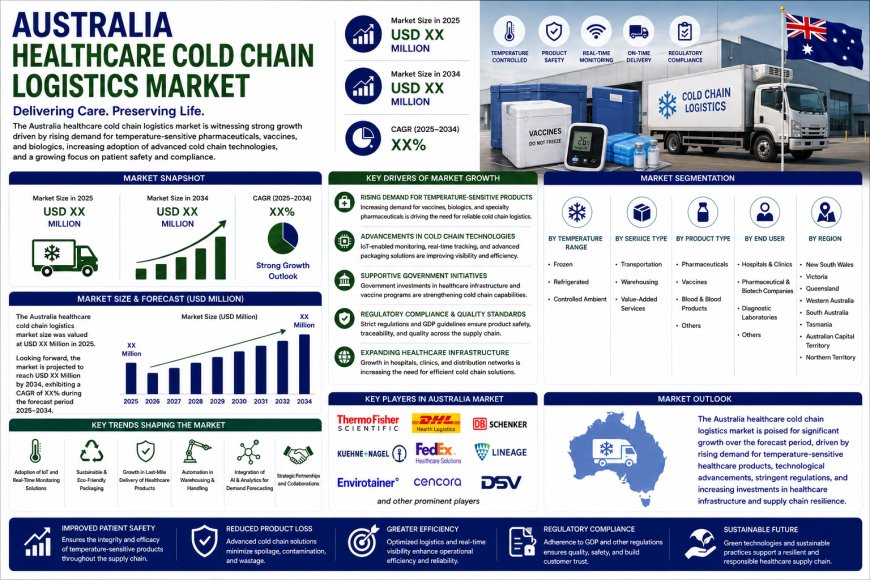
The Australia healthcare cold chain logistics market reached USD 520.0 Million in 2025 and is projected to reach USD 658.1 Million by 2034, exhibiting a CAGR of 2.52% during 2026-2034. The sustained expansion of Australia's biopharmaceutical product pipeline and the growing Australian clinical trial ecosystem are the primary growth catalysts. More than 16% of Australia's population is currently aged 65 years and above. This aging demographic is projected to grow significantly, with nearly one in four Australians (around 4.5 million people) expected to be aged 65 or older by 2066. Australia's expanding elderly population is increasing demand for temperature-sensitive pharmaceuticals, vaccines, biologics, insulin, specialty medicines, and advanced therapies used to manage chronic and age-related diseases.
This market is strategically important to Australia's healthcare and logistics economy, supporting the nation's position as a key player in the Asia-Pacific region for biopharmaceutical distribution. The Australia healthcare cold chain logistics market encompasses temperature-controlled transportation, warehousing, packaging, and monitoring solutions for clinical trial materials, vaccines, and biopharmaceuticals. The broader Australia cold chain logistics market, which includes food and beverage sectors, highlights the scale of temperature-controlled logistics infrastructure across the country.
The Australia healthcare cold chain logistics market is poised for sustained expansion, underpinned by the growing demand for biopharmaceuticals and vaccines, technological advancements in real-time monitoring, and investments in specialized cold chain infrastructure. With a projected CAGR of 2.52% through 2034, the market presents significant opportunities for logistics providers focusing on GDP/GMP compliance, IoT-enabled monitoring solutions, and sustainable cold chain practices.
AUSTRALIA HEALTHCARE COLD CHAIN LOGISTICS MARKET SUMMARY
The Australia healthcare cold chain logistics market encompasses temperature-controlled transportation, warehousing, packaging, and monitoring solutions for pharmaceuticals, vaccines, biopharmaceuticals, clinical trial materials, blood products, and diagnostic samples.
The ecosystem spans cold chain logistics providers, pharmaceutical manufacturers, biotechnology companies, hospitals and clinics, clinical research organizations (CROs), and regulatory bodies including the Therapeutic Goods Administration (TGA).
By Product, the market is segmented into Clinical Trial Materials, Vaccines, and Biopharmaceuticals.
By Segment, the market covers Transportation, Packaging, and Instrumentation.
By Region, the market serves Australia Capital Territory & New South Wales, Victoria & Tasmania, Queensland, Northern Territory & Southern Australia, and Western Australia.
Key trends shaping the market include the increasing demand for biopharmaceuticals and vaccines, technological advancements in real-time monitoring and data analytics, growing regulatory compliance requirements, and the adoption of sustainable cold chain solutions.
PORTER'S FIVE FORCES ANALYSIS – AUSTRALIA HEALTHCARE COLD CHAIN LOGISTICS MARKET
Competitive Rivalry: Moderate. The market features moderate competition among regional and international players including DHL Supply Chain, Kuehne + Nagel, DB Schenker, FedEx Express, UPS Healthcare, Toll Group, and Linfox. Companies compete across service quality, temperature control reliability, technology adoption, and regulatory compliance. Business implication: Providers must differentiate through real-time monitoring capabilities, compliance certifications, and value-added services.
Supplier Power (Infrastructure and Technology): Moderate. Healthcare cold chain logistics providers rely on suppliers of refrigerated transport equipment, cold storage facilities, temperature monitoring devices, and IoT-enabled tracking solutions. The technical expertise required for advanced monitoring solutions gives specialised suppliers moderate leverage. Business implication: Strategic partnerships and technology investments can reduce supplier dependency.
Buyer Power (Pharmaceutical Manufacturers and Healthcare Providers): Moderate. Large pharmaceutical manufacturers and hospital networks benefit from volume purchasing power. However, the critical nature of temperature-sensitive healthcare products and strict compliance requirements moderate pure price-based buyer power. Business implication: Providers must invest in quality assurance, regulatory compliance, and service reliability.
Threat of Substitutes: Low. Standard logistics represents a partial substitute, but the specialized temperature control, monitoring, and compliance requirements for healthcare products provide strong differentiation.
Threat of New Entrants: Moderate. Significant capital requirements for temperature-controlled infrastructure, regulatory compliance (GDP/GMP/TGA), and established client relationships create barriers. However, the growing demand for healthcare cold chain logistics has enabled new entrants focused on specialized services.
KEY ASPECTS REQUIRED FOR THE AUSTRALIA HEALTHCARE COLD CHAIN LOGISTICS MARKET
Market Performance: USD 520.0 Million in 2025, projected to reach USD 658.1 Million by 2034, driven by biopharmaceutical demand, vaccine logistics, and real-time monitoring adoption.
Market Outlook: A 2.52% CAGR through 2034 reflects steady growth led by biopharmaceutical product expansion, vaccine cold chain requirements, and technological innovation in monitoring solutions.
Growth Drivers: Increasing demand for biopharmaceuticals and vaccines; stringent regulatory standards (TGA, GDP, GMP); technological advancements in real-time monitoring and data analytics; growing demand for clinical trial materials; expansion of biopharmaceutical sector; and the need to maintain the integrity of temperature-sensitive products.
Competitive Landscape: Regional and international logistics providers competing across service quality, temperature control reliability, and regulatory compliance. Key players include DHL Supply Chain, Kuehne + Nagel, DB Schenker, FedEx Express, UPS Healthcare, Toll Group, Linfox, Biocair, and CEVA Logistics.
Value Chain Analysis: From pharmaceutical manufacturing through temperature-controlled transportation, warehousing, and packaging to final delivery to hospitals, pharmacies, and patients.
Industry Trends: IoT-enabled real-time temperature monitoring; blockchain for supply chain transparency; sustainable cold chain solutions (wool-pack insulation replacing polystyrene); AI-powered predictive analytics; growth in pharmaceutical cold chain logistics; increasing demand for clinical trial material logistics.
Strategic Recommendations: Invest in IoT-enabled real-time monitoring and data analytics; pursue GDP/GMP/TGA compliance certifications; expand biopharmaceutical and vaccine cold chain capabilities; develop sustainable cold chain solutions; target clinical trial logistics segment; strengthen last-mile delivery capabilities for remote areas.
Request for Sample Report: https://www.imarcgroup.com/australia-healthcare-cold-chain-logistics-market/requestsample
MARKET GROWTH DRIVERS
Biopharmaceutical Pipeline Growth
The Australian Government continues to list new biopharmaceutical medicines on the PBS at an accelerating pace, creating a new permanent cold chain demand stream once listed that persists for the medicine's entire commercial lifecycle. In July 2025, Biocon Biologics Ltd launched Nepexto, a biosimilar of Enbrel (etanercept), in Australia in partnership with Generic Health, expanding patient access to advanced biologic treatments. As biologics and biosimilars require strict temperature-controlled storage and transportation, their increasing commercialization is strengthening demand for specialized Australia cold chain pharmaceutical logistics services. The biopharmaceutical sector in Australia is expected to grow significantly, fueled by advancements in biotechnology. The Therapeutic Goods Administration (TGA) reported that over 65% of new drugs require strict temperature control, emphasizing the need for robust cold chain solutions.
MRFF-Funded Clinical Trial Expansion
The Australian Government announced a $6.5 billion third 10-year Medical Research Future Fund (MRFF) Investment Plan covering 2024–25 to 2033–34 as part of the 2024–25 Budget. The plan builds on earlier MRFF investments, strengthens and updates existing programs, and directs funding toward emerging healthcare priorities. The expanded funding strengthens demand for specialized cold chain infrastructure, validated packaging, and compliant logistics services to support the safe movement of clinical trial materials across research sites and healthcare facilities.
Regulatory Stringency and Compliance-Driven Infrastructure Investment
Regulatory stringency is driving investment in validated cold storage facilities, temperature-controlled vehicles, and real-time monitoring systems across Australia’s healthcare logistics sector. Pharmaceutical and logistics companies must maintain strict temperature ranges, product traceability, and documented handling procedures to protect medicine quality. Compliance requirements also encourage the adoption of automated data logging, backup power systems, and qualified packaging solutions. These investments improve supply chain reliability and support the safe distribution of vaccines, biologics, and specialty pharmaceuticals. The healthcare logistics market in Australia continues to expand as regulatory requirements become more stringent.
Technological Advancements in Real-Time Monitoring and Data Analytics
The Australia healthcare cold chain logistics market is expanding rapidly, owing to the implementation of new technologies such as real-time monitoring systems and data analytics to improve supply chain efficiency and dependability. Temperature-sensitive items are transported over great distances, and thus, maintaining constant temperatures is crucial for their efficacy and safety. As a result, tracking devices that can measure temperature, humidity, and position in real time have become increasingly common. These solutions provide logistics managers with quick notifications regarding any abnormalities, enabling timely, proactive actions to protect product integrity. The Australia cold chain monitoring solutions market encompasses a broader range of temperature-sensitive goods beyond healthcare, reflecting the rapid adoption of monitoring technologies across the cold chain sector.
AUSTRALIA HEALTHCARE COLD CHAIN LOGISTICS MARKET SEGMENTATION
Segmentation analysis provides a detailed view of the Australia healthcare cold chain logistics market by category:
Product Insights: Biopharmaceuticals (45.2% share in 2025) – the dominant product segment through PBS biologics dispensing volume and TGA-approved cell and gene therapies requiring the most demanding cold chain specifications. Biopharmaceuticals grow at ~2.90% CAGR through biologics listing expansion and cell therapy commercialization. Vaccines (36.7%) – serve the national immunization perpetual distribution requirement and flu vaccine program. Clinical Trial Materials (18.1%) – growing fastest at ~3.80% CAGR through research expansion and Australia's competitive position as a preferred clinical trial destination.
Segment Insights: Transportation (56.4% share in 2025) – commands the majority market share through the cost of maintaining temperature-controlled road, air, and cryogenic courier services across Australia's continental distribution geography. Transportation encompasses temperature-controlled road transport, temperature-controlled air freight, and specialist cryogenic courier services. Packaging (27.3%) – encompasses dry ice shippers, cryogenic dewars, and active powered containers that enable temperature maintenance during transit. Instrumentation (16.3%) – growing at ~3.10% CAGR, serves temperature monitoring compliance requirements with IoT data loggers, warehouse monitoring systems, and temperature mapping services.
Regional Insights: Australia Capital Territory & New South Wales (40.5% share in 2025) – the leading region, driven by Sydney's concentration of pharmaceutical companies, hospitals, and logistics infrastructure. Victoria & Tasmania (24.2%) – a significant market with strong healthcare and logistics presence in Melbourne. Queensland (15.9%) – a growing market with expanding healthcare infrastructure. Western Australia (11.3%) – an emerging market with increasing pharmaceutical logistics demand. Northern Territory & Southern Australia (8.1%) – growing at ~3.20% CAGR through resources sector workforce healthcare needs and NT immunization program complexity.
COMPETITIVE LANDSCAPE
The Australia healthcare cold chain logistics market is characterized by a dynamic mix of regional and international players. Leading participants contribute to innovation, geographic expansion, and service delivery in this space. The market is moderately concentrated, while specialist providers serve the high-value niche segments at premium service pricing that generates disproportionate margin contribution relative to their volume market share.
Key players include:
- Deutsche Post AG (DHL Health Logistics) – Market Leader. Deutsche Post AG, operating primarily through its DHL divisions, is a leading 3PL provider in Australia’s healthcare sector. It manages end-to-end temperature-sensitive logistics, supporting biopharmaceuticals, vaccines, and clinical trials.
- Linfox Pty Ltd. – Market Leader. Linfox Pty Ltd. serves as a critical, licensed backbone for Australia's healthcare cold chain, providing pharmaceutical companies with tier-one, digitally enabled warehousing and temperature-controlled transport.
- Cencora, Inc. – Established Player. Cencora, Inc. operates as a premier specialty logistics and third-party logistics (3PL) provider in Australia through its subsidiary, World Courier.
- Other Key Players – Including Kuehne + Nagel, DB Schenker, FedEx Express, UPS Healthcare, Toll Group, Biocair, CEVA Logistics, Lineage Logistics, and Americold.
The competitive landscape is progressively consolidating through strategic acquisitions reflecting global healthcare logistics providers' recognition that the Australian healthcare cold chain market's regulatory complexity, high operational standards, and specialist pharmaceutical customer relationships create durable competitive moats.
Investment opportunities exist in IoT-enabled real-time monitoring and data analytics, biopharmaceutical and vaccine cold chain capabilities, sustainable cold chain solutions, clinical trial logistics, and last-mile delivery for remote areas.
REGIONAL ANALYSIS
Australia Capital Territory & New South Wales represents the leading region, driven by Sydney's concentration of pharmaceutical companies, hospitals, and logistics infrastructure. Sydney serves as Australia's primary pharmaceutical import port and wholesale hub, with concentration of major pharmaceutical company Australian sponsor offices managing cold chain compliance. Toll Group's significant investment in a Western Sydney facility demonstrates the region's strategic importance.
Victoria & Tasmania is a significant market with strong healthcare and logistics presence in Melbourne. The region is home to major biotechnology and pharmaceutical manufacturing facilities, with growing clinical research activity and vaccine distribution driving demand for temperature-controlled logistics.
Queensland is a growing market with expanding healthcare infrastructure. Rising healthcare investments, expanding regional healthcare services, and increasing biologics distribution support market growth. The region's warm climate creates the need for efficient cold chain logistic solutions.
Western Australia is an emerging market with increasing pharmaceutical logistics demand. Demand is supported by long-distance transportation requirements and healthcare services for dispersed populations. Perth's role as a trade hub enhances the need for advanced cold storage facilities.
Northern Territory & Southern Australia represent developing markets with specialized healthcare logistics needs. Growth is driven by improving healthcare access, vaccine distribution programs, and expanding cold storage capacity to serve rural and remote communities efficiently. The NT and Northern WA represent the most operationally challenging healthcare cold chain environments in Australia.
RECENT INDUSTRY DEVELOPMENTS
2025 Activity: The Australia healthcare cold chain logistics market continued its growth trajectory from USD 520.0 Million in 2025 to USD 658.1 Million by 2034 at a CAGR of 2.52%.
2025 Activity: Biopharmaceuticals led product segmentation at 45.2% share; Transportation led segment segmentation at 56.4%; Australia Capital Territory & New South Wales led regionally at 40.5%.
July 2025: Biocon Biologics Ltd launched Nepexto, a biosimilar of Enbrel (etanercept), in Australia in partnership with Generic Health, expanding patient access to advanced biologic treatments.
September 2024: Merck introduced greener alternatives for cold chain shipments in Australia, replacing 3.6 tons of non-recyclable expanded polystyrene (EPS) annually with wool-pack insulation to encourage a more sustainable value chain.
December 2023: Sanofi Australia announced a partnership with supply chain provider Mediport to launch an active cold chain distribution service for medicines and vaccines in Tasmania, utilizing vehicles equipped with dual temperature zones and advanced monitoring.
2024 Activity: Toll Group moved into its largest Australian facility, a significant site in Western Sydney, involving substantial investment in advanced automation technology.
2024 Activity: Australia's refrigerated warehouse capacity was approximately 10.2 Million Cubic Meters, with projections to expand refrigerated warehouse space.
FREQUENTLY ASKED QUESTIONS
Q1: What is the current size of the Australia healthcare cold chain logistics market?
A: The Australia healthcare cold chain logistics market reached USD 520.0 Million in 2025 and is projected to reach USD 658.1 Million by 2034, growing at a CAGR of 2.52% during 2026-2034.
Q2: What are the key drivers of the Australia healthcare cold chain logistics market?
A: The market is driven by: (i) biopharmaceutical pipeline growth; (ii) MRFF-funded clinical trial expansion; (iii) regulatory stringency and compliance-driven infrastructure investment; (iv) technological advancements in real-time monitoring and data analytics; and (v) Australia's aging population.
Q3: What are the major product segments in the Australia healthcare cold chain logistics market?
A: Major product segments include Biopharmaceuticals (45.2% share in 2025), Vaccines (36.7%), and Clinical Trial Materials (18.1%).
Q4: What are the major service segments in the Australia healthcare cold chain logistics market?
A: Major service segments include Transportation (56.4% share in 2025), Packaging (27.3%), and Instrumentation (16.3%).
Q5: Which region leads the Australia healthcare cold chain logistics market?
A: Australia Capital Territory & New South Wales leads at 40.5% share in 2025, followed by Victoria & Tasmania (24.2%), Queensland (15.9%), Western Australia (11.3%), and Northern Territory & Southern Australia (8.1%).
Q6: How are technological advancements impacting the Australia healthcare cold chain logistics market?
A: Technological advancements in real-time monitoring, IoT sensors, data analytics, and blockchain are enhancing supply chain efficiency, transparency, and compliance. The Australia cold chain monitoring solutions market is expanding rapidly as providers deploy IoT-enabled temperature sensors, GPS tracking, cloud-based monitoring platforms, and real-time temperature analytics.
Q7: What are the regulatory compliance requirements for healthcare cold chain logistics in Australia?
A: The Therapeutic Goods Administration (TGA) Good Distribution Practice (GDP) and Good Manufacturing Practice (GMP) guidelines mandate stringent temperature control for healthcare products. Over 65% of new drugs require strict temperature control, emphasizing the need for robust cold chain solutions.
Q8: Who are the major players in the Australia healthcare cold chain logistics market?
A: Major players include Deutsche Post AG (DHL Health Logistics), Linfox Pty Ltd., Cencora, Inc., Kuehne + Nagel, DB Schenker, FedEx Express, UPS Healthcare, Toll Group, Biocair, CEVA Logistics, Lineage Logistics, and Americold.
Note: If you need any specific information that is not covered currently within the scope of the report, we will provide the same as a part of customization.
https://www.imarcgroup.com/request?type=report&id=33229&flag=E
Report Format, Delivery, and Customization Details
Report Format Mode: PPT, PDF, and Excel
Report Delivery Mode: Online Delivery, Physical Delivery
Report Delivery Time: Report Delivered Over Email within 24 to 48 hours. If requested by the client, a physical copy will be delivered within three to ten days.
Report Confirmation Mode: Yes via Email
Report Customization Mode: Yes via Email / Call
Report Table of Content: Yes
Report List of Figures: Yes
Report Methodology Mode: Yes
Request For Sample Report: Yes
What's Your Reaction?