





























Europe School Furniture Market Projected to Reach USD 2,655.2 Million by 2034
Explore the Europe school furniture market, valued at USD 1,775.4 million in 2025, projected to reach USD 2,655.2 million by 2034.

Market Overview
The Europe school furniture market size reached USD 1,775.4 Million in 2025. Looking forward, IMARC Group expects the market to reach USD 2,655.2 Million by 2034, exhibiting a growth rate (CAGR) of 4.44% during 2026-2034. The growing popularity of flexible classroom layouts and multi-functional learning spaces, emerging technological advancement, and increasing government investment in education infrastructure and modernization projects are among the key factors driving the market growth.
School furniture refers to the specialized seating, desks, tables, storage units, and lab equipment designed for educational environments, crafted to cater to the ergonomic needs of students and facilitate effective learning. It involves the design, manufacturing, and distribution of furniture available in various shapes and sizes to accommodate different age groups and learning activities, supporting proper posture, comfort, and collaboration. School furniture is crucial for creating conducive learning environments, promoting student wellbeing, and enhancing educational outcomes. The industry ensures that educational institutions have access to ergonomic, durable, and adaptable furniture, protecting students from posture-related discomfort while delivering functional and aesthetically appropriate learning spaces. School furniture plays a vital role in modern education, enabling flexible teaching methodologies, supporting technology integration, and fostering collaborative and interactive learning experiences.
This market is strategically important to Europe's education infrastructure and modernization initiatives, supporting the region's position as a leader in educational standards and learning environment design. The Europe school furniture market encompasses desks and chairs, storage, lab equipment, and other products, utilising wood, metal, plastic, and other materials distributed through offline and online channels across Germany, France, UK, Italy, Spain, and the rest of Europe.
The Europe school furniture market is poised for sustained expansion, underpinned by flexible classroom trends, government education investment, and sustainability initiatives. With a projected CAGR of 4.44% through 2034, the market presents significant opportunities for providers focusing on ergonomic and adaptable furniture, sustainable materials, technology-integrated solutions, and multi-functional learning space configurations.
EUROPE SCHOOL FURNITURE MARKET SUMMARY
The Europe school furniture market encompasses the design, manufacturing, and distribution of specialized seating, desks, tables, storage, and lab equipment designed for educational environments across diverse age groups and learning activities throughout the region.
The ecosystem spans furniture manufacturers, material suppliers, designers, educational supply distributors, and online retailers serving customers across primary schools, secondary schools, higher education institutions, and vocational training centers throughout Europe.
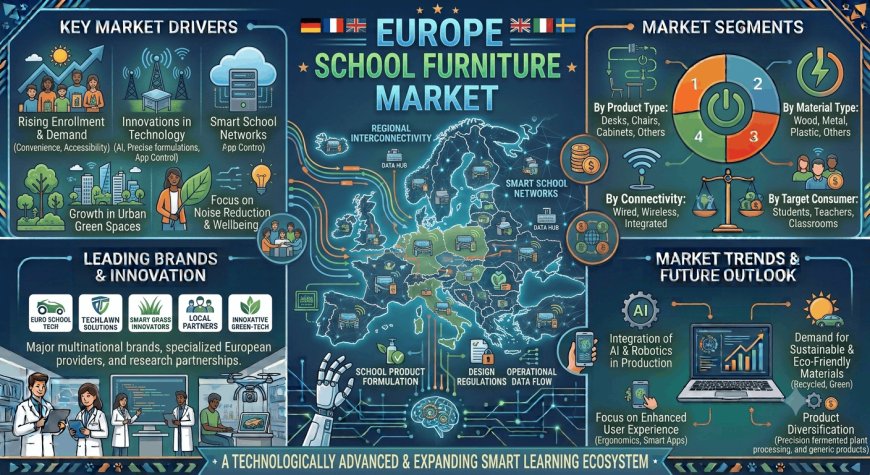
By Product, the market is segmented into Desks and Chairs (dominating), Storage, Lab Equipment, and Others.
By Material, the market serves Wood (dominating), Metal, Plastic, and Others.
By Distribution Channel, the market serves Offline and Online.
By Country, the market serves Germany (dominating), France, UK, Italy, Spain, and Rest of Europe.
Key trends shaping the market include growing popularity of flexible classroom layouts and learning spaces, increasing investment in education infrastructure and modernization projects, and integration of technology and sustainability in educational environments.
PORTER'S FIVE FORCES ANALYSIS – EUROPE SCHOOL FURNITURE MARKET
Competitive Rivalry: Moderate. The market features competition among established furniture manufacturers, regional specialists, and emerging online retailers. Competition centres on product design, ergonomic features, material quality, sustainability credentials, and price competitiveness. The market includes global brands competing alongside regional and local manufacturers. Business implication: Companies must differentiate through innovative design, sustainability performance, and value-added services.
Supplier Power (Material and Component Suppliers): Moderate. Manufacturers rely on suppliers of wood, metal, plastic, and specialized components. Raw material price fluctuations and supply chain dynamics influence production costs. Sustainable material sourcing is gaining importance. Business implication: Strategic partnerships with suppliers and investment in sustainable materials can reduce long-term dependency and cost pressures.
Buyer Power (Educational Institutions and Government Bodies): High. Educational institutions and government procurement agencies leverage volume purchasing power to negotiate favourable terms. Buyers increasingly demand ergonomic certification, sustainability credentials, and durability. Public procurement processes favor local manufacturers and sustainable products. Business implication: Providers must demonstrate ergonomic benefits, sustainability compliance, and cost-effectiveness to win contracts.
Threat of Substitutes: Low. School furniture serves essential functions for educational environments that cannot be substituted by alternative products. However, alternative configurations and multi-purpose furniture compete within the category. Business implication: Demonstrating superior ergonomics, durability, and adaptability is essential.
Threat of New Entrants: Moderate. Lower capital requirements for design-focused brands and growing e-commerce channels enable new entrants. However, manufacturing scale, distribution networks, and institutional relationships create barriers. The growth of online channels and direct-to-institution sales has enabled new entrants. Business implication: Incumbents must leverage scale, brand reputation, and institutional relationships while monitoring emerging niche players.
KEY ASPECTS REQUIRED FOR THE EUROPE SCHOOL FURNITURE MARKET
Market Performance: USD 1,775.4 Million in 2025, projected to reach USD 2,655.2 Million by 2034, driven by flexible classroom trends, government investment, and modernization projects.
Market Outlook: A 4.44% CAGR through 2034 reflects steady growth led by desks and chairs, wood materials, offline channels, and German market leadership.
Growth Drivers: Growing popularity of flexible classroom layouts and multi-functional learning spaces; increasing government investment in education infrastructure and modernization projects; integration of technology in education; emphasis on eco-friendly practices and sustainable materials; evolving architectural trends in educational spaces; increasing demand for ergonomic furniture.
Competitive Landscape: A moderately competitive market with established furniture manufacturers and regional specialists. Key players include Herman Miller, HNI Corporation, KI Furniture, Steelcase Inc., Fleetwood Group, Hertz Furniture, Knoll, Inc., and VS America.
Value Chain Analysis: From material sourcing and design through manufacturing, distribution, and installation across primary, secondary, and higher education institutions.
Industry Trends: Flexible classroom layouts; multi-functional learning spaces; ergonomic furniture design; sustainable materials; technology-integrated furniture; movable and adaptable configurations; collaborative seating arrangements.
Strategic Recommendations: Invest in flexible and adaptable furniture designs; develop sustainable and eco-friendly product ranges; pursue government education infrastructure contracts; expand online distribution channels; target ergonomic and technology-integrated furniture segments; strengthen presence in Germany and high-growth markets.
Request for Sample Report: https://www.imarcgroup.com/europe-school-furniture-market/requestsample
MARKET GROWTH DRIVERS
Growing Popularity of Flexible Classroom Layouts and Learning Spaces
The market is experiencing significant growth due to the increasing popularity of flexible classroom layouts and multi-functional learning spaces. Educators are recognizing the importance of adaptable furniture that can be easily rearranged to suit various teaching methodologies and activities, thus influencing the market growth. Moreover, flexible seating arrangements, such as movable desks and chairs, allow for quick transitions between group discussions, individual work, and interactive projects which enhances student engagement and encourages active participation, representing another major growth-inducing factor. Besides this, multi-functional learning spaces are becoming prevalent, accommodating numerous teaching methods, thus accelerating the market growth. Along with this, furniture that can transform into numerous configurations supports project-based learning, workshops, and presentations which promotes an interactive and immersive educational experience, propelling the market growth.
Increasing Investment in Education Infrastructure and Modernization Projects
The market is being fueled by growing government investments in education infrastructure and modernization projects. They are recognizing the essential role of well-equipped classrooms in fostering effective learning and allocating funds to upgrade school facilities and provide modern furniture solutions, thus influencing market growth. Moreover, several government initiatives aimed at improving educational outcomes often include provisions for the enhancement of school infrastructure and numerous investments in ergonomic and comfortable furniture that positively impact student engagement and academic performance, representing another major growth-inducing factor. Besides this, modernization includes the adoption of contemporary teaching methods requiring adaptable furniture that supports collaborative learning is accelerating the market growth.
Integration of Technology in Education
The integration of technology in the education sector represents another major growth-inducing factor. Schools are seeking furniture solutions that support connectivity and enhance the learning experience, thus propelling market growth. Furniture designed with integrated power outlets, cable management, and device storage supports technology-enabled learning environments. As educational institutions increasingly adopt digital tools and interactive learning platforms, demand for technology-compatible furniture grows.
Emphasis on Eco-Friendly Practices and Sustainable Materials
Educational institutions and governments are placing greater importance on eco-friendly practices which is escalating the demand for furniture produced from sustainable materials, thus propelling the market growth. Wood's renewable nature and lower carbon footprint compared to synthetic alternatives make it a preferred choice for environmentally conscious institutions. Schools and institutions are inclined to opt for environmentally responsible materials, making wood a logical choice. Manufacturers are incorporating sustainable practices including the use of eco-friendly materials, implementing energy-efficient manufacturing processes, and ensuring the recyclability of their products.
Evolving Architectural Trends in Educational Spaces
The evolving architectural trends in educational spaces, such as flexible classroom layouts and multipurpose areas, are driving the requirement for adaptable furniture that can be easily rearranged to suit different activities, thus augmenting the market growth. Modern educational facilities are designed to accommodate diverse teaching methods and learning activities, requiring furniture that supports quick reconfiguration and multi-purpose use.
EUROPE SCHOOL FURNITURE MARKET SEGMENTATION
Segmentation analysis provides a detailed view of the Europe school furniture market by category:
Product Insights: Desks and chairs represent the most popular product and accounted for the largest market share. Desks are integral components of the classroom environment that cater to the comfort and productivity of students, thus enhancing the educational experience. Additionally, the adaptability of desks to various teaching methods and technological integration are influencing the market growth. Moreover, chairs are essential school furniture that offers comfortable seating for a conducive learning atmosphere, promoting focus and engagement among students, representing another major growth-inducing factor. The advancements in chair design, coupled with an emphasis on posture support, are driving the market growth. Furthermore, desks and chairs address the holistic needs of educational institutions, including physical comfort and pedagogical efficiency which prioritize student well-being and learning efficacy. Apart from this, desks and chairs are essential in shaping modern classrooms with the integration of ergonomic furniture facilitating interactive learning, collaboration, and improved concentration. Storage, lab equipment, and others represent other significant product segments.
Material Insights: Wood holds the largest share of the market. Wood's timeless aesthetic and inherent warmth contribute to its popularity as the primary material for school furniture. Its natural allure creates an environment conducive to learning, fosters a welcoming atmosphere that resonates with students and educators. In addition, it allows for the creation of numerous furniture designs, accommodating various educational needs and preferences, thus influencing market growth. Moreover, the growing emphasis on sustainability resulted in the adoption of environmentally responsible materials such as wood due to their renewable nature and lower carbon footprint compared to synthetic alternatives, representing another major growth-inducing factor. Along with this, schools and institutions are inclined to opt for environmentally responsible materials, making wood a logical choice compared to synthetic alternatives. Furthermore, the durability and longevity associated with wooden furniture ensure extended usability and ultimately offer cost-effective solutions, while collaborating with local artisans and manufacturers is propelling the market growth. Metal, plastic, and others represent other significant material segments.
Distribution Channel Insights: Offline distribution channels include traditional brick-and-mortar establishments, including specialized furniture stores and educational supply retailers. These physical outlets offer customers the advantage of a hands-on experience, allowing them to assess the quality, design, and functionality of various school furniture pieces. Additionally, in-person interactions with knowledgeable staff members can provide valuable insights and recommendations, enhancing the decision-making process for educational buyers. Moreover, online distribution channels are gaining popularity due to their convenience and reach with e-commerce platforms and the official websites of manufacturers facilitating seamless browsing and purchasing experiences, representing another major growth-inducing factor. This virtual storefront enables customers to explore numerous products, compare specifications, and read user reviews, aiding in informed decision-making. Besides this, the online approach caters to a broader audience, allowing educational institutions across Europe to access an extensive range of school furniture solutions, irrespective of their geographic location.
Country Insights: Germany exhibits a clear dominance in the market. Germany is driven by a strong economic foundation and stability fostering an environment conducive to the growth of various industries. It provides schools with the necessary resources to invest in high-quality and modern furniture solutions, enhancing the learning environment. Moreover, the growing emphasis on education and educational infrastructure is essential to provide top-notch educational facilities that align with the demand for functional and innovative school furniture, representing another major growth-inducing factor. As a result, educational institutions in Germany are investing in furniture that aligns with modern pedagogical approaches and promotes comfortable learning spaces. Furthermore, the country's central position facilitates efficient distribution networks, enabling the timely and cost-effective transportation of school furniture to neighboring countries. This logistical advantage strengthens Germany's position as a preferred supplier of school furniture in the broader European market. France, UK, Italy, Spain, and the rest of Europe represent other significant regional markets.
COMPETITIVE LANDSCAPE
Nowadays, key players within the market are employing various strategic initiatives to bolster their positions and remain competitive in the dynamic landscape. These actions are aimed at enhancing their brand value, expanding market reach, and meeting evolving customer demands. They are investing in research and development to create innovative and ergonomic school furniture solutions by designing products that align with modern educational methodologies and technology integration, which attract schools seeking to create contemporary and efficient learning environments. Moreover, companies are incorporating sustainable practices into their operations including the use of eco-friendly materials, implementing energy-efficient manufacturing processes, and ensuring the recyclability of their products. Furthermore, key players are using digital platforms to showcase their products and services, maintaining informative websites, and engaging in an active social media presence allowing players to connect directly with potential customers across Europe.
The market research report has provided a comprehensive analysis of the competitive landscape in the market. Detailed profiles of all major companies have also been provided. Some of the major players include:
Herman Miller, Inc., HNI Corporation, KI Furniture, Steelcase Inc., Fleetwood Group, Hertz Furniture, Knoll, Inc., and VS America.
REGIONAL ANALYSIS
Germany exhibits a clear dominance in the market. Germany is driven by a strong economic foundation and stability fostering an environment conducive to the growth of various industries. It provides schools with the necessary resources to invest in high-quality and modern furniture solutions, enhancing the learning environment. Moreover, the growing emphasis on education and educational infrastructure is essential to provide top-notch educational facilities that align with the demand for functional and innovative school furniture, representing another major growth-inducing factor. As a result, educational institutions in Germany are investing in furniture that aligns with modern pedagogical approaches and promotes comfortable learning spaces. Furthermore, the country's central position facilitates efficient distribution networks, enabling the timely and cost-effective transportation of school furniture to neighboring countries. This logistical advantage strengthens Germany's position as a preferred supplier of school furniture in the broader European market.
France, UK, Italy, Spain, and the rest of Europe represent other significant regional markets with growing demand for school furniture driven by education infrastructure investment, modernization projects, and evolving pedagogical approaches.
RECENT INDUSTRY DEVELOPMENTS
2026 Activity: The Europe school furniture market continued its growth trajectory from USD 1,775.4 Million in 2025 toward USD 2,655.2 Million by 2034 at a CAGR of 4.44%.
2025: Continued investment in flexible classroom layouts and multi-functional learning spaces across European educational institutions.
2025: Growing adoption of sustainable materials and eco-friendly manufacturing practices by school furniture manufacturers.
Investment opportunities exist in ergonomic and adaptable furniture, sustainable materials, technology-integrated solutions, and multi-functional learning space configurations.
FREQUENTLY ASKED QUESTIONS
Q1: What is the current size of the Europe school furniture market?
A: The Europe school furniture market was valued at USD 1,775.4 Million in 2025 and is projected to reach USD 2,655.2 Million by 2034, exhibiting a CAGR of 4.44% from 2026-2034.
Q2: What are the key drivers of the Europe school furniture market?
A: The market is driven by: (i) growing popularity of flexible classroom layouts and multi-functional learning spaces; (ii) increasing government investment in education infrastructure and modernization projects; (iii) integration of technology in education; (iv) emphasis on eco-friendly practices and sustainable materials; and (v) evolving architectural trends in educational spaces.
Q3: What are the major products in the Europe school furniture market?
A: Major products include Desks and Chairs (dominating), Storage, Lab Equipment, and Others.
Q4: What are the major materials in the Europe school furniture market?
A: Major materials include Wood (dominating), Metal, Plastic, and Others.
Q5: What are the major distribution channels in the Europe school furniture market?
A: Major distribution channels include Offline and Online.
Q6: Which country leads the Europe school furniture market?
A: Germany exhibits a clear dominance in the market, driven by its strong economic foundation, emphasis on education infrastructure, and central position facilitating efficient distribution networks.
Q7: What is the outlook for the Europe school furniture market?
A: The market is projected to grow at a 4.44% CAGR through 2034, with growth driven by flexible classroom trends, government investment, and modernization projects. The shift toward ergonomic furniture, sustainable materials, and technology-integrated solutions are expected to shape the market's evolution.
Note: If you need any specific information that is not covered currently within the scope of the report, we will provide the same as a part of customization.
https://www.imarcgroup.com/request?type=report&id=1296&flag=E
Report Format, Delivery, and Customization Details
Report Format Mode: PPT, PDF, and Excel
Report Delivery Mode: Online Delivery, Physical Delivery
Report Delivery Time: Report Delivered Over Email within 24 to 48 hours. If requested by the client, a physical copy will be delivered within three to ten days.
Report Confirmation Mode: Yes via Email
Report Customization Mode: Yes via Email / Call
Report Table of Content: Yes
Report List of Figures: Yes
Report Methodology Mode: Yes
Request For Sample Report: Yes
What's Your Reaction?