































Why Investors Set Up Holding Companies in Dubai: Complete Guide 2026
Discover why investors choose holding company setup in Dubai for tax efficiency, asset protection, global expansion, and long-term wealth management.


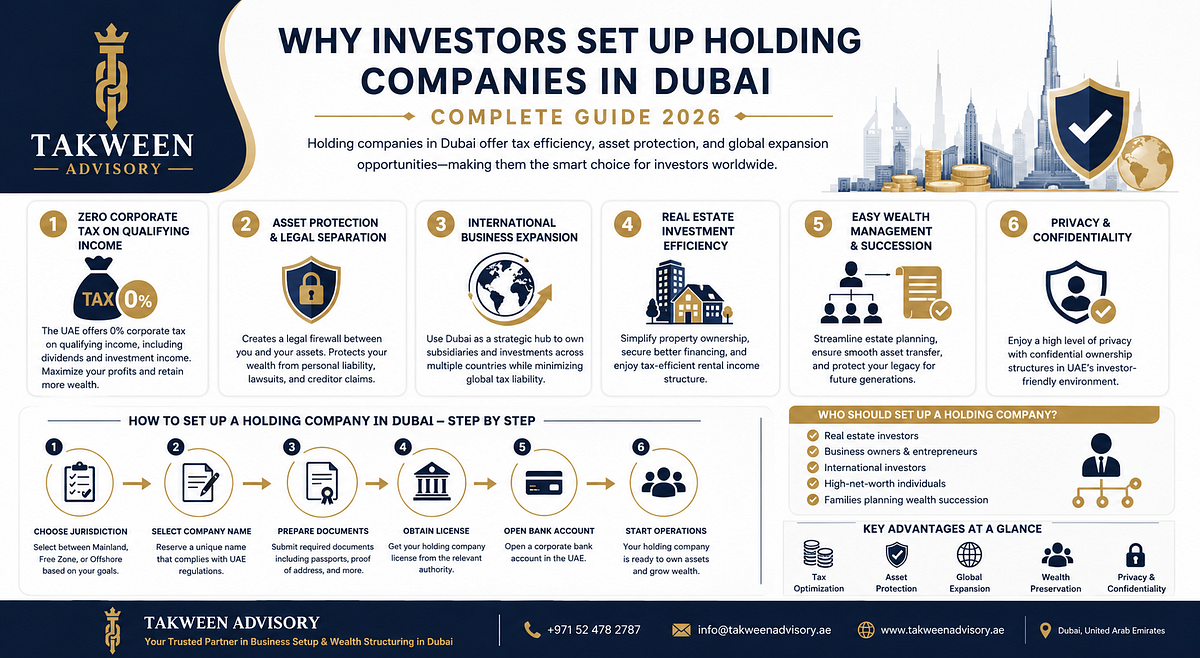
Dubai has become a global hub for wealth management and investment structuring. Every month, thousands of investors-from real estate moguls to business owners to international entrepreneurs-choose to set up holding companies in Dubai. But why? What makes a holding company the preferred structure for savvy investors worldwide?
Dubai’s position as a leading international business centre has made it a preferred jurisdiction for entrepreneurs, investors, and family offices looking for structured ownership solutions.
The answer lies in a combination of tax efficiency, asset protection, regulatory flexibility, and strategic positioning. Unlike traditional operating companies, holding companies serve as protective vessels for your assets while allowing you to optimize your financial structure and minimize tax liability across jurisdictions.
This guide explains exactly why holding companies are so attractive to investors, how they work, and how you can determine if a holding company setup is right for your wealth strategy.
What Is a Holding Company?

Before diving into the “why,” let’s clarify what a holding company actually is.
A holding company is a business entity created specifically to own and manage investments in other companies, real estate, or assets-rather than to operate a business directly. Think of it as a protective shell. The holding company doesn’t conduct day-to-day business operations; instead, it holds ownership stakes, collects dividends, manages property, and generates investment income.
For example, instead of you personally owning ten rental properties, a holding company owns those properties on your behalf. Instead of you personally owning shares in multiple businesses, your holding company owns those shares. The holding company becomes the legal owner, while you control the holding company.
This separation between you and your assets creates significant advantages.
Why Reason #1: Tax Efficiency on Qualifying Income

The most compelling reason investors set up holding companies in Dubai is tax efficiency.
The UAE introduced a 9% Corporate Tax on taxable profits exceeding AED 375,000. However, holding companies structured in qualifying free zones — such as IFZA, DMCC, Meydan, and RAKEZ — can still benefit from 0% corporate tax on qualifying investment income, including dividends, capital gains, and rental income (subject to zone-specific rules).
For mainland holding companies, the first AED 375,000 of profit remains tax-free, with 9% tax applying only to profits above this threshold.
The key is strategic jurisdiction selection:
Free zone holding companies: 0% tax on qualifying income
Mainland holding companies: 0% on first AED 375,000 + 9% above —
Offshore structures: 0% tax with no UAE operations
Compare the UAE’s competitive tax environment with other major economies:
United States: 21% federal corporate tax + applicable state taxes
United Kingdom: 25% main corporate tax rate
Canada: Combined federal and provincial corporate taxes may exceed 25%
Australia: Up to 30% corporate tax rate
For investors managing international assets, a properly structured holding company in Dubai can help improve tax efficiency, simplify ownership, and support long-term wealth planning. The UAE’s extensive double taxation treaty network with more than 140 countries can also help reduce double taxation risks and optimize cross-border investment structures, depending on the investor’s circumstances.
Why Reason #2: Asset Protection and Legal Separation

Investors fear litigation. A single lawsuit, business failure, or creditor claim can wipe out personal wealth if assets aren’t properly protected.
A holding company creates a legal firewall between you and your assets. Here’s how it works:
If you personally own ten rental properties and face a lawsuit from a tenant or contractor, a judgment could potentially reach all your assets. But if those properties are owned by a holding company, the holding company-not you personally-is the defendant. A creditor pursuing claims against the holding company can only reach the holding company’s assets, not your personal wealth or assets held separately.
This structure is especially valuable for:
Real estate investors (property liability protection)
Business owners (separates business risk from personal assets)
International investors (protects against home-country creditors)
High-net-worth individuals (shields accumulated wealth)
Dubai’s legal system and enforcement of holding company structures further strengthen this protection. The holding company becomes a recognized, legally distinct entity under UAE law.
Why Reason #3: International Business Expansion
Many investors use holding companies as springboards for international expansion.
A Dubai-based holding company can own subsidiaries, branches, or operating companies across multiple jurisdictions. The holding company itself remains in Dubai, benefiting from the UAE’s competitive tax environment and available tax exemptions for qualifying structures. While it controls operations in higher-tax countries like the UK, US, or Australia.
For example:
A holding company (in IFZA) owns 100% of an Australian operating company
The Australian company generates AED 5 million in profit
After Australian tax (30%), the company retains AED 3.5 million
The holding company receives this AED 3.5 million dividend
Under UAE corporate tax law and tax treaty provisions, this dividend is often received with minimal or no tax in the UAE The investor retains the full AED 3.5 million (vs. additional tax if structured differently)
Tax savings: AED 350,000+ per AED 3.5M dividend received
Why Reason #4: Real Estate Investment Efficiency
Dubai’s real estate market attracts investors from every continent. But property ownership comes with complexity-mortgage arrangements, tax reporting, currency fluctuation, inheritance complications.
A holding company owns the real estate on behalf of investors. This approach delivers several advantages:
Simplified Ownership Transfer: Transferring real estate directly requires government registration, property taxes, and potential capital gains taxes in your home country. Transferring shares in a holding company that owns the property is often simpler and may avoid property transfer taxes.
Mortgage Leverage: Banks prefer lending to registered companies rather than individuals. A holding company can secure mortgage financing at competitive rates, allowing investors to leverage capital across multiple properties.
Tax-Efficient Distributions: Rental income flows to the holding company, which can reinvest it, distribute it as dividends, or use it to acquire additional properties-all without triggering income tax.
Estate Planning: Property held in a holding company passes to heirs through company ownership transfer, often more efficiently than direct property ownership in various jurisdictions.
For property investors in Dubai, this structure is so common that many developers and banks specifically accommodate holding company ownership.
Why Reason #5: Flexible Dividend Repatriation
Investors from high-tax countries face a challenge: how do you move money earned abroad back home without triggering withholding taxes?
A holding company licensed in the UAE can distribute dividends to shareholders globally with minimal tax leakage:
Dividends from operating companies to the holding company: Often tax-free under UAE law
Dividends from the holding company to international shareholders: Subject to treaty provisions, often reduced to 0–5% withholding tax
This efficiency is impossible for investors operating as individuals. By centralizing ownership through a holding company, you dramatically reduce the tax cost of moving capital internationally.
Why Reason #6: Confidentiality and Privacy
Privacy matters to high-net-worth investors. Holding companies provide an additional layer of confidentiality.
Ownership of a holding company can be structured through various arrangements-nominee directors, discretionary trusts, or layered company ownership-that obscure the ultimate beneficial owner. While regulatory changes (including beneficial ownership registries) have increased transparency requirements, holding companies still provide significantly more privacy than direct asset ownership.
This is particularly valuable for investors in high-profile industries or those managing sensitive investments.
Why Reason #7: Flexibility to Pivot and Restructure
Holding companies provide operational flexibility that direct ownership doesn’t.
A holding company can quickly:
Sell shares in subsidiary companies (avoiding property transfer taxes)
Shift ownership between subsidiaries
Reclassify assets or operations without triggering capital gains
Exit jurisdictions by selling subsidiary stakes rather than liquidating operations
This flexibility is invaluable in fast-moving markets like Dubai’s real estate sector, where investors often need to respond rapidly to opportunities.
Why Reason #8: Succession Planning and Wealth Transfer
For family offices and multi-generational wealth, holding companies simplify succession.
Rather than transferring individual properties, businesses, or investments separately (each potentially triggering taxes and legal complications), a holding company can be transferred intact. Shares pass to heirs through a single transaction, and in many jurisdictions, this transfer is more tax-efficient than inherited assets.
This is especially important for investors with global family members. A centralized holding company in Dubai can be owned by beneficiaries across multiple countries while maintaining control over assets and investments.
Why Reason #9: Regulatory and Compliance Advantages
Setting up in Dubai provides regulatory certainty that investors don’t get elsewhere.
The UAE has:
Strong contract enforcement
Stable, business-friendly regulations
International banking relationships
No exchange controls (money flows freely in and out)
Recognition of holding company structures by international courts
This certainty is valuable. An investor knows that their holding company will be recognized by banks globally, that assets won’t be unexpectedly frozen, and that the regulatory environment won’t suddenly change.
Why Reason #10: Banking and Access to Finance
A holding company licensed in Dubai opens doors to international banking and financing.
Banks are more willing to lend to registered companies than individuals. A holding company with established operations and assets can:
Access corporate credit lines
Arrange syndicated financing for major investments
Secure favorable forex arrangements
Open accounts in major financial centers
Access wealth management services at favorable rates
The holding company becomes a financial hub, centralizing access to banking and credit.
Cost Breakdown: Is It Worth It?
Setting up a holding company isn’t free, but for most investors, the tax and efficiency savings justify the cost within the first year.
Initial Setup Costs:
Trade license and registration: AED 8,000–15,000
Legal setup and documentation: AED 3,000–5,000
Bank account opening: AED 0–2,000 (often free with minimum balance)
Total: AED 11,000–22,000
Annual Costs:
License renewal: AED 8,000–12,000
Accounting and compliance: AED 3,000–8,000
Bank fees and services: AED 1,000–3,000
Total: AED 12,000–23,000 annually
Tax Savings for a Property Investor:
Tax treatment of rental income depends on factors such as property type, ownership structure, and applicable UAE Corporate Tax rules.
Same income earned personally in a 30% tax jurisdiction: AED 150,000 tax
Annual saving: AED 150,000
Payback period: Less than 1 month
For investors with significant income or assets, the payback period is immediate.
How to Determine If a Holding Company Is Right for You
Ask yourself:
Do you have significant investment income or assets? (Above AED 500,000 annually)
Are you from a high-tax jurisdiction? (Earning elsewhere and seeking tax efficiency)
Do you own real estate or multiple investments? (Needing to consolidate ownership)
Do you plan long-term wealth building? (10+ year horizon)
Do you have international operations or aspirations? (Doing business across borders)
If you answer yes to three or more, a holding company deserves serious consideration.
The Setup Process
Setting up a holding company in Dubai is straightforward:
Choose your jurisdiction: Dubai mainland, free zone (IFZA, DMCC), or offshore (RAK ICC)
Reserve your company name: AED 620, takes 10 minutes
Prepare documents: Passport copies, business plan, source of funds
Apply for initial approval: Government confirms no objection
Secure office/registered address: Physical space or virtual address
Obtain trade license: Pay fees, receive license
Open corporate bank account: Provide license and documents
Structure ownership: Set up shareholding and dividend flows
The entire process typically takes 2–4 weeks.
Frequently Asked Questions
Can I hold property directly in a holding company?
Yes. The holding company owns the property in its name, and you own shares in the holding company.
Do I need employees?
No. Holding companies are passive investment vehicles and don’t require staff.
Can I get a visa through a holding company?
Yes. Shareholders and investors can apply for investor visas if they meet capital requirements (typically AED 1 million).
What if I want to exit?
Selling the holding company is simple-you transfer shares to a buyer. The company remains intact.
Is it legal to reduce taxes this way?
Yes. Tax efficiency through legitimate structures is legal. Tax evasion (hiding income) is not.
Final Thoughts
Investors set up holding companies in Dubai for one simple reason: they work. A holding company provides tax efficiency, asset protection, flexibility, and strategic advantage that individual ownership cannot match.
For investors with significant assets or international operations, the question isn’t whether to set up a holding company-it’s when.
If you're considering a Dubai holding company setup, professional guidance can help you choose the right jurisdiction and legal structure for your investment goals. At Takween Advisory, we help investors establish compliant and tax-efficient holding company structures tailored to their business needs across the UAE.
Disclaimer: This article is for informational purposes only and does not constitute legal or tax advice. Corporate Tax treatment depends on individual circumstances, business activity, ownership structure, and applicable UAE regulations. Consult a qualified advisor before making investment decisions.
What's Your Reaction?














