































What is FSRU operations and how important it is for oil & gas transfer?
FSRU operation is an important part of oil and gas transfer which involves the use of specialized ships that receives stores and convert the Liquefied Natural Gas (LNG) back in to its natural form or gaseous form.
FSRU operation is an important part of oil and gas transfer which involves the use of specialized ships that receives stores and convert the Liquefied Natural Gas (LNG) back in to its natural form or gaseous form. The special ship equipped for the purpose deliver LNG to onshore terminals that are especially located in areas where fast energy supply is required. FSRU operations (Floating Storage and Regasification Unit) are better than conventional land based terminals in supplying Clean Energy & LNG Solutions because the special ship can sail to the location and transfer energy thus saving time wasted in land based LNG transfer. The process includes offloading LNG from carriers, storing it in insulated tanks. The process uses onboard heaters (often with seawater) to vaporize and pressurizing the gas, and sending it to offshore grids and through pipelines.
How the process is done?
· Receiving LNG - An FSRU meets an LNG carrier and receives LNG (at about -160°C) via cryogenic hoses into its insulated tanks.
· Storage - The LNG is stored onboard the vessel at very low temperatures.
· Regasification - LNG is pumped from the tanks to the regasification units when needed,
· Vaporizing LNG - Heaters (often using seawater) warm the LNG, turning it into gaseous natural gas.
· Pressurization & Exporting - The gas is heated, pressurized, and sent through pipelines to the onshore gas network.
Advantages of FSRU operations:
· Speed & flexibility - Can be deployed quickly and moved to different locations, offering faster market entry than onshore terminals.
· Cost-Effective - Cheaper to build and lease, lowering entry barriers for smaller energy markets.
· Mobilized operation - Can operate near-shore, offshore, or quayside, adapting to local needs.
· Dual function - Can also function as a normal LNG carrier when not actively regasifying.
FSRU vessels are crucial for energy security, providing a versatile way to bring natural gas to regions without extensions. Crude oil transfer from ship to ship and ship to dock involves a complex process that requires careful planning, specialized equipment, and trained staff.
How Ship-to-Ship operation is crucial for crude oil transfer
Crude oil is exported throughout out the world and they are mostly accomplished by shipping line in specially built vessels for storing and transferring crude. What is the ship to ship (STS) crude oil transfer process?
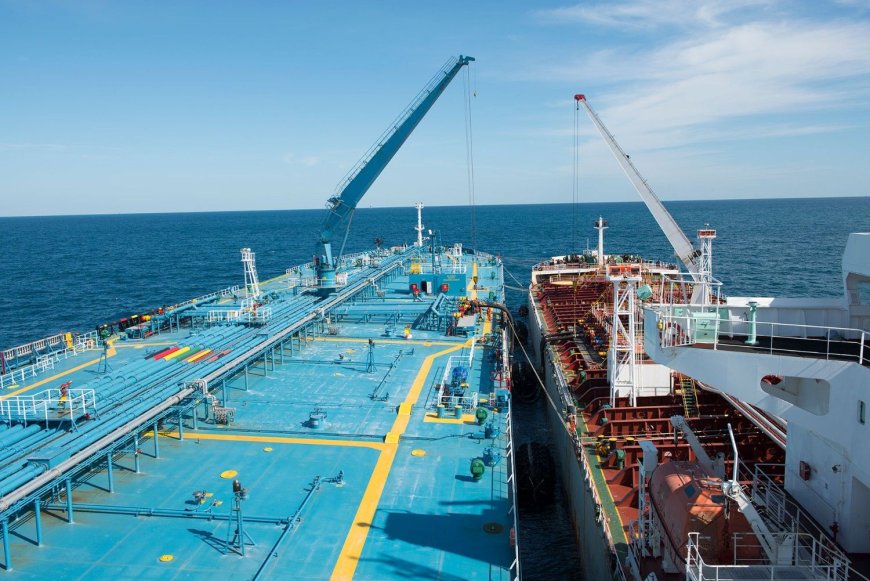
STS is a process where crude oil and other such fluids are transferred from one ship to another in mid sea.
Why follow Ship-to-Ship Transfer Process?
Ship-to-ship (STS) transfer involves transferring crude oil from one vessel to another, typically in open sea or designated areas. This process is often used to
· Reduce transportation costs: By transferring cargo from a larger vessel to a smaller one, ships can navigate through restricted waterways or ports
· Increase cargo flexibility - STS transfers enable vessels to change their cargo or destination without having to return to shore
Process of The STS transfer typically involves:
· Preparation - Both vessels are prepared for the transfer operation, with safety measures in place, such as fenders and communication equipment.
· Aligning ships - The vessels are positioned alongside each other, and the transfer hose or pipe is connected.
· Transfer - The crude oil is transferred from one vessel to the other through the hose or pipe.
Crude oil is also transferred through ship-to-dock transfer
Ship-to-Dock Transfer Process:
Transferring crude oil from a ship to a dock involves connecting the ship's cargo lines to the dock's piping system. This process typically occurs at a terminal or refinery facility and involves
· Berthing -The ship is secured at the dock, and the cargo lines are connected to the dock's piping system.
· Transfer - The crude oil is transferred from the ship's cargo tanks to the dock's storage tanks.
Safety measures considered during transfer:
Both ship-to-ship and ship-to-dock transfers require strict safety protocols to prevent accidents and minimize environmental impact. These protocols include
· Risk assessments - Thorough risk assessments are conducted before the transfer operation to identify potential hazards.
· Safety equipment - Safety equipment, such as firefighting systems and emergency shutdown valves, are installed and tested before the transfer operation.
· Trained personnel - Personnel involved in the transfer operation are trained and experienced in handling crude oil and operating the necessary equipment.
You may require expert consultants and service providers to conduct the above operations smoothly. You will find Ocean Group, UAE very much in line with your requirement and you can contact them on phone number Call / WhatsApp: +971 50 4974021 or send mail to operations@oceanemarine.com to field queries on STS operations.
What's Your Reaction?