






























India Shipping Container Market, Growth, Trends, Size, Share, Analysis, Forecast 2034
The India shipping container market grew from USD 403.7 Million in 2025 to USD 418.5 Million in 2026 and is projected to reach USD 562.9 Million by 2034, growing at a CAGR of 3.65% during 2026-2034.
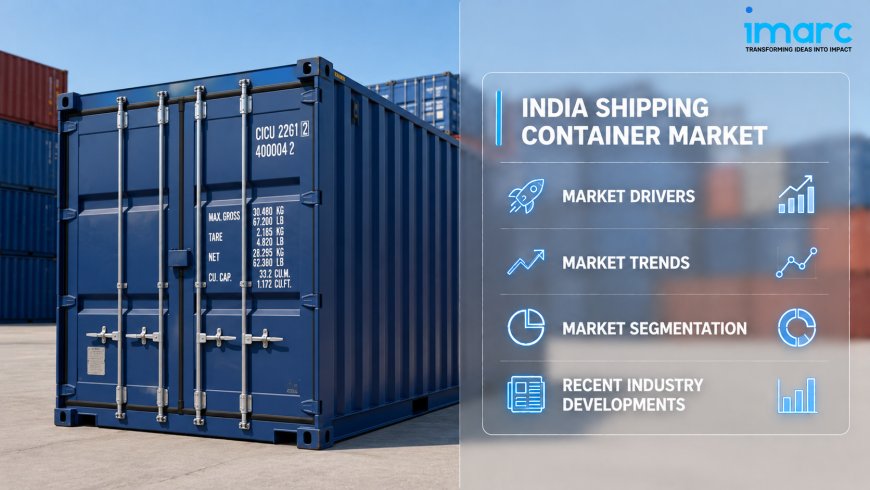
According to IMARC Group's report titled "India Shipping Container Market Size, Share, Trends and Forecast by Product, Container Size, Application, and Region, 2026-2034", The report offers a comprehensive analysis of the industry, including market forecast, growth, Share, and regional insights.
India's logistics and export-import (EXIM) networks are undergoing rapid modernization, anchoring a structural transition toward highly efficient, multimodal containerized transport. This pivot offers critical capital allocation opportunities for stakeholders targeting port infrastructure and specialized freight leasing operations.
Here is a detailed market analysis of the India Shipping Container Market, strictly sourced from official government policies, regulatory initiatives, and national infrastructure data.
Market Brief
-
Market Size (2025): USD 403.7 Million
-
Market Size (2026): USD 418.5 Million
-
Forecast (2034): USD 562.9 Million
-
CAGR (2026–2034): 3.65%
-
Leading Segment: Dry Storage Containers
Market Growth Catalysts
-
Container Manufacturing Assistance Scheme (CMAS): Announced in the Union Budget 2026-27, the government launched CMAS with an outlay of ₹10,000 crore over five years. This comprehensive policy provides direct capital assistance for establishing greenfield manufacturing facilities and brownfield expansions. It targets scaling India's annual container production capacity tenfold, reaching up to 7.5 lakh Twenty-foot Equivalent Units (TEUs).
-
Mitigating Supply-Chain Vulnerabilities: Historically, up to 99% of India's EXIM container trade by volume has been carried by foreign shipping lines, making the country highly vulnerable to freight rate volatility and the expensive repositioning of empty containers. The aggressive domestic push for manufacturing directly addresses this strategic gap, significantly reducing reliance on imported containers and insulating the logistics sector from global supply chain shocks.
-
Synergies with the Broader Maritime Resurgence Package: Container manufacturing is structurally accelerated by a massive ₹69,725 crore government package aimed at strengthening the overall domestic maritime ecosystem. This includes the Shipbuilding Financial Assistance Scheme (SBFAS) and the Maritime Development Fund, which synergistically boost domestic shipbuilding capacity, thereby generating captive, sustained demand for indigenously manufactured containers.
Industry Trends
-
Rollout of Domestically Manufactured EXIM Containers: Aligning with the Atmanirbhar Bharat vision, India has successfully produced its first domestically manufactured export-import (EXIM) shipping container for global shipping giant A.P. Moller-Maersk. Unveiled at the CONCOR Inland Container Depot in Dadri, Uttar Pradesh in July 2026, these prototypes are strictly built to international quality and safety benchmarks, including International Organization for Standardization (ISO) specifications and the International Convention for Safe Containers (CSC).
-
Establishment of the Bharat Container Shipping Line (BCSL): To anchor India's EXIM logistics strategy, the Ministry of Ports, Shipping and Waterways (MoPSW) spearheaded a Memorandum of Understanding (MoU) in February 2026 to establish BCSL. This consortium brings together the Shipping Corporation of India (SCI), Container Corporation of India (CONCOR), Sagarmala Finance Corporation Limited (SMFCL), and major Port Authorities to build an integrated national container and shipping ecosystem.
-
Expansion of PSU Roles in Terminal Operations: State-owned rail hauler CONCOR is strategically expanding its operational footprint by transitioning from a minority stakeholder to a primary terminal operator. This is evidenced by an MoU to operate and maintain the upcoming container terminal at Bhavnagar Port in Gujarat, which will extend logistical reach into Central Gujarat and the Dholera industrial belt.
➤ Unlock Industry Insights and Future Forecasts – Request Sample Report: https://www.imarcgroup.com/india-shipping-container-market/requestsample
Market Segmentation Analysis:
By Product
-
Dry Storage Containers (46.8% Market Share)
-
Refrigerated Containers (21.7% Market Share)
-
Flat Rack Containers (14.2% Market Share)
-
Special Purpose Containers (9.6% Market Share)
-
Others (7.7% Market Share)
By Container Sizes
-
Large Containers (40 feet) (44.9% Market Share)
-
Small Containers (20 feet) (32.6% Market Share)
-
High Cube Containers (15.8% Market Share)
-
Others (6.7% Market Share)
By Applications
-
Food and Beverages
-
Consumer Goods
-
Healthcare
-
Industrial Products
-
Vehicle Transport
-
Others
By Regions
-
West and Central India (36.2% Market Share)
-
South India (27.8% Market Share)
-
North India (21.4% Market Share)
-
East and Northeast India (14.6% Market Share)
Competitive Environment
-
Transition from Import Dependency to Domestic Rivalry: India’s container market has transitioned from nearly 100% reliance on Chinese-made boxes to an emerging, fiercely competitive domestic manufacturing hub. Backed by the government's ₹10,000 crore incentive—which acts as an equalizer against foreign price advantages—Indian enterprises are rapidly scaling up corten steel slitting, automatic welding lines, and assembly units to compete directly on the global stage.
-
Entry of Diversified Industrial Conglomerates: The lucrative push for Atmanirbhar Bharat has attracted heavily capitalized domestic industrial conglomerates into the container manufacturing space. For instance, the DCM Shriram Group emerged as the key manufacturer to secure the recent 1,000-container order from Maersk. This indicates that large-scale corporate entities are taking the lead in establishing state-of-the-art facilities that strictly comply with International Convention for Safe Containers (CSC) and ISO standards.
-
Public-Private Synergies and Financing Structures: The competitive landscape is uniquely shaped by specialized public sector financing structures. Entities like the Sagarmala Finance Corporation Limited (SMFCL) and IRFC are playing active roles in funding allied infrastructure. This creates a deeply integrated ecosystem where private domestic manufacturers benefit from captive demand generated by state-backed entities like SCI and CONCOR. Consequently, the market features a robust, multi-layered competitive ecosystem that blends private manufacturing agility with the financial backing of government-led mega-consortiums.
Key Players:
-
APPL Containers Limited
-
Jupiter Wagons
-
Retveyraaj Cargo Shipping Containers
-
Dhruv Container Line Pvt. Ltd.
Note: If you need specific information that is not currently within the scope of the report, we can provide it to you as a part of the customization.
➤ Align Insights with Your Business Goals – Request Customization: https://www.imarcgroup.com/request?type=report&id=21808&flag=E
Frequently Asked Questions (FAQs)
Q1: What is the current value and projected growth of the India Shipping Container Market?
According to IMARC Group, the India shipping container market reached USD 403.7 Million in 2025 to USD 418.5 Million in 2026 and is projected to reach USD 562.9 Million by 2034, registering a steady CAGR of 3.65% during the 2026-2034 forecast period.
Q2: Which product segment dominates the shipping container industry in India?
Dry storage containers hold the largest market share at 46.8% in 2025, heavily utilized for transporting manufactured goods, textiles, and standard consumer cargo across primary EXIM routes.
Q3: What is the fastest-growing container category in the market?
Refrigerated (reefer) containers represent the fastest-growing segment, projected to expand at a 4.8% CAGR, directly fueled by surging pharmaceutical and seafood export volumes requiring strict temperature compliance.
Q4: Which container size is most preferred by logistics operators?
Large containers (40-foot variants) capture the largest segment share at 44.9%, reflecting the industry's strategic preference for per-TEU cost optimization and high-volume freight consolidation.
Q5: Which region commands the highest market share for container logistics?
West and Central India dominate with a 36.2% share, driven by the operational scale of the Jawaharlal Nehru Port Trust (JNPT) and Mundra port, which together handle the vast majority of the nation's containerized cargo.
Strategic Insight & Verdict:
By analyzing the convergence of India's aggressive port modernization frameworks and its USD 2 Trillion export mandate, we at IMARC Group have observed that the India Shipping Container Market presents a highly resilient industrial investment. The expansion of multimodal networks under PM Gati Shakti is actively neutralizing historical logistical bottlenecks. For corporate investors, allocating capital toward specialized reefer fleets or domestic container manufacturing units represents a mathematically sound path to capturing long-term ROI.
Verified Data Source: India Shipping Container Market Report By IMARC Group
What's Your Reaction?