



































South East Asia Risk Management Market: $1.88 Billion Surge Triggered by a Massive Wave of Cyber Threats!
South East Asia risk management market size reached USD 579.8 Million in 2025. Looking forward, IMARC Group expects the market to reach USD 1,883.8 Million by 2034, exhibiting a growth rate (CAGR) of 13.57% during 2026-2034. The increasing frequency and sophistication of cyber threats, which continue to push organizations to invest in comprehensive risk management solutions to safeguard their digital assets and sensitive data, is driving the market.
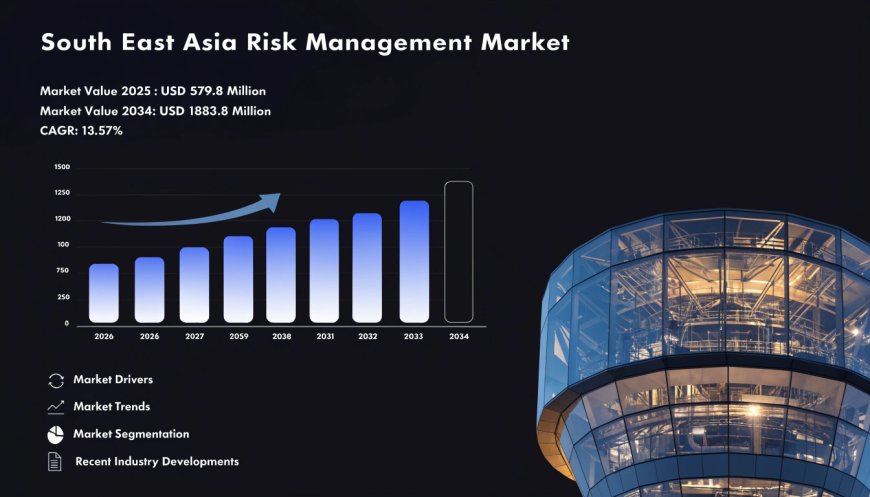
According to IMARC Group's report titled "South East Asia Risk Management Market Size, Share, Trends and Forecast by Component, Deployment Mode, Enterprise Size, Industry Vertical, and Country, 2026-2034", The report offers a comprehensive analysis of the industry, including market forecast, growth, South East Asia Risk Management Market Size, and regional insights.
South East Asia risk management market size reached USD 579.8 Million in 2025. Looking forward, IMARC Group expects the market to reach USD 1,883.8 Million by 2034, exhibiting a growth rate (CAGR) of 13.57% during 2026-2034.
Driven by an unprecedented escalation in sophisticated cyber-attacks and tightening regulatory frameworks across the ASEAN block, the South East Asia risk management sector is undergoing a rapid $1.88 billion digital transformation. This explosive market surge presents a highly lucrative capitalization window for enterprise software providers and strategic IT consultancies offering next-generation governance, risk, and compliance (GRC) architectures.
-
Explosive Market Valuation: The regional risk management market, firmly valued at USD 579.8 million in 2025, is strategically projected to scale to a formidable USD 1,883.8 million by 2034.
-
Robust Compound Growth: Enterprise SaaS investors can capitalize on a high-yield Compound Annual Growth Rate (CAGR) of 13.57% spanning the 2026-2034 forecast horizon.
-
Cybersecurity as the Primary Catalyst: The transition to remote work architectures and the digitization of critical supply chains have triggered a massive wave of digital threats, forcing the BFSI and IT sectors to aggressively procure proactive risk intelligence platforms.
-
Cloud-Native Deployment Shift: B2B buyers are systematically abandoning legacy on-premises systems, driving aggressive capital expenditure toward agile, cloud-based risk assessment software that offers real-time threat monitoring and multi-tenant scalability.
-
ASEAN Regulatory Convergence: Increasingly stringent regional data privacy laws act as a strict compliance mandate, compelling both large enterprises and SMEs to heavily invest in automated audit and data privacy treatment software.
➤ Request Sample Report - Evaluate Core Statistics Driving Your Industry Trends
India's Strategic Vision for the South East Asia Risk Management Market
-
Exporting Sovereign IT Security Frameworks: Indian tech conglomerates view the South East Asian cyber ecosystem as a critical export destination for indigenous, high-margin GRC (Governance, Risk, and Compliance) software, aiming to reduce the region's historical reliance on Western cybersecurity monopolies.
-
Establishing Cross-Border Data Corridors: Indian policymakers and Tier-1 IT enterprises are actively forging bilateral digital infrastructure agreements with key ASEAN nations to standardize cross-border data protection, fostering seamless, compliant risk management integration for multinational corporations.
-
Accelerating Digital Public Infrastructure (DPI) Integration: By leveraging its successful domestic rollout of secure digital identities, India seeks to deploy integrated, cyber-resilient DPI frameworks across emerging SEA markets, inherently creating massive B2B demand for underlying, interoperable risk architecture.
Why Invest in the South East Asia Risk Management Market: Key Growth Drivers & ROI
-
Massive Enterprise Consumption Base: The rapid digitalization of Indonesia and Vietnam’s financial sectors creates an infinitely scalable B2B consumption base. Investors secure robust ROI as thousands of newly digitized SMEs and established BFSI conglomerates continuously procure automated risk assessment tools to protect digital assets.
-
Stringent Policy Support & Compliance Mandates: Aggressive data sovereignty laws across the ASEAN block fundamentally de-risk institutional SaaS investments. These strict governmental compliance mandates force enterprises to continuously upgrade their GRC frameworks, guaranteeing highly predictable, recurring subscription revenues for B2B cybersecurity software developers.
-
Premiumization via AI-Driven Threat Intelligence: Corporate IT capital is rapidly shifting toward premium predictive risk analytics. By integrating artificial intelligence and machine learning algorithms, B2B vendors command premium pricing for platforms offering automated, real-time threat detection, drastically reducing enterprise exposure to catastrophic, multi-million-dollar cyber breaches.
-
Optimized Supply Chain Resilience: The integration of risk management software directly into global manufacturing nodes across Thailand and Malaysia fundamentally optimizes supply chain logistics. Automated risk modeling mitigates operational downtime from geopolitical disruptions and cyber-physical attacks, drastically accelerating the overall velocity of capital returns.
South East Asia Risk Management Market Trends & Future Outlook
-
Mainstreaming of Zero-Trust Architectures: The B2B cybersecurity landscape will witness an aggressive, region-wide pivot toward "Zero-Trust" security frameworks. Future enterprise IT procurement will heavily target continuous authentication software that assumes network perimeters are already breached, inherently driving demand for advanced identity and access management (IAM) risk modules.
-
Integration of Climate Risk Analytics (ESG): Beyond digital threats, institutional investors and regulatory bodies will force a massive structural shift toward ESG (Environmental, Social, and Governance) compliance. Risk platforms will rapidly evolve to incorporate complex climate risk modeling, predicting the financial impact of environmental vulnerabilities on critical physical infrastructure.
-
Rise of Automated GRC Platforms: The long-term trajectory guarantees the obsolescence of siloed, manual audit processes. Corporate capital expenditure will heavily target unified Governance, Risk, and Compliance (GRC) platforms that utilize Application Programming Interfaces (APIs) to autonomously aggregate risk data across disparate enterprise departments in real-time.
-
Hyper-Specialization by Industry Vertical: As threats become increasingly sophisticated, generalized risk software will lose market share. The sector will experience deep structural segmentation, with B2B developers aggressively launching hyper-specialized risk modules tailored explicitly for the distinct regulatory nuances of the BFSI, Healthcare, and Energy sectors.
➤ Request Full Brochure - Discover the Complete TOC and Data Coverage
By the IMARC Group, the Top Competitive Landscape & their Positioning:
Covering an in-depth analysis of the competitive landscape, market structure, key player positioning, competitive dashboards, top winning strategies, and detailed profiles of all major industry participants you will gain access to all these exclusive insights within the full research report.
South East Asia Risk Management Market Segmentation:
IMARC Group provides an analysis of the key trends in each segment of the market, along with forecasts at the regional and country level for 2026-2034. Our report has categorized the market based on component, deployment mode, enterprise size, and industry vertical.
Component Insights:
-
Software
-
Service
Deployment Mode Insights:
-
On-Premises
-
Cloud-based
Industry Vertical Insights:
-
BFSI
-
IT and Telecom
-
Retail
-
Healthcare
-
Energy and Utilities
-
Manufacturing
-
Government and Defense
-
Others
Country Insights:
-
Indonesia
-
Thailand
-
Singapore
-
Philippines
-
Vietnam
-
Malaysia
-
Others
Note: If you need specific information that is not currently within the scope of the report, we can provide it to you as a part of the customization.
➤ Request Customization - Shape the Data to Answer Your Specific Questions
FAQ’s
1. What is the current market size and projected growth of the South East Asia risk management market?
The South East Asia risk management market was valued at USD 579.8 Million in 2025. It is projected to reach USD 1,883.8 Million by 2034, exhibiting a strong Compound Annual Growth Rate (CAGR) of 13.57% during the forecast period of 2026–2034.
2. What are the primary factors driving the growth of this market?
The market's expansion is heavily driven by the increasing frequency and severity of cyber threats, which is pushing organizations to invest in robust cybersecurity risk management tools. Additionally, complex supply chains due to growing regional interconnectedness, an evolving regulatory landscape demanding strict compliance, and the mounting need to assess climate change and environmental vulnerabilities are propelling the adoption of advanced risk management solutions.
3. How is the risk management market segmented by component and deployment mode?
The market is categorized by component into two main segments: Software and Services. In terms of deployment mode, these risk management solutions are delivered through either On-Premises or Cloud-based platforms.
4. Which industry verticals are the primary adopters of risk management solutions in the region?
Risk management solutions are widely utilized across a diverse range of industry verticals, including BFSI (Banking, Financial Services, and Insurance), IT and Telecom, Retail, Healthcare, Energy and Utilities, Manufacturing, and Government and Defense.
5. What are the key countries analyzed within the South East Asia region?
The comprehensive market analysis covers major countries in the region, specifically Indonesia, Thailand, Singapore, the Philippines, Vietnam, and Malaysia.
Strategic Insight & Verdict
Strategic Insight & Verdict Having analyzed evolving enterprise risk landscapes and regulatory complexities, we observe Southeast Asia’s risk management market advancing toward integrated, technology-driven frameworks combining analytics, automation, and real-time monitoring. Organizations investing in AI-powered risk intelligence, cybersecurity resilience, and compliance automation will gain competitive advantage. We at IMARC Group anticipate sustained growth driven by digital transformation, cross-border trade expansion, and increasing focus on operational and financial risk mitigation.
— Pragati Bharadwaj, Digital Market Research Strategist at IMARC Group https://www.linkedin.com/in/pragati-bharadwaj/
Verified Data Source: IMARC Group
What's Your Reaction?