
































Philippines Apple Cider Vinegar Market: Trends, Growth Drivers, and Forecast 2034
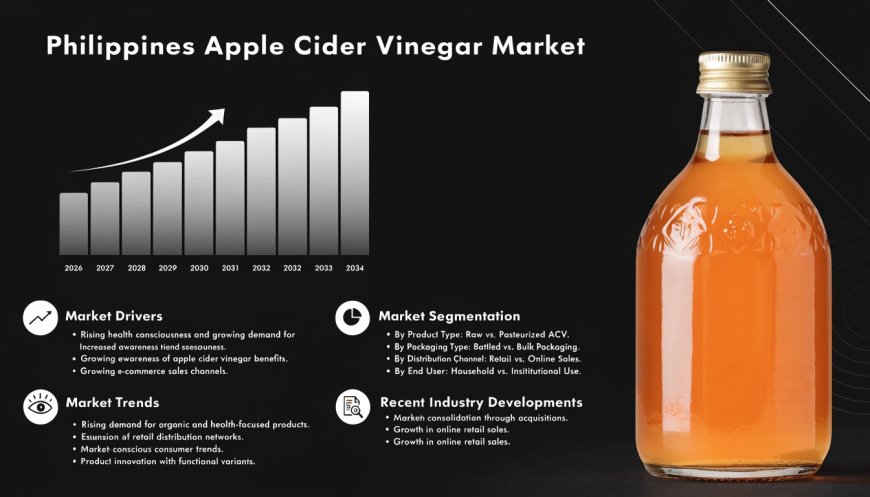
The Philippines apple cider vinegar market size reached USD 24.05 Million in 2025. The market is projected to reach USD 42.97 Million by 2034, growing at a CAGR of 6.66% during 2026-2034.

Market Overview
The Philippines apple cider vinegar market is gaining substantial momentum, driven by rising health and wellness consciousness among Filipino consumers, rapid e-commerce expansion enabling wider product accessibility across the archipelago, growing preference for organic and clean-label food products, and increasing awareness of gut health and digestive wellness benefits. The market size reached USD 24.05 Million in 2025 and is projected to reach USD 42.97 Million by 2034, exhibiting a CAGR of 6.66% during 2026-2034. The expanding middle class with increasing disposable incomes is gravitating toward premium health products, while digital health media and influencer-driven wellness campaigns are accelerating consumer education. The Philippines organic food market is projected to grow at a CAGR of 6.8% during 2025-2031, reflecting a broader shift toward natural and functional food products that directly benefits apple cider vinegar adoption. Historical analysis spans 2020 to 2025 with forecasts extending through 2034.
Key Market Summary and Scope
• The Philippines plant-based food market reached USD 58.0 Million in 2025 and is projected to reach USD 131.3 Million by 2034, reflecting a broader consumer shift toward health-conscious and natural food products that supports apple cider vinegar demand.
• A study found that 54.10 percent of Filipino consumers intend to increase plant-based food intake while 39.34 percent plan to reduce meat consumption, highlighting a strong transition toward healthier dietary habits and functional wellness products.
• Mobile wallet adoption exceeding 65 percent among Filipino online shoppers has transformed payment behavior, removing barriers for consumers purchasing health supplements including apple cider vinegar through major platforms like Lazada and Shopee.
• The Philippine FDA issued Advisory No. 2025-1552 warning against therapeutic claims for food supplements, reinforcing regulatory standards that benefit registered and compliant apple cider vinegar brands in the marketplace.
• In March 2024, discount grocery chain Dali Discount secured a USD 25 Million investment from Singapore's Venturi Partners and other investors, supporting expansion of affordable grocery retail that improves health product accessibility for middle-income consumers.
Request for Sample Report: https://www.imarcgroup.com/philippines-apple-cider-vinegar-market/requestsample
Key Sectors Driving Market Trends
Health and Wellness Consciousness Driving Functional Food Demand
The Philippines is experiencing a notable cultural shift toward preventive healthcare and holistic wellness that is reshaping consumer purchasing patterns across the food and beverage sector. Awareness of gut health and its connection to overall immunity has expanded rapidly, driven by widespread media messaging, social media influencer campaigns, and active promotion from wellness brands targeting Filipino consumers. Priorities such as boosting immune function, improving dietary habits, and managing weight have become central to everyday routines, creating strong demand for functional foods and natural health products. Apple cider vinegar fits naturally within this evolving landscape as it is widely associated with digestive support, weight management, and a clean natural profile that resonates with wellness-minded consumers. International supplement companies are expanding into the Philippine market to meet rising demand, making premium wellness products available through leading retail pharmacies, online platforms, and dedicated health stores across the archipelago.
E-Commerce Expansion and Digital Transformation Reshaping Product Access
The rapid digital transformation across the Philippines is fundamentally reshaping how consumers discover and purchase health and wellness products including apple cider vinegar. Online shopping has become deeply integrated into everyday life, with food and beverages emerging as one of the most dynamic e-commerce segments. Mobile wallet adoption exceeding 65 percent has removed payment barriers for consumers who previously had limited access to traditional banking services, enabling seamless purchasing of health supplements from anywhere in the country. Major e-commerce platforms including Lazada and Shopee provide broad nationwide reach, user reviews, promotional campaigns, and reliable delivery services across the archipelago. Social commerce models including community group-buying platforms are encouraging more consumers to shop online through localized trust-based purchase channels, democratizing access to apple cider vinegar products that were previously available mainly in urban specialty stores and pharmacy chains.
Organic and Clean-Label Product Preference Accelerating Premium Adoption
Filipino consumers are increasingly discerning about the food and health products they purchase, demonstrating a clear shift toward organic, natural, and clean-label options that mirrors global wellness trends. The Philippines organic food market growing at a CAGR of 6.8 percent during 2025-2031 reflects this accelerating consumer preference for products made from natural sources without artificial additives or preservatives. Apple cider vinegar benefits significantly from this movement, especially organic and unfiltered formats that retain naturally occurring cultures valued by health-conscious buyers. Government programs supporting organic agriculture are expanding the supply of natural ingredients, benefiting manufacturers in the health and wellness space. The combination of rising middle-class purchasing power, expanding organic product availability, and growing consumer attention to ingredient labels and certifications is creating favorable conditions for premium apple cider vinegar products across retail and e-commerce distribution channels.
Regulatory Framework and Policy Environment
Philippine FDA Registration and Product Safety Standards
The Philippine Food and Drug Administration administers comprehensive registration requirements for all food and beverage products including apple cider vinegar, ensuring safety, efficacy, and quality standards across the consumer health product market. Pursuant to Republic Act No. 9711, the manufacture, importation, sale, distribution, and promotion of health products without proper FDA authorization is prohibited. The FDA Center for Food Regulation and Research regulates food supplements including apple cider vinegar capsules, gummies, and concentrated formulations, requiring manufacturers and importers to obtain a Certificate of Product Registration before marketing products in the Philippines. Multiple FDA advisory warnings issued in 2025 and 2026 targeted unregistered apple cider vinegar supplement products, reinforcing the regulatory framework that protects consumers and benefits compliant brands with established registration credentials.
Therapeutic Claims Restrictions and Labeling Compliance
The Philippine FDA issued Advisory No. 2025-1552 providing a public health warning against the advertisement, promotion, marketing, and use of food and dietary supplements for therapeutic purposes and indications. This regulatory action reinforces the distinction between food supplements and pharmaceutical products, requiring apple cider vinegar manufacturers to ensure their marketing communications accurately represent product benefits without making unauthorized health claims. The FDA has published a draft Administrative Order establishing standards for vinegar and a code of practice for its manufacture, further formalizing quality requirements for vinegar products in the Philippine market. These regulatory measures establish clear guidelines for product positioning, labeling accuracy, and marketing compliance that benefit registered manufacturers while creating barriers for unregistered and non-compliant market participants.
Organic Agriculture Support and Trade Facilitation
Government programs supporting organic agriculture in the Philippines are creating favorable conditions for organic apple cider vinegar production and sourcing by expanding the domestic supply of certified organic raw materials. The Department of Agriculture's organic farming initiatives and certification programs are encouraging agricultural producers to adopt organic practices that supply the growing health food manufacturing sector. Trade regulations governing food product imports, including tariff classifications and customs requirements, influence the competitive dynamics between imported premium brands and domestically manufactured apple cider vinegar products. The Department of Trade and Industry's investment promotion programs support domestic food manufacturing capacity expansion through fiscal incentives, enabling local producers to develop competitive apple cider vinegar products that meet growing consumer demand for organic and naturally processed health food items.
Market Segments
The Philippines apple cider vinegar market is segmented by form, category, distribution channel, application, and region.
Breakup by Form
• Powder
• Tablet
• Capsule
• Liquid
Breakup by Category
• Organic
• Conventional
Breakup by Distribution Channel
• Supermarkets and Hypermarkets
• Retail Stores
• Specialty Stores
• Online Stores
• Others
Breakup by Application
• Food and Beverages
• Personal Care
• Pharmaceuticals
• Others
Breakup by Region
• Luzon
• Visayas
• Mindanao
Economic Benefits of Philippines Apple Cider Vinegar Market
• The expanding e-commerce ecosystem with mobile wallet adoption exceeding 65 percent is generating digital retail employment, logistics infrastructure investment, and payment technology development that supports health product distribution across the Philippines.
• Growth of organic apple cider vinegar demand is supporting agricultural employment and organic farming operations, creating income opportunities for farmers transitioning to certified organic apple and fruit production practices.
• Dali Discount's USD 25 Million investment is expanding affordable grocery retail networks that improve health product accessibility for middle-income consumers, supporting retail employment and supply chain development across underserved regions.
• The Philippines plant-based food market projected to reach USD 131.3 Million by 2034 is creating complementary demand for functional food products including apple cider vinegar, supporting cross-category innovation and manufacturing employment.
• Domestic apple cider vinegar manufacturing capacity expansion supported by government investment incentives is reducing import dependency, improving trade balance, and creating higher-value food processing employment within the Philippine health food sector.
Competitive Landscape
The Philippines apple cider vinegar market exhibits moderate competition characterized by a mix of international brands available through importers and distributors alongside growing local production. The competitive landscape is dominated by established international players such as Bragg, which enjoys strong brand recognition among health-conscious consumers, competing with regional and local brands offering more affordable alternatives. Major distribution channels including health and wellness specialty retailers like Healthy Options, mainstream pharmacy chains such as Mercury Drug and Watsons, large supermarket chains including SM Markets and Robinsons Supermarkets, and rapidly growing e-commerce platforms like Lazada and Shopee serve as critical battlegrounds for market share. Competition increasingly centers on product differentiation through organic certification, filtration methods, added functional ingredients, format innovation, and brand positioning emphasizing quality and authenticity.
Real-World Applications
• In March 2024, Dali Discount secured a USD 25 Million investment from Venturi Partners and other investors, expanding affordable grocery retail options that make health and wellness products including apple cider vinegar more accessible to Philippine consumers.
• Major e-commerce platforms Lazada and Shopee are driving apple cider vinegar sales through targeted wellness promotions, bundled health packs, and reliable delivery services that reach consumers across the Philippine archipelago including provincial areas.
• Health and wellness specialty retailers like Healthy Options are expanding organic apple cider vinegar product ranges, offering premium unfiltered and organic variants that cater to growing consumer demand for clean-label functional food products.
• Pharmacy chains Mercury Drug and Watsons are stocking apple cider vinegar supplements in capsule, tablet, and gummy formats, positioning the product within the growing preventive healthcare and dietary supplement categories across nationwide retail networks.
• Blended apple cider vinegar products combining complementary ingredients such as honey, ginger, turmeric, and probiotic cultures are gaining traction, attracting consumers seeking enhanced health benefits and differentiated flavor profiles.
Latest Recent News and Developments
January 2026: The Philippine FDA issued Advisory No. 2026-0098 warning against the purchase and consumption of unregistered apple cider vinegar gummies dietary supplements, reinforcing product registration requirements for consumer safety.
November 2025: The Philippine FDA issued Advisory No. 2025-1552 warning against the advertisement, promotion, and use of food and dietary supplements for therapeutic purposes, strengthening labeling compliance standards across the wellness product market.
September 2025: E-commerce platforms in the Philippines reported significant year-over-year growth in apple cider vinegar purchases, with digital promotions and bundled wellness packs driving online sales momentum among urban millennials.
July 2025: Major health-focused brands launched premium organic and unfiltered apple cider vinegar variants in the Philippines highlighting live cultures and functional benefits with enhanced packaging and targeted wellness messaging.
March 2024: Discount grocery chain Dali Discount secured a USD 25 Million investment from Singapore's Venturi Partners and other investors, supporting expansion of affordable grocery retail that improves health product accessibility.
Future Developments and Opportunities
• Continued expansion of e-commerce platforms and mobile payment adoption is expected to further democratize access to apple cider vinegar products across provincial areas, creating new demand channels beyond traditional urban retail concentrations.
• Growth of AI-powered personalized wellness recommendations on health apps and e-commerce platforms is anticipated to drive targeted apple cider vinegar product discovery, increasing consumer conversion rates and repeat purchase frequency.
• The Philippines organic food market growing at a CAGR of 6.8 percent is projected to create expanding demand for organic apple cider vinegar products, supported by government programs encouraging organic agriculture and natural ingredient sourcing.
• Innovation in apple cider vinegar product formats including gummies, effervescent tablets, ready-to-drink beverages, and flavored blends is expected to attract new consumer segments seeking convenient and palatable functional health products.
• Strengthening FDA regulatory frameworks for food supplements are anticipated to benefit established compliant brands by creating barriers for unregistered competitors, improving consumer trust, and supporting market formalization across the Philippines.
Browse Full Report with TOC & List of Figure: https://www.imarcgroup.com/philippines-apple-cider-vinegar-market
What's Your Reaction?