






























Australia Industrial Coatings Market to Reach USD 4.89 Billion by 2034
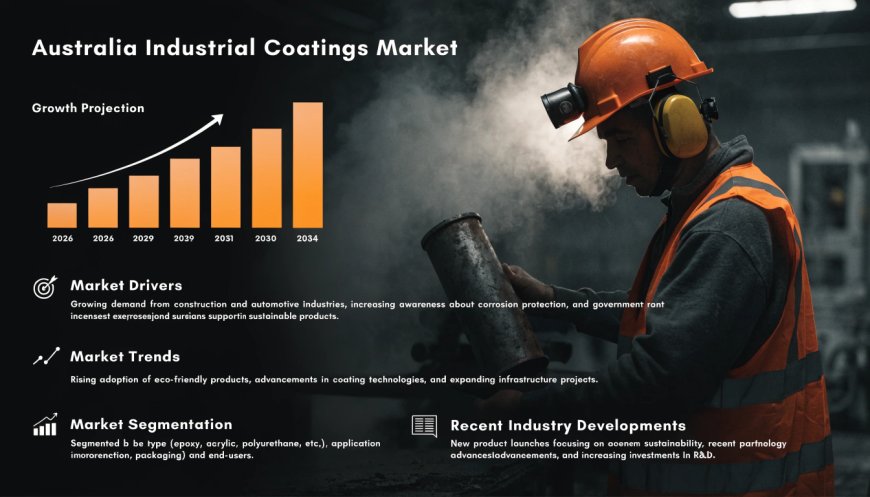
The Australia industrial coatings market size was valued at USD 3.37 Billion in 2025, according to the latest report from IMARC Group. The market is projected to reach USD 4.89 Billion by 2034, exhibiting a growth rate (CAGR) of 3.65% during 2026-2034.

Market Overview
The Australia industrial coatings market size was valued at USD 3.37 Billion in 2025, according to the latest report from IMARC Group. The market is projected to reach USD 4.89 Billion by 2034, exhibiting a growth rate (CAGR) of 3.65% during 2026-2034. The market is expanding steadily, driven by robust infrastructure development, growing manufacturing activity, and rising demand for protective surface solutions across diverse industrial sectors. Increasing environmental awareness and stricter regulatory frameworks are accelerating the shift toward sustainable, low-emission coating technologies. Advancements in formulation science, coupled with expanding applications in mining, marine, and energy sectors, continue to strengthen the Australia industrial coatings market share.
Request Sample Report (Including Graphs, Charts & Figures):
https://www.imarcgroup.com/australia-industrial-coatings-market/requestsample
How AI is Reshaping the Future of the Australia Industrial Coatings Market
The integration of artificial intelligence into Australia‘s coatings manufacturing and testing sector is fundamentally transforming how protective coatings are formulated, assessed, and applied across the country’s demanding industrial environments.
AI-Driven Corrosion Assessment Transforming Quality Testing – In February 2026, Sparc Technologies partnered with the Australian Institute for Machine Learning (AIML) at the University of Adelaide to develop AI-driven software aimed at modernising how protective coatings performance is evaluated. The software uses computer vision and machine learning to assess corrosion performance, replacing labour-intensive manual methods that have remained largely unchanged for more than two decades. Current testing methods typically rely on subjective human judgement to measure corrosion spread—a process that can take an experienced technician around 40 minutes per assessment. The AI-driven approach delivers higher accuracy and consistency, faster assessment times, and more detailed data outputs. AIML Director Professor Simon Lucey noted that “the replacement of outdated manual corrosion assessment with computer vision holds great potential to increase efficiencies”.
AI Agents in Coatings Supply Chains – AI agents are increasingly being considered for integration into highly regulated industries such as coatings manufacturing. A framework for successful implementation of AI Agents has been proposed, addressing barriers that have made implementation difficult to date, prioritising tasks appropriate for full or part automation. Industry 5.0 focuses on human-machine collaboration, integrating AI with human creativity to enable personalized and sustainable coatings solutions, while Industry 6.0 envisions hyper-connectivity through quantum computing, nanotechnology, and biotechnology, introducing innovations like substrate interactive coatings and autonomous application technologies.
Graphene-Enhanced Coatings and AI Testing Platforms – Sparc Technologies has accelerated the commercialisation of its graphene-based coating additive, ecosparc®, through a series of milestones spanning field deployment, first commercial revenue, and the development of AI-driven corrosion assessment software. In December 2025, Sparc announced its first commercial sale of ecosparc® to an Asian coatings manufacturer for incorporation into solvent-based protective coatings. The company’s dual-track commercial strategy includes collaboration with global protective coatings manufacturers and direct engagement with asset owners in mining, oil and gas, government infrastructure and defence sectors.
Future AI Integration and Industry Outlook – The AI-driven approach to coatings testing aims to address an addressable market of about 850 laboratories worldwide across manufacturing, testing and research organisations, with letters of support received from multiple industry participants. Commercialisation is expected to focus on industry co-development and software licensing to testing laboratories and coatings manufacturers, with beta testing in third-party labs targeted within 12 months.
Australia Industrial Coatings Market Trends
Rising Adoption of Sustainable and Low-VOC Coating Formulations – Environmental sustainability is reshaping the Australian industrial coatings landscape as manufacturers transition toward low-volatile organic compound and water-based formulations. Stricter regulatory frameworks and growing environmental consciousness are compelling industries to adopt coatings that minimise emissions while maintaining performance standards. New VOC limits for coatings in Australia took effect in January 2024 under the Green Building Council of Australia guidelines, further accelerating the shift. This regulatory impetus is fostering innovation in bio-based resins and eco-friendly formulations, driving market growth across construction, manufacturing, and infrastructure applications.
Integration of Nanotechnology and Smart Coating Solutions – Advanced nanotechnology is increasingly being integrated into industrial coating formulations to deliver enhanced protective capabilities, including self-healing, hydrophobic, and antimicrobial properties. These next-generation coatings respond to environmental stimuli such as temperature and humidity changes, providing proactive maintenance and extending asset lifespans. In October 2024, ACM CRC, LaserBond, and the University of Sydney announced a collaborative project to develop an automated laser cladding system for metal matrix composite coatings, targeting improved wear and corrosion resistance for mining, marine, and defence applications.
Expanding Application of Powder Coatings for Architectural and Industrial Use – Powder coating technology is gaining significant traction in Australia due to its superior durability, minimal waste generation, and absence of solvent emissions. These attributes align with the country‘s stringent environmental standards and the construction sector’s sustainability goals. In January 2025, AkzoNobel launched its Interpon D Futura Collection in Australia and New Zealand, offering sustainable powder coatings backed by 25-year warranties and Environmental Product Declarations. The growing preference for powder-based solutions across automotive, aerospace, and architectural applications is reinforcing this transformative trend.
Australia Industrial Coatings Market Summary
- Market Valuation: The market reached USD 3.37 Billion in 2025 and is projected to reach USD 4.89 Billion by 2034, registering a CAGR of 3.65% during 2026-2034.
- Acrylic Dominance: Acrylic dominates with a market share of 28.5% in 2025 owing to its exceptional versatility, superior weather resistance, and compatibility with eco-friendly water-based formulations.
- Solvent Borne Leadership: Solvent borne leads the market with a share of 42.5% in 2025, driven by its established performance credentials in heavy-duty industrial applications requiring superior adhesion, chemical resistance, and durability.
- General Industrial Segment: General industrial holds the largest end-user segment with a market share of 32.5% in 2025, reflecting broad-based demand for protective coatings across manufacturing facilities, warehouses, processing plants, and commercial structures.
- Regional Leadership: Australian Capital Territory & New South Wales represents the largest region with 34.8% share in 2025, driven by the concentration of industrial manufacturing, large-scale infrastructure investment, and Sydney metropolitan construction activity.
- Key Growth Drivers: Rising shifting toward sustainable, low-emission coating technologies, expanding mining industry operations in Western Australia and Queensland, and growing demand for corrosion-resistant coatings in marine and offshore applications.
Australia Industrial Coatings Market Growth Drivers
Government Infrastructure Investment Driving Demand for Protective Coatings – The Australian industrial coatings market is poised for positive growth driven by major infrastructure development initiatives including transportation infrastructure, energy infrastructure, and public buildings. The government‘s focus on these projects continues to fuel demand for advanced protective coatings. The expansion of mining industry operational activities continues to fuel demand for corrosion-resistant and abrasion-resistant coating solutions, while the energy shift towards renewable sources presents new development opportunities for specialised industrial coatings.
Mining Industry Expansion Creating Specialised Coating Demand – The rising growth of the mining industry in Western Australia and Queensland requires specialised coatings that can protect heavy machinery and infrastructure from the abrasive effects of particles, moisture, and chemicals. Technological innovations, such as nanotechnology-based and self-healing coatings, are expanding application areas and fuelling market growth in the industrial sector. The rising demand for corrosion-resistant coatings in marine and offshore applications further supports market growth.
Stricter Environmental Regulations and VOC Limits – The enforcement of strict construction standards aimed at sustainability and lowering carbon emissions is encouraging developers to choose materials that meet environmental goals. The new VOC limits for coatings in Australia that took effect in January 2024 under the Green Building Council of Australia guidelines have accelerated the shift toward low-emission and water-based coating technologies that meet stringent regulatory requirements while offering superior protective properties.
Graphene-Enhanced Protective Coatings Market Validation – The global protective coatings market is estimated to be valued at over US$16 billion in 2026, driven by massive infrastructure demands across construction, marine, and energy sectors. Sparc Technologies‘ ecosparc additive has demonstrated an ability to improve anti-corrosion performance by over 40% when added to standard epoxy coatings. The additive is designed to improve coating reliability, longevity, safety, and cost-effectiveness of the steel infrastructure it protects. In April 2026, AkzoNobel announced it will commercialise ecosparc-enhanced Interzone 954 in Australia from May 2026 on a made-to-order basis through its local manufacturing facility, marking a major graphene coatings breakthrough.
Australia Industrial Coatings Market Segments
Breakup by Product
- Acrylic (28.5% market share in 2025)
- Alkyd
- Polyurethane
- Epoxy
- Polyester
- Others
Breakup by Technology
- Solvent Borne (42.5% market share in 2025)
- Water Borne
- Powder
- Others
Breakup by End User
- General Industrial (32.5% market share in 2025)
- Construction and Infrastructure
- Mining
- Marine and Offshore
- Oil and Gas
- Energy and Power
- Others
Breakup by Region
- Australian Capital Territory & New South Wales (34.8% market share in 2025)
- Victoria & Tasmania
- Queensland
- Northern Territory & Southern Australia
- Western Australia
Competitive Landscape of the Australia Industrial Coatings Market
The Australia industrial coatings market features a dynamic mix of global coatings giants, specialised Australian-owned manufacturers, and emerging graphene technology innovators competing across protective, marine, architectural, and industrial segments.
Global Coatings Industry Leaders – AkzoNobel, a global coatings leader with €10.2 billion 2025 revenue, operates in more than 150 countries and employs about 31,500 people, with coatings brands including Dulux, International, Sikkens, and Interpon. In April 2026, AkzoNobel announced it will commercialise ecosparc-enhanced Interzone 954 protective coating in Australia, a heavy-duty coating with a global track record of more than 25 years used across offshore oil and gas facilities, offshore wind towers, jetties, sluice gates, and petrochemical plants. PPG Industries Australia Pty Ltd manufactures automotive, industrial, packaging, protective and marine coatings from its Clayton, Victoria and Adelaide facilities. The Sherwin-Williams Company provides protective and marine coatings with broad portfolio of high-performance coatings and systems that excel at combating corrosion. Jotun Australia Pty Ltd is part of the worldwide Jotun Group, operating in three divisions in Australia: Protective Coatings, Marine Coatings and Powder Coatings.
Major Australian-Owned Manufacturers – Dulux Powder & Industrial Coatings has been a leading manufacturer and supplier of quality protective coatings for Australia, New Zealand, Papua New Guinea and Fiji for over 80 years. Concept Paints is a 100% Australian-owned manufacturer specialising in automotive, industrial and marine coating systems with over three decades of operational history. A&I Coatings is an Australian-owned family business that develops and manufactures innovative niche coatings including polyurethanes, fluoropolymers, epoxies, acrylic and UV cured coatings for applications ranging from commercial projects through to mining and heavy industry. Astec Paints is a proudly South Australian-owned coatings manufacturer operating in Adelaide since 1978.
Emerging Graphene Technology Innovators – Sparc Technologies (ASX: SPN) has developed ecosparc®, a graphene-based performance additive for epoxy-based protective coatings. The company has secured a commercial release through AkzoNobel for ecosparc-enhanced Interzone 954 in Australia from May 2026. Sparc has also entered into a Letter of Intent with HydroGraph Clean Power Inc. to collaborate on the incorporation of fractal graphene into ecosparc® additives and is developing AI-driven corrosion assessment software in partnership with the Australian Institute for Machine Learning. First Graphene Limited (FGR) has entered an agreement to acquire key assets of Ionic Industries Inc., including graphene geotextile coating formulations, for a total consideration of AU$250,000 cash and shares.
Competition is centered on advanced formulation chemistry, graphene and nanotechnology integration, AI-powered quality testing, sustainability credentials including VOC compliance and carbon footprint reduction, distribution network strength across Australia‘s regions, and strategic partnerships with global coatings manufacturers and asset owners in mining, oil and gas, and infrastructure sectors. The growing adoption of smart coating technologies and AI-driven testing solutions is becoming an increasingly important differentiator as Australian manufacturers position themselves at the forefront of innovation.
Latest Recent News & Development in the Australia Industrial Coatings Market
April 2026: AkzoNobel announced it will commercialise Sparc Technologies‘ ecosparc-enhanced Interzone 954 protective coating in Australia from May 2026 on a made-to-order basis through its local manufacturing facility, following more than 21 months of field trials. AkzoNobel also integrated its Interpon powder coating brand with NATSPEC, Australia‘s national building specification system, streamlining compliance and sustainability specifications for architects and specifiers.
February 2026: Sparc Technologies partnered with the Australian Institute for Machine Learning (AIML) at the University of Adelaide to develop AI-driven software for protective coatings performance evaluation, targeting replacement of manual corrosion assessment methods that take approximately 40 minutes per test with AI analysis delivering results in tens of seconds.
February 2026: A pilot project validated a proof-of-concept under ISO 12944 corrosion boundary testing, with Sparc estimating the addressable market at about 850 laboratories worldwide across manufacturing, testing and research organisations.
January 2025: AkzoNobel launched its Interpon D Futura Collection in Australia and New Zealand, offering sustainable powder coatings backed by 25-year warranties and Environmental Product Declarations.
December 2025: Sparc Technologies announced its first commercial sale of ecosparc® to an Asian coatings manufacturer for incorporation into solvent-based protective coatings, marking the company‘s first direct revenue following more than six years of research and development.
October 2024: ACM CRC, LaserBond, and the University of Sydney announced a collaborative project to develop an automated laser cladding system for metal matrix composite coatings, targeting improved wear and corrosion resistance for mining, marine, and defence applications.
Browse Full Report with TOC & List of Figures:
https://www.imarcgroup.com/australia-industrial-coatings-market
About Us
IMARC Group is a leading market research company that offers management strategy and market research worldwide. We partner with clients in all sectors and regions to identify their highest-value opportunities, address their most critical challenges, and transform their businesses.
IMARC‘s information products include major market, scientific, economic and technological developments for business leaders in pharmaceutical, industrial, and high technology organisations. Market forecasts and industry analysis for industrial coatings, advanced materials, nanotechnology, chemicals, and novel processing methods are at the top of the company’s expertise.
Contact Us
IMARC Group
134 N 4th St., Brooklyn, NY 11249, USA
Email: sales@imarcgroup.com
Tel No: (D) +91 120 433 0800
United States: +1-631-791-1145
What's Your Reaction?