






























Saudi Arabia Freight and Logistics Market Size, Growth, Trends & Forecast Report 2026-2034
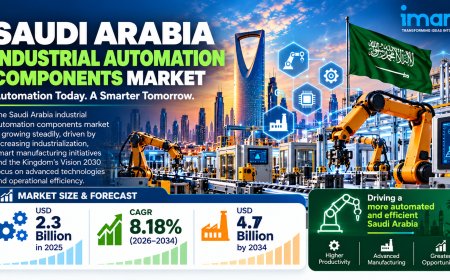
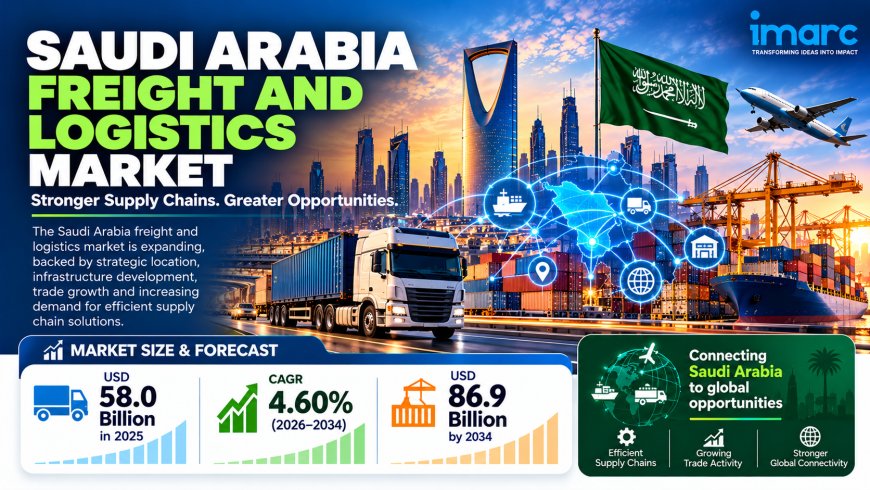
The Saudi Arabia freight and logistics market size was valued at USD 58.0 Billion in 2025. Looking forward, IMARC Group estimates the market to reach USD 86.9 Billion by 2034, exhibiting a CAGR of 4.60% from 2026-2034.

IMARC Group, a leading global market research and management consulting firm, has published its latest market intelligence report on the Saudi Arabia freight and logistics market. The Saudi Arabia freight and logistics market size increased from USD 55.29 Billion in 2025 to USD 57.88 Billion in 2026, and is projected to reach USD 83.41 Billion by 2034, exhibiting a CAGR of 4.67% during 2026-2034, driven by Vision 2030 infrastructure investments, surging e-commerce expansion, and the Kingdom's strategic positioning as a trade corridor connecting Asia, Europe, and Africa.
Freight and logistics benefits from the non-discretionary nature of trade, industrial, and consumer goods movement in Saudi Arabia, with every manufactured product, imported container, and online order requiring transportation, warehousing, and last-mile delivery services. The market is forecast to add USD 28.1 Billion in incremental value between 2025 and 2034, with three structural forces shaping this trajectory: Vision 2030 multimodal infrastructure delivery at scale, the largest port, rail, and airport buildout in the Kingdom's history ahead of Expo 2030 and FIFA World Cup 2034, and a decisive shift of retail sales toward e-commerce channels.
Saudi Arabia Freight and Logistics Market at a Glance:
- Market Size (2025): USD 55.29 Billion
- Market Size (2026): USD 57.88 Billion
- Forecast Market Size (2034): USD 83.41 Billion
- CAGR (2026-2034): 4.67%
- Leading Model Type (2025): 3 PL, 46.12% share
- Leading Transportation Mode (2025): Roadways, 59.08% share
- Leading End Use (2025): Manufacturing, 18.07% share
- How AI is Reshaping the Future of the Saudi Arabia Freight and Logistics Market
- AI-Driven Route Optimization and Predictive Analytics: Artificial intelligence-powered Transportation Management Systems are enabling dynamic routing, demand forecasting, and fleet utilization optimization, processing real-time traffic, weather, and delivery window data to reduce fuel consumption, improve on-time delivery rates, and lower per-kilometer operating costs across nationwide fleets.
- Warehouse Automation and Robotics: Advanced Warehouse Management Systems with automated sortation, robotic picking, and goods-to-person workflows are becoming standard in the Kingdom's larger logistics hubs, enabling faster order cycles, higher inventory accuracy, and scalable fulfillment capacity as e-commerce volumes accelerate.
- IoT-Enabled and Blockchain-Based Cargo Tracking: IoT-connected containers, GPS trackers, and temperature sensors are providing end-to-end visibility across multimodal shipments, while blockchain platforms enable tamper-proof customs documentation and proof-of-delivery, reducing paperwork cycles and disputes across cross-border corridors.
Grab a sample PDF of this report: https://www.imarcgroup.com/saudi-arabia-logistics-market/requestsample
Saudi Arabia Freight and Logistics Market Trends and Drivers:
Vision 2030's target to raise the transport and logistics sector's GDP contribution from 6% to 10% by 2030 is the foundational driver behind 3 PL's dominant 46.12% model type share in 2025, as enterprises increasingly outsource non-core supply chain operations to specialized providers offering integrated transportation, warehousing, and last-mile capabilities. Roadways lead the transportation mix at 59.08% share, reflecting the Kingdom's 73,000-kilometer highway network and the door-to-door flexibility of trucking, while Seaways, at 16.42% share, remain irreplaceable for bulk import-export flows through Jeddah Islamic Port, King Abdulaziz Port at Dammam, and King Abdullah Port.
E-commerce expansion is compounding this infrastructure-led growth with the fastest model type momentum in the market. With 33.6 million internet users by end of 2024, online retail is driving demand for micro-fulfilment centers, optimized distribution networks, and expanded last-mile delivery fleets, positioning 3 PL at approximately 5.1% CAGR as the market's fastest-growing model type through 2034. DHL Supply Chain announced a EUR 130 million investment in November 2025 to establish a 78,000 square meter regional logistics hub at the Special Integrated Logistics Zone (SILZ), while AJEX Logistics launched Saudi Arabia's first GMP-GxP compliant logistics facility in Riyadh in October 2025, both reinforcing the capacity race underway across the Kingdom.
Free trade zones and regional connectivity are reshaping distribution economics on top of these demand drivers. The Northern and Central Region's dominant 38.0% share in 2025 reflects Riyadh's population of nearly 7.95 million and its status as the Kingdom's deepest logistics and e-commerce fulfillment market, while the Southern Region, though smallest at 14.0% share, is the fastest-growing region at approximately 4.5% CAGR as Jazan Economic City and industrial diversification programs unlock previously underpenetrated freight demand. SILZ's 50-year tax holiday and 4-hour customs clearance are simultaneously attracting multinational operators seeking a regional distribution platform for Asia-Europe-Africa trade flows.
Government Schemes and Vision 2030 Initiatives Driving Demand:
- Transport and Logistics GDP Contribution Target: A core Vision 2030 objective targeting a rise in the transport and logistics sector's GDP contribution from 6% to 10% by 2030, backed by large-scale investments in port expansion, airport cargo capacity, and rail corridor extension that create integrated multimodal transport networks.
- Special Integrated Logistics Zone (SILZ): Located near Riyadh's King Khalid International Airport, SILZ offers a 50-year tax holiday and 4-hour customs clearance, attracting multinational operators and regional distribution platforms and generating sustained demand for warehousing and value-added logistics services.
- Expo 2030 and FIFA World Cup 2034 Infrastructure Buildout: Mega-event preparations are accelerating investment across ports, airports, and rail corridors, with Alstom's SAR 300 million agreement with Saudi Railway Company in November 2024 enhancing the east-west freight corridor and demonstrating continued multimodal connectivity commitment.
- Saudi Green Initiative and 2060 Net-Zero Targets: Operators aligning with the Kingdom's net-zero ambitions are integrating electric delivery vehicles, solar-powered warehouses, and carbon-neutral fleets, with Saudi Green Initiative funding creating commercial opportunities for low-emission logistics service providers.
- PIF-Led Investment in Logistics Platforms: Sovereign wealth fund and private equity interest in logistics platforms, combined with Vision 2030 PIF-led investments, is driving scale-building across 3PL, warehousing, and last-mile segments and reshaping competitive dynamics across the Kingdom.
Saudi Arabia Freight and Logistics Industry Segmentation:
The report has segmented the market into the following categories:
Breakup By Model Type:
- 2 PL
- 3 PL
- 4 PL
3 PL commands a 46.12% majority share in 2025, reflecting enterprise-wide outsourcing of non-core supply chain operations and rising demand for integrated transportation, warehousing, and last-mile solutions, growing at approximately 5.1% CAGR. 2 PL holds 33.58%, serving bulk shippers, oil and gas operators, and construction materials flows that prioritize carrier reliability and cost, while 4 PL at 20.30% serves premium supply chain orchestration mandates for complex multinational clients with globally distributed manufacturing and distribution footprints.
Breakup By Transportation Mode:
- Roadways
- Seaways
- Railways
- Airways
Roadways dominate at 59.08% share in 2025, the largest and most consistent freight category, sustained by the 73,000-kilometer highway network and upgrades such as the Eastern Expressway connecting Riyadh to Dammam, growing at approximately 4.8% CAGR. Seaways hold 16.42% on container, bulk, and Ro-Ro traffic through the Kingdom's major ports, while Railways at 13.75% and Airways at 10.75% support heavy industrial freight and high-value, time-sensitive cargo respectively.
Breakup By End Use:
- Manufacturing
- Consumer Goods
- Retail
- Food and Beverages
- IT Hardware
- Healthcare
- Chemicals
- Construction
- Automotive
- Telecom
- Oil and Gas
- Others
Breakup By Region:
- Northern and Central Region
- Western Region
- Eastern Region
- Southern Region
The Northern and Central Region commands 38.0% share in 2025, driven by Riyadh's status as both political and economic capital, the SILZ, and a population of nearly 7.95 million supporting e-commerce fulfillment. The Western Region follows at 27.4%, sustained by Jeddah Islamic Port, King Abdullah Economic City, and Makkah and Madinah pilgrimage logistics, while the Eastern Region holds 20.6% on oil and gas corridors, Dammam port, and petrochemical complexes, and the Southern Region's 14.0% share is the fastest-growing at approximately 4.5% CAGR as Jazan Economic City and industrial diversification programs unlock new demand.
Competitive Landscape:
The Saudi Arabia freight and logistics market is moderately fragmented, with international integrators competing alongside national champions and regional specialists. The report provides detailed profiles of all major companies, including:
- DHL Group
- Bahri
- AJEX
- Agility
- Kuehne+Nagel
- Saudi Post | SPL
- SAL
- GWC
DHL Group leads contract logistics through its SILZ regional hub and multi-sector capabilities, while Bahri anchors national shipping and energy exports, and AJEX leverages its DHL eCommerce partnership as an e-commerce-native express specialist. No single company commands more than 8-10% of total market revenue, and consolidation is emerging as strategic partnerships and minority acquisitions reshape the 3PL, warehousing, and last-mile segments.
Market Concentration Analysis:
- Fragmentation: The market is moderately fragmented at the national level; no single operator commands more than 8-10% of total revenue
- Segment Leadership: DHL Group, Kuehne+Nagel, and Agility lead contract logistics and freight forwarding, while Bahri dominates maritime energy shipping and SAL specializes in air cargo
- Consolidation Trend: Strategic partnerships and minority acquisitions, such as DHL eCommerce's stake in AJEX Logistics, are accelerating, while private equity and sovereign wealth fund interest is driving scale-building across 3PL, warehousing, and last-mile segments
What Does The Full Report Cover?
If you are tracking the Saudi Arabia freight and logistics market for investment decisions, market entry planning, competitive benchmarking, or strategic advisory, IMARC Group's report gives you everything in one place:
- Complete market sizing in value terms with forecasts covering the full 2026-2034 projection period
- Quantified growth driver analysis with impact scoring across model type, transportation mode, end use, and regional markets
- Sub-segment breakdowns for three model types, four transportation modes, twelve end uses, and four regions, each with individual share and CAGR data
- Competitive profiles of DHL Group, Bahri, AJEX, Agility, Kuehne+Nagel, Saudi Post | SPL, SAL, and GWC with strategic positioning analysis
- Value chain analysis, market concentration assessment, and technology landscape coverage across warehousing, transportation, and digital freight innovation
- Latest trends covering AI-driven logistics platforms, free trade zone expansion, green logistics, and Vision 2030-driven multimodal infrastructure opportunities shaping market competition across the Kingdom
Recent News and Developments in Saudi Arabia Freight and Logistics Market
- January 2026: Bahri and Hadeed signed a Letter of Intent to explore collaboration in maritime transport, focusing on supporting Hadeed's iron ore shipping requirements and identifying potential joint opportunities to leverage Bahri's shipping capabilities.
- November 2025: DHL Supply Chain announced a EUR 130 million investment to establish a 78,000 square meter regional logistics hub at SILZ under a 26-year lease agreement, strengthening the Kingdom's position as a regional distribution platform for Asia-Europe-Africa trade flows.
- October 2025: AJEX Logistics launched Saudi Arabia's first GMP-GxP compliant logistics facility in Riyadh, a purpose-built 3,000-square-meter site designed for temperature-controlled storage and distribution of pharmaceutical products, advancing the Kingdom's healthcare and life sciences supply chain infrastructure.
Note: If you require specific details, data, or insights that are not currently included in the scope of this report, we are happy to accommodate your request. As part of our customization service, we will gather and provide the additional information you need, tailored to your specific requirements. Please let us know your exact needs, and we will ensure the report is updated accordingly to meet your expectations.
Key Questions This Report Answers
- What is the current Saudi Arabia freight and logistics market size and what is its projected value?
- Which model type and transportation mode hold the largest share in the Saudi Arabia freight and logistics market?
- What are the key drivers of Saudi Arabia freight and logistics market growth?
- Which region dominates the Saudi Arabia freight and logistics market and which is growing fastest?
- How is Vision 2030's infrastructure investment pipeline reshaping the Saudi Arabia freight and logistics industry?
- Who are the top companies in the Saudi Arabia freight and logistics market and what are their competitive strategies?
- What are the investment and market entry opportunities across 3PL services, e-commerce last-mile delivery, and free trade zones in Saudi Arabia?
About Us
IMARC Group is a global management consulting firm that helps the world's most ambitious changemakers to create a lasting impact. The company provides a comprehensive suite of market entry and expansion services. IMARC offerings include thorough market assessment, feasibility studies, company incorporation assistance, factory setup support, regulatory approvals and licensing navigation, branding, marketing and sales strategies, competitive landscape and benchmarking analyses, pricing and cost research, and procurement research.
Media and Sales Contact
IMARC Group
Email: sales@imarcgroup.com
United States: +1-201-971-6302
India: +91-120-433-0800
United Kingdom: +44-753-714-6104
What's Your Reaction?