




























Philippines Cargo Handling Equipment Market to Reach USD 959.02 Million by 2034
Market to Grow at a CAGR of 4.39% as Artificial Intelligence and Predictive Maintenance Reshape Logistics Infrastructure

Market Overview
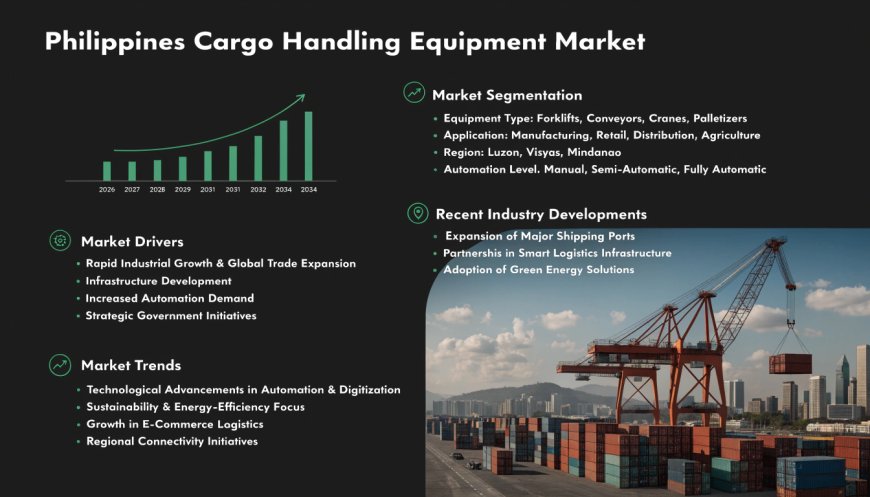
The Philippines cargo handling equipment market size reached USD 651.63 Million in 2025, according to the latest report from IMARC Group. The market is projected to reach USD 959.02 Million by 2034, exhibiting a growth rate (CAGR) of 4.39% during 2026-2034. Market growth is driven by substantial government infrastructure investment through the Build Better More program, ongoing port modernization initiatives with advanced automation technologies, and the increasing adoption of electric and eco‑efficient cargo handling equipment across logistics facilities. Moreover, expanding e‑commerce activities and warehouse development projects are supporting the Philippines cargo handling equipment market share.
Request Sample Report (Including Graphs, Charts & Figures):
https://www.imarcgroup.com/philippines-cargo-handling-equipment-market/requestsample
How AI is Reshaping the Future of the Philippines Cargo Handling Equipment Market
The integration of artificial intelligence into Philippine port and logistics operations is fundamentally transforming cargo handling efficiency, safety, and equipment longevity.
AI‑Powered Automated Gate Systems and Crane Operations – AI‑powered systems are being adopted for automated cargo handling, including AI‑driven crane operations that reduce human intervention in hazardous environments. In September 2022, DP World installed the AI‑powered CARGOES AVA+ automated gate system at the Batangas Container Terminal, paving the way for smarter, faster, and safer trade through Southern Luzon‘s international gateway port. The automated gate system has led to more efficient gate operations, higher gate capacity, and faster truck turnaround time. AI systems in the Philippines are also designed to optimize container management operations by predicting vessel arrivals, optimizing berth allocations, and streamlining cargo handling processes.
Predictive Maintenance Reducing Equipment Downtime – Predictive maintenance powered by AI can reduce equipment downtime by up to 30 percent, leading to significant operational savings for port operators and logistics providers across the archipelago. By analyzing real‑time sensor data and historical performance patterns, AI algorithms can predict equipment failures before they occur, enabling proactive maintenance scheduling that minimizes costly unplanned breakdowns. This capability is particularly valuable for sophisticated port equipment such as quay cranes, rubber‑tired gantries, and automated guided vehicles, which require specialized maintenance protocols and proprietary parts.
AI‑Enabled Warehouse Optimization and Inventory Management – AI‑enabled systems are transforming warehouse operations by optimizing layout, inventory placement, and equipment utilization. Machine learning algorithms analyze throughput patterns to determine optimal storage locations for fast‑moving and slow‑moving goods, reducing travel time for forklifts and other material handling equipment. IoT deployments provide live monitoring of material handling equipment, enabling fleet managers to track utilization rates, fuel consumption, and operator performance in real time. As these technologies mature, Philippine ports and logistics facilities are expected to increasingly leverage AI for route optimization and demand forecasting, supporting overall market efficiency and growth.
AI‑Powered Fleet Management and Driver Safety – AI is being integrated into logistics fleet management through dashcams that use machine learning algorithms to monitor driving behavior and detect high‑risk road conditions, reducing the risk of accidents and improving fleet management for cargo transporters.
Philippines Cargo Handling Equipment Market Trends
Unprecedented Government Infrastructure Investment Through Build Better More Program – The Philippine government‘s unprecedented commitment to infrastructure development stands as the primary catalyst for cargo handling equipment demand across the archipelago. Through the Build Better More program, the administration has allocated over USD 26 billion to infrastructure projects in 2025, representing more than five percent of national GDP. This comprehensive initiative encompasses 207 Infrastructure Flagship Projects valued at PHP 10.2 trillion (USD 176.7 billion), targeting critical transportation infrastructure including ports, airports, railways, and intermodal facilities. The Department of Transportation received PHP 214.3 billion in the 2024 budget, with approximately 76.4 percent designated for rail transport programs aimed at constructing and modernizing railway infrastructure that will enhance connectivity between production centers and port facilities. These investments directly translate into heightened demand for industrial trucks, port cranes, conveying equipment, and other cargo handling machinery required for newly constructed and upgraded facilities.
Port Modernization and Equipment Automation Enhancing Operational Efficiency – Philippine ports are undergoing a transformative modernization phase characterized by substantial investments in advanced cargo handling equipment and automation technologies. In April 2024, International Container Terminal Services, Inc. (ICTSI) received three new quay cranes at its flagship Manila International Container Terminal (MICT), including two Post‑Panamax cranes with a reach of 18 rows across and one Neo‑Panamax crane with a reach of 20 rows across. These additions expanded MICT‘s fleet to 18 quay cranes, establishing it as the largest in the Philippines. Additionally, ICTSI deployed eight new hybrid rubber‑tired gantries in September 2025, bringing the terminal‘s total container‑handling fleet to 60 RTGs alongside the quay cranes, representing the most modern and extensive cargo handling equipment deployment in the country. Construction has commenced on Berth 8 at MICT, designed with a 15‑meter depth to accommodate ultra‑large container vessels with capacities up to 18,000 TEUs, with the berth scheduled to be equipped with a minimum of four advanced ship‑to‑shore cranes beginning in 2025. The total investment for this expansion, including equipment, is estimated at PHP 15 billion (USD 267 million). Beyond Manila, ICTSI‘s 25‑year concession to operate the newly renamed Visayas Container Terminal in Iloilo emphasizes the introduction of modern cargo‑handling equipment to enhance operations in Central Philippines.
Growing Adoption of Electric and Eco‑Efficient Cargo Handling Equipment – Environmental considerations and operational cost optimization are accelerating the transition toward electric and hybrid‑powered cargo handling equipment throughout the Philippines. The global shift toward electric forklifts, powered by lithium‑ion and lead‑acid batteries, is gaining momentum in the Philippines, propelled by zero‑emission mandates, government sustainability initiatives, and their suitability for modern indoor warehouse operations. ICTSI‘s deployment of hybrid rubber‑tired gantries at Manila International Container Terminal exemplifies this trend, with the equipment engineered to achieve up to 60 percent reduction in fuel consumption compared to conventional diesel‑powered units, substantially lowering operational expenditure while meeting environmental standards. Electric‑powered forklifts and material handlers offer lower total cost of ownership through reduced maintenance requirements, absence of fuel costs, and longer operational lifespans compared to internal combustion alternatives. Industry forecasts indicate that electric forklift adoption will accelerate significantly in the Asia Pacific region, with the Philippines positioned to benefit from technology transfer, declining battery costs, and improving charging infrastructure.
Philippines Cargo Handling Equipment Market Summary
- Market Valuation: The market reached USD 651.63 Million in 2025 and is projected to reach USD 959.02 Million by 2034, registering a CAGR of 4.39% during 2026‑2034.
- Government Investment: The Build Better More program allocated over USD 26 billion to infrastructure projects in 2025, with 207 Infrastructure Flagship Projects valued at PHP 10.2 trillion.
- Port Equipment Investment: ICTSI invested PHP 15 billion (USD 267 million) in Berth 8 expansion at MICT, including four advanced ship‑to‑shore cranes.
- Equipment Type Diversity: Industrial trucks, tow tractors, conveying equipment, stackers, port cranes, and other specialized handling machinery serve marine, road and rail, and air cargo applications.
- Propulsion Types: The market is segmented into IC engine and electric propulsion, with electric equipment gaining strong momentum due to sustainability initiatives.
- Regional Demand: Luzon dominates market demand due to its concentration of major ports (Manila, Batangas, Subic) and economic zones, followed by Visayas and Mindanao.
- Port Modernization: The Luzon Economic Corridor Initiative (Philippines, Japan, US) enhances connectivity between Subic Bay, Clark, Metro Manila, and Batangas through coordinated port and rail investments.
- PPA Digitalization: The Philippine Ports Authority allocated PHP 12.47 billion specifically for port digitalization, necessitating modern, technology‑compatible cargo handling equipment.
Philippines Cargo Handling Equipment Market Growth Drivers
Build Better More Infrastructure Program Creating Sustained Equipment Demand – The Philippine government‘s sustained commitment to infrastructure modernization, exemplified by the Build Better More program, is a primary growth driver for the cargo handling equipment market. Infrastructure spending reached PHP 1.545 trillion in 2024, representing a 8.9 percent increase from the previous year and sustaining the government’s target range of five to six percent of GDP. The Luzon Economic Corridor Initiative, a trilateral project launched by the Philippines, Japan, and the United States, focuses on enhancing connectivity between key economic hubs including Subic Bay, Clark, Metro Manila, and Batangas through coordinated investments in port modernization and rail systems. The Philippine Ports Authority has also allocated PHP 12.47 billion specifically for port digitalization, which necessitates complementary investments in modern, technology‑compatible cargo handling equipment. Moreover, the establishment of new economic zones by the Philippine Economic Zone Authority across Metro Cebu and other strategic locations is generating significant freight movement, further bolstering equipment requirements across marine, road, and air cargo applications.
Expanding E‑Commerce and Warehouse Development Propelling Industrial Truck Demand – Material handling equipment, particularly forklifts and telehandlers, holds significant market share and is experiencing robust demand growth due to ongoing port expansion projects and warehouse development driven by e‑commerce proliferation. The high capacity forklift truck market in the Philippines is expanding due to increased demand in logistics, construction, and manufacturing industries. With increasing e‑commerce, warehouse expansions, and industrial growth, businesses are investing in electric and automated forklift technologies. The expansion of logistics infrastructure, particularly warehouses and distribution centers supporting e‑commerce growth, favors electric equipment due to indoor operational requirements and stringent air quality regulations.
Attracting International Logistics Providers Through Foreign Ownership Liberalization – The liberalization of foreign ownership regulations and the establishment of new economic zones across Luzon, Visayas, and Mindanao are attracting international logistics providers, further stimulating equipment demand and market expansion. International logistics companies bring established supplier relationships and global procurement standards, potentially reshaping competitive dynamics and elevating quality expectations across the market. Furthermore, international logistics providers entering the Philippine market through liberalized foreign ownership regulations are introducing global best practices in sustainable equipment deployment, creating demonstration effects that encourage domestic operators to upgrade their fleets with eco‑efficient alternatives.
Philippines Cargo Handling Equipment Market Segments
Breakup by Equipment Type
- Industrial Trucks
- Tow Tractors
- Conveying Equipment
- Stacker
- Port Cranes
- Others
Breakup by Propulsion Type
- IC Engine
- Electric
Breakup by Application
- Air
- Road and Rail
- Marine
Breakup by Region
- Luzon
- Visayas
- Mindanao
Competitive Landscape of the Philippines Cargo Handling Equipment Market
The Philippines cargo handling equipment market exhibits a moderately competitive structure characterized by the presence of international equipment manufacturers, regional distributors, and specialized service providers. Competition centers on equipment quality, technological sophistication, after‑sales service capabilities, and financing flexibility. Major global brands dominate the supply of advanced port equipment such as ship‑to‑shore cranes and automated guided vehicles, leveraging technological superiority and established relationships with large terminal operators. The market for industrial trucks and material handling equipment displays greater fragmentation, with multiple international and regional players competing across different price segments and application niches. Chinese and Japanese manufacturers have established strong distribution networks throughout the Philippines, offering competitive pricing and localized service support. Terminal operators, particularly ICTSI with its dominant position across multiple Philippine ports, wield significant influence over equipment procurement decisions and increasingly favor suppliers capable of providing integrated automation solutions and long‑term maintenance contracts.
Latest Recent News & Development in the Philippines Cargo Handling Equipment Market
February 2025: FAST Logistics, in collaboration with Evodine Company Builder, introduced the Philippines‘ first startup incubator focused exclusively on driving innovation in the logistics sector. The Revv‑Evodine Venture Studio aims to deliver breakthrough solutions to overcome interoperability issues within the nation‘s logistics and supply chain ecosystem, reflecting growing private sector interest in developing advanced logistics technologies.
September 2025: ICTSI deployed eight new hybrid rubber‑tired gantries at Manila International Container Terminal, bringing the terminal‘s total container‑handling fleet to 60 RTGs alongside 18 quay cranes. The hybrid equipment is engineered to reduce terminal emissions and fuel consumption per move by up to 40 and 60 percent respectively.
April 2024: ICTSI received three new quay cranes at its flagship Manila International Container Terminal, including two Post‑Panamax cranes and one Neo‑Panamax crane, expanding MICT’s fleet to 18 quay cranes – the largest in the Philippines.
2024: Infrastructure spending reached PHP 1.545 trillion, representing an 8.9 percent increase from the previous year, sustaining the government‘s target range of five to six percent of GDP.
September 2022: DP World installed the AI‑powered CARGOES AVA+ automated gate system at the Batangas Container Terminal, enabling faster gate operations, higher gate capacity, and reduced truck turnaround times.
Browse Full Report with TOC & List of Figures:
https://www.imarcgroup.com/philippines-cargo-handling-equipment-market
About Us
IMARC Group is a leading market research company that offers management strategy and market research worldwide. We partner with clients in all sectors and regions to identify their highest‑value opportunities, address their most critical challenges, and transform their businesses.
IMARC’s information products include major market, scientific, economic and technological developments for business leaders in pharmaceutical, industrial, and high technology organizations. Market forecasts and industry analysis for logistics equipment, port infrastructure, cargo handling technology, advanced materials, and novel processing methods are at the top of the company‘s expertise.
Contact Us
IMARC Group
134 N 4th St., Brooklyn, NY 11249, USA
Email: sales@imarcgroup.com
Tel No: (D) +91 120 433 0800
United States: +1-631-791-1145
What's Your Reaction?