

































3.48% CAGR Growth Forecast: The India Natural Gas Market Research Report and 87.2 Billion SCM Strategic Outlook
The India natural gas market size reached 63.5 Billion Standard Cubic Meters in 2025. Looking forward, IMARC Group expects the market to reach 87.2 Billion Standard Cubic Meters by 2034, exhibiting a growth rate (CAGR) of 3.48% during 2026-2034.
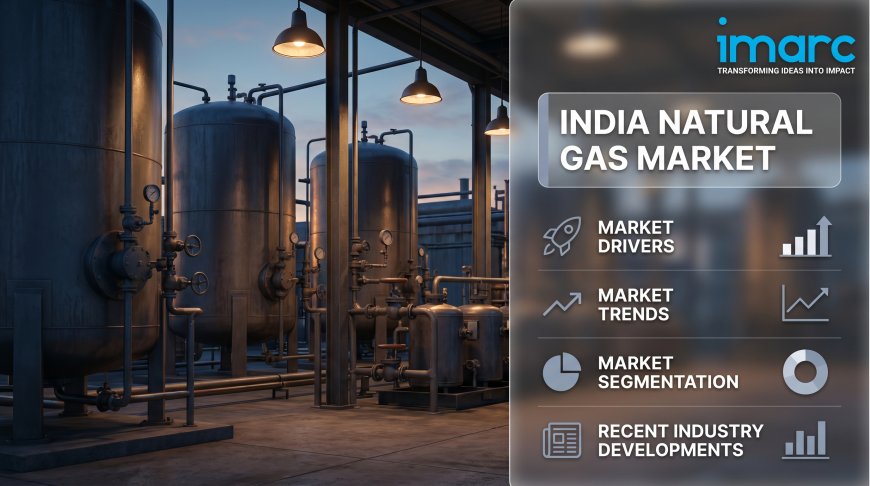
According to IMARC Group's report titled "India Natural Gas Market Size, Share, Trends and Forecast by Type and Region, 2026-2034", The report offers a comprehensive analysis of the India Natural Gas Market, including market forecast, growth, Share, and regional insights.
The India natural gas market size reached 63.5 Billion Standard Cubic Meters in 2025. Looking forward, IMARC Group expects the market to reach 87.2 Billion Standard Cubic Meters by 2034, exhibiting a growth rate (CAGR) of 3.48% during 2026-2034.
India’s energy sector is executing a rapid structural transition, pivoting toward a gas-based economy to balance industrial baseload demands with aggressive decarbonization mandates.
-
The domestic natural gas market volume reached 63.5 Billion Standard Cubic Meters in 2025 and is projected to scale to 87.2 Billion Standard Cubic Meters by 2034, registering a steady 3.48% CAGR.
-
The Government of India has committed immense capital to elevate natural gas from 6.2% to 15% of the national energy mix by 2030.
-
Massive infrastructure deployment has pushed the operational pipeline network past 25,429 kilometers, fundamentally derisking supply chain logistics for B2B consumers.
-
City Gas Distribution (CGD) network expansion currently encompasses over 307 geographical areas, servicing 1.57 crore domestic connections and unlocking profound retail and industrial revenue streams.
-
The acceleration of clean mobility is evident, with CNG stations expanding beyond 8,400 units, driving immediate offtake agreements in the commercial transportation sector.
The Strategic Market Challenge: Navigating the India Natural Gas Market in India
The central structural friction within India’s energy transition involves balancing rapid pipeline commissioning with the geopolitical volatility of liquefied natural gas (LNG) imports. While domestic production is scaling, a persistent reliance on imported LNG exposes heavy manufacturing and gas-based power generation to global spot market price fluctuations. This supply-side vulnerability compresses operating margins for unhedged downstream industries, making long-term capital expenditure planning difficult and highlighting the critical need for expanded strategic storage capacity and fortified domestic exploration efforts.
➤ Access Industry-Focused Insights and Future Forecasts - Request Sample Report: https://www.imarcgroup.com/india-natural-gas-market/requestsample
India's Strategic Vision for the India Natural Gas Market
-
The 15% Energy Mix Mandate: The Ministry of Petroleum and Natural Gas (MoPNG) has formalized a macro-economic target to increase the share of natural gas in India's primary energy mix from the current 6.2% to a definitive 15% by 2030.
-
One Nation, One Gas Grid: A monumental government initiative aimed at creating a deeply interconnected national pipeline infrastructure, ensuring equitable, affordable, and uninterrupted energy access across previously underserved Tier-2 and Tier-3 geographies.
-
De-carbonization and Hydrogen Synergy: The strategic vision encompasses leveraging natural gas as the definitive "bridge fuel," actively promoting pilot programs that blend green hydrogen into existing natural gas corridors to future-proof the grid against stringent global emission standards.
Why Invest in the India Natural Gas Market: Key Growth Drivers & ROI
-
City Gas Distribution (CGD) Monetization: Substantial institutional capital is flowing into CGD networks, which now cover almost the entire nation. This regulated monopoly structure provides investors with highly predictable, recession-resistant utility yields and massive volume scaling through mandatory industrial connections.
-
Clean Transportation Infrastructure Scaling: The aggressive national target to establish 17,500 CNG dispensing stations by 2030 guarantees sustained retail consumption trajectories. Investors funding localized compression and dispensing infrastructure benefit from immediate cash flow generation driven by escalating commercial and private fleet conversions.
-
Fertilizer and Petrochemical Offtake Guarantees: As the government mandates strict emission curbs, heavy industries like urea manufacturing and steel production are compelled to switch to natural gas. This structural shift secures multi-decade, high-volume B2B energy contracts, delivering exceptional revenue visibility and optimized ROI.
India Natural Gas Market Trends & Future Outlook
-
The market volume will maintain a resilient 3.48% CAGR through 2034, underpinned by an irreversible industrial pivot from coal and liquid fuels to cleaner alternatives.
-
A profound shift toward localized Liquid Natural Gas (LNG) terminals and floating storage regasification units (FSRUs) is accelerating, decentralizing energy imports along the eastern and western coastlines.
-
Heavy industries are increasingly utilizing natural gas coupled with Carbon Capture, Utilization, and Storage (CCUS) technologies to achieve compliance with evolving ESG mandates.
-
The integration of AI-driven predictive maintenance and smart metering across the pipeline network is drastically reducing transmission losses and optimizing distributor margins.
-
A strategic transition toward "hydrogen-ready" pipeline materials is gaining momentum, ensuring legacy gas infrastructure remains highly viable during the impending green hydrogen transition.
Regulatory Landscape & Policy Catalysts in India
-
Unified Tariff Policy Formulation: According to the Petroleum and Natural Gas Regulatory Board (PNGRB), the implementation of a unified pipeline tariff structure eliminates cascading distance-based charges, significantly democratizing gas pricing for hinterland industrial consumers.
-
FDI and Exploration Incentives: The Ministry of Petroleum and Natural Gas (MoPNG) permits 100% Foreign Direct Investment (FDI) through the automatic route in the exploration and refining sectors, actively courting global capital.
-
Hydrocarbon Exploration and Licensing Policy (HELP): This progressive framework offers uniform licensing for all forms of hydrocarbons and operates on an attractive revenue-sharing model, fundamentally de-risking upstream exploration economics.
-
Priority Allocation Mechanisms: The government enforces a strict domestic gas allocation policy, guaranteeing priority supply to critical sectors like City Gas Distribution (domestic PNG and transport CNG) and fertilizers, insulating core consumer segments from price shocks.
-
Infrastructure Exclusivity Rights: To ensure capital recovery for private investors, the PNGRB grants prolonged marketing and infrastructure exclusivity periods for authorized entities developing regional City Gas Distribution networks.
➤ Explore the Full Report with Charts, Table of Contents, and List of Figures: https://www.imarcgroup.com/india-natural-gas-market
By the IMARC Group, the Top Competitive Landscape & their Positioning:
Covering an in-depth analysis of the competitive landscape, market structure, key player positioning, competitive dashboards, top winning strategies, and detailed profiles of all major industry participants you will gain access to all these exclusive insights within the full research report.
India Natural Gas Market Segmentation:
IMARC Group provides an analysis of the key trends in each segment of the market, along with forecasts at the regional level for 2026-2034. Our report has categorized the market based on type.
Type Insights:
-
Compressed Natural Gas
-
Piped Natural Gas
-
Liquified Petroleum Gas
Regional Insights:
-
North India
-
South India
-
East India
-
West India
Note: If you need specific information that is not currently within the scope of the report, we can provide it to you as a part of the customization.
➤ Align the Report Insights with Your Strategic Goals - Request Customization: https://www.imarcgroup.com/request?type=report&id=29639&flag=E
Frequently Asked Questions (FAQs)
Q1: What is the current value and projected growth of the India Natural Gas Market?
According to IMARC Group, the India natural gas market reached a volume of 63.5 Billion Standard Cubic Meters in 2025. The market is expected to reach 87.2 Billion Standard Cubic Meters by 2034, exhibiting a CAGR of 3.48% during the forecast period of 2026-2034.
Q2: Which consumption segment dominates the domestic demand for natural gas?
The industrial and manufacturing sectors act as the primary consumption engines. Fertilizer production, power generation, and refinery operations heavily utilize natural gas as an indispensable feedstock and thermal fuel to meet strict environmental compliance standards.
Q3: How is the government's City Gas Distribution (CGD) policy influencing market volume?
The CGD expansion is a massive demand catalyst, currently encompassing over 307 geographical areas. By connecting 1.57 crore households with Piped Natural Gas (PNG) and expanding CNG retail networks, it establishes a permanent, high-volume domestic consumption base.
Q4: What role does natural gas play in India's broader renewable energy transition?
Natural gas serves as the critical bridge fuel in the decarbonization roadmap. It provides the essential, highly dispatchable baseload power required to stabilize the national grid against the inherent intermittency of rapidly expanding solar and wind generation.
Q5: How are infrastructure limitations being addressed to facilitate market growth?
To resolve logistical bottlenecks, the operational natural gas pipeline network has been expanded past 25,429 kilometers under the "One Nation, One Gas Grid" initiative, effectively bridging the supply gap between coastal LNG import terminals and inland industrial clusters.
Strategic Insight & Verdict:
The structural evolution of India’s energy matrix presents an exceptionally lucrative, policy-backed investment environment. As aggressive infrastructure deployment synchronizes with stringent industrial decarbonization mandates, we at IMARC Group have observed that natural gas has fundamentally transitioned from an alternative option to an operational necessity. Capital allocators must aggressively target City Gas Distribution monopolies and LNG regasification infrastructure. Ultimately, this sector provides immense volume predictability and highly defensive, long-term ROI for stakeholders navigating the broader transition toward a lower-carbon economy.
— Pragati Bharadwaj, Digital Market Research Strategist at IMARC Group
https://www.linkedin.com/in/pragati-bharadwaj/
Verified Data Source: IMARC Group
What's Your Reaction?