































Ethiopia Dairy Market Research Report, Share, Size, Trends, Forecast and Analysis 2026-34
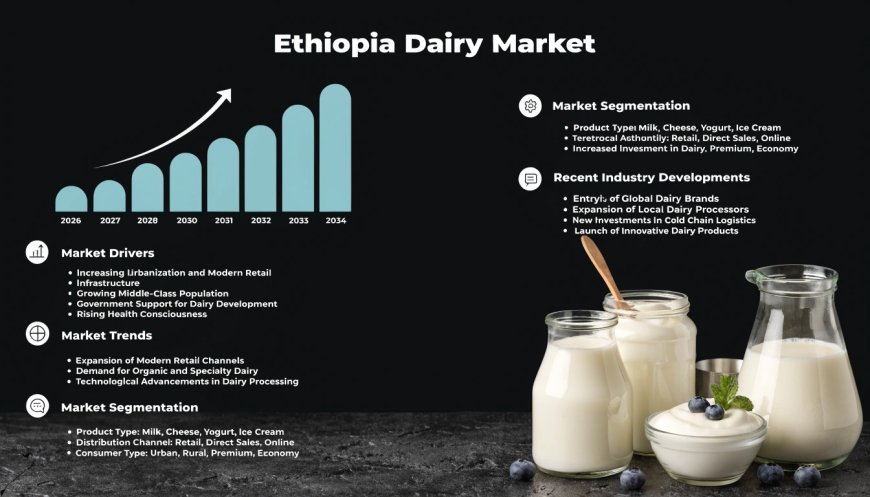
The Ethiopia dairy market size was valued at USD 1,149.35 Million in 2025 and is projected to reach USD 1,702.90 Million by 2034, growing at a compound annual growth rate of 4.47% from 2026-2034

Ethiopia Dairy Market Overview
The Ethiopia dairy market size was valued at USD 1,149.35 Million in 2025 and is projected to reach USD 1,702.90 Million by 2034, growing at a compound annual growth rate of 4.47% from 2026-2034. Market growth is underpinned by rapid urbanization at 4.6%, well above the global average of 1.9%, rising per-capita incomes, expanding health awareness, and the government's Yelemat Tirufat (Bounty of the Basket) initiative that has nearly doubled national milk production to 12 Billion liters in just three years. Liquid milk dominates the product landscape with a 43.2% share in 2025, while the Oromia region leads with a 43.5% share, supported by favorable agro-climatic conditions and proximity to major processing facilities. With per-capita dairy consumption at only 22 liters versus the WHO-recommended 205 liters, the market presents substantial headroom for growth across pasteurized milk, yoghurt, cheese, butter, and value-added dairy segments.
Request Sample Report (Including Graphs, Charts & Figures): https://www.imarcgroup.com/ethiopia-dairy-market/requestsample
How AI is Reshaping the Future of the Ethiopia Dairy Market
• The global AI in precision livestock farming market, valued at USD 2.7 Billion in 2025 and projected to reach USD 8.01 Billion by 2030 at a 23.4% CAGR, is opening pathways for Ethiopian dairy cooperatives and commercial farms to adopt sensor-based animal monitoring, automated feeding, and predictive health analytics.
• The precision dairy-technology market, projected at USD 5.59 Billion in 2025 with 9-15% annual growth, is enabling early adopters to reduce labor costs by 20-50% and lift milk yields by 10-20%, providing a blueprint for Ethiopia's scaling commercial dairy operations and new processing plants.
• AI-powered disease detection algorithms that analyze behavioral, thermal, and biometric data are helping dairy farmers identify early signs of mastitis, lameness, and heat stress, enabling faster interventions that reduce livestock losses and improve animal welfare across Ethiopian smallholder and semi-commercial herds.
• Automated milking systems and AI-driven milk-quality sensors, expected to account for a significant share of the broader USD 7.94 Billion precision livestock farming market in 2025, are being introduced through donor-funded and government-backed modernization programmes to improve hygiene, consistency, and shelf life of Ethiopian dairy products.
• Machine-learning-powered supply-chain optimization tools are helping Ethiopian dairy processors and cold-chain operators forecast demand, minimize spoilage across the perishable liquid milk and yoghurt segments, and improve logistics from farm-gate collection centres to urban supermarkets and retail outlets in Addis Ababa and regional hubs.
Ethiopia Dairy Market Trends
Government-Led Production Scaling and the Yelemat Tirufat Initiative
Ethiopia's dairy market is being transformed by the government's Yelemat Tirufat (Bounty of the Basket) initiative, which has nearly doubled national milk production to 12 Billion liters in just three years through cross-breeding programmes, improved feed availability, veterinary services, and cooperative strengthening. Five new dairy processing units have been acquired, with two already operational and three being installed, with plans to reach a total of ten plants by year-end. These investments are expanding the supply of pasteurized liquid milk, yoghurt, butter, cheese, and cream for both urban consumers and institutional buyers. The initiative is complemented by cold-chain storage enhancements and farmer cooperative support that are reducing post-harvest losses and improving the quality and safety of dairy products reaching retail shelves.
Foreign Investment Inflows and Commercial Dairy Modernization
Large-scale foreign investment is accelerating the modernization and commercialization of Ethiopia's dairy value chain. In February 2025, Ethiopian Investment Holdings (EIH) and the Ethiopian Agricultural Business Corporation (EABC) signed a landmark USD 600 Million shareholders agreement with UK private-equity firm Asset Green to develop an integrated dairy-farming and processing project, including large-scale feed production on 15,000 hectares, modern milking and processing operations, and cold-chain logistics. This deal, one of the largest foreign investments in Ethiopian agribusiness, is expected to boost commercial milk output, improve feed-to-milk conversion ratios, and create export-quality dairy products. Rising investor confidence, combined with government-led regulatory reforms and special economic zone incentives for agro-processing, is attracting additional capital into dairy manufacturing across Oromia, Amhara, and SNNPR.
Ethiopia Dairy Market Summary
• Market Valuation: The market was valued at USD 1,149.35 Million in 2025 and is projected to reach USD 1,702.90 Million by 2034, registering a CAGR of 4.47% from 2026-2034.
• Production Surge: The Yelemat Tirufat initiative has nearly doubled national milk production to 12 Billion liters, with five new processing plants acquired and plans to reach ten by year-end.
• Investment Milestone: A USD 600 Million joint investment by Ethiopian Investment Holdings, EABC, and UK-based Asset Green marks one of the largest foreign agribusiness deals in the country's history.
• Consumption Gap: Per-capita dairy consumption stands at only 22 liters versus the WHO-recommended 205 liters, signalling significant untapped demand across all product categories.
• Regional Leadership: Oromia region leads with a 43.5% market share in 2025, followed by Addis Ababa, Amhara, SNNPR, and Tigray, driven by favorable agro-climatic conditions and processing proximity.
Ethiopia Dairy Market Growth Drivers
Rapid Urbanization, Rising Incomes, and Health Awareness
Ethiopia's urbanization rate of 4.6%, more than double the global average, is creating a rapidly expanding urban consumer base with growing demand for safe, packaged dairy products. Rising per-capita incomes in Addis Ababa, Adama, Hawassa, Bahir Dar, and other emerging cities are enabling households to shift from traditional raw milk consumption toward pasteurized liquid milk, flavored milk, yoghurt, cheese, and ice cream. Increasing health awareness around protein intake, calcium, and childhood nutrition is driving institutional demand from schools, hospitals, and corporate canteens, while modern retail expansion through supermarkets and convenience stores is broadening product access. With per-capita dairy consumption at only 11% of WHO-recommended levels, Ethiopia's dairy market offers exceptional growth headroom as incomes and urban populations continue to rise.
Processing Infrastructure, Feed Improvement, and Cross-Breeding Programmes
Investments in processing infrastructure, animal feed, and genetic improvement are reinforcing the structural growth of Ethiopia's dairy market. The government's acquisition of five new processing plants, combined with the Asset Green USD 600 Million integrated dairy-farming project featuring 15,000 hectares of dedicated feed production, is expanding the country's capacity to convert raw milk into value-added products such as butter, cheese, cream, yoghurt, and milk powder. Cross-breeding programmes using Holstein-Friesian and Jersey genetics with local Boran and Horro breeds are improving per-cow yields, while a new USD 1 Million private animal-feed plant in Ethiopia's Somali Region is addressing one of the sector's primary constraints. Enhanced cold-chain infrastructure, cooperative-based collection networks, and direct distribution models are reducing spoilage and improving farm-gate prices, creating stronger incentives for smallholder dairy farmers to increase production and product quality.
Ethiopia Dairy Market Segments
Breakup by Product Type
• Liquid Milk
• Flavored Milk
• Cream
• Butter
• Cheese
• Yoghurt
• Ice Cream
• Anhydrous Milk Fat
• Skimmed Milk Powder
• Whole Milk Powder
• Whey Protein
• Lactose Powder
• Curd
• Paneer
Breakup by Distribution Channel
• Supermarkets
• Retail Outlets
• Restaurants
• Institutions
• Direct Distribution
Breakup by Region
• Addis Ababa
• Oromia Region
• Amhara Region
• SNNPR Region
• Tigray Region
• Others
Competitive Landscape of the Ethiopia Dairy Market
The Ethiopia dairy market features a competitive landscape that blends government-backed enterprises, established private processors, and emerging artisanal brands. Key participants include Holland Dairy, Ethiopia Dairy, and Banana Yoghurt, alongside a growing network of farmer cooperatives, SME processors, and institutional buyers. Competition is centred on product freshness, cold-chain reliability, pricing, packaging innovation, and distribution reach across supermarkets, retail outlets, restaurants, and direct-to-consumer channels. Foreign investors, including UK-based Asset Green, are entering through large-scale integrated farming and processing ventures, while donor-funded programmes continue to strengthen cooperative-based collection and processing capacity. Brand trust, quality certification, and the ability to serve both urban premium and mass-market segments are emerging as key differentiators.
Latest Recent News & Development in the Ethiopia Dairy Market
March 2025: Ethiopia's dairy sector reported that national milk production had nearly doubled to 12 Billion liters under the Yelemat Tirufat initiative, with five new processing units acquired, two operational, and three being installed, targeting ten processing plants by year-end.
February 2025: Ethiopian Investment Holdings (EIH) and the Ethiopian Agricultural Business Corporation (EABC) signed a landmark USD 600 Million shareholders agreement with UK private-equity firm Asset Green to develop an integrated dairy-farming and processing project, including large-scale feed production on 15,000 hectares and modern dairy operations.
March 2026: A private entrepreneur launched a USD 1 Million animal-feed manufacturing plant in Ethiopia's Somali Region, addressing one of the dairy sector's primary constraints by improving local access to quality feed for livestock producers.
January 2024: Signify introduced new Philips Hue products including the Dymera wall light and Perifo track lighting systems, while Ethiopian dairy industry stakeholders continued investing in cold-chain enhancements and cross-breeding programmes to boost commercial output.
Browse Full Report with TOC & List of Figures: https://www.imarcgroup.com/ethiopia-dairy-market
About Us
IMARC Group is a leading market research company that offers management strategy and market research worldwide. We partner with clients in all sectors and regions to identify their highest-value opportunities, address their most critical challenges, and transform their businesses.
IMARC's information products include major market, scientific, economic and technological developments for business leaders in pharmaceutical, industrial, and high technology organizations. Market forecasts and industry analysis for biotechnology, advanced materials, pharmaceuticals, food and beverage, travel and tourism, nanotechnology and novel processing methods are at the top of the company's expertise.
Contact Us
IMARC Group
134 N 4th St., Brooklyn, NY 11249, USA
Email: sales@imarcgroup.com
Tel No: (D) +91 120 433 0800
United States: +1-631-791-1145
What's Your Reaction?