





























Wall Putty Manufacturing Cost Report 2026: Plant Setup, Feasibility Study, ROI Analysis and Business Plan Consultant

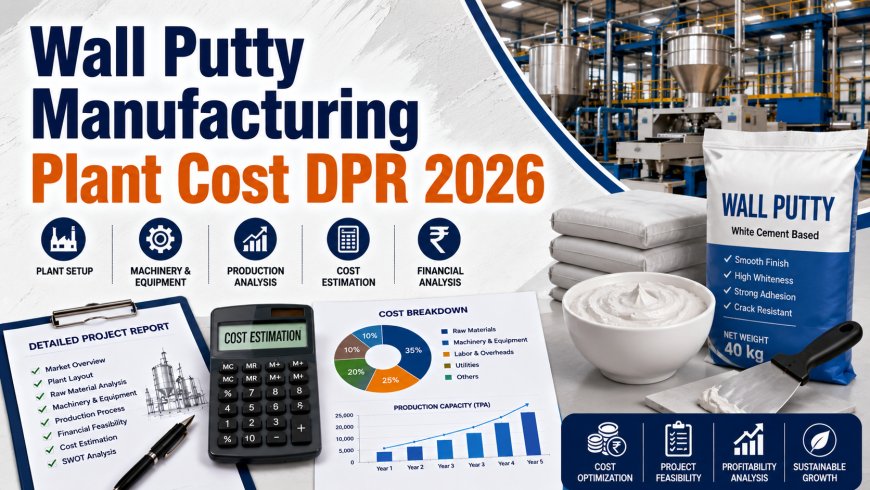
A wall putty manufacturing plant is an industrial production facility designed for manufacturing surface finishing materials formulated from white cement or acrylic-based compounds used for interior and exterior wall preparation prior to painting. The manufacturing process includes multiple stages such as raw material procurement and inspection, crushing and grinding, precise weighing and batching, uniform mixing, quality testing, and automated packaging operations. Compared with many other construction material industries, wall putty production generally requires relatively moderate capital investment; however, a comprehensive wall putty plant project report is essential for evaluating production requirements, investment planning, and long-term business sustainability.
Understanding Wall Putty
Wall putty is a white, powder-based finishing material primarily composed of white cement, calcium carbonate, redispersible polymer powders (RDP), and cellulose ether. It functions as a base coating material used to create smooth wall surfaces, repair cracks and surface imperfections, and improve the adhesion and durability of paint applications. Available in both powder and ready-mix variants, wall putty offers several advantages including high whiteness, excellent bonding strength, moisture resistance, and improved surface durability. Growing demand for premium surface finishing solutions across residential and commercial construction projects continues to support market expansion and increase industry opportunities.
Applications of Wall Putty
Wall putty is widely used across construction and renovation activities as an important material for surface preparation and finishing. In residential projects, it helps provide smooth and durable wall surfaces that improve the overall appearance and longevity of paint coatings. Commercial and institutional environments such as office buildings, hospitals, educational facilities, and public infrastructure projects also extensively utilize wall putty to achieve durable and low-maintenance wall finishes. Furthermore, it is commonly applied in refurbishment and restoration projects to improve existing wall conditions and enhance structural aesthetics.
The broad range of applications and consistent market demand continue to create favorable growth opportunities for manufacturers and investors. Therefore, conducting a detailed wall putty plant project report plays a critical role in understanding production capabilities, operational efficiency, market potential, and long-term profitability.
Get the Sample Report: https://www.imarcgroup.com/wall-putty-manufacturing-plant-project-report/requestsample
Key Factors for Wall Putty Plant Setup Requirements
Establishing a wall putty manufacturing plant requires careful assessment of several critical factors that influence both initial investment and long-term returns:
· Raw Materials and Supply Chain: The availability and pricing of key raw materials such as white cement, calcium carbonate, polymers (RDP), and cellulose ether play a vital role in controlling production costs. A reliable supply chain is essential for stable operations.
· Manufacturing Technology and Equipment: The selection of machinery—including crushers, pulverizers, ribbon blenders, dust collection systems, storage silos, and automated packaging units—directly impacts efficiency, product quality, and overall plant cost.
· Environmental Compliance and Approvals: Compliance with environmental regulations, including dust control, waste management, and safety standards, is necessary to ensure sustainable operations and avoid regulatory risks.
· Location and Infrastructure: Strategic location near raw material sources, along with access to reliable power, water, and transportation networks, significantly enhances operational efficiency and cost management.
Detailed Process Flow and Quality Control
The wall putty manufacturing process consists of a series of controlled and standardized operations to ensure consistent product quality:
· Unit Operations Involved: These include raw material receiving and inspection, size reduction (crushing and grinding), accurate weighing and batching, homogeneous mixing, quality testing, and automated packaging.
· Mass Balance and Raw Material Requirements: Precise calculations are required to determine the exact proportions of white cement, calcium carbonate, polymers (RDP), and cellulose ether per unit of output, directly impacting overall production cost.
· Quality Assurance Criteria: Product quality is evaluated based on parameters such as whiteness, compressive strength, workability, moisture resistance, and adhesion. Testing methods include chemical analysis, consistency checks, and visual inspection to ensure uniform blending and performance standards.
A well-structured approach covering these aspects enables efficient plant operations, consistent product quality, and long-term success in the competitive building materials industry.
Factors Influencing Wall Putty Manufacturing Costs
The overall wall putty manufacturing plant cost is a complex interplay of various factors. A detailed wall putty manufacturing cost analysis is essential for a profitable venture.
CapEx and OpEx Analysis for Wall Putty Manufacturing Cost:
• Raw Material Costs: As the largest component of variable costs at 60-70% of total operating expenses, the price of white cement, calcium carbonate, and polymer additives are major determinants of the final product's cost. Raw material price fluctuations significantly impact profitability.
• Capital Investment: The initial plant setup cost for grinding equipment, blending systems, storage silos, packaging machinery, land, and construction constitutes a notable barrier to entry. This investment is amortized over the plant's operational life.
• Operational Costs: These include fixed costs like skilled labor, maintenance, and insurance, as well as variable costs such as utilities (electricity and water) at 5-10% of OpEx, environmental compliance measures, and transportation.
• Product Quality and Grade: The whiteness index, compressive strength, and adhesion performance of the putty affect its suitability for different market segments. Consistent product quality is essential and impacts premium pricing capability.
• Manufacturing Capacity: The scale of manufacturing significantly influences unit costs through economies of scale. The proposed facility is designed with an annual production capacity of approximately 50,000 MT, enabling competitive unit economics.
• Location and Market Conditions: Geographical location influences transportation costs for raw materials and finished products, access to skilled labor, and proximity to key construction markets. Regional demand patterns and competitive conditions affect pricing and logistics costs.
Ask An Analyst: https://www.imarcgroup.com/request?type=report&id=7700&flag=C
Leading Wall Putty Manufacturers
The global market for wall putty is served by several major building materials and specialty chemicals companies who set industry standards for product quality, distribution reach, and manufacturing efficiency. Key manufacturers include:
• ABC Phil Inc.
• Aditya Birla Management Corp. Pvt. Ltd.
• Akzo Nobel NV
• Arkema Group
• Asian Paints Ltd.
About Us:
IMARC Group is a global management consulting firm that helps the world's most ambitious changemakers to create a lasting impact. The company excels in understanding its client's business priorities and delivering tailored solutions that drive meaningful outcomes. We provide a comprehensive suite of market entry and expansion services. Our offerings include thorough market assessment, feasibility studies, company incorporation assistance, factory setup support, regulatory approvals and licensing navigation, branding, marketing and sales strategies, competitive landscape, and benchmarking analyses, pricing and cost research, and procurement research.
Contact Us:
IMARC Group
134 N 4th St. Brooklyn, NY 11249, USA
Email: sales@imarcgroup.com
Tel No: (D) +91 120 433 0800
United States: (+1-201-971-6302)
What's Your Reaction?