



























Philippines Adhesives and Sealants Market Size, Share, Report 2034
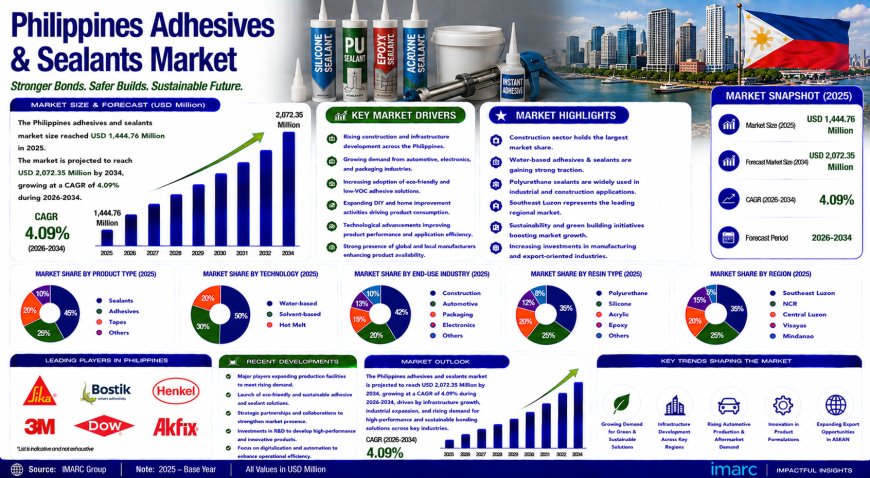
The Philippines adhesives and sealants market size reached USD 1,444.76 Million in 2025. The market is projected to reach USD 2,072.35 Million by 2034, growing at a CAGR of 4.09% during 2026-2034

Market Overview
The Philippines adhesives and sealants market is witnessing strong growth driven by the rise of local production, enhancing supply reliability, cost efficiency, and responsiveness, along with the increasing demand for sustainable, eco-friendly materials and the growing use of advanced surgical sealants in healthcare. According to IMARC Group, the market size reached USD 1,444.76 Million in 2025 and is projected to reach USD 2,072.35 Million by 2034, exhibiting a compound annual growth rate (CAGR) of 4.09% during 2026‑2034. The shift toward bio‑based, biodegradable sealants and the expansion of local manufacturing capacity are expanding the Philippines adhesives and sealants market share. This market is strategically important to the Philippines’ economy as it directly supports the nation’s infrastructure development under the “Build Better More” program, automotive and packaging industry growth, and the advancement of sustainable and medical technologies.
Philippines Adhesives and Sealants Market Summary
- The Philippines adhesives and sealants market encompasses a wide range of products used for bonding, sealing, and surface protection across construction, automotive, packaging, medical, footwear, and consumer applications.
- The ecosystem includes multinational corporations with established global footprints, domestic manufacturers serving localized segments, raw material suppliers, distributors, and end‑use consumers spanning building and construction, automotive and transportation, paper and packaging, medical, consumer and DIY, footwear and leather, and industrial assembly sectors.
- Major segments identified in the market include type (adhesives and sealants), with adhesives further broken down by product (acrylic, PVA, polyurethanes, styrenic block, epoxy, EVA, and others), technology (water‑based, solvent‑based, hot melt, and reactive and others), and application (paper and packaging, consumer and DIY, building and construction, footwear and leather, automotive and transportation, medical, and others). Sealants are segmented by product (silicones, polyurethanes, acrylic, polyvinyl acetate, and others) and application (construction, automotive, packaging, assembly, consumers, and others).
- The market is driven by the strategic expansion of domestic manufacturing capabilities, increasing demand for sustainable and eco‑friendly materials, and the growing adoption of advanced surgical sealants in healthcare institutions.
- The market faces challenges including raw material price fluctuations, regulatory compliance with environmental standards, and skilled labour shortages, but overall growth momentum remains positive throughout the forecast period.
PORTER’S FIVE FORCES ANALYSIS – PHILIPPINES ADHESIVES AND SEALANTS MARKET
Bargaining Power of Suppliers – Moderate
- The Philippines relies on imports for a portion of its adhesives and sealants raw material requirements, with key supply sources including China, South Korea, Japan, the USA, and Malaysia. Many raw materials are derived from petrochemical byproducts, making them responsive to global supply and demand fluctuations.
- The presence of multiple international suppliers and increasing local production capacity through investments such as Sika’s P980‑million manufacturing plant in Taguig help balance supplier influence over pricing and availability.
Bargaining Power of Buyers – Moderate
- Buyers in the Philippines adhesives and sealants market include construction firms, automotive manufacturers, packaging companies, healthcare institutions, and consumer goods producers. The availability of products across different technology platforms (water‑based, solvent‑based, hot melt) and price points provides buyers with choice.
- The shift toward sustainable and eco‑friendly materials gives buyers additional leverage, as manufacturers compete to offer bio‑based and low‑VOC formulations that meet evolving user preferences and regulatory requirements.
Threat of New Entrants – Low to Moderate
- Capital requirements for manufacturing facilities, quality certifications, and distribution networks create barriers for new entrants. However, the growing demand from construction, automotive, and packaging sectors attracts new players.
- Domestic manufacturers focusing on cost‑competitive commodity adhesives for construction and packaging applications serve small and medium‑sized enterprises through regional distribution channels, creating niche opportunities for well‑positioned entrants.
- Innovation‑led entrants such as the developer of Pili Seal®, a bio‑based aircraft sealant made from agricultural waste, demonstrate that the market remains accessible to genuinely differentiated technology propositions.
Threat of Substitutes – Low
- Adhesives and sealants possess unique bonding and sealing properties essential for construction, automotive, packaging, and medical applications. Alternative joining methods such as mechanical fasteners cannot fully replicate the performance characteristics of advanced adhesive and sealant formulations.
- The shift toward water‑based, bio‑based, and reactive technologies represents product evolution rather than substitution, creating new growth opportunities within the adhesives and sealants category.
Competitive Rivalry – Moderate
- The market exhibits a moderately competitive landscape characterized by the presence of both multinational corporations with established global footprints and domestic manufacturers serving localized segments. Market concentration remains relatively high, with major international players leveraging their technological capabilities, extensive product portfolios, and strong distribution networks to maintain market leadership. These multinational companies compete primarily on innovation, technical service capabilities, and brand reputation, offering specialized formulations for demanding applications in automotive, construction, and industrial manufacturing.
- Domestic manufacturers focus on cost‑competitive commodity adhesives for construction and packaging applications, creating a multi‑tier competitive environment.
Request for Sample Report:
MARKET GROWTH DRIVERS
Expansion of Local Production Capacity Strengthening Supply Reliability
Several key factors are propelling the expansion of the Philippines adhesives and sealants market. The strategic expansion of domestic manufacturing capabilities serves as a powerful demand driver, significantly enhancing supply stability, product availability, and industry responsiveness. Local production enables faster distribution, reduced import dependence, and improved cost efficiency, allowing suppliers to meet the growing demand generated by nationwide construction and infrastructure development. The establishment of advanced manufacturing facilities also promotes the localization of specialized formulations tailored to regional climate conditions, structural requirements, and evolving industry standards. As manufacturers invest in modern production technologies and quality control systems, the market benefits from a broader portfolio of high‑performance adhesives, sealants, and complementary construction materials. In 2024, Swiss specialty chemicals company Sika unveiled a new P980‑million manufacturing plant in Taguig, marking its 30th anniversary in the Philippines. The facility aimed to produce construction chemicals, including adhesives, sealants, grouts, and waterproofing products. Sika also aimed to support the growth of the Philippine construction and infrastructure sector. Moreover, the presence of robust local operations encourages greater collaboration with developers, contractors, and project engineers, facilitating quicker adaptation to market needs and fostering innovation. This strengthening of the domestic industrial base ultimately supports continuous market growth by ensuring consistent supply, elevated product quality, and stronger alignment with the country’s long‑term development priorities.
Innovation in Sustainable and Eco‑Friendly Materials
The Philippines adhesives and sealants market is also benefiting from a significant shift toward sustainable, eco‑friendly materials driven by environmental concerns and regulatory pressures. With environmental issues increasingly gaining attention in the country, industries are focusing on creating products that reduce negative impacts on both the planet and public health. There is a movement toward bio‑based, biodegradable, and non‑toxic options for traditional sealants, which are typically derived from petrochemicals that present environmental and health hazards. This transformation is driven by the growing individual demand for eco‑friendly solutions and regulatory pressures promoting sustainability. Advances in bio‑based adhesives and sealants, particularly those sourced from renewable agricultural materials, are progressively becoming popular across sectors such as construction, automotive, and aviation. These innovative materials provide performance similar to or even exceeding traditional sealants, all while minimizing environmental effects. In 2025, Filipino engineer Mark Kennedy Bantugon developed Pili Seal®, a bio‑based aircraft sealant made from agricultural waste of Pili tree resin. The innovation offers a safer, biodegradable alternative to toxic conventional sealants used in aviation. Bantugon’s work earned him a spot among the top 10 Young Inventors Prize 2025 finalists. Furthermore, the enforcement of the Philippine Green Building Code is shifting developer preferences toward low‑VOC adhesives, water‑based coatings, and bio‑based admixtures. Many manufacturers are investing in research and development to create sustainable solutions that cater to the rising demand for environment‑friendly materials.
MARKET GROWTH DRIVERS
Growing Adoption of Advanced Surgical Sealants in Clinical Practice
The Philippines adhesives and sealants market is experiencing transformative growth driven by the rising integration of advanced surgical bonding and hemostatic technologies within the medical sector. Healthcare institutions across the country are progressively prioritizing materials that enhance procedural safety, support minimally invasive techniques, and improve patient outcomes. This shift is attributed to the growing burden of complex surgical cases, the expanding capabilities of specialized medical fields, and the broader adoption of innovative biomaterials that reduce operative time and postoperative complications. As medical professionals place greater emphasis on precision, reliability, and efficiency, demand strengthens for high‑performance sealants capable of delivering superior tissue adhesion, reduced bleeding, and improved healing conditions. In 2025, Getz Healthcare Philippines launched Baxter’s Coseal Surgical Sealant and Floseal Hemostatic Matrix during a hybrid event in Quezon City. The event, attended by over 100 thoracic and cardiovascular surgeons, aimed to introduce these innovative products to the medical community. The launch was organized in partnership with the Philippine Association of Thoracic, Cardiac and Vascular Surgeons Inc. (PATACSI). Such advancements reinforce the need for clinically validated adhesive and sealing solutions, positioning the medical segment as a significant contributor to the overall growth of the market.
Infrastructure Investment and Government Construction Initiatives
The Philippine government’s unprecedented infrastructure investment under the “Build Better More” program continues to drive substantial demand for adhesives and sealants across construction and infrastructure projects. Key flagship projects include the North‑South Commuter Railway, Metro Manila Subway, and other major transportation and social housing initiatives that specifically call for silicone and polyurethane products for joints and sealing applications. In January 2026 alone, the Philippines issued building permits for 13,577 constructions, with residential buildings accounting for a significant portion. This sustained infrastructure push creates consistent demand for adhesives and sealants across all construction phases, from initial structural bonding to finishing and waterproofing operations.
Philippines Adhesives and Sealants Market Segmentation
Segmentation analysis provides a detailed view of the Philippines adhesives and sealants market by category:
- Type Insights: Adhesives [breakup by product (acrylic, PVA, polyurethanes, styrenic block, epoxy, EVA, and others), breakup by technology (water‑based, solvent‑based, hot melt, and reactive and others), and breakup by application (paper and packaging, consumer and DIY, building and construction, footwear and leather, automotive and transportation, medical, and others)]; Sealants [breakup by product (silicones, polyurethanes, acrylic, polyvinyl acetate, and others) and breakup by application (construction, automotive, packaging, assembly, consumers, and others)].
- Regional Insights: Luzon, Visayas, Mindanao.
Competitive Landscape
The competitive landscape of the Philippines adhesives and sealants market exhibits a moderately competitive structure characterized by the presence of both multinational corporations with established global footprints and domestic manufacturers serving localized segments. Market concentration remains relatively high, with major international players leveraging their technological capabilities, extensive product portfolios, and strong distribution networks to maintain market leadership. These multinational companies compete primarily on innovation, technical service capabilities, and brand reputation, offering specialized formulations for demanding applications in automotive, construction, and industrial manufacturing. Domestic manufacturers focus on cost‑competitive commodity adhesives for construction and packaging applications, serving small and medium‑sized enterprises through regional distribution channels. The market is witnessing increased activity in sustainable product development, with companies investing in water‑based formulations, bio‑based materials, and recyclable packaging to meet evolving user preferences and regulatory requirements. Strategic partnerships between adhesive manufacturers and end‑user industries are becoming more prevalent, facilitating collaborative product development tailored to specific application needs. Key companies operating in the market include Bostik Philippines Inc. (leader in elastomeric sealants and contact adhesives), Pioneer Adhesives Inc. (wholly Filipino‑owned manufacturing and distribution company), Sika, 3M, Henkel, H.B. Fuller, Dow, and Avery Dennison.
Regional Analysis
Regional dynamics within the Philippines adhesives and sealants market are shaped by varying levels of infrastructure development, industrial activity, and population concentration.
- Luzon emerges as the largest demand center, driven by the National Capital Region’s high concentration of construction projects, manufacturing facilities, and commercial activities. The region benefits from extensive distribution networks, proximity to major import terminals, and the presence of key manufacturing facilities including Sika’s P980‑million plant in Taguig. Major infrastructure projects such as the Metro Manila Subway and North‑South Commuter Railway are concentrated in this region, creating substantial demand for adhesives and sealants.
- Visayas sees demand from infrastructure projects, tourism‑related construction, and industrial activities. The region benefits from growing port facilities and economic zone developments that drive demand for construction and packaging adhesives.
- Mindanao represents a significant growth market, driven by agricultural processing industries, infrastructure development, and emerging industrial zones. The region’s expanding food processing and packaging sectors create demand for hot melt and water‑based adhesives, while construction projects supporting economic development drive sealant consumption.
Recent Industry Developments
- October 2025: Brenntag expanded its partnership with Momentive Performance Materials to include the Philippines, building on existing agreements in Indonesia and Vietnam. This collaboration will enhance Brenntag’s Material Science CASE division with Momentive’s advanced silicone and specialty solutions for industries like coatings, adhesives, and sealants. The new agreement aims to deliver improved performance and innovation to customers in the region.
- July 2025: Filipino engineer Mark Kennedy Bantugon developed Pili Seal®, a bio‑based aircraft sealant made from agricultural waste of Pili tree resin. The innovation offers a safer, biodegradable alternative to toxic conventional sealants used in aviation. Bantugon’s work earned him a spot among the top 10 Young Inventors Prize 2025 finalists.
- June 2025: Magna Prime Chemical Technologies Inc. celebrated its 24th anniversary by inaugurating the Buildrite Academy and the Philippines’ first Modified Silicone Manufacturing Facility in Bulacan. The academy aims to enhance training for construction professionals, while the new facility will produce advanced sealants with improved flexibility and longevity.
- March 2026: Buildrite Construction Chemicals wrapped up four days of dynamic product demonstrations and industry engagement at WORLDBEX 2026 at the SMX Convention Center Manila. Visitors experienced hands‑on demonstrations of key solutions including concrete crack injection systems, injection anchoring adhesives for rebar installation, macro fiber reinforcement for crack‑resistant concrete flooring, and protective surface coatings.
- 2025 (Throughout): Getz Healthcare Philippines launched Baxter’s Coseal Surgical Sealant and Floseal Hemostatic Matrix during a hybrid event in Quezon City, attended by over 100 thoracic and cardiovascular surgeons. The launch was organized in partnership with the Philippine Association of Thoracic, Cardiac and Vascular Surgeons Inc. (PATACSI).
- 2024: Swiss specialty chemicals company Sika unveiled a new P980‑million manufacturing plant in Taguig, marking its 30th anniversary in the Philippines. The facility aimed to produce construction chemicals, including adhesives, sealants, grouts, and waterproofing products, supporting the growth of the Philippine construction and infrastructure sector.
Browse Full Report with TOC & List of Figures for In‑Depth Market Insights: https://www.imarcgroup.com/philippines-adhesives-sealants-market
Note: If you need any specific information that is not covered currently within the scope of the report, we will provide the same as a part of customization.
About Us
IMARC Group is a global management consulting firm that helps the world’s most ambitious changemakers to create a lasting impact. The company provides a comprehensive suite of market entry and expansion services. IMARC offerings include thorough market assessment, feasibility studies, company incorporation assistance, factory setup support, regulatory approvals and licensing navigation, branding, marketing and sales strategies, competitive landscape and benchmarking analyses, pricing and cost research, and procurement research.
Contact Us
IMARC Group
134 N 4th St., Brooklyn, NY 11249, USA
Email: sales@imarcgroup.com
Tel No.: (D) +91 120 433 0800
United States: +1-201-971-6302
What's Your Reaction?