





























What Is Portable Hardness Tester - UCI & LEEB Portable Hardness Tester
A portable hardness tester is used to measure the hardness of small & heavy jobs in field. Leeb & UCI is also portable hardness testers.

Portable Hardness Tester: How UCI Technology Improves
Precision Metal Inspection
Modern manufacturing depends on accurate material verification. In industries such as aerospace, automotive, metal processing, and engineering, hardness testing helps confirm that components meet expected material and heat-treatment requirements. A Portable Hardness Tester makes this process more convenient by allowing technicians and quality professionals to inspect suitable metal components directly at the point of testing.
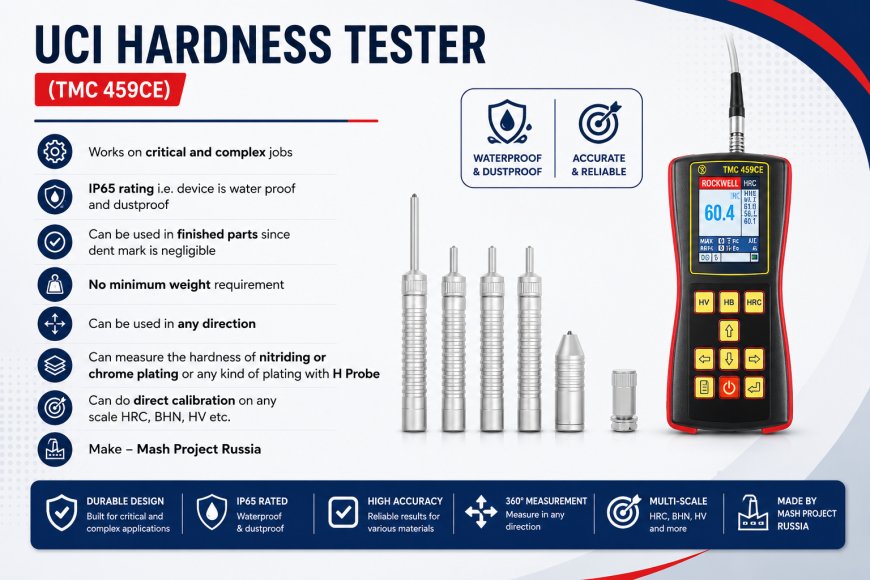
For small components, thin sections, precision-machined parts, and areas where only a limited testing surface is available, a Portable UCI Hardness Tester can be an effective solution. Using Ultrasonic Contact Impedance technology, UCI instruments are designed for localized hardness measurements while maintaining the flexibility required for industrial inspection.
RiM LaS Pvt Ltd provides industrial testing and measurement solutions for professionals working across demanding metal, automotive, aerospace, and engineering applications.
What Is a Portable Hardness Tester?
A Portable Hardness Tester is a compact hardness measurement instrument that can be carried directly to the component being inspected. Unlike conventional bench-mounted hardness machines, portable systems are useful when a component is too large, heavy, installed, or difficult to transport.
Hardness testing can help engineers evaluate material consistency, verify heat-treatment processes, support incoming inspection, and identify potential variations in manufactured components.
The ideal testing technology depends on the component. Factors such as material, thickness, geometry, surface finish, accessibility, and required measurement area should be considered before selecting a tester.
Why Use a Portable Hardness Tester?
Traditional laboratory hardness testing can be highly effective, but it is not always practical for industrial components.
Imagine a large machine shaft, an installed component, or a finished precision part that cannot easily be transported. Taking that component to a laboratory may involve significant handling, downtime, and logistics.
A Portable Hardness Tester solves this practical challenge by bringing the measurement instrument to the component.
Key advantages include:
-
On-site hardness measurement
-
Reduced component transportation
-
Convenient field inspection
-
Faster quality-control decisions
-
Localized testing capability
-
Suitability for many industrial applications
-
Digital measurement and reporting options on applicable instruments
How Does a Portable UCI Hardness Tester Work?
A Portable UCI Hardness Tester works using the Ultrasonic Contact Impedance principle.
The instrument uses a probe containing a diamond indenter. When the probe is brought into controlled contact with the material surface, the contact changes the ultrasonic frequency of the vibrating probe. The instrument evaluates this change and calculates the corresponding hardness value.
The method is particularly useful when a quality professional needs to evaluate a relatively small or localized area.
For reliable measurements, however, the test surface, component support, probe force, calibration, and measurement procedure must be appropriate for the application.
Portable UCI Hardness Tester for Precision Components
A Portable UCI Hardness Tester can be especially useful for components where a conventional hardness test is difficult to perform.
Typical applications may include:
Small Metal Components
Small components can present practical challenges for conventional hardness testing. A localized UCI measurement can be useful when the component meets the requirements of the testing method.
Thin Sections
Certain thin components require careful consideration because component thickness and support conditions can affect hardness measurements. UCI can be considered for suitable applications after evaluating the test conditions.
Finished and Precision-Machined Parts
When a component has already undergone machining or finishing, manufacturers may want to verify hardness without performing a large indentation or removing the part from production.
Difficult-to-Access Areas
Portable probes provide flexibility when the component cannot be positioned easily under conventional laboratory equipment.
Portable Hardness Tester Applications
A Portable Hardness Tester can support a wide range of industrial inspection activities.
Common applications include:
-
Automotive component inspection
-
Aerospace component verification
-
Metal manufacturing
-
Heat-treatment inspection
-
Tool and die inspection
-
Gear and shaft testing
-
Forged component inspection
-
Maintenance and repair
-
Quality control
-
Incoming material inspection
The actual suitability of a testing method should always be established according to the material, component geometry, surface condition, and applicable testing procedure.
Portable UCI Hardness Tester in Aerospace and Automotive Industries
Aerospace and automotive components often require controlled manufacturing processes and reliable quality verification.
Hardness can be an important property when components have undergone heat treatment, machining, forging, or other manufacturing operations.
A Portable UCI Hardness Tester may be useful for suitable applications involving:
-
Engine components
-
Transmission parts
-
Gears
-
Shafts
-
Tooling
-
Dies
-
Precision-machined components
-
Heat-treated parts
-
Small engineering components
For critical aerospace or automotive components, hardness testing should be performed using an appropriate procedure and equipment configuration, with suitable calibration and verification practices.
Portable Hardness Tester: UCI vs Leeb Testing
UCI is not the only portable hardness testing technology. A Portable Leeb Hardness Tester can be advantageous for different types of applications, particularly where larger components need to be inspected.
A simplified comparison is:
| Factor | UCI Testing | Leeb Testing |
|---|---|---|
| Small testing areas | Highly useful | Application dependent |
| Localized measurement | Excellent | Good |
| Large components | Application dependent | Often advantageous |
| Field testing | Yes | Yes |
| Precision components | Often suitable | Application dependent |
| Heavy components | Application dependent | Often suitable |
The right choice depends on the actual inspection requirement rather than simply choosing the most advanced or portable instrument.
How to Choose the Right Portable Hardness Tester
Before selecting a Portable Hardness Tester, technical teams should evaluate several factors.
1. Material:
Confirm the types of metals and alloys that will be tested.
2. Component size:
Large and heavy components may favor one testing approach, while small components may favor another.
3. Testing area:
If only a small localized area is available, UCI technology may be worth considering.
4. Surface condition:
Surface roughness, coatings, contamination, and preparation can influence measurement quality.
5. Required hardness scale:
Confirm that the instrument supports the scales required by your inspection process.
6. Testing environment:
Consider whether measurements will be performed in a laboratory, production area, workshop, or field environment.
7. Documentation:
For professional quality management, data storage and reporting capabilities may also be important.
Why Choose RiM LaS Pvt Ltd?
RiM LaS Pvt Ltd supports technical and industrial requirements in metal testing and measurement, with applications across automotive, aerospace, manufacturing, and engineering sectors.
Selecting a hardness tester is not only about purchasing an instrument. Proper method selection, surface preparation, calibration, probe handling, testing technique, and result interpretation are all important for obtaining meaningful measurements.
RiM LaS can help technical and commercial teams understand their inspection requirements and identify a suitable portable hardness testing solution. Its focus on technical applications also supports professionals who want practical knowledge and training related to industrial inspection technologies.
Conclusion
A Portable Hardness Tester provides an efficient way to bring hardness measurement directly to suitable metal components. For localized measurements, precision parts, thin sections, and difficult-to-access areas, a Portable UCI Hardness Tester can offer significant practical advantages.
For larger components and other suitable applications, Leeb technology may provide a more appropriate alternative. The best choice depends on the material, geometry, surface condition, testing area, required hardness scale, and inspection procedure.
Need help selecting a Portable Hardness Tester for your application? Contact RiM LaS Pvt Ltd today. Share your material, component, and testing requirements with our technical team and get professional guidance on the appropriate hardness testing solution.
What's Your Reaction?