


























LIS-02 LIBS PMI Analyzer vs Handheld XRF Analyzer: A Complete Comparison
If your team is choosing between a Portable LIBS Spectrometer and a handheld XRF analyzer for positive material identification, the decision usually comes down to one question: what happens when the material in front of you needs accurate carbon detection? That single point separates these two technologies more than any other spec on the sheet.

LIS-02 LIBS PMI Analyzer vs Handheld XRF Analyzer: A
Complete Comparison
If your team is choosing between a Portable LIBS Spectrometer and a handheld XRF analyzer for positive material identification, the decision usually comes down to one question: what happens when the material in front of you needs accurate carbon detection? That single point separates these two technologies more than any other spec on the sheet.
At NPP Strukturnaya Diagnostika Pvt. Ltd. (NPPSD), we manufacture the Portable LIBS Spectrometer LIS-02, and we get this comparison question constantly from quality teams already using XRF who are evaluating whether LIBS technology fills a gap in their current PMI process. Here's how the two actually stack up, parameter by parameter.
Technology and Working Principle
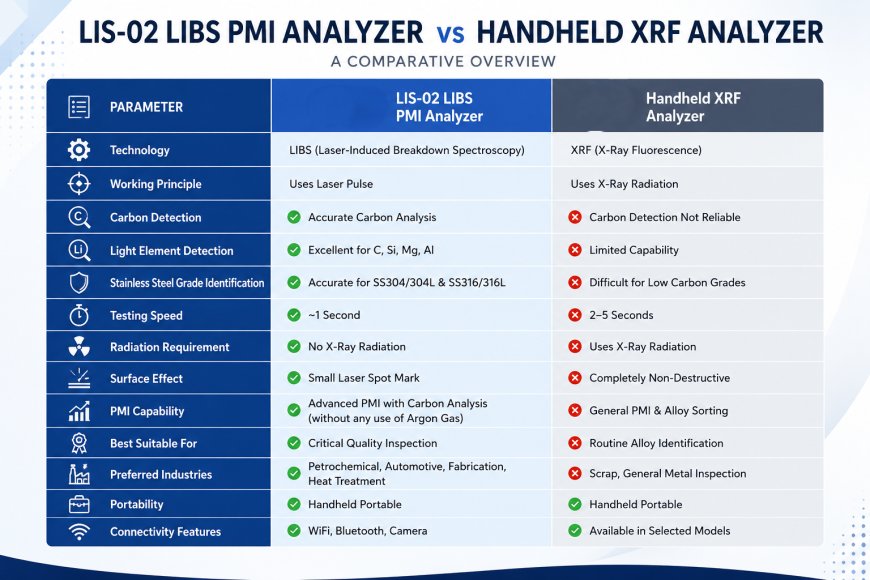
The core difference starts with how each device physically works. LIBS-based instruments like the LIS-02 use a focused laser pulse to vaporize a microscopic amount of the sample surface, creating a plasma that emits light unique to each element present. XRF analyzers instead use X-ray radiation to excite atoms in the sample and read the resulting fluorescence.
This distinction isn't just technical trivia — it drives nearly every practical difference that follows, starting with carbon.
Carbon and Light Element Detection: The Biggest Gap
This is where the two technologies diverge most sharply. The LIS-02 delivers accurate direct carbon analysis, along with strong performance on light elements like silicon, magnesium, and aluminum. XRF technology, by contrast, is widely recognized as unreliable for carbon detection and limited when it comes to light elements generally.
For applications like stainless steel grade identification, this matters in a concrete way. The LIS-02 handles SS304/304L and SS316/316L grade identification accurately, while XRF units typically struggle specifically with low-carbon grade distinctions — precisely the kind of close call that matters most in quality-critical inspection.
Speed and Radiation Considerations
Testing speed favors LIBS as well. The LIS-02 delivers a result in about one second, compared to the two-to-five-second range typical of handheld XRF units. Across a full shift of incoming inspection, that difference adds up in ways that affect daily throughput.
Radiation is another meaningful factor. XRF analyzers rely on X-ray radiation to function, which brings regulatory, training, and handling considerations that come standard with any radiation-emitting device. The LIS-02 uses laser technology instead, with no X-ray radiation involved — a difference worth weighing carefully for facilities looking to simplify their safety and compliance overhead.
Surface Effect: A Fair Trade-Off to Understand
XRF is completely non-destructive, leaving no visible mark on the sample. LIBS testing, by comparison, leaves a small laser spot mark where the plasma forms. It's a genuinely fair trade-off to weigh: XRF avoids any surface mark, while LIBS accepts a microscopic spot in exchange for direct carbon analysis and light element detection that XRF can't reliably provide.
For most industrial inspection contexts, that small spot mark is a reasonable cost for the accuracy gain — but it's worth understanding clearly rather than glossing over, especially for cosmetic or highly finished surfaces where any mark matters.
PMI Capability and Where Each Technology Fits Best
The LIS-02 is built for advanced PMI with full carbon analysis, and does this without requiring argon gas — a practical advantage that removes a recurring consumable cost some competing systems carry. This makes it particularly well suited to critical quality inspection work, where an incomplete elemental picture isn't an acceptable trade-off.
XRF analyzers remain a strong fit for general PMI and alloy sorting tasks, where carbon precision isn't the deciding factor. This makes them commonly used for scrap sorting and general metal inspection, where speed of rough sorting matters more than fine carbon-level distinction.
Industry Fit
The LIS-02's accuracy profile makes it particularly well suited to petrochemical, automotive, fabrication, and heat treatment applications — industries where alloy verification often needs to include a reliable carbon reading as part of the grade confirmation. XRF units continue to serve well in routine alloy identification and general scrap or metal inspection contexts, where a broader, faster sort matters more than precise carbon-level accuracy.
Portability and Connectivity: Where They're Evenly Matched
It's worth noting where these two technologies aren't fundamentally different. Both the LIS-02 and typical handheld XRF analyzers are fully portable, handheld devices built for field and shop-floor use. Connectivity is another area of overlap — the LIS-02 includes WiFi, Bluetooth, and camera capability, while many XRF models offer similar connectivity features depending on the specific model chosen.
The decision, in other words, isn't about portability or convenience. It comes down to what your inspection process actually needs to measure accurately.
Choosing the Right Fit for Your Inspection Needs
If your quality process depends on accurate carbon and light element detection — stainless steel grading, critical alloy verification, or applications where an incomplete reading isn't acceptable — the LIS-02's LIBS-based approach directly addresses gaps that handheld XRF struggles with. If your priority is fast, non-destructive general sorting across large volumes of mixed scrap or routine alloy checks, XRF remains a solid, proven tool for that specific job.
Many quality teams end up using both, applying each technology where its strengths line up with the task at hand.
Want to see how the LIS-02 performs against your current XRF setup? Contact NPPSD at sales@nppsd.co.in or call (+91) 9289924641 for a side-by-side demo and a straightforward look at where LIBS technology fits into your existing PMI process.
Frequently Asked Questions
1. Why is carbon detection more accurate with the LIS-02 than with handheld XRF? The LIS-02 uses laser-induced breakdown spectroscopy, which directly excites carbon atoms in the sample for accurate reading, while XRF technology is widely recognized as unreliable for carbon detection.
2. Is the LIS-02 faster than a handheld XRF analyzer? Yes. The LIS-02 delivers a result in about one second, compared to the typical two-to-five-second reading time of handheld XRF analyzers.
3. Does the LIS-02 use X-ray radiation like XRF analyzers do? No. The LIS-02 uses laser pulse technology and does not require X-ray radiation, unlike XRF analyzers, which rely on X-ray fluorescence to function.
4. Does LIBS testing damage the sample surface? It leaves a small laser spot mark where the plasma forms, unlike XRF, which is completely non-destructive. This is a trade-off for the LIS-02's stronger carbon and light element detection.
5. Which is better for stainless steel grade identification, LIBS or XRF? The LIS-02 is accurate for identifying grades like SS304/304L and SS316/316L, while XRF analyzers typically have more difficulty distinguishing low-carbon grade variations.
What's Your Reaction?