































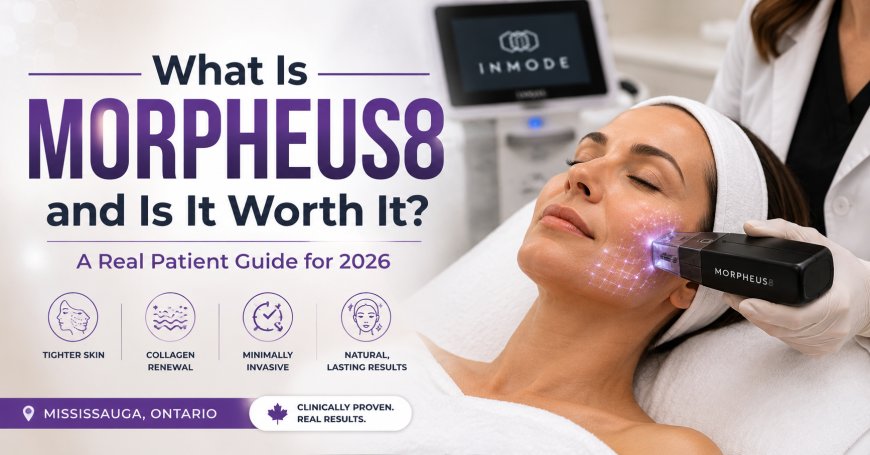
What Is Morpheus8 and Is It Worth It? 2026 Guide
A real patient guide to Morpheus8 in 2026. Learn how it works, what results to expect, how much it costs in Mississauga, and who it is best suited for.

Introduction
Morpheus8 has achieved a level of cultural visibility that few medical aesthetic devices reach. It has been discussed extensively by dermatologists, aesthetic physicians, and patients in online communities and clinical publications, and it consistently appears in lists of the most sought-after non-surgical treatments in major urban markets, including Mississauga.
The interest is grounded in a genuine clinical gap that Morpheus8 fills: it addresses skin laxity and subdermal remodelling with a level of precision and efficacy that lasers and topical treatments cannot achieve, while stopping well short of the risk, recovery time, and cost of surgical lifting. For patients who are noticing the early signs of facial or body skin laxity but are not ready for a facelift or are not suitable surgical candidates, Morpheus8 offers a credible, evidence-based alternative.
However, the treatment has also attracted attention for less accurate reasons. Patient testimonials and social media posts sometimes overstate what Morpheus8 can achieve, particularly in cases of significant skin laxity where surgical intervention remains the medically appropriate recommendation. This guide is written to give you an honest, clinically accurate picture of what Morpheus8 does, what it does not do, what the treatment experience is like, and how to determine whether you are a suitable candidate.
What Is Morpheus8? The Science Explained
Morpheus8 is a fractional radiofrequency microneedling device manufactured by InMode, a Canadian-founded medical technology company. It combines two established technologies into a single treatment platform: microneedling and radiofrequency energy delivery.
How Microneedling Works in Morpheus8
The Morpheus8 handpiece contains a matrix of 24 gold-coated bipolar radiofrequency pins. When pressed against the skin surface, the pins penetrate to a pre-selected depth between 0.5 mm and 8 mm, depending on the treatment area and the targeted tissue layer. This depth range is significantly greater than standard microneedling devices, which typically penetrate to a maximum of 2.5 mm, and allows Morpheus8 to reach the dermal-epidermal junction, the deep dermis, and the superficial subcutaneous fat layer.
How Radiofrequency Energy Works in Morpheus8
As the pins reach their programmed depth, they deliver bipolar RF energy directly into the tissue. RF energy generates controlled heat in the targeted tissue, raising the temperature of collagen fibres to 60 to 70 degrees Celsius. At this temperature range, two therapeutic responses occur: immediate collagen contraction (producing visible tightening that some patients notice even during the session) and the triggering of neocollagenesis, the body's process of synthesizing new collagen fibres that develops progressively over the following three to six months.
Fractional Delivery and Subdermal Remodelling
The 'fractional' aspect of Morpheus8 refers to the fact that the RF pins treat discrete columns of tissue rather than the entire surface area simultaneously. This fractional approach preserves surrounding tissue, which accelerates recovery significantly compared to fully ablative treatments and allows the body's own healing mechanisms to contribute to the outcome. The subdermal reach of the deepest settings allows Morpheus8 to melt and remodel superficial fat in addition to tightening skin, a dual effect that no surface-level treatment can replicate.
The combination of precise needle depth, controlled RF thermal energy, and fractional delivery architecture makes Morpheus8 the most clinically sophisticated non-surgical skin tightening and remodelling device currently available at Mississauga cosmetic clinics.
What Concerns Does Morpheus8 Treat?
Morpheus8 is a versatile platform that addresses a broader range of concerns than any single alternative treatment. The following are the primary indications clinically validated and routinely treated at leading Mississauga medical spas.
Facial Skin Laxity and Jowl Formation
Early-to-moderate facial skin laxity, including the beginnings of jowling, loss of jaw definition, and softening of the nasolabial fold area, represents the most common primary indication for Morpheus8. The treatment does not replace surgical lifting in patients with significant tissue excess, but for patients in their late thirties to mid-fifties who are beginning to notice gravitational changes, the results from a course of three Morpheus8 treatments are clinically meaningful and objectively measurable.
Neck and Decolletage Laxity
The neck is notoriously difficult to treat non-surgically. Skin on the neck is thinner and more fragile than facial skin, and surface-level treatments often underdeliver. Morpheus8's adjustable depth settings allow the device to be safely configured for neck anatomy, treating the platysmal muscle and subdermal fat layer while inducing dermal remodelling that improves the appearance of horizontal neck lines and crepiness.
Acne Scarring
For patients with atrophic (depressed) acne scars, particularly rolling and boxcar scar subtypes, Morpheus8 represents one of the most effective non-surgical interventions available. The deep fractional injury triggers a wound-healing response that fills in the depressed scar tissue with newly synthesized collagen. Clinical studies report scar depth improvements of 40 to 60 percent after two to three Morpheus8 sessions, with results continuing to develop for up to six months post-treatment.
Skin Texture and Enlarged Pores
The dermal remodelling induced by Morpheus8 consistently improves overall skin texture, pore size, and skin surface irregularities. Patients who do not have significant laxity but are concerned about rough texture or visibly enlarged pores benefit from the shallower depth settings, which focus RF energy in the upper dermis without the deeper subdermal remodelling that the anti-laxity protocol delivers.
Hyperhidrosis (Excessive Sweating)
Morpheus8 with the Body handpiece has received clinical validation as a treatment for primary axillary hyperhidrosis (excessive underarm sweating). RF energy delivered to the sweat gland-rich layer of the axillary dermis disrupts the secretory function of the eccrine glands, producing a lasting reduction in sweat output that compares favourably to Botox hyperhidrosis treatment in duration of effect.
Body Contouring and Skin Tightening
The Morpheus8 Body handpiece, featuring a larger pin matrix and extended depth settings up to 8 mm, is approved for use on the abdomen, thighs, arms, and buttocks. It addresses skin laxity and superficial fat pockets in these areas, making it particularly useful for patients who have experienced weight loss or post-pregnancy skin changes and want to improve body skin quality without surgery.
What Does a Morpheus8 Treatment Feel Like? A Real Patient Experience
One of the most searched questions about Morpheus8 is whether it is painful. The honest answer is that it is a more significant treatment experience than a HydraFacial or a light chemical peel, but it is very manageable for the vast majority of patients with proper numbing.
Before the Treatment
A topical anaesthetic cream, typically a compounded lidocaine and prilocaine formula, is applied to the treatment area 45 to 60 minutes before the session. This numbing window is critical. Inadequate numbing time is one of the most common reasons patients report more discomfort than necessary, and reputable Mississauga clinics allocate the full numbing time rather than rushing this preparation step.
During the Treatment
Patients typically describe a feeling of pressure and warmth rather than sharp pain during the procedure. The sensation intensity varies by treatment area and the depth settings used. Deeper settings on areas with less subcutaneous fat, such as the jaw and neck, produce more sensation than treatment of the cheeks or body. The handpiece is systematically moved across the treatment zone in a grid pattern. Total treatment time for a full face is typically 20 to 40 minutes, depending on the number of passes performed.
Immediately After the Treatment
The immediate post-treatment appearance includes redness, mild swelling, and in some patients, pin-point micro-scabbing at needle insertion points. These effects are more pronounced than after HydraFacial or Botox but resolve significantly faster than ablative laser resurfacing. Most patients describe the appearance in the first 24 hours as resembling moderate sunburn.
Recovery Timeline
Day 1 to 2: Redness and mild swelling. The skin feels warm and sensitive. Most patients prefer to avoid social engagements during this window. Day 3 to 5: Redness subsides to a pinkish hue. Micro-scabbing, where present, begins to resolve. Makeup can typically be applied after 48 hours in most patients. Day 5 to 7: The skin returns to a normal appearance for most patients. Day 14 onwards: The progressive collagen remodelling phase begins. Results continue to develop for 3 to 6 months as newly synthesized collagen matures and reorganizes.
Morpheus8 Results: What to Realistically Expect
Setting realistic expectations is one of the most important conversations a practitioner should have with any prospective Morpheus8 patient. The treatment produces genuine, measurable results but within defined limits.
After a Single Session
Some patients notice an initial improvement in skin firmness and texture within the first two to four weeks following their first session. However, the most significant results require the full neocollagenesis cycle to complete, which takes three to six months. A single session is a meaningful treatment, but the clinical protocol calls for a series of three sessions for optimal outcomes.
After a Series of Three Sessions
Clinical studies using objective measurement tools, including the FACE-Q patient-reported outcome measure and practitioner-rated skin laxity scales, report the following average improvements after three Morpheus8 sessions: 20 to 35 percent improvement in skin laxity scores, significant reduction in acne scar depth for atrophic scar subtypes, measurable improvement in skin texture and pore size, and high patient satisfaction rates exceeding 85 percent in published clinical studies.
What Morpheus8 Cannot Do
Morpheus8 cannot replace a surgical facelift, blepharoplasty (eyelid surgery), or neck lift in patients with significant skin excess. It cannot eliminate deep structural wrinkles caused by volume loss, which are better addressed with dermal fillers. It cannot produce the immediate, dramatic transformation that some social media content suggests. Patients with realistic expectations who fall within the appropriate candidate profile consistently report high satisfaction. Patients whose concerns exceed the treatment's clinical scope are better served by honest redirection to appropriate surgical or combination options.
Is Morpheus8 Worth the Cost?
The value assessment for Morpheus8 depends significantly on the patient's specific concerns and alternatives. For a patient with mild-to-moderate facial laxity who is not a surgical candidate or who is not ready for surgery, the cost of a three-session Morpheus8 series ($3,000 to $3,800) compares favourably to a lower facelift (typically $12,000 to $20,000 in the GTA including facility and anaesthetic fees), while the results are proportionally less dramatic.
Compared to Thermage FLX, the leading alternative non-surgical RF skin tightening device, Morpheus8's series pricing is comparable. The clinical differentiation is that Morpheus8 offers deeper subdermal reach and the added benefit of acne scar treatment, while Thermage FLX offers a single-session protocol and more established long-term evidence in older patient populations. The choice between them is a nuanced clinical decision that should be made in consultation with an experienced practitioner.
Who Is an Ideal Morpheus8 Candidate?
Best-Suited Candidates
Patients between the ages of 30 and 65 with mild-to-moderate facial laxity, neck crepiness, acne scarring, or enlarged pores represent the optimal candidate profile. Morpheus8 is one of the very few RF devices clinically validated for all Fitzpatrick skin types including types V and VI, making it an important option in Mississauga's highly diverse patient population. Patients who have already been told by a surgeon that they are not yet ready for a facelift or who prefer a non-surgical approach represent another strong candidate cohort.
Patients Who May Not Be Suitable
Patients with active skin infections, open wounds, or inflammatory skin conditions in the treatment area are not suitable candidates during the active phase. Patients who are pregnant or breastfeeding should defer treatment. Patients with pacemakers or implanted electronic devices require careful medical assessment, as RF devices are contraindicated in some configurations. Patients with keloid scarring tendencies should approach fractional treatments with caution and consult a board-certified dermatologist before proceeding.
Patients Who Should Consider Surgical Alternatives
Patients with significant skin excess, defined jowling that creates a visibly sagging lower face, or neck skin that has fully lost its elasticity will not achieve meaningful improvement with Morpheus8 alone. For these patients, honest counsel points toward a surgical consultation. Some clinics offer Morpheus8 as a post-surgical maintenance protocol to extend surgical results, which is a clinically appropriate application.
Morpheus8 vs. Alternative Skin Tightening Treatments in Mississauga
|
Device |
Cost/Session |
Downtime |
Skin Types |
Best For |
|
Morpheus8 |
$1,200-$1,500 |
5-7 days |
All types |
Laxity, scars, pores, body |
|
Thermage FLX |
$2,000-$3,500 |
Minimal |
All types |
Skin laxity, single session |
|
Ultherapy |
$1,500-$3,000 |
Minimal |
All types |
Deep tissue lifting, brow |
|
Sofwave |
$1,000-$1,800 |
None |
All types |
Fine lines, mild laxity |
|
RF Microneedling |
$800-$1,200 |
3-5 days |
All types |
Texture, mild laxity |
Clinical Evidence: What Published Research Says About Morpheus8
|
Key Research Findings 20 to 35 percent improvement in skin laxity scores after 3 sessions (InMode clinical data; multiple published studies) 40 to 60 percent improvement in atrophic acne scar depth after 2 to 3 sessions (Journal of Drugs in Dermatology, 2022) Greater than 85 percent patient satisfaction rate in prospective clinical cohort studies Validated safe and effective for Fitzpatrick skin types I through VI without increased PIH risk vs. laser alternatives Morpheus8 Body demonstrated statistically significant axillary hyperhidrosis reduction in controlled study (Dermatologic Surgery, 2023) Collagen remodelling continues to develop for 6 months post-final session; long-term results maintained at 12 months in follow-up studies Morpheus8 is cleared by Health Canada for use in Canada and approved by the US FDA for subdermal adipose tissue remodelling |
How to Find a Qualified Morpheus8 Provider in Mississauga
The quality of your Morpheus8 outcomes depends substantially on the skill of the practitioner and the quality of the consultation before treatment. Here is what separates an excellent provider from an average one.
-
Physician supervision: Morpheus8 is a minimally invasive device that penetrates living tissue. In Ontario, its use should be performed by or directly supervised by a licensed physician with training in the device. Confirm the supervising physician's credentials through the CPSO public register.
-
Device authenticity: Confirm the clinic uses a genuine InMode Morpheus8 device, not a generic RF microneedling platform marketed under a similar-sounding name. Ask to see the device and its InMode serial documentation if you have any uncertainty.
-
Consultation depth: A qualified practitioner will conduct a thorough facial assessment, including an evaluation of skin thickness, elasticity, fat compartment volume, bone structure, and scar distribution before recommending a protocol. A consultation that skips these assessments and immediately quotes a price is a warning sign.
-
Before-and-after documentation from actual patients: Ask to see the clinic's own patient outcomes for your specific concern (laxity, or acne scarring, for example). Reputable clinics maintain organized portfolios of documented patient results rather than relying on brand-supplied stock images.
-
Realistic expectation setting: The best providers are the ones who tell you honestly if you are not a suitable candidate for the outcomes you are hoping to achieve. A practitioner who promises dramatic transformation without assessing your tissue quality is prioritizing the sale over your outcome.
-
Aftercare and follow-up: Morpheus8 requires structured aftercare including specific sun protection, gentle cleansing protocols, and prescribed topical support. A clinic that does not provide written aftercare instructions and a follow-up window is not delivering a complete standard of care.
Frequently Asked Questions About Morpheus8 in 2026
Q1. How many Morpheus8 sessions are needed to see results?
The standard clinical protocol calls for a series of three sessions spaced four to six weeks apart. Some patients with mild concerns notice meaningful improvement after a single session, but the full benefit of subdermal remodelling and neocollagenesis requires the complete series. Results continue to develop progressively for three to six months after the final session as newly synthesized collagen matures. A maintenance session is typically recommended annually to preserve outcomes.
Q2. Is Morpheus8 safe for dark skin tones?
Yes. This is one of Morpheus8's most clinically significant advantages over laser-based skin tightening alternatives. Because RF energy is delivered through insulated microneedles below the skin surface rather than via surface-level light energy, there is no differential absorption by epidermal melanin. This eliminates the risk of post-inflammatory hyperpigmentation that makes fractional lasers and IPL unsuitable for many patients with Fitzpatrick skin types IV through VI. Morpheus8 is validated as safe and effective for all skin types, making it a particularly valuable option in a diverse city like Mississauga.
Q3. How long do Morpheus8 results last?
Clinical follow-up studies report that the structural improvements from a completed Morpheus8 series are maintained at 12-month follow-up, with most patients retaining meaningful results for 18 to 24 months. The treatment stimulates genuine neocollagenesis and tissue remodelling rather than delivering a temporary surface effect, which contributes to its durability. Annual maintenance sessions are recommended to continue the collagen-building stimulus and compensate for the natural ageing process that continues after treatment.
Q4. Can Morpheus8 be combined with other treatments?
Yes, and combination approaches often produce superior outcomes. Morpheus8 is frequently combined with dermal fillers and Botox in the same clinical visit or as part of a sequenced treatment plan. The RF remodelling addresses structural laxity and tissue quality while injectables manage dynamic wrinkles and volume loss. Some practitioners also combine Morpheus8 with a HydraFacial or PRP application immediately post-treatment to support recovery and enhance skin quality outcomes. Discuss your full treatment goals at the consultation so a coherent plan can be designed.
Q5. What is the difference between Morpheus8 and standard RF microneedling?
Morpheus8 is a specific platform in the RF microneedling category, but it differs from generic RF microneedling devices in several clinically meaningful ways. Its maximum needle depth of 8 mm is greater than most competing devices, allowing it to reach and remodel the subdermal fat layer rather than treating only the dermis. Its 24-pin matrix delivers more uniform RF distribution than smaller-pin arrays. Its fractional delivery system is optimized for both facial and body applications. And its InMode regulatory clearance is backed by a more extensive published clinical evidence base than most generic alternatives. Not all RF microneedling devices produce equivalent clinical outcomes.
Q6. When will I see results after Morpheus8?
Patients typically notice initial improvements in skin texture and firmness within two to four weeks of the first session. More significant improvements in skin laxity and deeper remodelling become visible at three months and continue to develop through to six months post-treatment. The timeline for acne scar improvement follows a similar arc, with maximum scar filling evident at the four-to-six-month mark after the final session. Photographing your skin at baseline and at regular intervals post-treatment is the most reliable way to track the progressive changes that occur gradually and may be difficult to appreciate without comparison images.
Q7. What should I avoid after a Morpheus8 treatment?
For the first 24 to 48 hours: avoid direct sun exposure, active skincare ingredients such as retinol and vitamin C, vigorous exercise, saunas, and swimming pools. For the first week: use only gentle cleansers and fragrance-free moisturizers as directed, apply a broad-spectrum SPF 50 sunscreen every morning, and avoid any other professional skin treatments unless specifically coordinated with your practitioner. For four weeks: avoid high-intensity laser treatments in the same area. Your clinic will provide written aftercare instructions specific to your treatment protocol.
Conclusion
For the right patient, Morpheus8 is one of the most genuinely effective non-surgical skin tightening and remodelling treatments available at Mississauga cosmetic clinics in 2026. It delivers measurable improvements in skin laxity, acne scarring, and skin texture that are difficult to replicate with any single alternative non-surgical treatment at a comparable price point. Its safety profile across all skin types makes it an equitable option for Mississauga's diverse patient population.
The honest qualification is that it works within defined limits. Patients with realistic expectations who fall within the appropriate candidate profile, who receive treatment from a skilled, properly trained practitioner, and who complete the full recommended series consistently report high satisfaction. Patients whose concerns exceed those limits are better served by honest counsel toward appropriate alternatives, including surgical options.
What's Your Reaction?