


























India Generic Drugs Market Share & Growth Trends | 2034
The India generic drugs market size reached USD 30.0 Billion in 2025. The market is expected to reach USD 53.5 Billion by 2034, exhibiting a growth rate (CAGR) of 6.42% during 2026-2034.
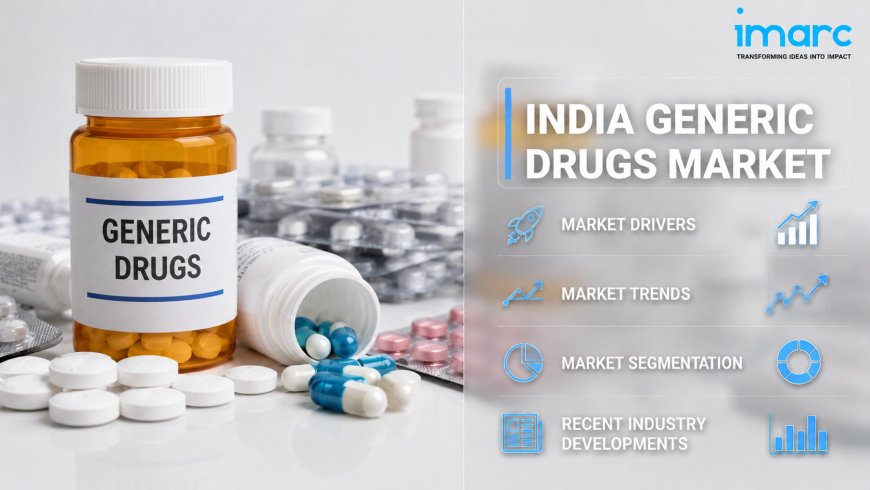
According to IMARC Group's report titled "India Generic Drugs Market Size, Share, Trends and Forecast by Therapy Area, Drug Delivery, Distribution Channel, and Region, 2026-2034", The report offers a comprehensive analysis of the industry, including market forecast, growth, and regional insights.
India's pharmaceutical ecosystem is undergoing a structural paradigm shift, evolving from a low-cost manufacturing base into a highly regulated, technology-driven anchor for global healthcare. For corporate investors, life sciences stakeholders, and international healthcare procurers, this maturing sector offers resilient, high-yield capital deployment opportunities:
-
The India generic drugs market achieved a valuation of USD 30.0 billion in 2025 and is projected to scale to USD 53.5 billion by 2034.
-
The sector is forecast to expand at a steady Compound Annual Growth Rate (CAGR) of 6.42% between 2026 and 2034.
-
Supported by a robust infrastructure of over 10,000 manufacturing facilities and 3,000 pharmaceutical firms, the region maintains unparalleled economies of scale.
-
India currently hosts the second-largest number of U.S. FDA-approved manufacturing plants outside the United States, securing a massive 20% share of global generic drug export volumes.
The Strategic Market Challenge: Navigating the Generic Drugs Market in India
A critical structural vulnerability constraining long-term profitability is the intense domestic pricing pressure combined with a heavy historical reliance on imported Active Pharmaceutical Ingredients (APIs). While formulation capabilities remain world-class, raw material bottlenecks expose manufacturers to severe margin compression during logistical disruptions. If pharmaceutical leaders fail to aggressively backward-integrate, they risk acute production delays, compromising both domestic universal health coverage mandates and critical export commitments to highly regulated western markets.
➤ Access Key Market Statistics and Actionable Insights - Request Sample Report
India's Strategic Vision for the Generic Drugs Market
-
Universal Health Coverage Expansion: Aligning with macro-level public health mandates, programs like the Pradhan Mantri Bhartiya Janaushadhi Pariyojana (PMBJP) target the rapid expansion of dedicated retail generic pharmacies to ensure ultra-affordable medicines reach rural and Tier-III populations.
-
API Supply Chain Sovereignty: Through capital outlays under the Production Linked Incentive (PLI) scheme, the government is aggressively incentivizing the localized synthesis of critical starting materials and APIs, structurally reducing import dependency.
-
Global Quality Compliance: Policymakers are actively pushing domestic manufacturers to upgrade formulation facilities to meet stringent WHO-GMP standards, fortifying the country's dominant position as the primary supplier for international health organizations.
Why Invest in the India Generic Drugs Market: Key Growth Drivers & ROI
-
Epidemiological Transition to Chronic Care: The rapidly escalating domestic prevalence of cardiovascular, central nervous system (CNS), and oncological disorders guarantees a massive, recurring revenue base for generic manufacturers producing affordable, long-term therapeutic interventions.
-
Advanced Manufacturing Competence: Deploying capital into India offers access to an established, highly skilled human resource pool capable of executing complex mass-production at exceptionally low operational costs, ensuring highly competitive profit margins across global supply chains.
-
Expansion in Retail Pharmacy Channels: Retail distribution dominates the market, propelled by the aggressive proliferation of organized, tech-enabled pharmacy chains and government-subsidized Janaushadhi Kendras, ensuring consistent, high-volume offtake directly to the end consumer.
-
Shift Toward Complex Formulations: Institutional investors are achieving superior ROI by funding the pivot from commoditized oral solids toward high-margin complex generics, including injectables, respiratory inhalers, and targeted oncology therapies, which face significantly lower market competition.
India Generic Drugs Market Trends & Future Outlook
-
Metabolic and Weight Loss Generics: The sector is rapidly preparing for the localized introduction of high-demand metabolic treatments, highlighted by domestic giants actively developing generic versions of semaglutide for the expanding obesity management segment.
-
AI-Driven R&D Integration: Manufacturers are increasingly adopting artificial intelligence platforms to optimize virtual molecule screening, accelerating bioequivalence testing and significantly compressing generic drug development timelines.
-
Biosimilar Commercialization: As major biological patents expire, domestic pharmaceutical firms are strategically scaling biosimilar production, targeting highly lucrative export markets across North America and Europe.
-
Digital Supply Chain Traceability: The integration of blockchain and IoT solutions within pharmaceutical logistics is standardizing cold-chain integrity, heavily reducing counterfeit risks, and ensuring end-to-end compliance for export-grade generics.
Regulatory Landscape & Policy Catalysts in India
-
According to the Ministry of Health and Family Welfare (MoHFW), the expansion of the Pradhan Mantri Jan Arogya Yojana (PMJAY) acts as a primary demand catalyst by structurally incentivizing public and empaneled hospitals to procure generic medicines over costly branded alternatives.
-
According to the Department of Pharmaceuticals, the targeted Production Linked Incentive (PLI) scheme provides substantial financial subsidies to manufacturers establishing greenfield plants for Key Starting Materials (KSMs) and APIs, securing the upstream supply chain.
-
According to the Central Drugs Standard Control Organisation (CDSCO), rigorous regulatory frameworks are strictly enforced for bioequivalence and bioavailability testing, ensuring domestic generic outputs match global innovator efficacy standards.
-
Under the guidelines of the National Pharmaceutical Pricing Authority (NPPA), price ceilings are continuously monitored and enforced on essential medicines, balancing consumer affordability with sustainable manufacturer profit margins.
-
According to the Ministry of Commerce and Industry, favorable Foreign Direct Investment (FDI) norms allow 100% investment through the automatic route in greenfield pharma projects, catalyzing massive international capital inflow into the sector.
➤ Explore the Exact Chapters and Data Scope - Get Full Brochure
By the IMARC Group, the Top Competitive Landscape & their Positioning:
Covering an in-depth analysis of the competitive landscape, market structure, key player positioning, competitive dashboards, top winning strategies, and detailed profiles of all major industry participants you will gain access to all these exclusive insights within the full research report.
India Generic Drugs Market Segmentation:
IMARC Group provides an analysis of the key trends in each segment of the market, along with forecasts at the region/country level for 2026-2034. Our report has categorized the market based on therapy area, drug delivery, and distribution channel.
Therapy Area Insights:
-
Central Nervous System
-
Cardiovascular
-
Dermatology
-
Genitourinary/Hormonal
-
Respiratory
-
Rheumatology
-
Diabetes
-
Oncology
-
Others
Drug Delivery Insights:
-
Oral
-
Injectables
-
Dermal/Topical
-
Inhalers
Distribution Channel Insights:
-
Retail Pharmacies
-
Hospital Pharmacies
Regional Insights:
-
North India
-
South India
-
East India
-
West India
Note: If you need specific information that is not currently within the scope of the report, we can provide it to you as a part of the customization.
➤ Tailor the Research to Your Exact Business Needs - Request Customization
Frequently Asked Questions (FAQs)
Q1: What is the current value and projected growth of the India Generic Drugs Market?
According to IMARC Group, the India generic drugs market size reached USD 30.0 billion in 2025. The market is expected to reach USD 53.5 billion by 2034, exhibiting a growth rate (CAGR) of 6.42% during the 2026-2034 forecast period.
Q2: Which therapeutic segment drives the highest demand in the market?
The central nervous system and cardiovascular segments generate the highest demand. This dominance is intrinsically tied to the surging domestic prevalence of chronic, lifestyle-related disorders that strictly require long-term, cost-effective therapeutic management.
Q3: How are generic drugs primarily administered in India?
Oral drug delivery remains the most dominant segment across the market. The high stability, ease of packaging, and patient compliance associated with oral solids make them the preferred format for mass-market distribution in both retail and clinical settings.
Q4: Which distribution channel holds the largest market share?
Retail pharmacies account for the majority of the market share. Their supremacy is driven by widespread geographic penetration, the rise of organized pharmacy chains, and massive state-sponsored networks ensuring immediate consumer access to affordable generics.
Q5: How does international export impact the Indian generic ecosystem?
India is a premier global supplier, accounting for approximately 20% of global generic drug export volumes. Driven by a high concentration of U.S. FDA-approved manufacturing plants, this export volume acts as a fundamental revenue stabilizer for domestic pharmaceutical corporations.
Strategic Insight & Verdict:
As the global pharmaceutical architecture pivots toward cost-containment, we at IMARC Group have observed that the India generic drugs market is transitioning from basic formulation assembly into a deeply integrated manufacturing powerhouse. Anchored by a 6.42% CAGR, aggressive PLI scheme subsidies, and massive domestic healthcare expansion, demand for cost-effective therapeutics is structurally guaranteed. For corporate investors, deploying capital into complex generics, API backward integration, and biosimilar development presents a highly defensible, high-yield strategic pathway in this expanding market.
Verified Data Source: India Generic Drugs Market Report By IMARC Group
What's Your Reaction?