




























India Cold Chain Market, Size, Trends, Analysis, Growth, Outlook 2034
The India cold chain market was valued at INR 2,535.87 Billion in 2025 and is estimated to reach INR 2,800.4 Billion in 2026. The market is further projected to grow INR 6,190.91 Billion by 2034, expanding at a robust CAGR of 10.43% during the forecast period 2026-2034.
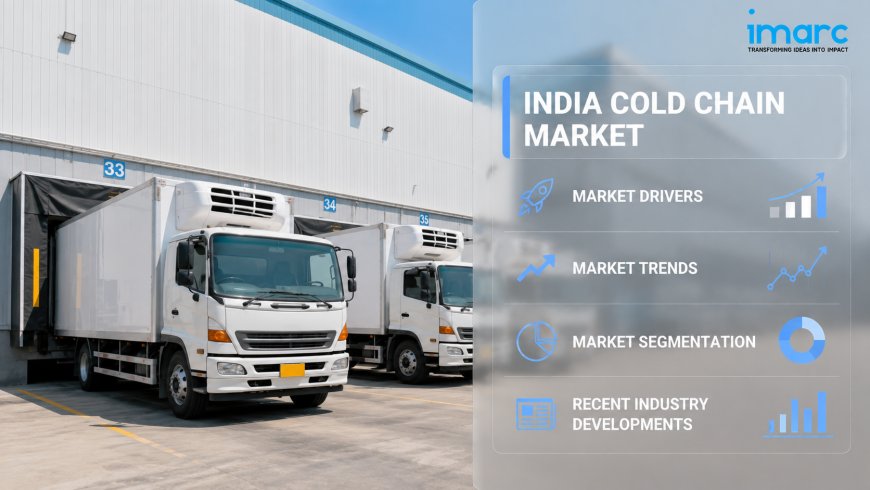
According to IMARC Group's report titled "India Cold Chain Market Size, Share, Trends and Forecast by Segment, Product, Sector, Organised and Unorganised, and States, 2026-2034", The report offers a comprehensive analysis of cold chain market in india including market forecast, Share, Market Growth, and regional insights.
The Indian logistics sector is undergoing a rapid, technology-driven transition, pivoting toward integrated, temperature-controlled networks to support pharmaceutical distribution and organized food retail. For corporate investors and supply chain operators, this evolution presents immediate, scalable commercial opportunities:
-
The Indian cold chain market size and forecast indicate that the market was valued at INR 2,535.87 billion in 2025 and is projected to reach INR 6,190.91 billion by 2034.
-
Stakeholders can capitalize on a robust compound annual growth rate (CAGR) of 10.43% between 2026 and 2034.
-
Cold chain storage dominates the sector, commanding 68.0% of the total market revenue as of 2025.
-
The private sector leads capital investments, holding a 72.0% share of total market revenue through structured logistics networks.
-
Uttar Pradesh and Maharashtra represent the core infrastructure hubs, collectively contributing 24.5% of the national market share.
Factors Driving Market Growth
-
Government Grant-in-Aid Schemes: Financial intervention is a primary catalyst. The “Scheme for Integrated Cold Chain and Value Addition Infrastructure” (ICCVAI) under the Pradhan Mantri Kisan Sampada Yojana (PMKSY) provides substantial government grants to private entities for setting up deep freezers, frozen storage, and irradiation units.
-
Mitigation of Post-Harvest Losses: The urgent national priority to reduce the massive post-harvest wastage of fresh fruits, vegetables, dairy, and fisheries acts as a fundamental structural driver, directly boosting the need for modern preservation infrastructure to secure farmer incomes.
-
Expansion of the Food Processing Sector: As the government continuously sanctions new integrated cold chain projects, the parallel expansion of India’s food processing industry inherently drives demand for temperature-controlled warehousing and logistics.
-
FDI and Policy Incentives: Backed by regulatory ease promoted through Invest India, the sector allows 100% Foreign Direct Investment (FDI) under the automatic route. This policy framework strongly incentivizes institutional capital and international logistics players to build domestic infrastructure.
Current Market Trends
-
Farm-to-Retail Integration: A major operational shift is underway as the Ministry of Food Processing Industries (MoFPI) pushes for seamless, uninterrupted cold chain networks connecting farm gates directly to retail outlets. This trend is rapidly replacing fragmented handling practices to preserve the quality of horticultural and agricultural produce.
-
Market Formalization: The sector is migrating from decentralized, localized single-commodity storage to organized, multi-purpose infrastructure hubs. Underscoring this formalization, the Indian cold chain market reached an official valuation of approximately ₹2,28,700 crore (US$ 26.60 billion) in 2024.
-
Real-Time Monitoring in Pharma & Vaccines: Driven by national healthcare initiatives, there is an accelerated adoption of technology within pharmaceutical logistics. The deployment of real-time temperature tracking and traceability software is becoming standard practice to ensure safe vaccine and medical transport.
-
Commodity-Specific Customization: There is a distinct trend toward specialized infrastructure. Rather than generic cold storage, new facilities are being engineered to support the exact temperature, hygiene, and handling protocols unique to varying food commodities and perishable goods.
➤ Unlock Industry Insights and Future Forecasts – Request Sample Report: https://www.imarcgroup.com/indian-cold-chain-market/requestsample
India Cold Chain Market Segmentation:
By Segment
-
Cold Chain Storage (68.00% Market Share)
-
Cold Chain Transportation (32.00% Market Share)
By Products
-
Fruits and Vegetables
-
Meat and Fish
-
Dairy Products
-
Healthcare Products
By Sector
-
Private (4.2% Market Share)
-
Cooperative (16.80% Market Share)
-
Public (11.20% Market Share)
By Organised and Unorganised
-
Organised
-
Unorganised
By States
-
Uttar Pradesh (14.2% Market Share)
-
Maharashtra (10.3% Market Share)
-
West Bengal (9.8% Market Share)
-
Punjab (8.4% Market Share)
-
Gujarat (7.6% Market Share)
-
Tamil Nadu (7.4% Market Share)
-
Andhra Pradesh (6.8% Market Share)
-
Bihar (6.3% Market Share)
-
Karnataka (6.3% Market Share)
-
Madhya Pradesh (5.9% Market Share)
-
Haryana (5.7% Market Share)
-
Rajasthan (5.1% Market Share)
-
Orissa (4.2% Market Share)
-
Chhattisgarh (3.4% Market Share)
-
Others (8.7% Market Share)
Competitive Ecosystem
-
Organized vs. Unorganized Restructuring: Historically dominated by unorganized, regional cold storage owners operating single-facility sites, the competitive landscape is rapidly restructuring. Organized Third-Party Logistics (3PL) and Fourth-Party Logistics (4PL) operators are aggressively capturing market share by offering end-to-end, integrated supply chain solutions.
-
Subsidy-Driven Competitive Advantage: Competition is heavily influenced by private sector participation in government programs. Companies that successfully leverage PMKSY and MoFPI grants to fund the construction of modern pack-houses, ripening chambers, and reefer transport fleets secure a massive operational and financial advantage over non-subsidized peers.
-
Compliance as a Differentiator: In a highly regulated space, operators differentiate themselves by adhering to the stringent handling and safety standards outlined by the Food Safety and Standards Authority of India (FSSAI) and the National Centre for Cold-chain Development (NCCD).
-
Niche Sector Segmentation: The competitive structure is divided into three distinct operational segments: static infrastructure providers (warehouses and cold rooms), mobility and transport operators (refrigerated fleets), and technology integrators (IoT tracking and supply chain software). Intensified competition is currently concentrated in the mobility and technology layers as operators strive to guarantee farm-to-retail integrity.
Key Players
-
Snowman Logistics Ltd.
-
Mahindra Logistics Ltd
-
Delhivery Ltd.
-
Container Corporation of India
-
AFL (Agri Fresh Logistics)
-
Radhakrishna Foodsland
-
Riviera Cold Storage
Note: If you need specific information that is not currently within the scope of the report, we can provide it to you as a part of the customization.
➤ Align Insights with Your Business Goals – Request Customization: https://www.imarcgroup.com/request?type=report&id=1040&flag=E
Frequently Asked Questions (FAQs)
Q1: What is the current value and projected growth of the Indian Cold Chain Market?
According to IMARC Group, the market reached a valuation of INR 2,535.87 Billion in 2025 and is estimated to reach INR 2,800.4 Billion in 2026. The market is further projected to grow INR 6,190.91 Billion by 2034, registering a robust CAGR of 10.43% during the forecast period from 2026 to 2034.
Q2: Which operational segment dominates the Indian cold chain sector?
Cold chain storage represents the dominant segment, accounting for 68.0% of the total market revenue in 2025. This dominance is sustained by aggressive capital investments in multi-temperature warehousing and automated retrieval systems.
Q3: Who are the primary drivers of investment within the industry?
The private sector leads the market, contributing 72.0% of the total revenue. This is largely driven by organized retail chains, third-party logistics (3PL) operators, and specialized pharmaceutical distributors actively scaling their localized infrastructure.
Q4: Which states are leading the cold chain infrastructure expansion?
Uttar Pradesh and Maharashtra are the most prominent regional hubs, collectively representing 24.5% of the national market share. Their leadership is supported by massive agricultural output, established industrial corridors, and advanced multi-modal connectivity.
Q5: What impact is technology having on cold chain logistics?
Technological integrations, notably IoT-enabled sensors and blockchain traceability, are drastically reducing temperature excursions (by up to 68%). These advancements guarantee real-time visibility, ensuring strict compliance for temperature-sensitive pharmaceuticals and perishable food items.
Strategic Insight & Verdict:
Analyzing the convergence of multi-modal logistics frameworks and smart warehousing adoption, we at IMARC Group have observed that digital traceability and multi-temperature storage represent the most defensible avenues for capital allocation. Corporate investors should prioritize IoT-integrated transportation fleets and solar-powered cold storage infrastructure. Stakeholders who align their capacity expansions with MoFPI subsidy schemes and the accelerating logistics demands of the pharmaceutical sector will secure a dominant, high-yield position within this INR 6,190.91 billion market trajectory.
Verified Data Source: India Cold Chain Market Report By IMARC Group
What's Your Reaction?