





























How Advanced Tile Manufacturing Supports Consistent Quality for Global Buyers
Discover how advanced tile manufacturing, quality control, digital printing, certifications, and export capabilities help global buyers source consistent tiles from India.

Key Takeaways
-
Advanced manufacturing helps improve consistency across large tile production batches.
-
Controlled raw materials, precision forming, and firing contribute to predictable product characteristics.
-
Digital printing supports repeatable surface designs and detailed visual finishes.
-
Quality control should cover dimensions, surfaces, shades, and relevant technical performance.
-
Certifications can help global buyers evaluate a manufacturer's quality management approach.
-
Production capacity and export experience are important for large international orders.
-
Packaging and logistics also play a role in protecting product quality after manufacturing.
Experienced tile manufacturers in India can provide a combination of manufacturing capability, product variety, and global export support.
For global tile buyers, product quality is about more than appearance. Architects, developers, distributors, contractors, and importers need tiles that maintain consistent dimensions, surface finish, colour, strength, and performance across large orders. When products are sourced internationally, manufacturing consistency becomes especially important because variations can affect installation, project timelines, material waste, and customer satisfaction.
This is where advanced tile manufacturing plays an important role. Modern production systems combine controlled raw materials, precision forming, advanced surface technologies, controlled firing, quality testing, and systematic inspection to produce tiles with more predictable characteristics. Italica Tiles operates within the Morbi ceramic manufacturing ecosystem and highlights modern production techniques, strict quality control, and global supply as important parts of its manufacturing approach.
For global buyers, understanding how manufacturing influences consistency can make it easier to evaluate suppliers and select products that meet project requirements.
Why Consistent Tile Quality Matters to Global Buyers
Large construction projects often require significant quantities of tiles, sometimes across multiple rooms, floors, buildings, or project phases. If products vary noticeably between batches, the difference can become visible after installation.
Consistent tile manufacturing helps reduce these risks by creating greater uniformity across production batches. Buyers can evaluate samples before placing an order and expect the bulk shipment to maintain the agreed specifications.
Consistency is particularly important for:
-
Large residential developments
-
Commercial buildings
-
Hotels and hospitality projects
-
Retail spaces
-
Public infrastructure
-
Distribution and dealer networks
For distributors, reliable quality also supports repeat business. If a product performs consistently, customers are more likely to reorder the same collection for future projects.
Quality consistency can therefore influence more than the appearance of an individual tile. It can affect installation efficiency, project planning, inventory management, and long-term supplier relationships.
How Advanced Tile Manufacturing Improves Product Consistency
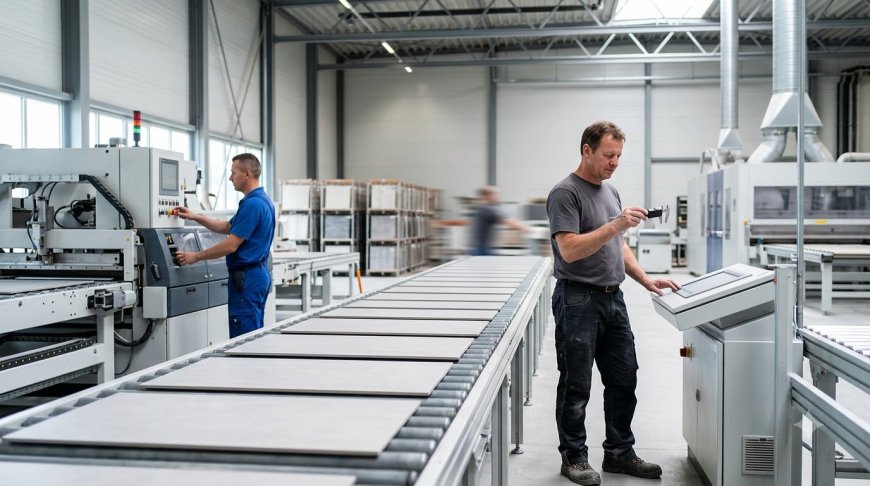
Modern tile manufacturing technology allows manufacturers to control several stages of production with greater precision. Instead of depending only on final inspection, quality is addressed throughout the manufacturing process.
Controlled Raw Material Preparation
The production process begins with the preparation of raw materials. Consistent material preparation is important because variations in the composition or processing of the body can influence the final tile's characteristics.
Modern manufacturing systems focus on controlled processing to create a more uniform tile body. This provides a stable foundation for subsequent stages such as forming, surface treatment, and firing.
Precision Forming and Pressing
Forming and pressing influence the dimensions, thickness, and shape of a tile. Precision equipment helps manufacturers maintain greater dimensional consistency across production runs.
This matters during installation because tiles with consistent dimensions can be easier to align and lay according to the planned pattern. For large projects, even small variations across thousands of pieces can create installation challenges.
Controlled Firing
Firing is another critical stage in the tile manufacturing process. Carefully controlled production conditions help establish the final characteristics of the tile body and surface.
Modern production systems allow tiles manufacturers in Morbi to monitor and manage manufacturing parameters more consistently. This supports repeatable results across production batches and contributes to the reliability and quality expected from export-quality tiles.
The Role of Digital Technology in Modern Tile Production
Digital technology has changed how manufacturers approach both tile design and production consistency. High-resolution digital printing allows manufacturers to reproduce detailed patterns and surface visuals with greater precision.
Modern tile collections can replicate the visual characteristics of:
-
Natural marble
-
Stone
-
Concrete
-
Wood
-
Terrazzo
-
Contemporary decorative patterns
Digital printing is not only about creating attractive designs. Consistent digital application also helps manufacturers reproduce approved patterns across larger production quantities.
Italica Tiles' current product information demonstrates the use of HD inkjet and digital printing on selected products, alongside technical performance information and export availability.
This combination of digital surface technology and controlled manufacturing gives architects and buyers greater flexibility when specifying products for projects that require both visual consistency and practical performance.
Quality Control Throughout the Tile Manufacturing Process
Advanced equipment alone does not guarantee consistent quality. A structured tile quality control system is necessary to verify whether finished products meet the required specifications.
Dimensional Accuracy
Dimensions are an important consideration for professional tile buyers. Length, width, thickness, and edge consistency can influence installation and the final appearance of tiled surfaces.
For large-format products, dimensional consistency becomes particularly important because larger surfaces can make alignment differences more noticeable.
Surface and Shade Consistency
Surface quality includes factors such as finish, colour, pattern, and overall visual uniformity. Buyers often approve a sample before production, so maintaining consistency between the approved sample and the final shipment is important.
Systematic inspection helps identify variations before products are prepared for export.
Performance Characteristics
Depending on the product and application, buyers may also evaluate characteristics such as water absorption, stain resistance, slip resistance, frost resistance, scratch resistance, and fire performance.
For example, selected Italica Tiles products publish technical characteristics including water absorption below 0.5%, R10 slip resistance, Class 5 stain resistance, and Class A1 fire resistance. Product specifications can vary by collection, so buyers should always verify the technical data for the specific tile being considered.
Certifications and Standards Give Global Buyers Greater Confidence
International buyers often look beyond product appearance when evaluating tile manufacturers in India. Certifications and documented standards can provide additional evidence that a manufacturer operates structured quality and management systems.
Italica Tiles publishes certifications including ISO 9001, ISO 13006, ISO 14001, ISO 45001, EC, and IGBC on its certification page.
For buyers, these certifications can be useful when comparing potential suppliers because they provide information about areas such as quality management, environmental management, workplace practices, and product-related requirements.
However, certifications should be considered alongside product specifications, samples, manufacturing capability, testing procedures, and export experience.
What Should Global Buyers Check Before Choosing a Tile Manufacturer?
A practical evaluation should include:
-
Product specifications and technical data
-
Quality management systems
-
Relevant certifications
-
Manufacturing capacity
-
Batch consistency
-
Product testing procedures
-
Packaging standards
-
Export experience
-
Sample approval processes
-
Logistics and documentation support
This broader evaluation gives buyers a clearer picture of the supplier's ability to deliver consistent products at scale.
Why Manufacturing Capacity Matters for International Projects
Quality and production capacity are closely connected when supplying large projects. A manufacturer may produce excellent products, but international buyers also need confidence that the supplier can maintain those standards when order volumes increase.
Large projects can require substantial quantities of tiles in specific sizes, finishes, colours, and technical specifications. Reliable advanced tile manufacturing helps suppliers manage these requirements while maintaining consistency across production batches.
Italica Tiles states that it supports bulk requirements for residential and commercial projects and offers more than 800 designs, textures, and finishes. The company also highlights consistency across large orders as part of its offering to builders, architects, and designers.
For international buyers, this capacity can simplify sourcing by allowing multiple requirements to be managed through an experienced manufacturer.
How Export Packaging Protects Tile Quality
Manufacturing quality needs to be maintained after production. Tiles may travel long distances by road, sea, and other transportation methods before reaching their final destination. Proper packaging and handling are therefore important parts of the overall supply process.
Export packaging can help protect tiles against damage during loading, transportation, and unloading. Proper palletisation, container loading, and secure handling are especially important for large-volume shipments.
Italica Tiles states that its export operation includes pallet packaging, container management, secure transportation, export documentation, shipping coordination, and dedicated export support.
This demonstrates an important principle for global buyers: consistent quality depends not only on what happens inside the factory, but also on how products are prepared and transported.
What Global Buyers Should Evaluate Before Choosing a Tile Manufacturer
Choosing an international tile supplier requires a combination of technical and commercial evaluation.
1. Manufacturing Capability
Confirm whether the supplier can handle the required order quantity and production schedule.
2. Product Consistency
Ask how the manufacturer manages dimensional, surface, and shade consistency across production batches.
3. Technical Specifications
Review product data relevant to the intended application, including water absorption, slip resistance, strength, and surface performance where applicable.
4. Certifications
Check relevant quality and product certifications and confirm that they apply to the products being considered.
5. Product Range
A broad portfolio can make it easier to source different products for residential, commercial, hospitality, or infrastructure requirements.
6. Export Experience
An experienced tiles exporter from India should understand international documentation, packaging, container loading, and shipment coordination.
7. Sample and Approval Process
Request samples and technical documentation before confirming a large order. This helps buyers establish a clear reference point for the final shipment.
How Italica Tiles Supports Global Buyers
Italica Tiles combines manufacturing and export capabilities to serve international markets. The company states that it exports ceramic and porcelain tiles to more than 85 countries and supports distributors, developers, and project partners across global markets.
Its portfolio includes ceramic, vitrified, GVT, PGVT, porcelain, and large-format products, giving buyers access to different tile categories through one manufacturing partner.
The company's approach combines manufacturing technology, quality control, certifications, product variety, packaging, and export logistics. These capabilities are particularly relevant for buyers managing bulk requirements where consistency and supply reliability are as important as design.
Conclusion
Consistent tile quality is the result of a complete manufacturing and supply system. From raw material preparation and precision forming to firing, digital surface technology, testing, packaging, and international logistics, each stage can influence the final product received by the buyer.
For global construction projects, choosing a manufacturer based only on design or price may not provide enough assurance. Buyers should also examine manufacturing capabilities, quality control systems, certifications, technical specifications, production capacity, and export experience.
With modern production techniques, structured quality processes, and an established international supply network, Indian manufacturers are increasingly positioned to meet the requirements of global buyers. Italica Tiles combines these capabilities with a broad product portfolio and export presence across 85+ countries, supporting architects, developers, distributors, and importers looking for consistent tile solutions for international projects.
What's Your Reaction?