































What Are Passive Electronic Components? A Clear Guide to Resistors, Capacitors & Inductors
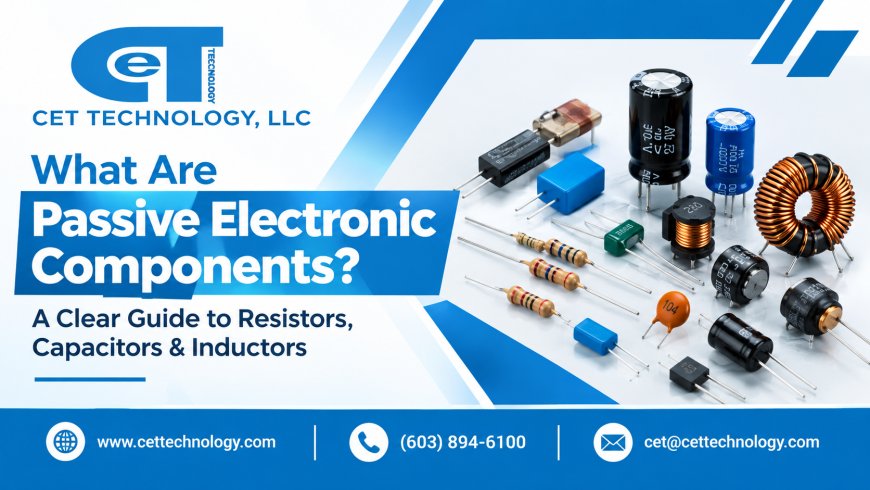
Every contemporary gadget you come into contact with depends on a silent network of components that carry out their functions without drawing notice. The passive electronic component, a class of components that never amplify signals or produce power on their own but enable nearly every circuit, is at the center of that network. Anyone who creates, fixes, or just has questions about the technology used in daily life can benefit from knowing how these components operate.
Understanding the Passive Electronic Component
What an electronic component does not do defines it as passive. It doesn't need an external power source to function and it can't make a signal stronger. Rather it resists current, stores energy and predictably modifies the flow of electricity. The traditional trio that fits this definition are resistors, capacitors and inductors. Although they all work differently, they all are fundamentally passive while influencing the behaviour of every circuit they connect to. Complex systems are able to operate without frequent intervention because of this silent reliability.
The Steady Work of Resistors
Consider a resistor as the electrical traffic controller. The resistor only tells current to "slow down" as it tries to rush through a path. It restricts the amount of current that can flow by turning some electrical energy into heat. This straightforward process establishes voltage levels where designers require them and safeguards delicate components later on. Many circuits would burn up in a matter of seconds without this passive electronic component's constant presence. One of the first decisions taken on practically every board is the careful selection of resistor values by engineers to keep the rest of the system within safe bounds. As a result, users hardly ever notice reliable performance unless something goes wrong.
How Capacitors Shape Energy Flow
A distinct strategy is used by capacitors. They store electrical energy in the electric field set up by the insulator between two conductive plates. The capacitor accumulates charge when the voltage rises and discharges the charge when the voltage falls. With these qualities, the capacitor is able to generate time delays, dissallow DC and allow AC signals to pass through and reduce sudden surges in the circuit. The capacitor in the power supply acts as a small reservoir to keep a constant voltage despite the fast changes in the load. It aids in tone shaping in audio circuitry. It collaborates with other components in timing circuits to provide exact intervals. These functions are all part of the same family of passive electronic component behaviour, which is silent but necessary for dependable and clean functioning.
Inductors and the Magnetic Advantage
Inductors round off the trio by creating magnetic energy storage. Whenever an electric current passes through a wire wound into a coil, a magnetic field is created around the wire. In case there is a change in the current, an opposing voltage is produced by the inductor in order to resist the change. These characteristics make inductors useful for purposes of noise filtering, energy storage in switch-mode power supplies, and radio circuit tuning. The transformer, a device based on the principle of mutual induction between the coils, also works along the same principles. The passive electronic component, once more, simply handles the energy and does not create any.
Why These Parts Matter in Real Designs
In general, all three passive electronic components can be used in any combination without active devices. A simple filter could contain only a resistor and a capacitor to eliminate unnecessary frequencies. Power supply circuitry could contain both capacitors and inductors to change the voltage level of the power supply source. Moreover, even the most complicated processors will be located on boards made of these basic building blocks. The engineers from CET Technology are spending an immense amount of time choosing right values, tolerances, and packaging options to make sure that every passive electronic component will have a right place in the whole system.
Reliability is another reason why the passive electronic component is so important. Since these components do not have a chance to generate additional heat while amplifying something or switching, they tend to be more reliable in the long run than the active components. Passive components are still affected by the temperature, humidity, and other mechanical factors, but the physics of these components is clear and predictable enough to make them last decades inside industrial machines, medical equipment, or household appliances.
Bringing It All Together
The bigger picture becomes evident when one looks beyond the individual components. Every industrial controller, medical monitor, smartphone, and EV charger relies on the same quiet base. A passive electrical component works quietly to bend signals, stabilise voltages, and store or release energy at precisely the appropriate times. Understanding how these components function improves the tools available to designers and provides interested readers with a greater understanding of the invisible architecture that is all around us.
The same is true at CET Technology. Choosing the right passive electronic components for each task is never a small issue. It is considered to be the foundation of reliable operation. As soon as you have chosen the right resistor to limit current, the right capacitor to stabilize voltage, and the right inductor to filter noise, your device will be much more stable and efficient. It is exactly such an approach to work that makes our products unique.
Learning about passive electronic components does not mean getting an engineering degree. All you have to do is to pay attention to the unsung heroes behind all of those amazing gadgets. The next time you see that your device starts up without any problems, provides you with clear audio, and charges batteries smoothly, you will know that your network of resistors, capacitors, and inductors is functioning exactly how it was supposed to do. They may never shine with their own light, but they are still very important.
What's Your Reaction?