



























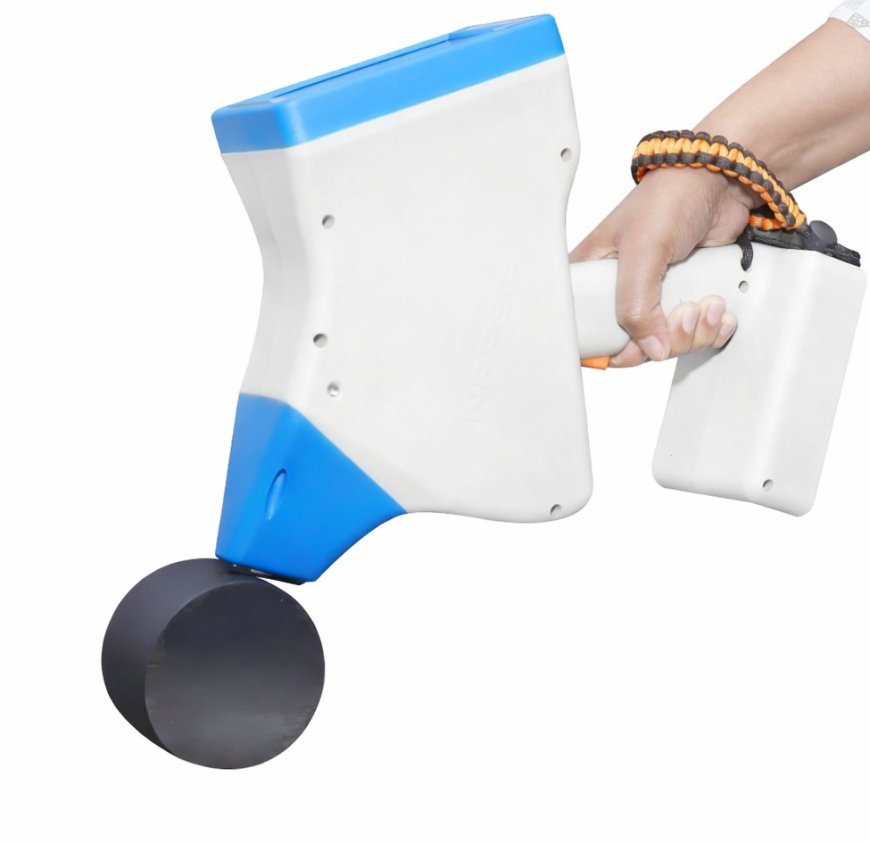
Portable LIBS Spectrometer LIS-02, Carbon detection spectrometer
Portable LIBS Spectrometer LIS-02 deducts the carbon without use of argon gas in one second. It is Fast, precise metal analyzer.

How Does a Portable LIBS Spectrometer Actually Work?
Ask most quality engineers what happens inside a handheld metal analyzer, and you'll get a rough answer: "it fires a laser and tells you what the metal's made of." That's true, but it skips over exactly why that process is fast, accurate, and reliable enough to trust on a production floor. Understanding how a Portable LIBS Spectrometer works isn't just academic — it explains why the technology performs the way it does, and what actually drives accuracy in a real testing environment.
NPPSD's LIS-02 uses Laser-Induced Breakdown Spectroscopy, and once you understand the mechanics, it becomes much easier to evaluate the technology on its merits rather than taking a vendor's speed claims on faith.
The Basic Science Behind LIBS
LIBS stands for Laser-Induced Breakdown Spectroscopy. The process happens in a few rapid stages, all within roughly one second:
1. The laser pulse. A focused, high-energy laser pulse strikes the surface of the metal being tested. The pulse is extremely short — measured in nanoseconds — but intense enough to vaporize a microscopic amount of material at the point of contact.
2. Plasma formation. That vaporized material forms a small, extremely hot plasma — essentially a glowing cloud of excited atoms and ions. This plasma exists for only a fraction of a second before it cool.
3. Light emission. As the plasma cools, the atoms inside it emit light at specific wavelengths. Crucially, every element emits light at its own distinct set of wavelengths — this is the same underlying physics that gives neon signs their color or lets astronomers determine what distant stars are made of.
4. Spectral analysis. A spectrometer inside the device captures this emitted light and breaks it down by wavelength. The intensity and position of each spectral line tell the instrument exactly which elements are present and in what concentration.
5. Result output. The device compares the spectral pattern against a built-in library of known alloy grades and returns a result — typically identifying the alloy grade and key elemental percentages, including carbon.
Why Carbon Detection Is the Hard Part
Most elements produce strong, easily distinguished spectral lines. Carbon is trickier. Its emission lines can be affected by interference from atmospheric nitrogen and oxygen, which is why many LIBS devices historically required an argon gas purge — flooding the testing area with argon to displace air and get a cleaner carbon reading.
The LIS-02 is built to detect carbon accurately without that argon purge, using signal processing that filters out atmospheric interference directly. This matters practically: it means an operator can test material in open air, without carrying gas cylinders or managing a purge cycle before every reading, which is a meaningful difference when you're running tests continuously throughout a shift.
What Determines Accuracy in a Portable LIBS Spectrometer
A few factors genuinely separate a well-engineered unit from a weaker one:
Laser Consistency
Since the entire reading depends on the plasma the laser pulse creates, consistent laser output pulse to pulse is essential. Variability here shows up as inconsistent readings on the same material.
Detector Sensitivity
The spectrometer component needs to resolve closely spaced spectral lines clearly. Higher resolution — often described in nanometers — means the device can distinguish between elements with similar emission wavelengths rather than blending them into a less precise average.
Grade Library Quality
Raw spectral data alone isn't useful to most operators. The device's built-in database of known alloy grades is what turns a spectral reading into a practical pass/fail result, so the breadth and accuracy of that library directly affects how useful the device is day to day.
Calibration Stability
A device that drifts out of calibration after routine daily handling — dust, vibration, temperature swings — will produce less reliable results over time. Build quality and internal calibration routines matter as much as the underlying optics.
Why This Matters for Buyers, Not Just Engineers
Understanding the mechanics behind a Portable LIBS Spectrometer isn't just interesting background — it's genuinely useful when evaluating equipment. A vendor claiming a fast reading time, for instance, means little if detector sensitivity is weak and results are inconsistent between tests on the same known sample. Asking pointed questions about laser stability, detector resolution, and how the grade library is maintained tells you far more about real-world reliability than a headline speed number does.
It's also worth understanding this technology so you can explain results confidently to your own team, your suppliers, or an auditor asking how a reading was obtained. A quality team that understands why the device works — not just that it works — is in a much stronger position when a reading gets questioned.
The Bottom Line
A Portable LIBS Spectrometer isn't a black box — it's a fast, physics-based process that happens to compress what used to take a full lab procedure into about one second at the point of inspection. Knowing how the laser pulse, plasma formation, and spectral analysis work together makes it much easier to evaluate a device on real technical merit, rather than marketing claims alone.
NPPSD built the LIS-02 around solving the two hardest parts of this process well: getting a clean, argon-free carbon reading, and keeping the device stable enough for daily shop-floor use without losing calibration accuracy.
Want to see the technology in action? Contact NPPSD to arrange a live demonstration of the LIS-02, including a look at how it handles carbon detection and alloy identification on your own material.
FAQs
1. How does a Portable LIBS Spectrometer identify metal composition? It fires a laser pulse that vaporizes a tiny amount of material into plasma, then analyzes the light that plasma emits, since every element gives off a distinct spectral signature.
2. Why is carbon harder to detect with LIBS than other elements? Carbon's spectral lines can be affected by interference from atmospheric nitrogen and oxygen, which is why some devices require an argon purge to get a clean reading.
3. Does the LIS-02 need argon gas to detect carbon? No. The LIS-02 uses signal processing that filters out atmospheric interference, allowing accurate carbon detection without an argon purge.
4. What makes one Portable LIBS Spectrometer more accurate than another? Laser consistency, detector sensitivity, the quality of the built-in alloy grade library, and calibration stability under real working conditions all affect accuracy.
5. Is LIBS testing destructive to the material? No. The laser only vaporizes a microscopic spot on the surface, so the part or sample isn't meaningfully damaged.
What's Your Reaction?