


























India Destination Wedding Market Size, Share, Emerging Trends and Analysis Report 2026-2034
Destination Wedding

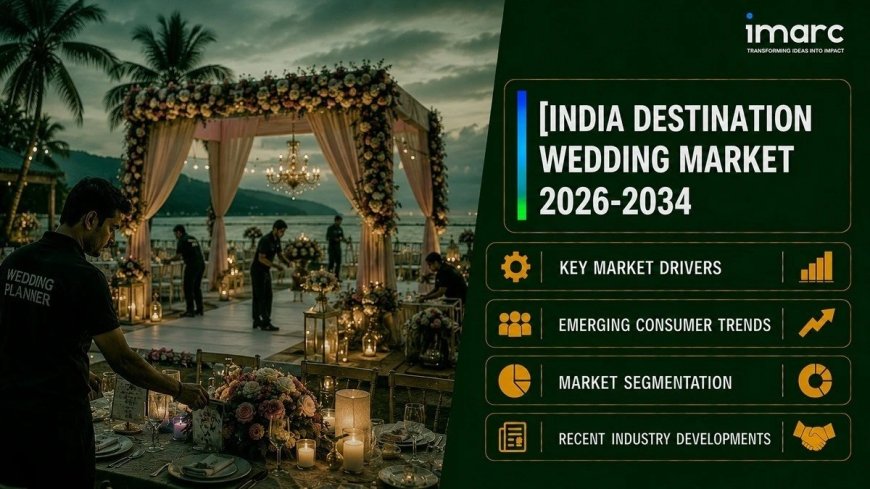
According to IMARC Group’s report titled “India Destination Wedding Market Size, Share, Trends and Forecast by Function, Inclusion and Activity, Season, Venue, Booking Channel and Region, 2026-2034“, the report offers a comprehensive analysis of the industry, including market share, forecast, growth and regional insights.
Market Overview & Summary
The India destination wedding market size reached USD 4.3 Billion in 2025 and is projected to reach USD 26.6 Billion by 2034, growing at a compound annual growth rate (CAGR) of 21.87% from 2026-2034. The industry is experiencing robust growth propelled by inflating disposable incomes, rising social media influence, and an escalating demand for highly personalized experiences among millennials and affluent families. The market is further accelerated by evolving preferences for exotic locations, luxury hospitality packages, and customized themed celebrations. Furthermore, a strong structural shift toward multi-day itineraries and strategic government campaigns promoting heritage-based marriage tourism continue to sustain strong market momentum across both national and international venues.
Market Size & Forecast
- Market Size (2025): USD 4.3 Billion
- Projected Market Size (2034): USD 26.6 Billion
- CAGR (2026 - 2034): 21.87%
Key Market Trends & Insights
- By Function: Segmented into Pre-Wedding Ceremonies, Wedding Ceremonies, Reception, and Others.
- By Inclusion and Activity: Segmented into Accommodation Services, Food Service, Butler Services, and Others.
- By Season: Segmented into High Season, Mid Season, Low Season, and Mid Peak Season.
- By Venue: Segmented into National and International.
- By Booking Channel: Segmented into Phone Booking, Online Booking, and In Person Booking.
- By Region: Segmented into North India, South India, East India, and West India.
➤ Request Sample Report (TOC & Charts): https://www.imarcgroup.com/india-destination-wedding-market/requestsample
Key Market Trends
Popularity of Experiential and Themed Weddings
Experiential and themed weddings have become an important trend influencing the market as couples opt for atypical, customized experiences over traditional ceremonies. This shift has led to the widespread inclusion of themed celebrations, where the venue, decor, and attire are tailored to specific concepts such as a regal Rajputana theme, beachside settings, or glamorous vintage Hollywood aesthetics. Couples are creating extensive multi-day itineraries integrating pre-wedding ceremonies, private dinners, and offbeat leisure activities like yacht parties or desert safaris. This personalization trend is heavily supported by specialized wedding planners and designers who create immersive guest environments, fostering a positive market outlook.
Rise of International Destination Weddings
A defining trend within the market is the increasing preference for international wedding locations. While traditional domestic sites like Rajasthan, Kerala, and Goa remain highly popular, an increasing number of couples are choosing international venues across Europe, the Middle East, and Southeast Asia. Italy, Bali, Dubai, and the Maldives are among the most sought-after locations for couples looking to host celebrations in exotic settings. This geographic transition is driven by picturesque locales, upmarket luxury resorts, and the desire to merge the wedding celebration with a honeymoon. Furthermore, the expansion of global marriage tourism has made international settings viable by offering travel and accommodation packages for large groups, a trend heavily amplified by celebrity weddings, social media exposure, and easier air travel accessibility.
Rise in Multi-Day Celebrations
Multi-day celebrations are becoming a defining feature of destination weddings in India, reflecting an industry-wide transition toward elaborate, immersive guest experiences. Couples are increasingly opting for extended itineraries spanning three to five days, which allow more time to celebrate in a relaxed, festive environment. These events typically begin with pre-wedding shoots at scenic spots and welcome dinners, followed by traditional functions like mehendi, sangeet, and haldi ceremonies, before concluding with post-wedding brunches or farewell lunches. This format enhances guest engagement, allows for greater design creativity across multiple days, and directly benefits hoteliers and planners by driving higher service requirements and elevated spending across the value chain.
Strategic Market Dynamics
Growth Drivers
- Inflating Disposable Incomes and Affluent Spending: Rising purchasing power among millennials and dual-income households allows families to allocate significant financial resources toward premium, luxury event experiences.
- Social Media Influence and Celebrity Culture: Visual platforms and high-profile celebrity celebrations serve as powerful lifestyle benchmarks, driving mass consumer demand for photogenic, exotic locations and sophisticated themes.
- Expanding Marriage Tourism Packages: The professionalization of travel hospitality enables seamless group coordination, providing comprehensive packages that bundle international or domestic transit, premium lodging, and customized event services.
- Favorable Government Tourism Initiatives: Targeted state campaigns boost the industry's global visibility; for instance, in August 2023, the Ministry of Tourism launched a dedicated campaign to promote India as a premier global wedding destination, leveraging the nation's rich heritage and diverse landscapes.
Competitive Landscape & Key Company Insights
The India destination wedding market features a competitive landscape comprising specialized event management enterprises, luxury hospitality groups, boutique design agencies, and emerging digital venue aggregation platforms. Market players aggressively focus on geographical footprint expansion and service diversification to capture high-value consumers. The competitive arena is increasingly shaped by tech-enabled service platforms introducing end-to-end planning capabilities in both established heritage circuits and emerging leisure destinations.
➤ Explore the Full Report with Charts, Table of Contents, and List of Figures: https://www.imarcgroup.com/india-destination-wedding-market
India Destination Wedding Market Segmentation:
The market report offers a comprehensive analysis of the segments, highlighting those with the largest India destination wedding market share. It includes forecasts for the period 2026-2034 and historical data from 2020-2025 for the following segments.
Function Insights:
- Pre-Wedding Ceremonies
- Wedding Ceremonies
- Reception
- Others
Inclusion and Activity Insights:
- Accommodation Services
- Food Service
- Butler Services
- Others
Season Insights:
- High Season
- Mid Season
- Low Season
- Mid Peak Season
Venue Insights:
- National
- International
Booking Channel Insights:
- Phone Booking
- Online Booking
- In Person Booking
Regional Insights:
- North India
- South India
- East India
- West India
Recent Developments:
- July 2024: Online venue and services platform Weddingz.in officially launched its dedicated destination wedding planning service in India. The specialized planning service was initially deployed across sought-after locations including Udaipur, Lonavala, Goa, Ranthambore, and Jaipur, with near-term expansion plans targeting Corbett, Pushkar, Kasauli, Shimla, and Mussoorie.
Note: If you need specific information that is not currently within the scope of the report, we can provide it to you as a part of the customization.
➤ Shape the Data to Answer Your Specific Questions - Request Customization: https://www.imarcgroup.com/request?type=report&id=31114&flag=E
Frequently Asked Questions (FAQs)
Q1: What is the current value and projected growth of the India Destination Wedding Market?
A1: According to IMARC Group, the India destination wedding market size reached USD 4.3 Billion in 2025. Looking forward, the market is projected to reach USD 26.6 Billion by 2034, exhibiting a structured compound annual growth rate (CAGR) of 21.87% during the 2026–2034 forecast period.
Q2: Which primary component inclusion dictates the largest volume share within the market?
A2: The extensive value-chain matrix is distinctly categorized into Accommodation Services, Food Service, Butler Services, and Others. Accommodation services and high-end food services secure dominant market footprints across the value chain, driven by the operational requirement of hosting hundreds of guests across multi-day celebration cycles.
Q3: How is market demand structured regarding the physical venue classifications?
A3: The structural venue landscape is split into National and International locations. While national heritage hubs like Rajasthan, Goa, and Kerala retain massive historical volume baselines, international properties across Southeast Asia and the Middle East represent the fastest-growing premium consumer tier.
Q4: What specific booking channel is registering the highest transactional growth rate?
A4: The commercial fulfillment pipeline maps across Phone Booking, Online Booking, and In Person Booking. Online booking channels—encompassing secure digital aggregation systems, integrated virtual slot planning nodes, and electronic transaction systems—are delivering exponential expansion, heavily propelled by India's deep digital infrastructure.
Q5: Which regional geographic block exhibits the highest concentration of active consumer spending?
A5: The domestic operational framework maps across North India, South India, East India, and West India. North India commands the largest regional market footprint, heavily anchored by concentrated high-net-worth family profiles, elevated disposable incomes, and deep clusters of luxury heritage palace hotels throughout Rajasthan and the National Capital Region (NCR).
Strategic Insight & Verdict:
The structural optimization of India’s premium consumer retail and lifestyle infrastructure presents an unmissable window for high-volume corporate capital allocation. As consumer preferences and sovereign tourism masterplans permanently pivot away from generic, unorganized local banquet halls toward traceable, highly automated, and eco-certified multi-day destination architectures, we at IMARC Group have observed that the highest financial yields will favor investors who secure control over advanced integrated resort properties and deploy unified omnichannel digital orchestration platforms.
Verified Data Source: India Destination Wedding Market Report by IMARC Group
What's Your Reaction?