





























Philippines Crane Market 2026-2034: Industry Size, Share, Growth and Forecast Report
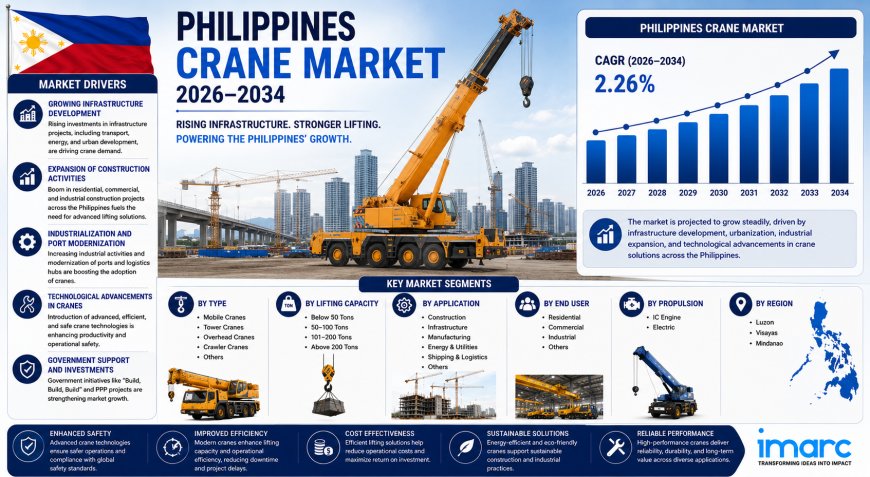
The Philippines crane market size was valued at USD 246.87 Million in 2025 and is projected to reach USD 301.76 Million by 2034, growing at a compound annual growth rate of 2.26% from 2026 to 2034.

Market Overview
The Philippines crane market size reached USD 246.87 Million in 2025 and is projected to reach USD 301.76 Million by 2034, growing at a compound annual growth rate (CAGR) of 2.26% from 2026 to 2034. The market is experiencing sustained expansion driven by accelerating infrastructure modernization, urban development initiatives, and industrial growth across key economic zones. Rising demand for heavy lifting equipment spans construction, mining, port operations, and energy sectors, supported by government investments in transportation networks and private sector real estate development. This evolving landscape underscores the growing relevance of the Philippines crane market share, reflecting the nation's broader economic transformation and commitment to building world-class infrastructure.
Request a Sample Report for In-Depth Market Insights: https://www.imarcgroup.com/philippines-crane-market/requestsample
Philippines Crane Market Summary
- The market covers mobile cranes, marine and port cranes, and fixed cranes, deployed across construction and infrastructure, mining, oil and gas, and other applications.
- These machines are valued for enabling structural component installation, heavy material handling, and cargo operations across construction, mining, and port sectors.
- The ecosystem includes international equipment manufacturers, regional distributors, and local rental service providers.
- Major segments identified in the market include product type (mobile cranes, marine and port cranes, fixed cranes), application (construction and infrastructure, mining, oil and gas, others), and region (Luzon, Visayas, Mindanao).
- The market is benefiting from surging urban vertical development, renewable energy infrastructure expansion, and adoption of advanced crane technologies including telematics and digital monitoring.
- Mobile cranes lead the product segment at 78.61%, construction and infrastructure leads applications at 35.04%, and Luzon leads regionally at 58%, all as of 2025.
Porter's Five Forces Analysis — Philippines Crane Market
Bargaining Power of Suppliers — Moderate to High
- The supply chain includes international crane manufacturers, component suppliers, and specialized parts distributors, with the Philippines relying heavily on imported equipment.
- Import duties and logistics costs associated with heavy equipment give international manufacturers meaningful leverage over local operators.
- A concentrated group of global crane manufacturers holds influence over pricing and availability, particularly for large-tonnage specialized equipment.
- Growing strategic partnerships between international manufacturers and local distributors are helping moderate supplier leverage through improved local service and parts availability.
Bargaining Power of Buyers — Moderate
- Large contractors and infrastructure developers with high-volume equipment needs can negotiate favorable terms given their scale and recurring demand.
- High acquisition and operating costs push many buyers toward rental arrangements, giving rental service providers influence over buyer purchasing decisions.
- Smaller contractors have comparatively less negotiating power and are more exposed to financing and equipment availability constraints.
Threat of New Entrants — Moderate
- High capital requirements for crane fleet acquisition create substantial barriers for new equipment providers.
- Skilled operator shortages and training requirements add further complexity for new entrants seeking to build service capabilities.
- Growing infrastructure and mining investment is attracting new international manufacturers and distributors seeking to enter the Philippine market.
- Established players with existing after-sales service networks and financing relationships hold a strong advantage over new entrants.
Threat of Substitutes — Low
- There are few effective substitutes for cranes given the scale and precision requirements of construction, mining, and port operations.
- Alternative lifting methods, such as smaller hoists or manual handling, serve as substitutes only for lower-scale projects, not major infrastructure work.
- The Philippines' expanding vertical construction and mining sector activity continues to reinforce demand for dedicated crane equipment over these limited alternatives.
Competitive Rivalry — Moderate
- The Philippines crane market includes international equipment manufacturers, regional distributors, and local rental service providers competing across product types and applications.
- Differentiation occurs through equipment quality, after-sales service capabilities, financing options, and technical support infrastructure.
- Competition is intensifying as manufacturers introduce cranes with advanced safety features, telematics, and improved fuel efficiency.
- Strategic partnerships between international manufacturers and local distributors are becoming a key competitive lever for market coverage and service delivery.
Market Growth Drivers
Government Infrastructure Investment Programs
The Philippine government's sustained commitment to infrastructure development represents the primary growth catalyst for the market, with national development plans emphasizing expressway construction, bridge building, and railway system development creating substantial demand for heavy lifting equipment. Urban renewal initiatives and port modernization efforts further stimulate demand, while regional development programs extending infrastructure improvements beyond Metro Manila are broadening geographic demand patterns across the archipelago.
Expanding Mining and Natural Resource Sector
The Philippines' abundant mineral resources, including substantial nickel, copper, gold, and chromite deposits, are driving mining sector expansion and associated crane demand for equipment installation, material transport, and processing facility construction. The global transition toward electric vehicles and renewable energy technologies has intensified international interest in Philippine nickel and copper reserves, with mining operations in remote locations requiring rugged crane equipment capable of operating in challenging terrain.
Real Estate Development and Urbanization
Rapid urbanization and rising middle-class prosperity are fueling real estate development, with high-rise residential condominium construction and commercial real estate development requiring tower cranes and mobile lifting equipment for multi-story construction. The Philippines real estate market, valued at USD 94.4 Billion in 2025 and projected to reach USD 135.9 Billion by 2034, continues to expand alongside tourism infrastructure development, extending crane demand to leisure destinations across the archipelago.
Philippines Crane Market Segmentation
Product Type Insights:
- Mobile Cranes
- Marine and Port Cranes
- Fixed Cranes
Application Insights:
- Construction and Infrastructure
- Mining
- Oil and Gas
- Others
Regional Insights:
- Luzon
- Visayas
- Mindanao
Competitive Landscape
The market features a competitive landscape characterized by established international equipment manufacturers alongside regional distributors and local rental service providers. Market participants differentiate through equipment quality, technological capabilities, after-sales service networks, and financing solutions tailored to customer requirements. International manufacturers leverage global brand recognition and advanced product technologies, while regional distributors provide localized service capabilities and established relationships with domestic contractors.
Key players mentioned in the report context include:
- Shanghai Zhenhua Heavy Industry (ZPMC)
- Zoomlion
- Yuantai Crane
Shanghai Zhenhua Heavy Industry supplied three new quay cranes to International Container Terminal Services, Inc. for the Manila International Container Terminal upgrade in April 2024, including two post-Panamax cranes and one neo-Panamax crane to boost vessel-handling capacity.
Zoomlion delivered its ZCC11800 crawler crane, an 800-ton model, to a prominent Philippine construction company in January 2024, marking the largest-tonnage crawler crane ever exported to the country.
Yuantai Crane supplied three 10-ton single-girder overhead cranes to a Philippine client in October 2025, providing end-to-end services including system design, installation, operator training, and spare parts support.
Regional Analysis
Luzon: Luzon leads the market with a 58% share in 2025, anchored by Metro Manila's status as the national capital and primary commercial center, with concentrated infrastructure projects, high-rise developments, and strategic port facilities driving crane demand.
Visayas: The Visayas region represents a smaller but developing crane market, supported by expanding construction and port activity in urban centers such as Cebu.
Mindanao: Mindanao remains an emerging market for cranes, with growth tied to mining sector activity and broader infrastructure development, though it trails Luzon in overall demand.
Recent Industry Developments
Note: If you need any specific information that is not currently covered within the scope of the report, we will provide the same as a part of customization.
Speak to an analyst: https://www.imarcgroup.com/request?type=report&id=41858&flag=C
Report Format, Delivery, and Customization Details
- Report Format Mode: PDF and Excel
- Report Delivery Mode: Online Delivery, Physical Delivery
- Report Delivery Time: Report delivered over email within 24 to 48 hours. If requested by the client, a physical copy will be delivered within three to ten days.
- Report Confirmation Mode: Yes via Email
- Report Customization Mode: Yes via Email / Call
- Report Table of Content: Yes
- Report List of Figures: Yes
- Report Methodology Mode: Yes
- Request For Sample Report: Yes
About Us
IMARC Group is a global management consulting firm that helps the world's most ambitious changemakers to create a lasting impact. The company provides a comprehensive suite of market entry and expansion services. IMARC offerings include thorough market assessment, feasibility studies, company incorporation assistance, factory setup support, regulatory approvals and licensing navigation, branding, marketing and sales strategies, competitive landscape and benchmarking analyses, pricing and cost research, and procurement research.
Contact Us
IMARC Group
134 N 4th St., Brooklyn, NY 11249, USA
Email: sales@imarcgroup.com
Tel No: (D) +91 120 433 0800
United States: +1-201-971-6302
What's Your Reaction?