






























India Battery Recycling Market Size, Share, Growth & Comprehensive Analysis 2026-2034
The India battery recycling industry is experiencing significant growth, expanding from USD 603.9 Million in 2025 to a projected USD 1,323.4 Million by 2034, driven by a compound annual growth rate (CAGR) of 8.65%.

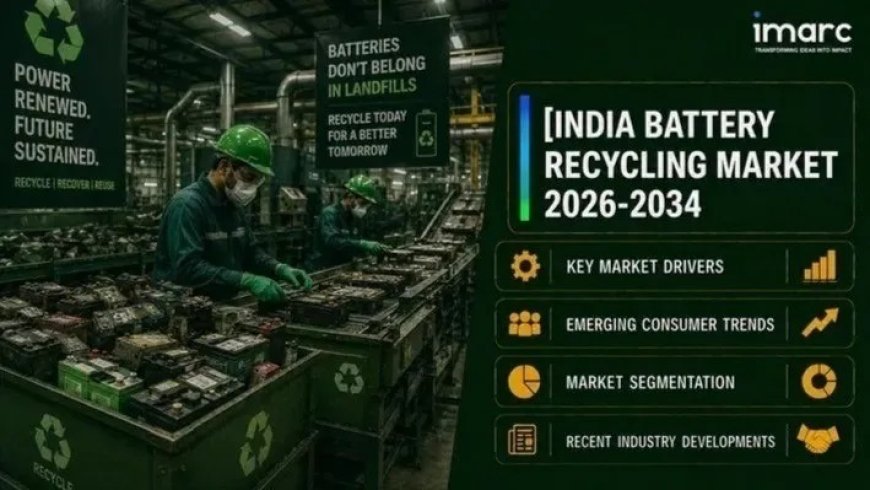
According to IMARC Group’s report titled “India Battery Recycling Market Size, Share, Trends and Forecast by Type, Source, End Use, Material, and Region, 2026-2034“, the report offers a comprehensive analysis of the industry, including market forecast, growth and regional insights.
Market Outlook
The India battery recycling industry is experiencing significant growth, expanding from USD 603.9 Million in 2025 to a projected USD 1,323.4 Million by 2034, driven by a compound annual growth rate (CAGR) of 8.65%. Market expansion is primarily propelled by accelerating electric vehicle (EV) adoption, stringent government regulations under the Battery Waste Management Rules (BWMR 2022 and 2025 amendments), and mandatory Extended Producer Responsibility (EPR) collection targets. Furthermore, a strategic imperative to reduce import reliance on critical minerals such as lithium, cobalt, and nickel is accelerating the transition from an informal recycling sector to a formalized, technology-driven domestic ecosystem.
Core Market Metrics & Snapshot
A consolidated view of critical market metrics and leading segments.
- Market Valuation (2025): USD 603.9 Million
- Forecast Valuation (2034): USD 1,323.4 Million
- CAGR (2026-2034): 8.65%
What are the Key Developments and Emerging Shifts in the India Battery Recycling Market?
- Battery Waste Management Rules (BWMR): The Ministry of Environment, Forest and Climate Change rigorously enforces the Battery Waste Management Rules. By legally mandating Extended Producer Responsibility (EPR), this centralized framework forces manufacturers to collect and recycle end-of-life batteries. It systematically eliminates unorganized dismantling, structurally transforming the sector into a highly compliant, circular ecosystem for critical mineral recovery continually.
- PLI Scheme for Advanced Chemistry Cells: The Ministry of Heavy Industries aggressively deploys the Production-Linked Incentive scheme for Advanced Chemistry Cells. By heavily subsidizing domestic battery fabrication, this state mandate strongly incentivizes localized closed-loop manufacturing. It systematically compels manufacturers to integrate urban mining and recycling infrastructure, radically securing domestic supply chains for critical minerals like lithium and cobalt nationwide.
- Vehicle Scrappage Policy Enforcement: The Ministry of Road Transport and Highways strictly mandates the phasing out of unfit commercial and passenger vehicles. This critical government framework systematically eliminates archaic fleets, driving immense structural extraction of legacy lead-acid batteries. It significantly modernizes the secondary recycling market, ensuring highly organized, environmentally compliant material recovery across domestic automotive logistics continuously.
- National Critical Minerals Mission: The Ministry of Mines actively executes targeted strategies under the Critical Minerals Mission to heavily secure strategic materials. By structurally prioritizing urban mining and battery recycling, this centralized mandate systematically reduces reliance on volatile global supply chains. It aggressively drives large-scale institutional investments in advanced hydrometallurgical processing facilities for maximum domestic lithium and nickel recovery.
- NITI Aayog Circular Economy Mandates: NITI Aayog strictly formulates comprehensive strategic frameworks to heavily promote a circular economy for electric vehicle batteries. By aggressively encouraging second-life applications and structured material extraction, this government initiative systematically maximizes total lifecycle value. It fundamentally accelerates technological innovation within regional recycling clusters, creating a highly organized, lucrative domestic market for battery waste processing continually.
What Factors are Driving Growth in the India Battery Recycling Market?
- The Ministry of Heavy Industries’ aggressive execution of the FAME II and subsequent PM E-DRIVE schemes fundamentally revolutionizes domestic electric mobility. Government policies accelerating massive electric vehicle adoption drastically increase long-term battery deployment. This infrastructural modernization guarantees immense future volumes of end-of-life lithium-ion packs, massively driving corporate recyclers to heavily procure advanced material recovery technologies continually.
- Massive decentralized capital deployment under the Swachh Bharat Abhiyan heavily stimulates organized regional e-waste collection networks. By actively funding sustainable waste management infrastructure across municipalities, the government systematically creates a highly structured urban supply chain. This directly generates sustained localized aggregation of consumer batteries, heavily boosting the commercial viability of authorized regional recycling processing plants.
- Strict government policies promoting digital financial transparency heavily incentivize authorized material trading. By aggressively pushing digital EPR compliance portals through the Central Pollution Control Board, state directives actively force a structural shift away from unaccounted scrap dealing. This regulatory intervention successfully accelerates the mass adoption of formal invoicing, heavily boosting legitimate battery recycling operations nationwide.
- The Department for Promotion of Industry and Internal Trade heavily incentivizes Foreign Direct Investment in the green technology sector. By strictly allowing 100% FDI under the automatic route, this aggressive government policy rapidly catalyzes massive external capital inflows. It fundamentally accelerates the nationwide expansion of world-class, automated hydrometallurgical recycling facilities, accommodating surging domestic waste volumes continuously.
- State-level directives actively promoting specialized industrial parks heavily incentivize the establishment of modern battery recycling clusters. Government frameworks aggressively funding regional infrastructure, subsidized land, and dedicated power supply ensure uncompromising operational efficiency. This critical structural upgrade directly aligns domestic waste processing with global environmental standards, driving massive corporate procurement of specialized battery shredding machinery continually.
➤ Request Sample Report (TOC & Charts): https://www.imarcgroup.com/india-battery-recycling-market/requestsample
How Is the Market Segmented?
By Type
- Lead-acid Batteries (Leading Share): Dominates the segment, holding a 46.8% share based strictly on IMARC Group valuations, supported by widespread automotive and UPS applications.
- Lithium-based Batteries: Captures a highly significant 32.4% market share, registering the fastest growth trajectory driven by retired EV cells.
- Nickel-based Batteries: Accounts for a 15.7% market share.
- Others: Represents the remaining 5.1% of the market.
By Source
- Automotive (Leading Share): Represents the dominant segment with a 41.6% market share according to IMARC Group data.
- Industrial: Represents a major secondary source holding a 28.9% share.
- Electronic Appliances: Captures a 14.8% share.
- Consumer Products: Accounts for a 9.7% share.
- Others: Represents the remaining 5.0% share.
By End Use
- Reuse
- Repackaging
- Extraction
- Others
By Material
- Manganese
- Iron
- Lithium
- Nickel
- Cobalt
- Lead
- Aluminium
- Others
By Region
- West and Central India (Leading Share): Commands the maximum regional market share at 31.9%, anchored by heavy industrial battery volumes.
- North India: Holds a robust 27.6% share.
- South India: Accounts for 24.5% of the domestic market.
- East and Northeast India: Represents the remaining 16.0% share.
Competitive Landscape
The market features intensely competitive activity strictly focused on rapid capacity expansion, compliance with rigid national environmental safety frameworks, and seamless integration with formalized automotive supply chains. A massive strategic focus remains on heavily leveraging advanced localized hydrometallurgical processing to cater to the rapidly evolving material requirements of newly sanctioned domestic gigafactories. According to IMARC Group, key players driving the India battery recycling market include:
- Attero Recycling Pvt. Ltd.
- Lohum Cleantech Pvt. Ltd.
- Gravita India Ltd.
- Exigo Recycling Pvt. Ltd.
➤ Shape the Data to Answer Your Specific Questions - Request Customization: https://www.imarcgroup.com/request?type=report&id=21412&flag=E
Frequently Asked Questions (FAQ)
Q1: What is the size of the India Battery Recycling Market?
A1: The India battery recycling market reached USD 603.9 Million in 2025 and is projected to reach USD 1,323.4 Million by 2034.
Q2: What is the projected growth rate?
A2: The market is expected to grow at a CAGR of 8.65% during 2026–2034.
Q3: What are the key drivers?
A3: Rising EV adoption, Battery Waste Management Rules (2022), and increasing demand for critical mineral recovery are the key growth drivers.
Q4: Which regions are analyzed in the market?
A4: The market is analyzed across North India, South India, East & Northeast India, and West & Central India.
Q5: What companies operate in the market?
A5: Major companies include Attero Recycling Pvt. Ltd., Lohum Cleantech Pvt. Ltd., Gravita India Ltd., and Exigo Recycling Pvt. Ltd.
What's Your Reaction?