































What Buildings in Hot Climates Can Learn From Structures That Have Survived Deserts for Centuries
Discover how desert architecture uses passive cooling, shading, thick walls, and airflow to create resilient buildings in hot climates.

Air conditioning changed how we build in hot climates, and mostly for the better. But it also let a lot of buildings get away with sloppy design, thin walls, poor orientation, glass facades that trap heat because a compressor could always be relied on to fix the mistake later. That works until the power grid gets stressed on the hottest day of the year, or energy costs make constant mechanical cooling too expensive to run the way it was designed to.
Buildings in genuinely extreme heat real deserts, not just "warm climates" never had that luxury. For centuries, the only way to make a structure livable in 110-degree heat was to design it correctly from the start. That constraint produced solutions that are worth paying attention to again, especially as more regions start experiencing desert-like heat that their existing buildings were never designed for.
Old Solutions, Modern Relevance
A few ideas that historic desert builders relied on keep showing up in serious climate-responsive design today:
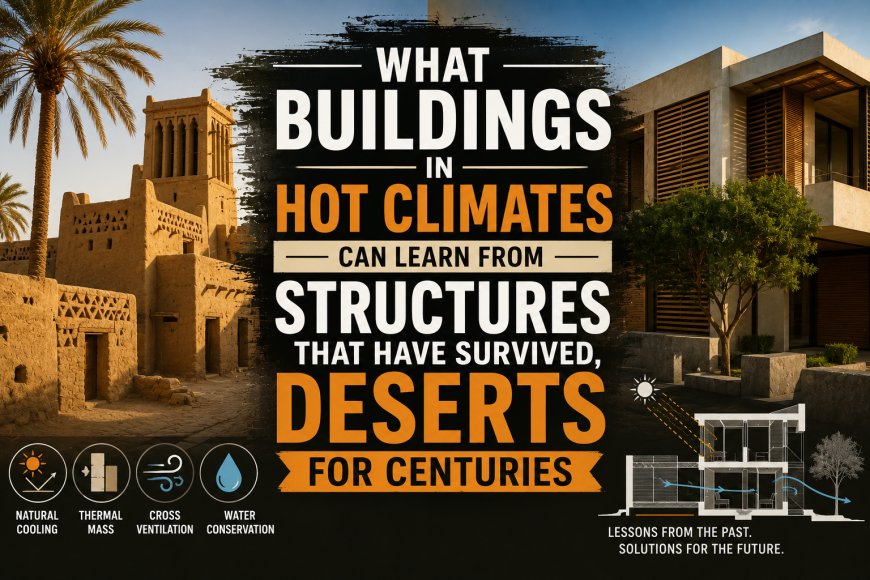
Thick walls that slow heat down. Traditional adobe and stone construction wasn't just about what was locally available; thick, dense material absorbs heat slowly during the day and releases it slowly at night, which flattens out the extreme swings between scorching afternoons and cold desert nights.
Shade as structure, not decoration. Deep overhangs, recessed windows, and covered walkways aren't stylistic flourishes in desert vernacular architecture; they're doing real thermal work, keeping direct sun off walls and glass that would otherwise become radiators.
Airflow instead of mechanical cooling. Courtyards and wind-catching towers create pressure differences that pull air through a building without a single fan. It's a passive system, which means it keeps working during a power outage, something no compressor-based system can claim.
Compact, connected forms. Older desert buildings tend to cluster together and minimize exposed surface area, reducing the total amount of building skin exposed to direct sun. Modern buildings often do the opposite, spreading out and maximizing glazing for views, which trades comfort for aesthetics.
Why This Matters Beyond Actual Deserts
Extreme heat isn't confined to traditional desert regions anymore. Cities that never used to plan around sustained 100-plus degree stretches now have to, and a lot of existing housing stock built assuming mechanical cooling would always be cheap and reliable is poorly suited for it.
That's pushed architects working outside classic desert regions to borrow directly from desert design principles: thicker envelopes, smarter shading, and ventilation strategies that don't collapse the moment the power grid does. It's less about copying a specific aesthetic and more about copying the underlying logic treating the building itself as the first line of defense against heat, not the air conditioning system.
Where Visualization Fits In
One real difficulty with climate-responsive design is that a lot of what makes it work shading angles at different times of day, how airflow moves through a courtyard, how a material actually looks against a bright desert sky is hard to evaluate from a flat plan. This is where visualization tools have become genuinely useful rather than just a sales aid: modeling how sun and shade interact with a specific building form across the day, or testing a material palette before it's committed to construction, catches problems while they're still cheap to fix.
For anyone digging deeper into the material choices and passive design strategies that make desert buildings work from earth-based construction to more modern insulation approaches, this complete guide to desert architecture, materials, and visualization covers the specifics in more depth than a single overview like this one can.
The Real Lesson
The most resilient desert buildings were never fighting the climate they were designed around it. As more places deal with heat that used to be unusual, that same mindset (build for the conditions you actually have, rather than assume mechanical systems will compensate for a design that ignores them) is turning out to be less of a regional specialty and more of a general principle worth relearning.
What's Your Reaction?














